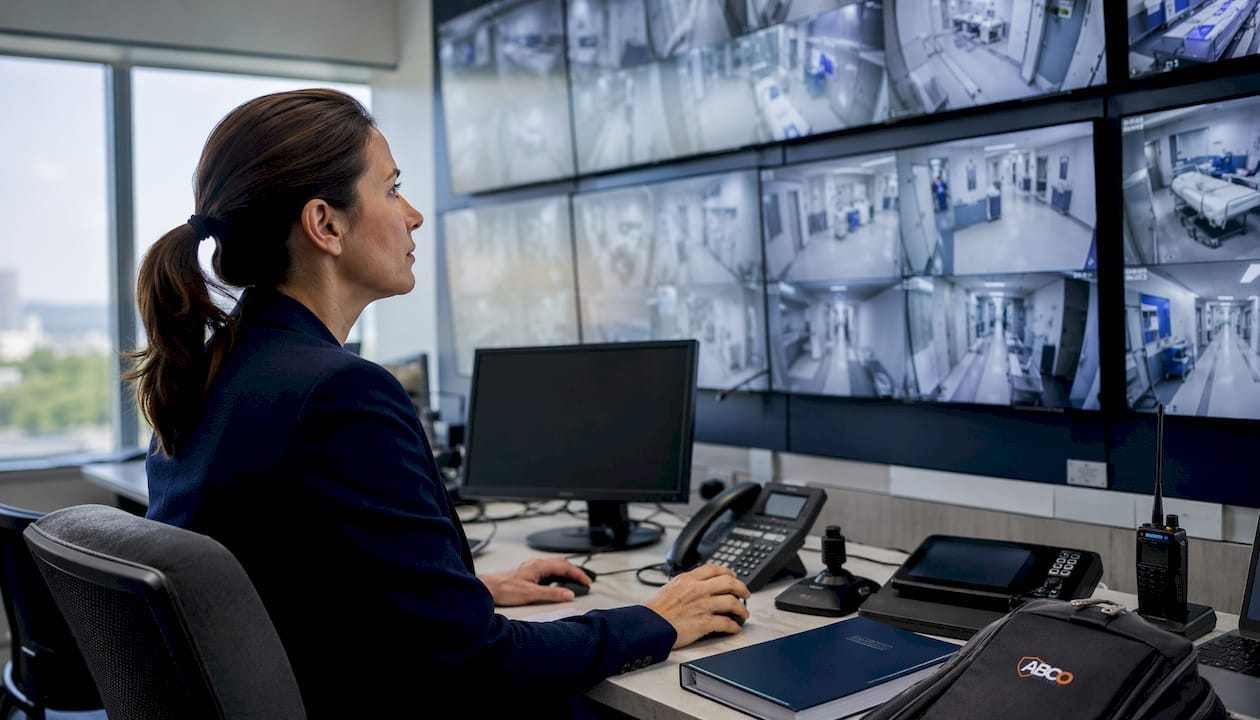
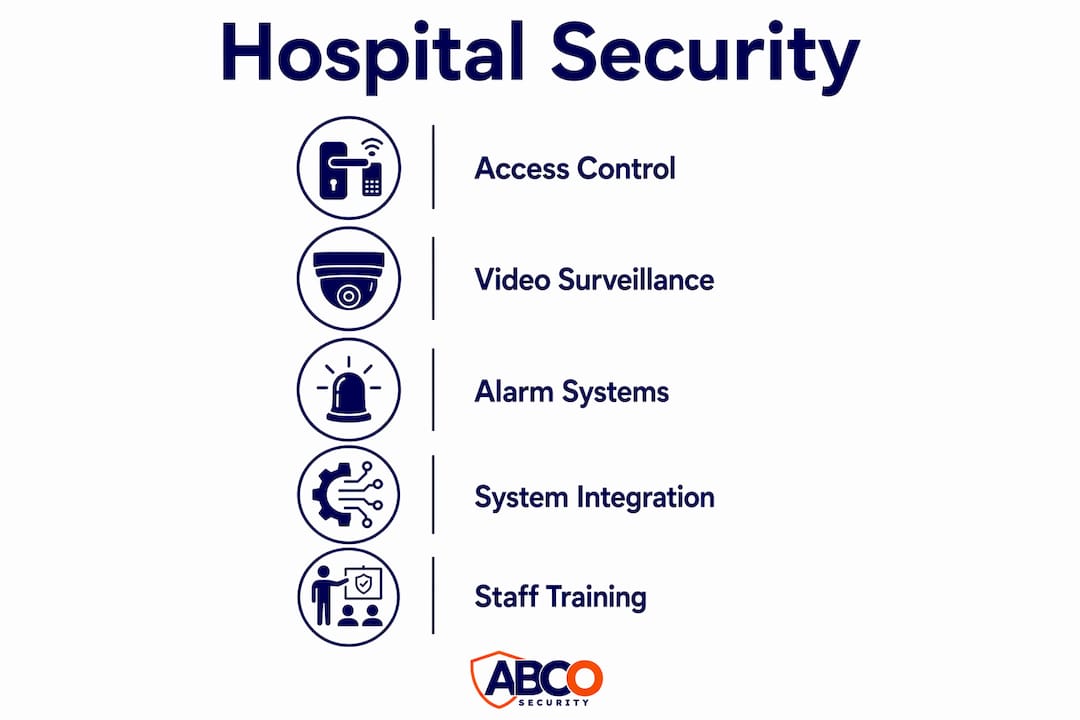
Effective hospital security systems are integrated frameworks combining video surveillance, access control, alarm systems, and trained personnel to protect patients, staff, and assets across healthcare facilities. In Australia, these systems operate under AS 4485.1:2021 and AS 4485.2:2021, the mandatory standards setting out general requirements and operational procedures for healthcare security. The core components you’ll find across Australian hospitals include:
- CCTV surveillance covering entries, waiting areas, corridors, and restricted zones
- Electronic access control for staff identification, visitor management, and sensitive areas like pharmacies
- Duress alarm systems with two-button activation to reduce false alerts
- Fire alarm integration and public address systems linked to monitoring centres
- Operational protocols including Code Black procedures and regular staff training
Abcosecurity delivers all of these as integrated healthcare security services for Australian hospitals, combining licensed professionals with 24/7 monitoring and over 15 years of industry experience.
Table of Contents
- What security challenges do Australian hospitals actually face?
- What do hospital security systems actually consist of?
- How does real-time monitoring and system integration work?
- How do hospital security systems improve patient and staff safety?
- What standards and regulations govern Australian hospital security?
- Why regular maintenance and testing of security systems matters
- How should hospital staff be trained on security systems?
- Abcosecurity’s integrated approach to hospital security
- FAQ
- Key takeaways
What security challenges do Australian hospitals actually face?
Occupational violence and aggression (OVA) is the dominant security risk in Australian hospitals, concentrated most heavily in emergency departments and mental health units. This is not a marginal issue. Security staffing has increased by 10% in some regions, with ongoing government reviews examining security powers and how to better manage challenging patient behaviours.
The physical environment creates its own complications. Hospital campuses are inherently open, with complex public access routes, multiple entry points, and areas designed for therapeutic calm that can inadvertently create concealment spots. Balancing a welcoming patient environment with effective surveillance is a genuine design tension, not one that resolves neatly.
Key challenges security managers encounter include:
- OVA incidents in emergency and mental health units requiring rapid, de-escalation-first responses
- Complex physical layouts with concealment risks and high public foot traffic
- Technology integration difficulties when overlaying new systems onto ageing infrastructure
- Staffing balance between visible deterrence and a non-punitive, clinically-integrated approach
- Legal recognition gaps addressed by the 2022 Crimes Act 1900 amendments, which formally recognised hospital security staff as frontline healthcare workers
Statistic: Security staffing has increased in some Australian regions following high-profile incidents, with state governments actively reviewing security powers to address the escalating frequency of OVA in public hospitals.
What do hospital security systems actually consist of?
The technology stack in a well-designed hospital security system is broader than most facility managers initially expect. Each layer addresses a different threat vector.
Video surveillance forms the backbone. Healthcare security cameras should cover all entry and exit points, waiting areas, medication rooms, and restricted clinical zones. Modern systems use video analytics to flag unusual movement patterns, and some facilities are beginning to trial facial recognition as a force multiplier for identifying known aggressors.
Access control goes well beyond a swipe card on a door. Electronic locks, staff ID protocols, and visitor management systems work together to track who is in the building and where. Access control systems for pharmacies and medication rooms are particularly critical, given the theft risk and patient safety implications. Electronic visitor management with simple check-in and check-out workflows, combined with door-open alerts, gives security teams real-time visibility of movement throughout the facility.
Alarm systems need careful design. Two-button duress alarms are the current best practice over single-button devices, specifically because they reduce false activations. A large hospital site may carry numerous duress alarm points, and the reliability of each one matters when a staff member is in genuine danger.
“Natural surveillance through design and security zoning is a first-line defence in healthcare settings, preferred before heavy reliance on electronic and mechanical barriers which may hinder usability and patient comfort.”
— Australasian Health Facility Guidelines, security design principles
Crime Prevention Through Environmental Design (CPTED) principles underpin all of this. Sightlines, lighting, and spatial zoning reduce risk before any electronic system is even switched on.
How does real-time monitoring and system integration work?
A hospital with separate, siloed security systems is a hospital with blind spots. The goal is a centralised video management system that consolidates CCTV feeds, duress alarms, fire systems, and public address capabilities into a single operational platform staffed by trained personnel.
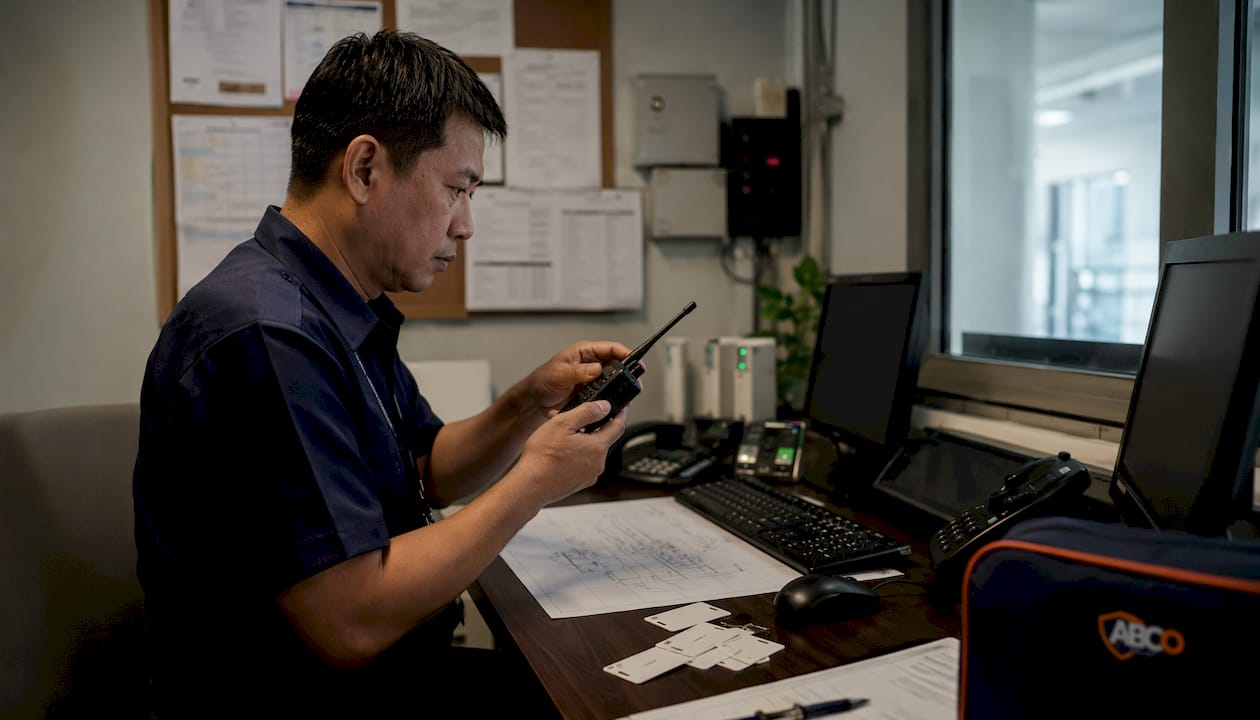
When a duress alarm activates, the integrated system should automatically pull up the nearest camera feed for the monitoring operator, trigger a public address alert if warranted, and log the event with a timestamp. That sequence, happening in seconds rather than minutes, is what technology integration actually delivers in practice.
Wireless alarm devices require automated testing schedules to confirm they remain operational. Hard-wired systems are generally more reliable but more expensive to retrofit in older buildings. The practical answer for most hospitals is a hybrid approach, with hard-wired systems in high-risk zones and wireless devices in lower-risk areas, all feeding into the same management platform.
- Centralise CCTV, duress, fire, and PA systems under one video management platform
- Automate alarm testing to confirm device reliability across all zones
- Integrate door-open alerts and visitor management into the same operational view
- Staff the monitoring centre with personnel trained specifically for healthcare environments
- Document all events and responses for audit and compliance purposes
Pro Tip: Engage a specialist physical and electronic security consultant before committing to any system architecture. The Australasian Health Facility Guidelines explicitly recommend designing security in from the planning stage, and retrofitting is significantly more expensive and less effective than getting the design right initially.
How do hospital security systems improve patient and staff safety?
The direct safety gains from a well-implemented system are measurable. Unauthorised entry drops when access control is properly configured. Violent incidents are deterred by visible surveillance and the knowledge that duress alarms reach a monitored response centre within seconds. Staff working in high-risk areas report greater confidence when they know a two-button duress alarm is within reach and that someone is watching.

The 2022 Crimes Act amendments matter here beyond symbolism. Legally recognising hospital security staff as frontline healthcare workers changes how incidents are prosecuted and how seriously OVA is treated at a policy level. It also affects how security personnel are integrated into clinical teams, which is where the real de-escalation gains come from.
Sensitive areas benefit disproportionately from targeted security measures. Pharmacies, paediatric zones, and mental health units each carry specific risks that generic security approaches miss. Protecting medication storage from theft protects patients directly. Securing paediatric areas from unauthorised access protects some of the most vulnerable people in the building.
“Modern hospital security applies a layered approach with prevention, de-escalation, and rapid response; technology like body-worn cameras forms part of a toolkit rather than replacing trained personnel or protocols.”
— Australasian Health Facility Guidelines, security approach
What standards and regulations govern Australian hospital security?
The AS 4485 series is the foundational framework. AS 4485.1:2021 covers general requirements and AS 4485.2:2021 provides the procedures guide. Both were updated in 2021 and set mandatory requirements for safeguarding patients, staff, pharmaceuticals, and property across healthcare settings.
Beyond the standards, the Security of Critical Infrastructure Act designates specific hospitals as critical infrastructure, mandating comprehensive risk management across physical security, cyber risks, and supply chain threats. Designated hospitals include major metropolitan facilities across every state and territory, from Royal Adelaide Hospital and Royal Darwin Hospital to Royal Melbourne Hospital and Royal Prince Alfred Hospital in Sydney.
Recent innovations worth noting:
- Body-worn cameras are being trialled in 15 regional NSW hospitals as of 2025, with early evidence suggesting they support de-escalation by changing the behaviour of both staff and patients during incidents
- Cybersecurity is now inseparable from physical security in any comprehensive risk management plan, particularly for hospitals under the critical infrastructure framework
- Australasian Health Facility Guidelines require security to be designed into healthcare architecture from the earliest planning stages, not retrofitted after construction
NSW Health’s Protecting People and Property manual reinforces that governance structures, risk management processes, and incident reporting systems must be formally established and maintained at every facility level.
Why regular maintenance and testing of security systems matters
Security systems degrade silently. A duress alarm with a flat battery, a CCTV camera with a misaligned lens, or an access control reader that intermittently fails will not announce itself until the moment it is needed most.
Australian hospitals operating under AS 4485 are required to monitor and regularly evaluate risk control strategies, including the physical security equipment that implements them. In practice, this means scheduled testing of all duress alarm points, CCTV camera checks, access control audits, and fire system integration tests. Automated testing features in modern video management platforms handle some of this, but manual verification by qualified technicians remains necessary for full compliance.
Maintenance records serve a dual purpose: they demonstrate compliance during audits and they create an evidence trail if an incident leads to a legal or insurance review. Facilities that skip documentation often discover this gap at the worst possible time.
How should hospital staff be trained on security systems?
Technology without trained people behind it is just expensive hardware. Staff training on security systems covers two distinct areas: knowing how to use the tools (activating a duress alarm, following access control protocols, understanding what a Code Black means) and knowing how to respond when those tools activate.
NSW Health’s interim security review recommended standardised Code Black procedures across all facilities, with regular practice drills so that every staff member understands their role before an incident occurs. The review also recommended a dedicated Class 1G licence subclass for hospital security staff, recognising that their role differs fundamentally from a building guard or crowd controller.
Training should be documented, refreshed annually, and integrated into clinical onboarding. Security staff benefit from joint training with clinical teams, particularly around de-escalation, since the most effective responses to OVA involve both disciplines working together rather than security acting in isolation.
Abcosecurity’s integrated approach to hospital security
Healthcare facilities managing security across multiple systems, compliance obligations, and a 24/7 operational environment need more than a product vendor. They need a partner who understands the specific pressures of the healthcare context.
Abcosecurity brings over 15 years of experience delivering integrated security solutions to Australian healthcare facilities, combining licensed static guards, mobile patrols, CCTV installation and monitoring, access control, and duress alarm systems under a single managed service. The difference from a piecemeal approach is that every component is designed to work together, monitored 24/7, and maintained to ISO 9001 and ISO 30000 standards. For facility managers who need to demonstrate compliance with AS 4485 while managing day-to-day security operations, that integrated accountability matters. Contact Abcosecurity to discuss a security assessment for your facility.
FAQ
What security systems do Australian hospitals use?
Australian hospitals use integrated systems combining CCTV surveillance, electronic access control, duress alarms, fire alarm integration, and public address systems, all governed by the AS 4485.1:2021 and AS 4485.2:2021 standards. Many facilities also employ licensed security personnel and 24/7 monitoring services.
Are there cameras in hospital rooms in Australia?
Cameras are not typically installed inside patient rooms due to privacy requirements, but CCTV covers entries, corridors, waiting areas, and restricted zones such as pharmacies and medication rooms throughout Australian hospitals.
What are the main types of alarm systems used in hospitals?
Hospital alarm systems include duress alarms (two-button devices are best practice), fire alarms integrated with the security management platform, and video alarm monitoring linked to CCTV feeds for immediate incident verification.
Which hospitals are classified as critical infrastructure in Australia?
Designated hospitals under the Security of Critical Infrastructure Act include major facilities in every state and territory, such as Royal Adelaide Hospital, Royal Darwin Hospital, Royal Melbourne Hospital, and Royal Prince Alfred Hospital, among many others listed in Schedule 1 of the Act.
How does Abcosecurity support hospital security compliance?
Abcosecurity delivers integrated healthcare security solutions aligned with AS 4485 requirements, including CCTV installation, access control, duress alarm systems, and 24/7 monitoring, all maintained to ISO 9001 and ISO 30000 standards.
Key takeaways
Effective hospital security in Australia requires a layered, integrated approach combining technology, trained personnel, and compliance with AS 4485.1:2021 and AS 4485.2:2021.
| Point | Details |
|---|---|
| AS 4485 is mandatory | AS 4485.1:2021 and AS 4485.2:2021 set the foundational requirements for all Australian hospital security systems. |
| OVA is the primary risk | Occupational violence and aggression drives most security incidents, concentrated in emergency and mental health units. |
| Two-button duress alarms | Two-button devices are best practice over single-button alarms, reducing false activations across large hospital sites. |
| Design security in early | Australasian Health Facility Guidelines require security to be integrated at the planning stage, not retrofitted after construction. |
| Abcosecurity’s integrated service | Abcosecurity delivers CCTV, access control, duress alarms, and 24/7 monitoring as a single managed service for Australian healthcare facilities. |
Recommended
about
avada factory
Sempery ultricies nibh at dolor cras urna eleifend nec. Atiam efficitur tempor.