
Integrated fire and security solutions combine fire detection panels, alarm systems, access control, CCTV and alarm monitoring into a single coordinated platform that speeds emergency response, cuts false activations and simplifies compliance across Australian standards. Rather than managing separate contractors and disconnected systems, you get one auditable operating model where every component talks to every other. Core components typically include:
- Fire detectors and panels (addressable or conventional)
- Local fire indicator panels (FIPs) and annunciators
- Access control systems (card readers, electric locks, interlocks)
- CCTV with pre-event buffering
- Alarm monitoring via an approved Alarm Receiving Centre (ARC)
- Building Management System (BMS) and HVAC interfaces
If you haven’t audited your current systems against AS 1670.1 and AS 1851 obligations, now is the right time. Contact Abcosecurity for a gap assessment before your next Annual Fire Safety Statement (AFSS) is due.
Pro Tip: Start with a single-page event-to-action matrix before you buy anything. Map every fire system state (alarm, fault, isolate, disable) to the expected response from access control, CCTV and BMS. That document becomes your commissioning test plan and your ongoing audit trail.

Table of Contents
- What do you actually gain from integrating fire and security?
- How do integrated fire & security solutions actually work?
- What Australian standards and regulations apply?
- What should commissioning and testing actually cover?
- How do you manage maintenance and stay compliant long-term?
- How do you choose the right integrator?
- How Abcosecurity approaches integrated system projects
- How should you tailor a system to your facility’s specific risks?
- What training do staff need on integrated systems?
- What are the data privacy and cybersecurity risks?
- How do you budget for an integration project?
- Key takeaways
- Why compliance-first integration is the only approach worth taking
- Abcosecurity’s integrated fire and security services
- Useful sources
- FAQ
What do you actually gain from integrating fire and security?
The clearest operational benefit is coordinated response. When a fire alarm triggers, an integrated system can simultaneously release magnetic door locks on egress paths, push a pre-event CCTV clip to the control room and notify the ARC, all within seconds. Without integration, each of those actions depends on a human making three separate decisions under pressure.

False alarm management is where many facilities see the fastest return. A standalone fire panel cannot distinguish a genuine smoke event from a dusty detector, but when CCTV analytics and occupancy data from access control are correlated in real time, operators can verify an alarm before committing to a full evacuation. Fewer unnecessary evacuations means less disruption, lower emergency service call-out costs and better staff confidence in the system.
Operational cost savings come from consolidating monitoring contracts, maintenance visits and software licences. A single ARC connection covering both fire and security is typically more cost-effective than two separate monitoring agreements, and a unified maintenance workflow means one contractor visit covers both scopes.
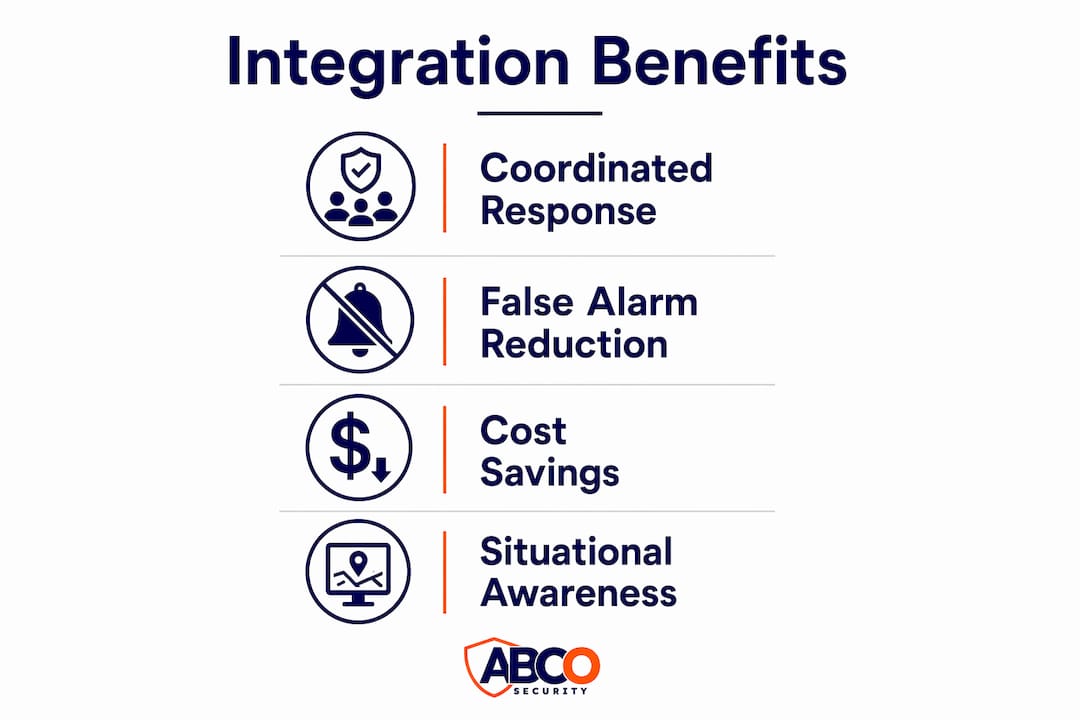
Situational awareness is the subtler gain. Consider a healthcare facility where a fire alarm activates in a medication storage room at 2 AM. An integrated system correlates the alarm with access control logs (who badged in last?) and pulls the CCTV pre-event buffer automatically. The security operator sees the full picture before the fire brigade arrives, which can be the difference between a controlled response and a chaotic one.
How do integrated fire & security solutions actually work?
Integration should be treated as an operating model with explicit design, mapping and failure-mode testing so all components behave as one auditable system. The architecture typically follows one of three patterns:
- Panel-to-panel signalling: Direct dry-contact or relay outputs from the fire panel trigger access control or BMS actions. Simple and reliable, but limited in granularity.
- Middleware/event bus: A software layer translates events between systems using supervised protocols (BACnet, Modbus, OPC-UA or proprietary APIs). More flexible, but requires careful cybersecurity controls.
- Secure cloud APIs: Modern platforms push events to a cloud-hosted integration layer with role-based access and encrypted transport. Suitable for multi-site portfolios.
The event-to-action matrix is the heart of any integration. A fire alarm state should release egress doors and trigger CCTV recording. A fault state should alert maintenance without releasing doors or shutting down HVAC unnecessarily. An isolate state needs to be visible to the ARC so monitoring staff know a zone is offline. Getting these mappings wrong creates nuisance actions that erode trust in the system.
For access control integration, specify fail-safe defaults in writing before installation begins. Every electric lock must have a defined behaviour on power loss and on communication loss, and those defaults must be tested, not assumed.
Pro Tip: Treat cybersecurity as part of the integration design, not an afterthought. Specify encrypted protocols, unique device credentials, network segmentation between IT and OT layers, and a documented process for firmware updates. A breach of your access control network is also a breach of your fire system logic.
What Australian standards and regulations apply?
Three documents form the compliance backbone for any integrated fire protection system in Australia.
AS 1670.1 covers design, installation and commissioning of fire detection and alarm systems. It cross-references AS 1851 for ongoing maintenance, so your project plan should treat commissioning deliverables and service obligations as two distinct scopes.
AS 1851 governs routine service, inspection and testing. From 13 February 2026, NSW requires essential fire safety measures to be inspected and tested in accordance with AS 1851-2012 for relevant building classes, tying AFSS lodgement directly to accredited practitioner assessments.
The National Construction Code (NCC) sets performance requirements for fire safety systems in new and altered buildings. NCC Specification 23 covers installation requirements for local fire indicator panels in residential buildings, including their location in a central, staff-accessible area and connection to approved monitoring services.
The Annual Fire Safety Statement process requires an accredited practitioner (fire safety), or APFS, to inspect and verify every listed fire safety measure. The AFSS template specifies that inspection dates must fall within three months prior to the statement’s issue date, and the practitioner’s APFS accreditation number must be recorded on the document.
Jurisdictional note: Standards obligations vary by state and territory. NSW has introduced the most prescriptive reforms to date, but Queensland, Victoria and Western Australia each have their own building regulation frameworks. Always confirm current requirements with your state’s building commission or an accredited practitioner before lodging an AFSS.
What should commissioning and testing actually cover?
Commissioning must consider how building systems interpret fire system states to prevent nuisance actions or confusing control-room displays. Require these deliverables from your integrator before sign-off:
- Approved design drawings showing all integration points and cable routes
- Event-to-action matrix (every fire state mapped to every connected system response)
- Witnessed test plan with pass/fail criteria for each integration point
- Sign-off certificates from licensed fire and security practitioners
- As-built configuration files and software version records
- Time-synchronised event log samples from commissioning tests
The testing scope must cover all four fire system states:
- Alarm: Confirm door releases, CCTV triggers, ARC notification and BMS responses all activate correctly and within specified timeframes.
- Fault: Verify that maintenance alerts are generated without triggering access releases or HVAC shutdowns.
- Isolate: Confirm the ARC receives an isolate notification and that the control room display reflects the zone status accurately.
- Disable: Check that disabled zones are clearly flagged and that no downstream system interprets a disable as an alarm.
Failure-mode testing is non-negotiable. Simulate a communication loss between the fire panel and the integration middleware. The system must fall back to local control deterministically, not hang in an undefined state. Test power-loss scenarios for every electric lock and confirm that time-synchronised logs capture the event sequence accurately enough for post-incident investigation.
How do you manage maintenance and stay compliant long-term?
ABCB model guidance recommends installation, testing, independent certification and routine maintenance by registered practitioners to ensure ongoing performance. For integrated systems, the maintenance scope is broader than a standard fire-only checklist because performance solutions and jurisdictional law can expand obligations.
FPA Australia and NSW guidance recommend building owners update preventative maintenance programmes to meet AS 1851-2012 requirements and prepare proposals covering all required systems.
| Maintenance interval | Typical tasks for integrated systems |
|---|---|
| Monthly | Visual inspection of FIP, test ARC communication link, review event logs for anomalies |
| 6-monthly | Functional test of integration points (door releases, CCTV triggers), review access control audit logs |
| Annual | Full AS 1851 inspection, APFS assessment, AFSS lodgement, software/firmware update review |
| 5-yearly | Full system performance review, cable and termination inspection, integration architecture review |
Recordkeeping for integrated systems must capture more than fire-only service reports. Every maintenance visit should produce a signed record covering fire panel, access control, CCTV and monitoring link status. Those records feed directly into the AFSS process: the APFS practitioner needs evidence that every listed measure has been maintained, not just inspected on the day of assessment.
Pro Tip: Write your maintenance contract to explicitly name integrated-system scopes: fire panel, access control, CCTV, ARC link and software updates. A contract that covers only the fire panel leaves the integration logic unserviced. Require the contractor to hand over signed service records within five business days of each visit.
How do you choose the right integrator?
Ask every prospective integrator these questions before you evaluate their proposal:
- Which licensed practitioners will design, install and commission the system, and can you provide their licence numbers?
- How do you document the event-to-action matrix, and who signs off the integration test plan?
- What commissioning deliverables do you hand over at practical completion?
- How do you handle software updates and firmware patches for integrated components after commissioning?
- Does your maintenance scope explicitly cover integration logic, or only individual system components?
- Can you provide AFSS support, including APFS-accredited assessments?
Pricing for integrated systems is driven by integration complexity (number of event-to-action mappings), hardware scope, ARC monitoring charges, commissioning effort and whether software licences are one-off or subscription-based. A proposal that bundles everything into a single line item is a red flag.
Watch for these warning signs:
- No event-to-action matrix in the proposal
- Commissioning described as “testing” with no defined test plan or pass/fail criteria
- Maintenance scope limited to individual systems with no mention of integration interfaces
- No accredited practitioners named in the project team
- Handover documentation described as “available on request” rather than a contractual deliverable
Insist on contract clauses that require handover of all event logs, as-built drawings and software licences at practical completion. Service-level agreements for ARC monitoring should specify maximum response times and escalation paths. For commercial alarm monitoring, confirm the ARC holds the relevant approvals and that the monitoring agreement covers both fire and security signals.
How Abcosecurity approaches integrated system projects
Abcosecurity’s integrated system projects typically combine fire detection and alarm monitoring with CCTV, access control and 24/7 ARC monitoring into a single commissioned solution. In a healthcare facility context, for example, the scope covers addressable fire panels, IP CCTV with pre-event buffering, card-based access control on high-risk zones and a monitored ARC link, with the result that false alarm call-outs reduce and incident resolution times improve because operators have correlated evidence before they act.
Trust signals that matter when selecting an integrator:
- ISO 9001 and ISO 30000 certification, demonstrating documented quality and security management processes
- Licensed and accredited practitioners across fire, security and access control disciplines
- Over 15 years of sector experience across construction, healthcare, corporate, retail and government facilities
- Documented commissioning methodology with event-to-action matrices and witnessed test plans
- 24/7 monitoring capability through an approved ARC
Abcosecurity operates across Australia and can support gap assessments, tender preparation, design, commissioning and ongoing accredited maintenance. To request a gap assessment or discuss a specific project, visit the integrated security solutions page or contact the team directly.
How should you tailor a system to your facility’s specific risks?
A generic system design is rarely the right answer. A construction site has different hazards from a hospital, and a multi-tenancy office tower has different access control requirements from a single-occupancy warehouse. Risk analysis should precede any integration design.
Start with a structured hazard identification: what are the ignition sources, fuel loads and occupancy patterns in each zone? Map those against the access control topology (who needs to be where, and when?) and the CCTV coverage gaps. The output is a risk register that drives integration design decisions, not the other way around.
For high-risk occupancies such as aged care, healthcare or chemical storage, consider supplementary detection technologies (aspirating smoke detection, linear heat detection) and confirm that the integration architecture can handle the higher event volumes without creating alert fatigue. A security risk assessment is a practical starting point for this process.
What training do staff need on integrated systems?
An integrated system is only as effective as the people operating it. Staff training should cover three levels: awareness (all staff), operator (security and facilities personnel) and administrator (system managers).
Awareness training covers evacuation procedures, how to interpret panel indicators and who to contact when an alarm activates. Operator training covers control room procedures, how to verify an alarm using CCTV, how to interpret access control logs during an incident and how to escalate to the ARC or emergency services. Administrator training covers event-to-action matrix review, user provisioning in access control, report generation and the evidence requirements for AFSS lodgement.
Run a full evacuation drill that exercises the integrated system at least annually. Document the drill outcome and any system anomalies observed, as those records support the AFSS process and demonstrate due diligence.
What are the data privacy and cybersecurity risks?
Integrated systems collect significant volumes of personal data: CCTV footage, access control movement records and alarm event logs all carry privacy obligations under the Privacy Act 1988 and the Australian Privacy Principles. CCTV footage retention periods, access log storage and data sharing with monitoring providers must be addressed in a privacy policy and in contracts with third-party service providers.
Cybersecurity risk is amplified when fire and security systems share network infrastructure with IT systems. Specify network segmentation between operational technology (OT) and IT networks, enforce unique credentials for every device, and require encrypted transport for all integration communications. Establish a documented process for firmware and software updates across every integrated component, because an unpatched access control server is an entry point to the entire system.
How do you budget for an integration project?
Integration projects have three cost phases: design and procurement, commissioning, and ongoing operations. Design costs cover risk assessment, system architecture, integration mapping and specification writing. Procurement covers hardware, software licences and installation labour. Commissioning covers witnessed testing, documentation and APFS sign-off.
Ongoing operational costs include ARC monitoring fees, maintenance contracts (which should explicitly cover integration logic), software subscription renewals and periodic APFS assessments for AFSS lodgement. The cost-benefit case rests on avoided costs: fewer false alarm call-outs, reduced emergency service fees, lower insurance premiums (in some cases), and the avoided cost of a compliance failure or a preventable incident.
Avoid the common mistake of budgeting only for hardware and installation. Integration logic, commissioning documentation and ongoing maintenance of the integration layer typically represent 30–40% of total lifecycle cost for a well-designed system, and under-budgeting those items is the most common reason integrated systems degrade within two years of installation.
Key takeaways
Integrated fire and security systems deliver faster coordinated response, fewer false alarms and simpler compliance, but only when designed, commissioned and maintained as a single auditable operating model under AS 1670.1, AS 1851 and NCC obligations.
| Point | Details |
|---|---|
| Audit your systems now | Map current fire, access control and CCTV against AS 1670.1 and AS 1851 before your next AFSS is due. |
| Require an event-to-action matrix | Every integrator proposal must include a documented mapping of fire states to connected system responses. |
| Confirm APFS accreditation | Your maintenance contractor must name accredited practitioners; AFSS lodgement depends on their signed assessment. |
| Budget for the full lifecycle | Integration logic, commissioning documentation and ongoing maintenance typically represent a significant portion of total lifecycle cost. |
| Abcosecurity for end-to-end delivery | Abcosecurity provides design, commissioning, accredited maintenance and 24/7 monitoring across Australia. |
Why compliance-first integration is the only approach worth taking
The industry conversation about integrated fire and security often focuses on technology: which platform, which protocol, which vendor ecosystem. That framing misses the point. The technology is largely solved. What fails in practice is the operating model around it.
Most integration failures aren’t hardware failures. They’re documentation failures, scope gaps between contractors, and maintenance contracts that cover individual systems but leave the integration logic unserviced. A fire panel that passes its annual AS 1851 inspection while the access control interface sits untested for three years is not a compliant integrated system. It’s a compliant fire panel attached to an unverified integration.
The compliance-first approach forces you to define the operating model before you specify the technology. What states does the fire system have? What should every connected system do in each state? Who tests that mapping, and how often? Those questions have to be answered in writing before installation begins, and the answers have to be verified at commissioning and re-verified at every maintenance interval.
Abcosecurity’s value isn’t just in the hardware or the monitoring contract. It’s in the documented commissioning methodology, the accredited practitioners who can sign an AFSS, and the 24/7 support that keeps the operating model functioning between inspections.
Abcosecurity’s integrated fire and security services
When a facility manager needs a single partner to take an integrated system from gap assessment through to commissioned operation and ongoing accredited maintenance, Abcosecurity covers the full scope. The process starts with a site audit that maps existing fire, security and BMS infrastructure against AS 1670.1, AS 1851 and NCC obligations, identifies gaps, and produces a prioritised remediation plan.
From there, Abcosecurity’s licensed practitioners design the integration architecture, produce the event-to-action matrix, manage installation and conduct witnessed commissioning tests. Ongoing alarm monitoring services through an approved ARC cover both fire and security signals under a single agreement, and the maintenance programme explicitly includes integration logic, software updates and APFS-accredited assessments for AFSS lodgement.
Abcosecurity holds ISO 9001 and ISO 30000 certifications and has delivered integrated solutions across construction, healthcare, corporate, retail and government facilities throughout Australia for over 15 years. To get started, request a gap assessment or download a security risk assessment template to prepare for your first conversation.
Useful sources
The following Australian standards, government guidance and model documents are the primary references for integrated fire and security compliance:
- AS 1670.1 — Design, installation and commissioning of fire detection and alarm systems (Standards Australia)
- AS 1851 — Routine service of fire protection systems and equipment (Standards Australia)
- NCC Specification 23 — Residential fire safety systems, including local fire indicator panel location and monitoring connection requirements: ncc.abcb.gov.au
- NSW Government: Responsibilities of building owners under AS 1851-2012 — Covers the February 2026 reform timeline and AFSS obligations: nsw.gov.au
- AFSS template (Version 3.1) — Inspection timing requirements and APFS accreditation recording: innerwest.nsw.gov.au
- ABCB model guidance: Fire safety systems — National guidance on certification, maintenance and registered practitioners: abcb.gov.au
- NSW Planning: Fire safety certification — AFSS process, accredited practitioner roles and fire safety schedules: planning.nsw.gov.au
- FPA Australia: AS 1851-2012 and NSW reforms — Practical guidance for building owners updating maintenance programmes: fpaa.com.au
Standards obligations vary by state and territory. Always confirm current requirements with your state or territory building commission, or engage an accredited practitioner (fire safety) for advice specific to your building class and location.
FAQ
What is an integrated fire and security system?
An integrated fire and security system connects fire detection panels, access control, CCTV and alarm monitoring into a single coordinated platform so that events in one system automatically trigger responses in others, speeding emergency response and simplifying compliance.
Which Australian standards govern integrated fire and security systems?
AS 1670.1 covers design, installation and commissioning; AS 1851 governs routine maintenance and inspection; and the NCC sets performance requirements for fire safety systems in new and altered buildings, including Specification 23 for residential indicator panel placement.
What is an Annual Fire Safety Statement and who can sign it?
An AFSS is a document issued annually by or on behalf of a building owner confirming that an accredited practitioner (fire safety) has inspected and verified every listed fire safety measure. In NSW, inspection dates must fall within three months prior to the statement’s issue date.
What should I require from an integrator at commissioning?
Require an event-to-action matrix, witnessed test plans covering alarm, fault, isolate and disable states, sign-off certificates from licensed practitioners, as-built configuration files and time-synchronised event log samples. Abcosecurity provides all of these as standard commissioning deliverables.
How does integration affect data privacy obligations?
Integrated systems collect CCTV footage, access control movement records and alarm event logs, all of which carry obligations under the Privacy Act 1988 and the Australian Privacy Principles. Retention periods, data sharing with monitoring providers and network security controls must be addressed in your privacy policy and contractor agreements.
Recommended
about
avada factory
Sempery ultricies nibh at dolor cras urna eleifend nec. Atiam efficitur tempor.