An industrial security system for an Australian site should be a fully integrated platform linking CCTV, access control, intrusion and perimeter detection, process and hazard sensors, and a Critical Infrastructure Risk Management Program (CIRMP) aligned management regime. That is the baseline. Anything less leaves gaps that regulators, insurers, and incident investigators will find.
Before you brief a supplier or draft an RFP, confirm your site covers these components:
- CCTV and video analytics (fixed, PTZ, thermal as required)
- Electronic access control aligned to AS/NZS IEC 60839.11.1/2:2019
- Intruder alarm system meeting the AS/NZS 2201 series
- Perimeter detection (sensors, lighting, fencing, radar or virtual tripwires)
- Process and hazard sensors (flame, gas, vibration, SCADA correlation)
- 24/7 professional monitoring with documented SLAs
- A single system of record that produces audit-ready logs for CIRMP evidence
Start with a site survey and risk register. Abcosecurity can conduct that assessment and produce a specification you can take straight to tender.
Table of Contents
- What does an industrial security system actually cover?
- How do access control and alarm systems work in industrial settings?
- What camera and analytics features matter for industrial surveillance?
- How do you protect the perimeter of an industrial site?
- How does process monitoring connect security to operational safety?
- Which integration architecture suits your site?
- What monitoring and maintenance services should you contract for?
- What compliance obligations apply to Australian industrial sites?
- How do you assess your site and specify requirements?
- Key takeaways
- What the industry gets wrong about industrial security
- Abcosecurity’s turnkey industrial security services
- Useful sources and standards
- FAQ
What does an industrial security system actually cover?
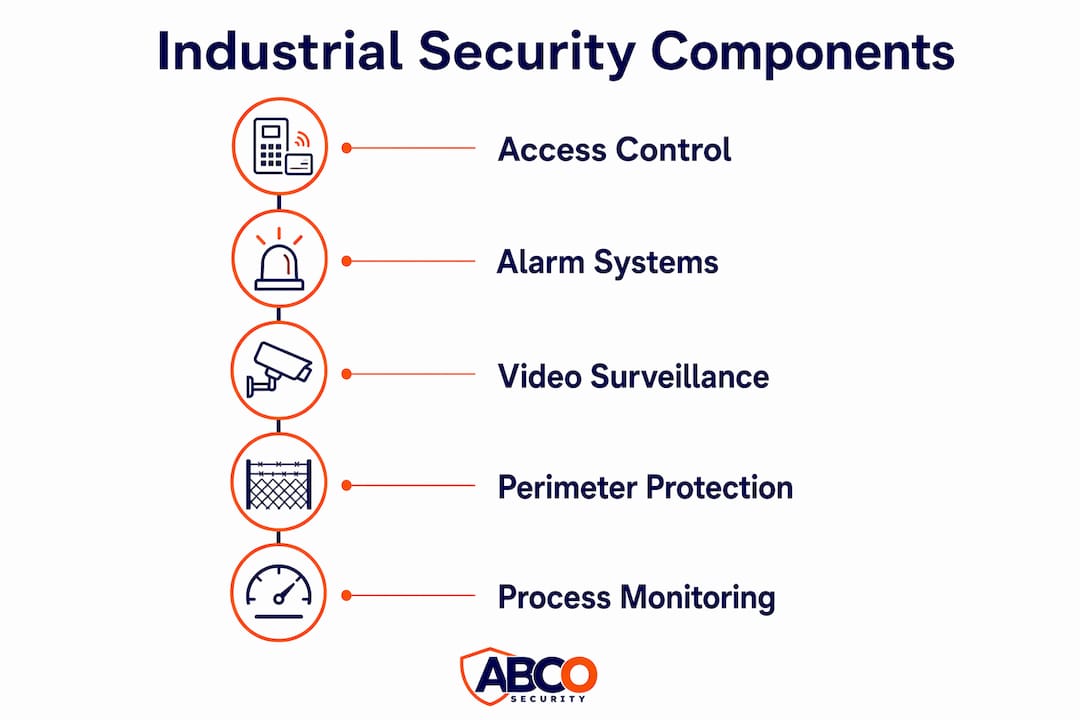
The scope goes well beyond a camera on the gate. A properly designed system protects the perimeter, building access points, operations and plant areas, data and control systems, and supply chain touchpoints — all simultaneously.
The primary objectives are:
- Prevent theft, vandalism, and sabotage of plant, equipment, and stock
- Protect personnel from unauthorised access and workplace hazards
- Prevent interference with production processes or safety systems
- Generate the incident logs and footage that satisfy audit obligations and insurer requirements
Three short examples show how components map to outcomes. A distribution warehouse needs LPR cameras at loading docks, zoned access control for pick-face areas, and alarm verification linked to a monitoring centre. A manufacturing plant adds SCADA event correlation and gas/flame sensors to catch process anomalies before they escalate. A remote mine depot, where a technician callout can cost thousands of dollars, relies on solar-powered perimeter radar, remote diagnostics, and a mobile operator interface so issues are resolved without anyone driving three hours. Each site gets a different configuration, but the underlying architecture is the same: detect, verify, respond, record.
Custom design per site risk profile is not a luxury. It is what makes the system defensible when something goes wrong.
How do access control and alarm systems work in industrial settings?
Access control in an industrial context runs from basic mechanical keys through to biometric readers and gated vehicle access. The practical options are:
- Mechanical keys and padlocks — lowest cost, highest administration burden, no audit trail
- Proximity/smart card and mobile credential — fast throughput, revocable, integrates with HR systems for joiner/leaver workflows
- Biometric — high assurance for server rooms, chemical stores, or areas with strict personnel hazard obligations under the SOCI Act
- Gated vehicle access — LPR or boom-gate integration for yards and loading areas
Alarm systems layer on top: intruder zones, door contacts, glass-break detectors, tamper switches, and forced-entry sensors each cover a different attack vector. The verification workflow matters as much as the hardware. A confirmed alarm (video-verified or dual-detector) reaches a monitoring centre with context, not just a signal.
Industrial environments add complications. Readers, panels, and cable runs must handle dust, moisture, vibration, and chemical exposure. Fail-safe versus fail-secure decisions — whether a door defaults open or locked on power loss — must align with both security policy and WHS obligations under the Work Health and Safety Regulations 2011. Backup power for panels and readers is non-negotiable on any site with safety interlocks.

Pro Tip: Nominate a single access control platform as your system of record from day one. Every credential, access event, and door-forced alert flows into one database. When an auditor or insurer asks for a CIRMP evidence package, you export one report rather than reconciling three spreadsheets.
For a deeper look at credential options and procurement checklists, the Abcosecurity access control guide covers device-level selection in detail.
What camera and analytics features matter for industrial surveillance?
Camera selection for industrial surveillance systems starts with the environment. Loading docks need wide dynamic range to handle the contrast between a bright yard and a dark container interior. Perimeter fences need IR illumination or thermal imaging for night coverage. Plant areas with steam, dust, or chemical vapour need ruggedised housings rated to IP66 or better.
The analytics layer is where factory security solutions separate from basic CCTV:
- Motion detection and line-crossing — flags perimeter breaches without operator fatigue from watching live feeds
- Loitering detection — catches pre-theft behaviour at yards and loading areas
- Licence-plate recognition (LPR) — automates vehicle access logs and flags unregistered vehicles
- AI false-alarm reduction — filters wind-blown vegetation and small animals before the alert reaches a monitoring centre
Storage and retention policy is a compliance question as much as a technical one. A local NVR works for a single site with reliable power; edge recording adds resilience where network links are unreliable; a central video management system (VMS) is the right answer for multi-site operations that need unified search and audit export. Insurers and the CIRMP framework both expect footage to be retained long enough to support incident investigations — confirm the required retention period with your insurer and legal team before specifying storage capacity.
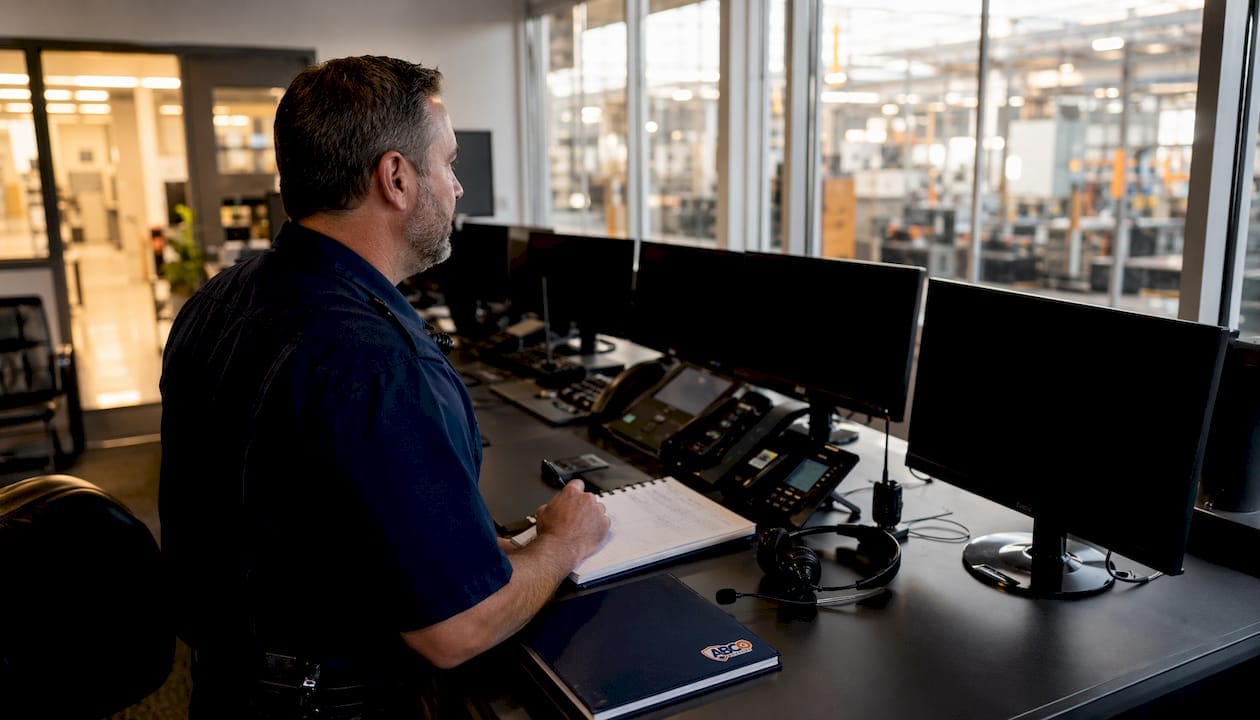
Integrated platforms automatically bring the relevant camera view to the foreground when an access event or alarm activates, cutting verification time and reducing the chance an operator misses a genuine threat.
How do you protect the perimeter of an industrial site?
Perimeter protection works in layers, and the layers must be designed together rather than added one at a time.
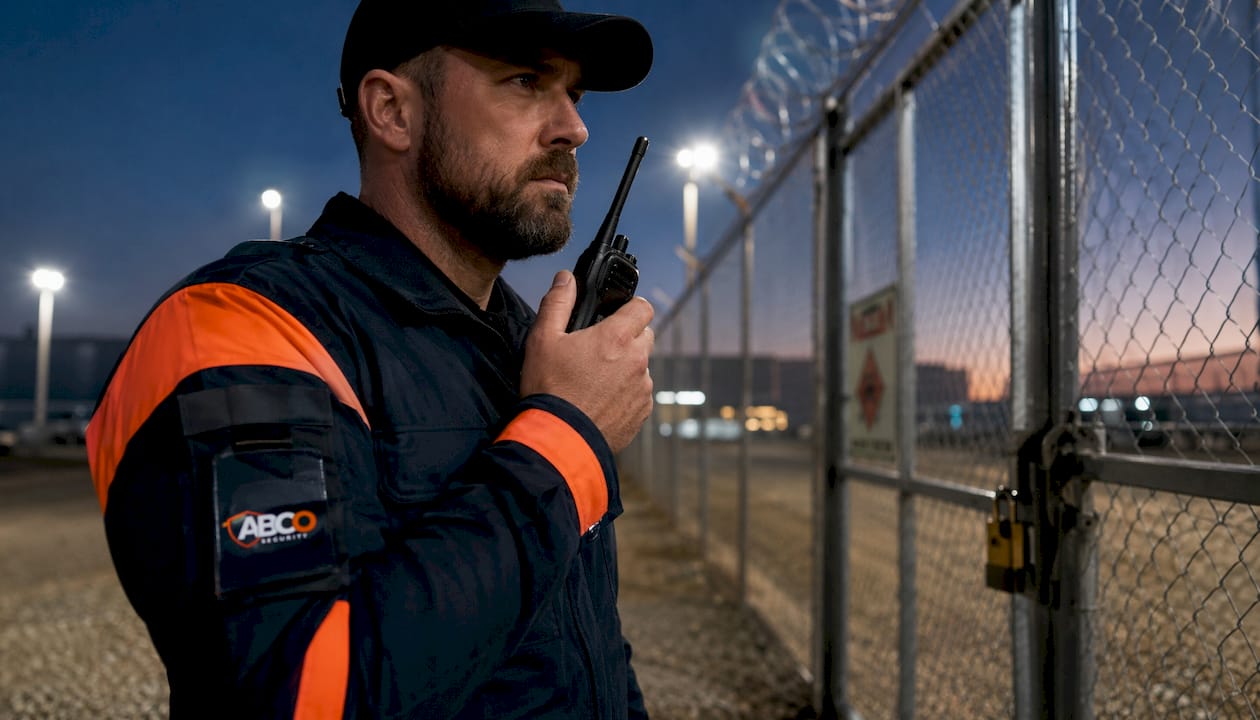
The deterrent layer — fencing, gates, signage, and lighting — raises the effort required to breach the site and creates the physical boundary that sensors reference. The detection layer sits behind it: passive infrared beams, buried cable sensors, wall-mounted vibration detectors, radar-based detection, and virtual tripwires drawn in the VMS analytics engine. Detection without verification is just noise, so the third layer — CCTV and intercom — confirms whether a triggered sensor represents a genuine intrusion or a false alarm. The response layer, whether a guard dispatch or a monitored alarm escalation, only activates on a verified event.
For remote sites, the design constraints are different. Solar and battery power must be sized for the worst-case winter generation period. Tamper-proof mounting protects sensors from environmental damage and deliberate interference. Communications redundancy — primary cellular with mesh radio backup — keeps the site connected when a single link fails. A maintenance plan with remote diagnostics capability reduces the number of physical site visits required, which on a remote Australian site is often the single biggest cost driver.
Perimeter detection integrates directly with access control and the VMS. When a sensor triggers, the system pulls the nearest camera view and checks whether an access credential was used at the adjacent gate in the preceding 60 seconds. That automated workflow is what turns a perimeter alarm into a verified event in seconds rather than minutes.
How does process monitoring connect security to operational safety?
Security systems and safety systems share a boundary in industrial environments, and the most effective deployments treat that boundary deliberately rather than accidentally.
Relevant sensors and integrations include:
- Flame and heat detectors (aligned to AS 1670.1 for fire detection)
- Fixed gas monitors for flammable or toxic atmospheres
- Vibration sensors and door interlocks on plant enclosures
- SCADA event correlation — linking a process alarm to the access log to confirm whether an authorised operator was present
- Tamper alerts on control cabinets and communications equipment
When a gas detector triggers at 2 AM and the access log shows no authorised entry to that zone in the preceding four hours, the security system has already told the response team something critical: this is not an operator error, it is either a process fault or a deliberate act. That context changes the response.
Pro Tip: Keep safety-critical control outputs — emergency shutdowns, fire suppression triggers — on a separate, certified safety system. Security automation should correlate and alert, not actuate safety functions. Mixing the two introduces failure modes that neither system was designed to handle.
A manufacturing client that integrated SCADA alarms with access logs and CCTV found that process anomalies previously investigated over several hours were resolved in under 30 minutes, because operators arrived at the right location with video context already on screen.
Which integration architecture suits your site?
Three design patterns cover most industrial deployments. Each has a different risk and cost profile.
| Pattern | Reliability | Scalability | Cost | Support burden |
|---|---|---|---|---|
| Native vendor integration | High — tested by vendor | Limited to vendor ecosystem | Low upfront | Low — single vendor |
| Middleware / PSIM | Medium — depends on middleware health | High — vendor-agnostic | Medium–high | Medium — middleware layer adds complexity |
| Bespoke API integration | Variable — depends on build quality | High | High upfront | High — custom code requires ongoing maintenance |
Native integrations are the right starting point for most sites. A single vendor’s access control, VMS, and alarm platform share a tested data model, and failures are the vendor’s problem to fix. Middleware or PSIM solutions make sense when a site has legacy systems from multiple vendors that cannot be replaced. Bespoke API work is justified only when a specific integration — SCADA to VMS, for example — has no off-the-shelf path and the operational benefit is clearly quantified.
Choosing a single system of record matters regardless of which pattern you use. Audit logs, video footage, and alarm triggers aligned by time and location reduce manual coordination and false-alarm costs. For CIRMP evidence, a unified log is far easier to produce than a reconciled export from three separate platforms.
Architecture checklist before commissioning:
- Network segmentation between OT (operational technology) and IT/security networks
- PoE switch design with UPS backup sized for a minimum four-hour outage
- Documented failure-mode tests: what happens when the network link drops, when a node loses power, when the server restarts
- Named system of record with a defined data-retention and backup schedule
For practical implementation detail, the Abcosecurity integrated security solutions guide covers unified platform design and lifecycle support.
What monitoring and maintenance services should you contract for?
Monitoring models range from self-monitored (operator watches live feeds) through hybrid (automated alarm escalation with operator confirmation) to fully professionally monitored (a licensed monitoring centre handles all alarm events). Most industrial sites above a certain size need professional monitoring for out-of-hours coverage; the question is how much verification happens before a guard is dispatched.
A maintenance lifecycle for an industrial security system typically covers:
- Scheduled health checks (quarterly as a minimum for critical sites)
- Firmware updates for cameras, panels, and VMS servers
- Camera cleaning and lens inspection, especially in dusty or chemical environments
- Certified repairs and a spare-parts holding for critical components
Procurement to handover typically runs 8–16 weeks for a medium-complexity site: site survey and design (2–3 weeks), procurement and staging (3–4 weeks), installation and cabling (2–4 weeks), commissioning and testing (1–2 weeks), operator training and handover (1 week). SLA expectations for a professionally monitored system should include alarm response within 60 seconds and a guaranteed uptime target for monitoring infrastructure.
One vendor managing the full lifecycle — design, installation, monitoring, and maintenance — removes the accountability gap that split contracts create. When a camera goes offline and the monitoring contract is with a different company from the installer, the finger-pointing starts before the fault is fixed.
What compliance obligations apply to Australian industrial sites?
The Security of Critical Infrastructure Act 2018 (SOCI Act) requires responsible entities for designated critical infrastructure assets to adopt and maintain a written CIRMP covering physical security, cyber, personnel, and supply-chain hazards. The CIRMP Rules (LIN 23/006) specify what the program must contain. Systems of National Significance face additional Enhanced Cyber Security Obligations including vulnerability assessments and incident response planning.
Key Australian standards for electronic security:
- AS/NZS IEC 60839.11.1/2:2019 — minimum requirements for electronic access control systems and application guidelines
- AS/NZS 62676.1.1:2020 — system requirements for video surveillance
- AS/NZS 2201 series — intruder alarm systems covering design, installation, monitoring centres, and transmission
- AS 1670.1 — fire detection, warning, and control systems
Regulatory note: SOCI Act obligations and CIRMP rules are administered by the Cyber and Infrastructure Security Centre (CISC). Insurer and WHS expectations increasingly require the same evidence the CIRMP demands: documented retention periods, incident logs, and proof of operator training. Aligning supplier contracts to these requirements from the start avoids expensive retrofits.
Pro Tip: Document device ownership (who is responsible for each camera, panel, and sensor), retention periods, and operator training records as named sections in your CIRMP. An auditor will ask for exactly these three things first.
Insurer expectations are tightening alongside regulatory ones. Reviewing commercial insurance requirements before finalising your specification can prevent gaps that void a claim.
How do you assess your site and specify requirements?
A structured assessment produces a specification that suppliers can price accurately and that you can evaluate objectively.
- Site survey — walk every zone, map entry/exit points, identify blind spots, note environmental conditions (dust, moisture, temperature, vibration)
- Risk register mapping — assign likelihood and consequence to each threat: theft, vandalism, unauthorised access, process interference, personnel hazard
- Required detections — list what each zone must detect and the acceptable false-alarm rate
- Integration points — identify SCADA, HR, and building management systems that must share data with the security platform
- Communications and power audit — confirm network topology, available bandwidth, UPS capacity, and generator coverage
- Retention and privacy impact — determine required footage retention, confirm compliance with the Privacy Act 1988, and document data-handling procedures
Your RFP should specify functional requirements (what the system must do), performance SLAs (response times, uptime), as-built drawings, acceptance test procedures, and documented failure-mode tests. Ballpark cost ranges vary widely by scope: a small single-site installation runs from tens of thousands of dollars; a medium manufacturing plant with SCADA integration and 24/7 monitoring typically has a substantial budget; a multi-site rollout with centralised VMS and PSIM middleware can involve very high costs. Integration complexity, ruggedisation requirements, and retention capacity are the three biggest cost drivers.
When evaluating tenders, weight compliance credentials and installer licences heavily. A cheaper quote from an unlicensed or under-resourced installer creates liability that far exceeds the price difference. Check security industry best practices to build your evaluation scorecard.
Key takeaways
An effective Australian industrial security system requires a CIRMP-aligned, integrated platform with documented SLAs, a single system of record, and a long-term support partner who can produce audit evidence on demand.
| Point | Details |
|---|---|
| CIRMP alignment is the starting point | Every system design decision should map to a CIRMP obligation under the SOCI Act. |
| Integration beats point solutions | A single system of record reduces verification time and simplifies audit evidence. |
| Compliance drives procurement criteria | Weight AS/NZS standards, installer licences, and SLA evidence heavily in tender evaluation. |
| Remote sites need remote-first design | Solar power, communications redundancy, and remote diagnostics are central to the business case for remote Australian sites. |
| Abcosecurity covers the full lifecycle | Design, installation, 24/7 monitoring, maintenance, and CIRMP support from a single ISO-committed provider. |
What the industry gets wrong about industrial security
Most industrial security projects fail not because of bad technology but because of poor system design decisions made before a single cable is run. The naming convention problem is a good example: sites where cameras are labelled “CAM001” through “CAM147” with no zone reference create genuine delays during high-severity incidents. An operator searching for the right feed while an event unfolds is a design failure, not a human one.
The second pattern worth naming is the split-contract trap. Facility managers often separate the installation contract from the monitoring contract to get a lower headline price. What they get instead is a gap in accountability that surfaces at the worst possible moment — when a camera goes offline at 3 AM and neither vendor accepts responsibility until business hours.
Abcosecurity’s 15-plus years of industrial deployments, backed by ISO 9001 and ISO 30000 commitments, reflect a consistent lesson: the sites that perform best under audit and incident review are the ones that treated compliance as a design input, not an afterthought. That means a CIRMP-aligned system of record, documented failure-mode tests before go-live, and a maintenance plan that is written into the contract rather than promised verbally.
Choosing a supplier comes down to three verifiable things: a current security licence for the jurisdiction, a written maintenance plan with named response times, and demonstrated local response capability. Ask for all three before signing anything.
Abcosecurity’s turnkey industrial security services
Protecting an industrial site from a single provider means one contract, one point of accountability, and one evidence package when the auditor arrives. Abcosecurity designs, installs, monitors, and maintains integrated security solutions for industrial sites across Australia, with local teams, ISO credentials, and a compliance-first methodology built around CIRMP obligations.

The practical benefit is straightforward: you get a system designed to produce audit-ready logs, a monitoring centre that verifies alarms before dispatching a response, and a maintenance contract that keeps the system performing to spec. For sites that need electrical compliance work alongside security installation, Abcosecurity coordinates with qualified trades to deliver a complete, code-compliant outcome.
Request a site assessment or an RFP template from Abcosecurity’s industrial security team. A site survey is the fastest way to move from a risk register to a specification you can price and tender.
Useful sources and standards
The table below lists the primary sources referenced in this article. Use them when writing CIRMP documentation, drafting tender requirements, or verifying compliance obligations.
| Source | Scope | Why it matters | Link |
|---|---|---|---|
| SOCI Act 2018 (CISC guidance) | Critical infrastructure obligations, CIRMP requirement | Primary legal basis for CIRMP and positive security obligations | cisc.gov.au |
| CIRMP Rules LIN 23/006 | Specific CIRMP content requirements | Sets out what a CIRMP must contain for physical, cyber, and personnel hazards | legislation.gov.au |
| SOCI Act 2018 (consolidated text) | Full legislative text | Primary citation for legal obligations and reporting requirements | legislation.gov.au |
| AS/NZS IEC 60839.11.1/2:2019 | Electronic access control systems | Minimum requirements and application guidelines for access control | asial.com.au |
| AS/NZS 62676.1.1:2020 | Video surveillance systems | System requirements for CCTV in security applications | asial.com.au |
| AS/NZS 2201 series | Intruder alarm systems | Design, installation, monitoring centre, and transmission requirements | asial.com.au |
| WHS Regulations 2011 Reg 298 | Workplace security obligations | Underpins physical security requirements for workplaces | austlii.edu.au |
When drafting tender documentation, reference the SOCI Act and CIRMP Rules as mandatory compliance requirements, and list the relevant AS/NZS standards as minimum performance specifications. Suppliers who cannot demonstrate alignment to these standards should be disqualified at the shortlisting stage.
This article provides general information about Australian industrial security obligations and is not legal or professional advice. Confirm current legislative requirements with the CISC, Standards Australia, or a qualified security consultant for your specific site.
FAQ
What is an industrial security system?
An industrial security system is an integrated platform combining CCTV, access control, intrusion detection, perimeter protection, and process or hazard sensors to protect an industrial site’s assets, personnel, and operations. In Australia, it should align with the SOCI Act CIRMP obligations and relevant AS/NZS standards.
What are the four main types of security systems used in industry?
The four core types are access control systems, intruder alarm systems, video surveillance systems, and perimeter detection systems. Effective industrial deployments integrate all four into a single platform with a unified audit log.
What is an example of industrial security in practice?
A manufacturing plant integrating SCADA event correlation with access logs and CCTV is a clear example: when a gas detector triggers in an unmanned zone, the system immediately confirms no authorised access occurred and alerts the monitoring centre with video context, cutting investigation time significantly.
How customisable is an industrial security system for different site types?
Highly customisable. A warehouse, a remote mine depot, and a chemical plant each require different camera types, sensor configurations, power solutions, and integration points. Abcosecurity designs systems to a site-specific risk register rather than a standard template, which is what the CIRMP framework requires.
Does an industrial security system need to meet Australian standards?
Yes. Electronic access control must meet AS/NZS IEC 60839.11.1/2:2019, video surveillance must meet AS/NZS 62676.1.1:2020, and intruder alarm systems must meet the AS/NZS 2201 series. Sites designated under the SOCI Act also face CIRMP obligations administered by the CISC.
Recommended
about
avada factory
Sempery ultricies nibh at dolor cras urna eleifend nec. Atiam efficitur tempor.