
For Australian corporate and facility managers, the recommended approach is to prioritise WHS-aligned, multi-channel parallel delivery with automated HRIS sync. Abcosecurity is the in-market option that integrates mass notification strategy with physical security services to close the accountability loop under AS 3745 and Safe Work Australia emergency plan requirements.
Before you open a single vendor demo, work through these steps:
- Assign a named owner for the system (contact audits, drills, template reviews)
- Audit your contact data quality now — stale lists are the most common failure point
- Run a tabletop drill against your three highest-risk scenarios
- Request written throughput and p95 delivery evidence from every shortlisted vendor
- Confirm HRIS/Active Directory sync is production-tested, not just documented in an API guide
- Reference AS 3745 (emergency planning and training) and AS 1670.4 (EWIS hardware) in your RFP, and align with the Safe Work Australia emergency plan requirements
Table of Contents
- What must the best mass notification systems actually do?
- What Australian WHS law and AS 3745 actually require
- How to plan implementation and govern the system long-term
- How to evaluate vendors and run a defensible RFP
- Why Abcosecurity is the recommended WHS-aligned option for Australian facilities
- Key takeaways
- The gap most facility managers don’t see until it’s too late
- Abcosecurity’s integrated security and notification services
- Useful sources
- FAQ
What must the best mass notification systems actually do?
The non-negotiables come down to six capabilities. Miss any one of them and the system will let you down at the worst possible moment.
| Capability | Why it matters | What to require |
|---|---|---|
| Parallel multi-channel delivery | Sequential fallback (SMS, then email after timeout) is too slow for life-safety events | Simultaneous fire to SMS, voice, push, desktop and MS Teams |
| Two-way response and roll-call | Incident commanders need safe/need help/no response status in real time | Categorised responses with live dashboard and audit export |
| Automated HRIS/SSO sync | Manual CSV uploads produce stale contact lists that fail during incidents | Production-tested connectors to Azure AD, Okta or Google Workspace |
| Geo-targeting and zone alerting | Badge swipe and desk-booking data let you target where people actually are | Integration with access control and occupancy systems |
| Throughput, SLA and redundancy | A system that queues messages during a peak-load incident is useless | Multi-carrier routing, multi-region delivery, written uptime SLA |
| Audit trails and reporting | Compliance, insurer queries and legal review all require timestamped logs | Per-recipient delivery status, channel used, timestamp and response |
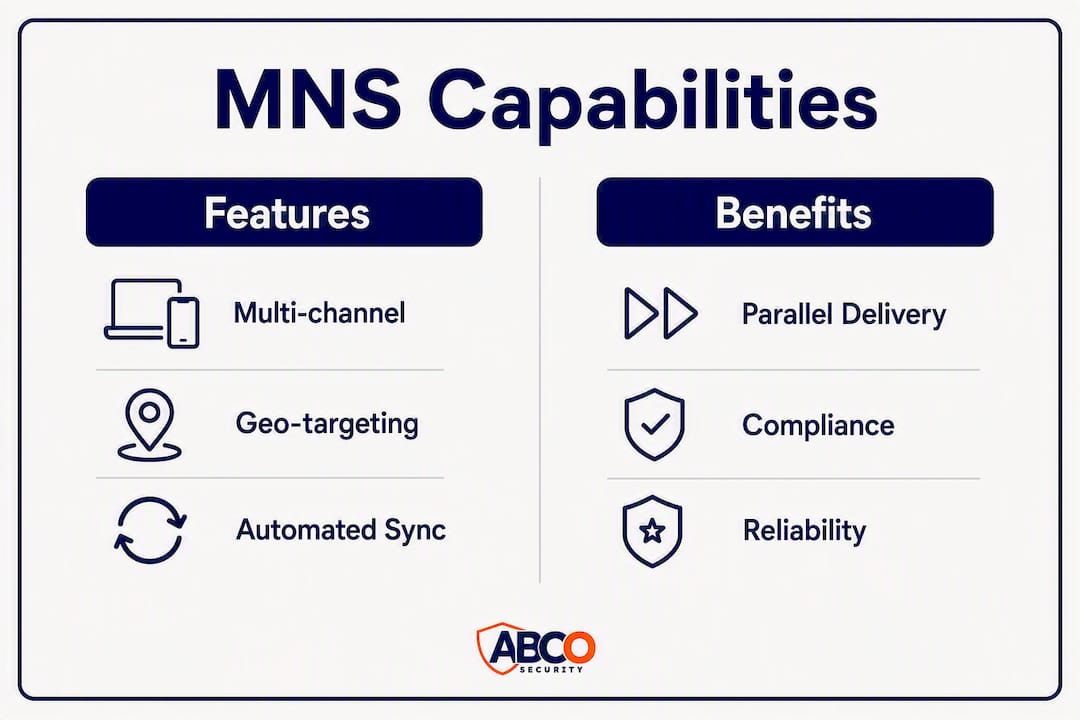
Parallel, simultaneous delivery across all enabled channels is the single biggest differentiator between a dependable platform and a box-checking tool. Sequential approaches were designed for a world where SMS was the only channel. They have no place in a modern emergency notification solution.
Geo-targeting fed by access control or desk-booking data takes this further. Alerts reach people where they actually are, not where their roster says they should be. Pair that with access control systems for office buildings that feed live presence data into your MNS, and your roll-call accuracy improves substantially.
For IP-based EWIS, network design is a separate but related obligation. Audio VLANs, UPS-backed switches and isolation from general data traffic are required to preserve life-safety audio performance. Raise this explicitly in your RFP when you expect EWIS and MNS to share an IP network.
What Australian WHS law and AS 3745 actually require
Under WHS regulations, every Australian workplace must prepare, maintain and implement a formal emergency plan covering occupant alerting, emergency service notification and effective communications. Annual drills are the industry standard for validating those procedures.
Two standards govern this space, and conflating them is one of the most common procurement mistakes:
- AS 3745 is a management standard. It covers emergency planning, the emergency control organisation, training, testing and the ongoing governance of your emergency procedures. It governs people and process, not hardware.
- AS 1670.4 is a technical standard for EWIS hardware — the physical fire and evacuation warning systems installed in buildings. The National Construction Code requires EWIS in buildings over 25 metres effective height and in certain healthcare, aged-care and school buildings.
A software MNS complements EWIS rather than replacing it. EWIS handles fire-specific life-safety audio with dedicated power resilience and installation rules. An MNS handles non-fire emergencies, geofenced zone alerts, two-way accountability and the kind of flexible multi-channel reach that hardwired PA systems cannot provide. Both obligations must be met independently.
Procurement clause to include: Require vendors to supply drill reports, timestamped audit logs suitable for WHS recordkeeping, and written confirmation of how their system integrates with your EWIS where required.
When drafting your emergency response procedures, map each MNS capability directly to an AS 3745 obligation. That mapping becomes your compliance evidence.
How to plan implementation and govern the system long-term
Deployment rarely fails at the technology layer. It fails because no one owns the system after go-live.

| Milestone | Owner | Typical duration |
|---|---|---|
| Discovery and requirements | Facility manager + IT | 2–4 weeks |
| HRIS/AD and access control integration | IT + vendor | 2 weeks |
| Pilot (one building or floor) | Facility manager + vendor | 2–4 weeks |
| Full rollout and training | Vendor-led, facility manager sign-off | 2 weeks |
Primary cost drivers are recipient count, per-message throughput requirements, custom integration development, and whether you need a managed service for ongoing drill facilitation and contact audits. Organisations that skip assigned ownership and quarterly drills end up with systems that fail in real incidents — the technology works, but no one kept the contact list current or tested the templates.
Pro Tip: Build a governance calendar into your contract: quarterly contact audits, quarterly drills, annual full-scale exercise, and an annual template review. Tie these milestones to your AS 3745 obligations so they are not optional.
Your contract should also specify data retention periods for audit logs, export formats acceptable to your insurer, escalation paths for SLA breaches, and training commitments for new staff and wardens.
How to evaluate vendors and run a defensible RFP
A vendor who looks good in a demo and falls apart under load is a liability. Structure your evaluation to expose that gap before you sign.
- Request written throughput evidence. Ask for p95 delivery times at your target recipient count and for simultaneous multi-channel sends. Verbal assurances are not acceptable.
- Test integrations in production, not staging. Require a live demonstration of your HRIS, identity provider and access control connectors working against real data.
- Evaluate SLA and redundancy architecture. Multi-carrier routing, multi-region delivery nodes and a documented disaster recovery plan should all be in writing.
- Time a trained user triggering a pre-built alert. The goal is under 60 seconds from decision to send. Role-based permissions and pre-approved templates make this achievable.
- Run your three highest-risk scenarios live. Measure time-to-delivery, confirmation rates and roll-call accuracy on each vendor’s environment before shortlisting.
Use this weighted scoring rubric in your RFP:
| Category | Weight |
|---|---|
| Reliability and SLA / redundancy | 25% |
| Delivery performance (throughput, parallel channels) | 15% |
| Two-way accountability and roll-call | 15% |
| Usability and training support | 15% |
Audit reporting is a compliance requirement, not a nice feature. Every alert must generate a timestamped log with per-recipient delivery status, channel used and response data. Confirm this is exportable in a format your WHS records system can ingest.
Pro Tip: Ask each vendor for a reference from an Australian facility of comparable size and sector. A peer reference reveals operational realities that no demo will show you.
Why Abcosecurity is the recommended WHS-aligned option for Australian facilities
Abcosecurity brings over 15 years of experience in integrated security and holds ISO 9001 and ISO 30000 certifications, which means quality management and information security governance are built into delivery, not bolted on after the fact.
Where most software vendors hand you a platform and a knowledge base, Abcosecurity integrates mass notification planning with commercial alarm monitoring services, access control, CCTV and licensed on-ground response. That means when an alert fires, there is a physical response capability behind it, not just a delivery receipt.
Facility managers who engage Abcosecurity for an on-site assessment receive a gap analysis against AS 3745 obligations, a recommended channel architecture, and a clear integration path for their existing HRIS and access control systems. Contact Abcosecurity to request an RFP support session or a live scenario demonstration with the implementation team.
Key takeaways
A WHS-compliant mass notification system requires parallel multi-channel delivery, automated HRIS sync, two-way roll-call accountability, and a named internal owner who runs drills and audits contacts on a scheduled basis.
| Point | Details |
|---|---|
| Assign ownership first | Name a single owner for contact audits, drills and template reviews before go-live. |
| Require parallel delivery | Simultaneous SMS, voice, push and desktop sends are mandatory; sequential fallback is inadequate. |
| Automate contact sync | HRIS and SSO integration prevents stale lists; manual CSV uploads are a known failure mode. |
| EWIS remains a separate obligation | AS 1670.4 hardware compliance is independent of your AS 3745 management obligations. |
| Abcosecurity for integrated delivery | Abcosecurity combines MNS strategy with physical security services for a complete WHS-aligned solution. |
The gap most facility managers don’t see until it’s too late
Most procurement conversations about mass notification focus on features and price. The harder question is whether the system will actually work on a Tuesday afternoon when the contact list hasn’t been touched in eight months and the warden who knew the templates has left the organisation.
A mass notification system is a living stack. The technology is the easy part. What determines whether it works is assigned ownership, automated sync with your identity provider, a drill calendar that gets kept, and integration with the occupancy data that tells you where people actually are. Organisations that treat deployment as a one-time project consistently discover this the hard way.
The other failure mode worth naming is sequential delivery. Many platforms still default to SMS first, then email after a timeout, then a push notification. That architecture made sense when SMS was the only reliable channel. Today it means the person sitting at their desktop with Teams open gets the alert two minutes after the person who left their phone in the car. Parallel delivery is not a premium feature. It is the baseline.
Abcosecurity’s integrated security and notification services
Abcosecurity is the practical alternative to a standalone software platform for Australian facilities that need WHS compliance built into their security stack, not managed separately.
Abcosecurity’s services directly supporting mass notification outcomes include system design and channel architecture, HRIS and identity provider integration support, EWIS and PA coordination, 24/7 alarm monitoring, and drill facilitation tied to AS 3745 obligations. For construction sites and multi-site corporate portfolios, Abcosecurity’s construction site security management experience means the notification architecture accounts for dynamic site populations and contractor access, not just permanent staff.
The next step is straightforward: contact Abcosecurity for an on-site gap analysis against your current AS 3745 obligations, or request RFP support to structure your vendor evaluation. The implementation team can run a live scenario demonstration against your environment before you commit.
Useful sources
- Safe Work Australia — emergency plans fact sheet: primary WHS guidance on emergency plan requirements, drill frequency and employer obligations
- WorkSafe NT — emergency plans bulletin: plain-language guidance on preparing and maintaining emergency plans under WHS regulations
- QFES — emergency planning guidance: Queensland Fire and Emergency Services guidance on incident management structures and emergency planning for larger workplaces
- Think Pickle — AS 1670.4 and AS 3745 overview: technical explanation of the distinction between EWIS hardware standards and emergency management obligations
- CCC Engineering — EWIS overview: NCC requirements for EWIS installation and AS 1670.4 compliance
- Abcosecurity — duress alarm systems guide: integration guidance for duress alarms and on-site emergency response procedures
- Abcosecurity — employee safety in the workplace: WHS obligations and practical measures for employee protection aligned with emergency notification planning
FAQ
What is the difference between AS 3745 and AS 1670.4?
AS 3745 is a management standard covering emergency planning, training and testing for the emergency control organisation. AS 1670.4 is a technical standard governing EWIS hardware installation and performance. Both apply to most commercial facilities, but they address different obligations.
How often must Australian workplaces run emergency drills?
Safe Work Australia requires training at intervals that ensure workers can implement the emergency plan; annual drills are the industry standard for most workplaces.
Why does parallel multi-channel delivery matter for mass notification?
Sequential delivery (SMS first, then email after a timeout) is too slow for life-safety events. Parallel delivery fires SMS, voice, push, desktop and collaboration channels simultaneously, reaching recipients on whichever device is closest.
What is the biggest operational failure point for mass notification systems?
Stale contact data. Automated, real-time syncing with HRIS and identity providers such as Azure AD or Okta is the standard mitigation; manual CSV uploads consistently produce inaccurate lists that fail during actual incidents.
Can Abcosecurity support both MNS strategy and physical security for Australian facilities?
Yes. Abcosecurity integrates mass notification planning with CCTV monitoring, access control, alarm monitoring and licensed on-ground response, providing a single coordinated system aligned with AS 3745 and WHS obligations.
Recommended
about
avada factory
Sempery ultricies nibh at dolor cras urna eleifend nec. Atiam efficitur tempor.