TL;DR:
- Virtual guarding is an AI-augmented remote monitoring system that uses live operators to verify alerts and issue voice warnings without on-site guards. It is most effective for construction sites, warehouses, and retail car parks, especially when existing CCTV infrastructure is in place. The model offers cost savings and deterrence benefits but cannot replace physical intervention where required by law or site response protocols.
Virtual guarding is an AI-augmented remote monitoring model where analytics-filtered camera alerts are reviewed by a live operator who issues a voice-down warning or dispatches a mobile patrol, all without a guard physically present on site. For most construction sites, logistics warehouses, retail car parks, and multi-site commercial portfolios across Australia, it is worth a serious evaluation. Sites that require physical intervention as a primary response, such as mental health facilities or high-contact retail, are better served by a hybrid or static-guard model.
TL;DR decision prompts:
- Evaluate now if your site has existing CCTV infrastructure, predictable after-hours risk, and you are paying for static guards primarily to deter rather than physically intervene.
- Consider hybrid if your risk profile includes occasional physical confrontation or you need a licensed guard on site for compliance reasons.
- Stay with static if your site requires constant physical presence, access control decisions, or hands-on emergency response as a primary function.
Table of Contents
- How does virtual guarding actually work?
- What are the real benefits and how do you frame ROI?
- Which Australian sites get the most from virtual guarding?
- How does virtual guarding compare with on-site guards?
- What does deployment look like in Australia?
- What are the legal and compliance requirements in Australia?
- What do real-world results look like?
- Why Abcosecurity is a strong option for virtual guarding in Australia
- Key takeaways
- When would I recommend virtual guarding to a client?
- Ready to run a virtual guarding pilot?
- Useful sources
- FAQ
How does virtual guarding actually work?
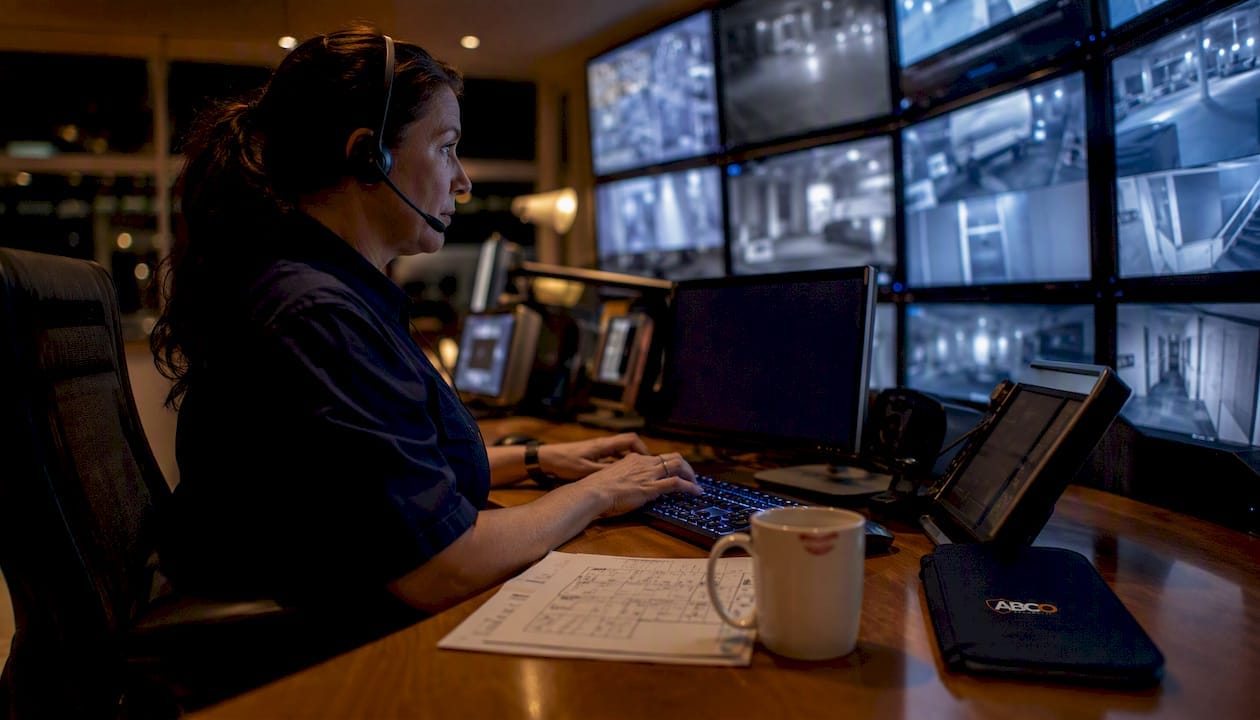
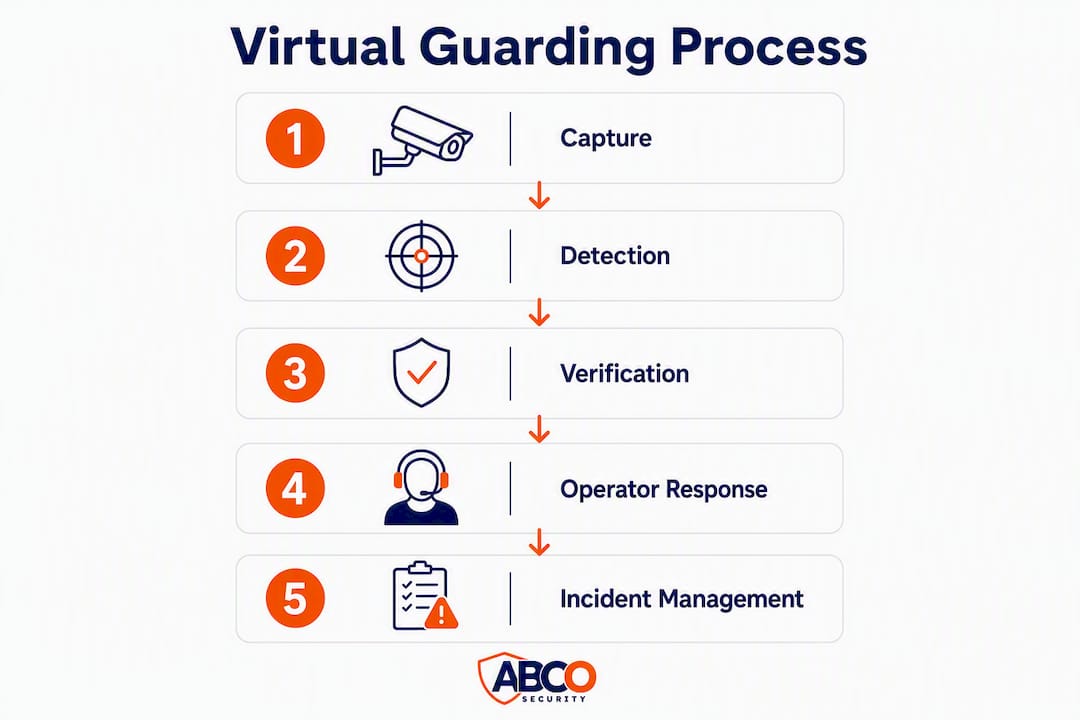
The operational flow moves through five stages. Cameras and sensors capture activity across the site. An AI video analytics layer filters that feed, suppressing irrelevant motion (wind in trees, passing vehicles outside the perimeter) and flagging genuine anomalies. Those flagged events reach a trained operator at a remote security operations centre (RSOC), who reviews the live feed in real time. If the operator confirms a threat, they issue a live voice-down through an on-site speaker, identifying themselves and warning the intruder they are being recorded and that police or a mobile patrol are being contacted. Only verified threats trigger dispatch. Every step is timestamped and logged for evidence.
Core technical components
The system depends on several integrated layers working together:
- Cloud or on-premises VMS (video management system) that aggregates feeds from all cameras into a single operator interface
- Edge AI or server-side video analytics for motion classification, object detection, and loitering alerts
- Two-way audio hardware including IP speakers and microphones for live voice-down capability
- Siren and strobe integration for automated deterrence when an operator triggers an alarm
- Mobile patrol integration so verified incidents can be dispatched to a roaming patrol unit with GPS tracking
- System health monitoring that flags camera faults, network drops, or obstructed lenses before they create blind spots
- Timestamped incident logs exported in formats suitable for insurers and police
Remote guarding works best when these components are treated as a single system rather than bolted together from separate vendors. Operators at a well-run RSOC handle continuous live monitoring, alert assessment, verbal deterrence, law enforcement coordination, and incident documentation across multiple sites simultaneously.
Operator staffing model
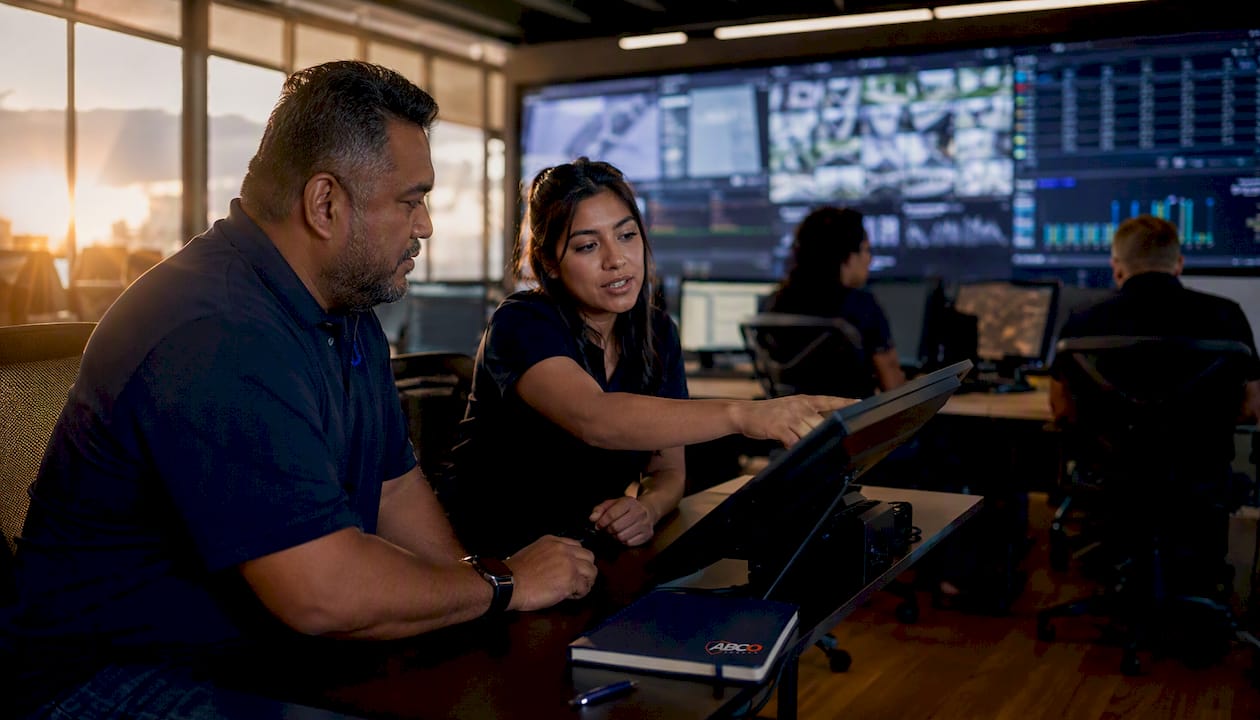
Grade A1 trained monitoring operators typically supervise multiple sites from a single console, which is the core economic lever in the model. Shift patterns cover 24/7 operations, with escalation protocols written into each site’s playbook. The operator-to-site ratio varies by alert volume and site complexity, but a well-tuned analytics layer keeps that ratio manageable by suppressing nuisance alerts before they reach the operator queue.
Integration points with existing infrastructure:
- ONVIF-compliant cameras can usually feed directly into a new VMS without hardware replacement
- Access control systems can trigger camera pop-ups on door-forced or tailgate events
- Existing alarm panels can be integrated as secondary alert sources
- Mobile patrol dispatch platforms connect via API or direct RSOC communication
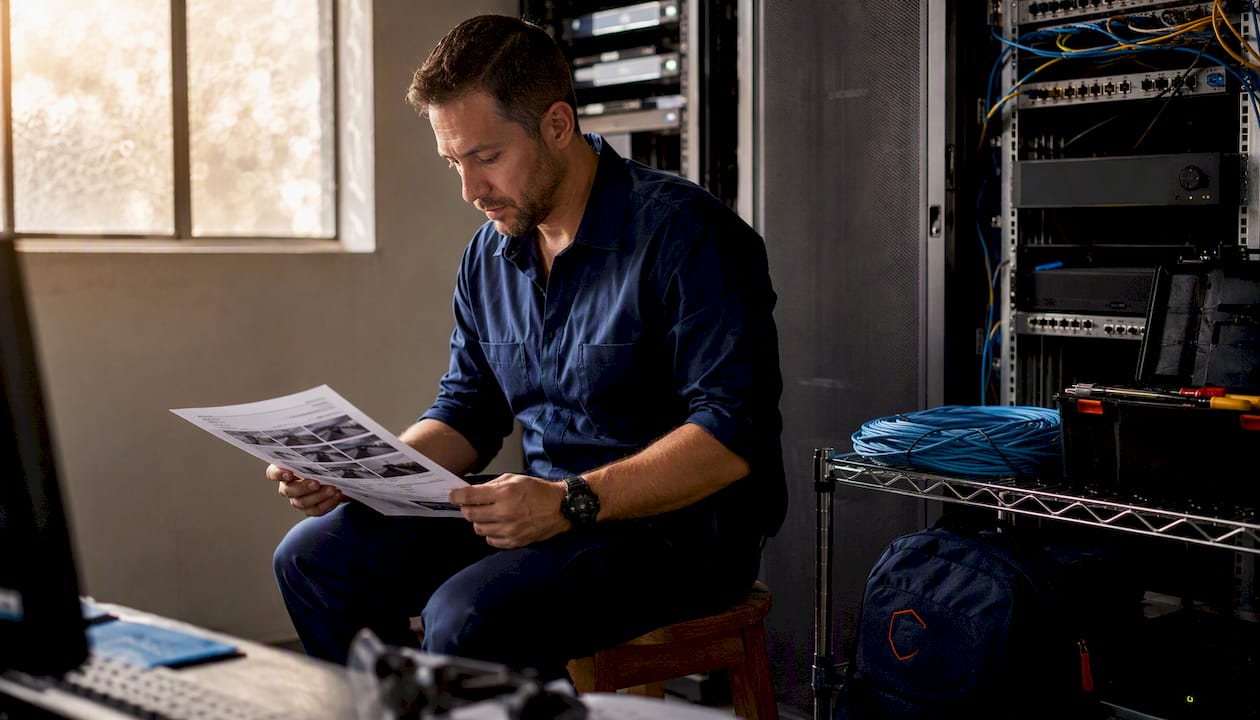
Pro Tip: Before any site survey, pull a camera health report from your existing VMS. Check for cameras with persistent faults, degraded image quality, or obstructed fields of view. A site survey that skips this step routinely uncovers remediation work that delays go-live by four to six weeks.
What are the real benefits and how do you frame ROI?
The primary operational benefit is deterrence at the moment of detection. A live voice-down from an operator who can name the intruder’s location and describe their clothing is far more effective than a recorded warning. Virtual guarding replaces reactive response with proactive intervention, which changes the incident trajectory entirely.
Performance metrics that matter to procurement
Track these from day one of any pilot:
- Reduction in confirmed incidents (month-on-month against baseline)
- False alarm rate (nuisance alerts as a percentage of total alerts)
- Time to verification (seconds from alert trigger to operator confirmation)
- Average incident duration (time from first detection to resolution)
- Mobile patrol dispatches avoided (verified deterrence events where voice-down resolved the incident without dispatch)
Cost comparison: virtual guarding vs static guards
Virtual guarding can significantly reduce total operating costs by eliminating many labour-related expenses that accumulate invisibly in static guard contracts. The categories of saving include:
- Award wages, overtime, and penalty rates for night and weekend shifts
- Superannuation, workers’ compensation, and payroll tax
- Attrition and recruitment costs (security guard turnover in Australia is high)
- Sick day coverage and last-minute shift fill costs
- Liability exposure from guard conduct incidents
The OPEX subscription model for virtual guarding typically covers monitoring fees, incident handling, and system maintenance as a recurring monthly cost, with hardware and installation as a one-off capital item. That structure is easier to budget and easier to scale across a portfolio than adding headcount.
Framing a 12–18 month ROI narrative
Start with your current static guard spend: total annual hours multiplied by the fully loaded hourly rate. Project the hours that virtual guarding would replace (typically after-hours and weekend coverage). Add the avoided mobile patrol dispatch costs. Set that against the annual monitoring subscription plus amortised hardware. Most sites reach payback within 12–18 months when after-hours coverage is the primary use case. The KPIs to report to stakeholders are incident reduction percentage, false alarm rate improvement, and cost-per-verified-incident.
Which Australian sites get the most from virtual guarding?
Remote guarding is particularly effective for distributed or multi-site portfolios because one operator can supervise multiple locations simultaneously. The highest-fit site types in the Australian context are:
| Site type | Primary threat | Peak risk window | Why virtual guarding fits |
|---|---|---|---|
| Construction sites | Theft of plant and materials | After-hours and weekends | Large perimeter, no permanent occupants, high deterrence value |
| Logistics warehouses | Cargo theft, trespass | Night shift and early morning | Predictable access points, existing CCTV infrastructure common |
| Retail car parks | Vehicle crime, assault, vandalism | Evening and overnight | Wide open areas suited to panoramic and PTZ cameras |
| Industrial yards | Copper theft, arson, vandalism | Overnight | Remote locations, limited lighting manageable with thermal cameras |
| Vacant commercial buildings | Squatting, arson, vandalism | Continuous | No staff on site, high deterrence value from voice-down |
| Campus perimeters | Trespass, after-hours access | Evening and overnight | Large perimeter, multiple entry points, scalable coverage |
For construction sites specifically, the combination of high-value plant, open perimeters, and zero after-hours occupancy makes virtual guarding one of the most cost-effective security models available. Abcosecurity’s construction site security technology guide covers the integration of virtual guarding with site access control and mobile patrols in detail.
Multi-site portfolios benefit from centralised reporting: one dashboard showing incident frequency, camera health, and operator activity across all locations. That visibility is difficult to achieve with distributed static guard teams.
How does virtual guarding compare with on-site guards?
Neither model is universally superior. The right answer depends on your site’s risk profile, budget structure, and response requirements.
| Dimension | Virtual guarding | Traditional static guard | Hybrid model |
|---|---|---|---|
| Detection & verification | AI analytics + live operator verification; low false dispatch rate | Human observation; quality varies by officer and fatigue | AI detection with guard verification on site |
| Coverage & scalability | One operator covers multiple sites simultaneously | One guard covers one post | Operator covers multiple sites; guard handles high-risk zones |
| Response model | Voice-down deterrence, then verify-then-dispatch to police or mobile patrol | Physical presence and intervention | Voice-down plus immediate on-site response |
| Cost model | OPEX subscription; lower labour cost | Labour-heavy; wages, super, attrition | Moderate; combines subscription and part-time guard costs |
| CCTV/VMS integration | Native; system is built around camera feeds | Supplementary; guard may not monitor feeds actively | Full integration; guard uses same VMS as RSOC |
| Compliance & credentials | RSOC operators hold monitoring licences; Grade A1 standard | Security licence required; quality varies by provider | Both sets of credentials required |
Remote guarding operators perform continuous live monitoring, alert assessment, verbal deterrence, law enforcement coordination, and incident documentation. A static guard on a quiet overnight shift rarely matches that level of consistent attention across a full shift.
Limitations of virtual guarding
Be clear-eyed about these before committing:
- No physical intervention. A voice-down deters most opportunistic intruders, but a determined offender requires a mobile patrol or police response, which takes time.
- Technology dependency. Camera faults, network outages, or power failures create blind spots. System health monitoring and redundant communications are non-negotiable.
- High false-positive environments. Sites with dense vegetation, wildlife, or heavy vehicle traffic near the perimeter require careful AI tuning to avoid alert fatigue.
- Camera angle and lighting constraints. Poor placement or inadequate lighting limits detection accuracy regardless of analytics quality.
When to use a hybrid model
A hybrid approach, pairing virtual guarding with scheduled mobile patrol visits or a part-time static guard, suits sites where physical deterrence is needed at peak risk times but 24/7 guard presence is not justified by the risk level. It also works well as a transition model when moving from full static coverage.
What does deployment look like in Australia?
A well-run deployment follows a defined sequence. Skipping steps, particularly the site audit and network provisioning, is the most common cause of delayed go-lives.
- Site survey and technology audit — camera inventory, field-of-view assessment, network bandwidth and latency testing, PoE switch capacity, VMS compatibility check, and lighting audit.
- Coverage design and response protocol — define detection zones, alert rules, voice-down scripts, escalation hierarchy, and dispatch contacts (police station, mobile patrol provider).
- Hardware upgrades or camera reconfiguration — replace or reposition cameras that fail the field-of-view or image quality threshold; install speakers, sirens, and any additional sensors.
- Network provisioning and cyber hardening — dedicated VLAN for security devices, encrypted video transmission, firewall rules, and failover connectivity (4G/5G backup).
- RSOC operator onboarding and playbook creation — site-specific playbooks covering response protocols, escalation contacts, and any site-specific hazards or access restrictions.
- Acceptance testing and go-live — test every camera, every alert rule, every voice-down speaker, and every dispatch pathway before handover.
Typical timeline
| Phase | Typical duration | Common delay factors |
|---|---|---|
| Site survey and audit | 1–2 weeks | Access restrictions, incomplete camera inventory |
| Design and approvals | 1–2 weeks | Stakeholder sign-off, council or body corporate approvals |
| Hardware and installation | 2–4 weeks | Equipment lead times, cabling complexity |
| Network provisioning | 1–2 weeks | ISP lead times, IT security approvals |
| Operator onboarding and testing | 1–2 weeks | Playbook complexity, alert tuning |
| Total: site survey to go-live | 6–12 weeks |
Pricing models
Pricing structures vary, but the common components are:
| Cost component | Typical model | Notes |
|---|---|---|
| Hardware (cameras, speakers, sirens) | One-off capital cost | Varies by camera count and type |
| Installation and cabling | One-off project fee | Complexity drives cost |
| Recurring monitoring subscription | Per-camera or per-site monthly fee | Core ongoing cost |
| Incident handling fees | Per-verified-incident or included in subscription | Clarify in SLA |
| Mobile patrol integration | Per-dispatch or included in patrol contract | Separate contract common |
Pro Tip: When issuing an RFP, require the vendor to specify their SLA for time-to-verification (the elapsed time from alert trigger to operator confirmation and voice-down). A credible provider will commit to a figure. If they won’t, that tells you something about their monitoring model.
For a professional CCTV monitoring setup, the recurring subscription is the line item that compounds over a multi-year contract, so scrutinise it carefully against the static guard cost it replaces.
What are the legal and compliance requirements in Australia?
Australia does not have a single national CCTV law. Obligations are split across federal privacy legislation and state and territory surveillance laws, and they vary meaningfully depending on your jurisdiction and sector.
Key legal obligations for Australian operators
- Privacy Act 1988 (Cth) applies to organisations with an annual turnover above $3 million (and some smaller organisations in specific sectors). It governs collection, storage, and disclosure of personal information captured on CCTV.
- State surveillance laws vary. New South Wales, Victoria, Queensland, and Western Australia each have surveillance devices legislation that governs audio recording and monitoring. Two-way audio capability in virtual guarding systems triggers listening device provisions in some states — confirm with legal counsel before deploying audio.
- CCTV signage is required in most jurisdictions. Signage must notify people that they are being recorded and identify the operator. This also serves as a deterrence signal, so it is operationally useful.
- Police dispatch protocols differ by state and territory. Some jurisdictions require a verified incident before police will respond to a CCTV-based alarm; others accept operator-verified calls. Establish the local protocol with your police area command before finalising your dispatch playbook.
- Evidence chain-of-custody is critical for insurance claims and prosecutions. Video evidence must be retained in a tamper-evident format, with documented export procedures that satisfy insurer and police requirements.
Operational limitations and mitigations
| Limitation | Mitigation |
|---|---|
| Camera faults creating blind spots | Automated health monitoring with operator alerts |
| Network outages cutting the RSOC feed | 4G/5G failover on all critical cameras |
| High false-positive rate from vegetation or wildlife | Scene-specific AI tuning; exclude zones for known nuisance sources |
| Low-light detection failures | Thermal cameras or IR illuminators at high-risk points |
| Weather-related image degradation | IP-rated hardware; regular lens cleaning schedule |
Pro Tip: A compliant site notice for most Australian jurisdictions reads something like: “This area is monitored by CCTV. Images are recorded and may be provided to law enforcement.” Keep it factual, name the operator, and place it at every entry point. Check your state’s specific wording requirements with your legal team or the relevant privacy commissioner.
For industry best-practice guidance on security operations and compliance in Australia, Abcosecurity’s published checklist covers the key procurement and operational obligations.
What do real-world results look like?
The most consistent outcome reported across virtual guarding deployments is deterrence at the point of detection. When an operator issues a live voice-down that names the intruder’s location and describes their actions, most opportunistic offenders leave immediately. That single capability prevents the majority of incidents from escalating to theft, vandalism, or assault.
SecVision, an Australian virtual guarding provider, has documented cases where live voice-down intervention deterred intruders before any physical damage or theft occurred, with the operator identifying the intruder’s exact position and issuing a clear warning that police had been contacted.
Measurable outcomes to expect from a pilot
- Reduction in confirmed incidents against a pre-pilot baseline (typically measured over 90 days)
- Reduction in unnecessary mobile patrol dispatches (voice-down resolution rate)
- Faster time to verification compared with alarm-only systems
- Improved incident documentation quality for insurance claims
What to ask for in a proposal
Any credible provider should be able to supply:
- Incident logs from comparable sites showing alert volume, verification rate, and resolution method
- Before/after metrics from existing clients (anonymised is acceptable)
- Video evidence samples showing operator workflow and voice-down quality
- Operator training records confirming Grade A1 or equivalent monitoring credentials
How to structure a pilot
Run a 90-day pilot on one or two representative sites. Define success criteria before go-live: target incident reduction percentage, acceptable false alarm rate, and maximum time-to-verification. Assign a reviewer from your team to assess the data at 30, 60, and 90 days. A pilot that cannot demonstrate measurable improvement against those criteria in 90 days is either the wrong technology for that site or the wrong provider.
Why Abcosecurity is a strong option for virtual guarding in Australia
Abcosecurity brings more than 15 years of integrated security experience across construction, healthcare, corporate, and industrial sectors in Australia. The service suite covers the full deployment stack: CCTV and camera installation, 24/7 monitoring, static guards, mobile patrols, access control, and security risk assessments. That matters for virtual guarding because the technology only performs as well as the human and operational layer around it.
Abcosecurity’s core credentials and capabilities:
- ISO 9001 and ISO 30000 certified, providing documented quality management and security management frameworks
- Verify-then-dispatch model with timestamped incident logging for legal and insurance evidence
- Integrated mobile patrol capability so verified incidents can be dispatched without switching providers
- Licensed monitoring operators with Grade A1 credentials
- CCTV installation and system health monitoring included in the service model, not outsourced
- Experience across commercial video security systems and multi-site portfolio deployments
What a pilot with Abcosecurity typically includes
A structured pilot covers site survey, camera health audit, analytics configuration, operator playbook creation, and a 90-day monitoring period with monthly reporting against agreed KPIs. Abcosecurity’s approach to evidence management includes secure video retention and export procedures that meet Australian insurer and police requirements.
To initiate a pilot, prepare the following:
- Site plans or floor plans with camera locations marked
- Existing camera inventory (make, model, resolution, age)
- Current security incident register or log
- Stakeholder contacts for escalation and dispatch authorisation
- Any existing VMS or alarm system documentation
Pro Tip: If you have an existing security risk register, share it with Abcosecurity at the first meeting. It cuts the site survey time significantly and lets the team focus on coverage gaps rather than starting from scratch.
[Insert specific case studies demonstrating Abcosecurity’s effectiveness here.] [Insert author professional qualifications and certifications if applicable.]
Key takeaways
Virtual guarding delivers verified deterrence and measurable cost reduction for most Australian commercial and construction sites, with the strongest ROI where after-hours coverage currently relies on static guards.
| Point | Details |
|---|---|
| Best-fit sites | Construction, logistics, retail car parks, industrial yards, and multi-site portfolios benefit most from virtual guarding. |
| Primary benefit | Live voice-down deterrence resolves most opportunistic incidents without requiring a mobile patrol dispatch. |
| Main limitation | No physical intervention capability; verified threats still require police or patrol response, which takes time. |
| Procurement priority | Require a verified SLA on time-to-verification, Grade A1 operator credentials, and timestamped incident logs in any contract. |
| Abcosecurity pilot | Abcosecurity offers a structured 90-day pilot with monthly KPI reporting, integrated mobile patrol dispatch, and ISO-certified monitoring. |
When would I recommend virtual guarding to a client?
The conventional wisdom in security procurement is that more guards equals more protection. That framing is wrong for most commercial and construction sites in Australia, and it is expensive. A tired guard on a quiet overnight shift at a construction site is not a security system. A trained operator watching six camera feeds with AI-filtered alerts and a live voice-down capability is.
The clients I would steer toward full virtual guarding are those with large, low-occupancy sites, predictable after-hours risk, and existing CCTV infrastructure that is underutilised. A construction site running 24/7 static guards when the risk is concentrated between 10 PM and 5 AM is paying for 19 hours of low-value coverage to get five hours of genuine protection. Virtual guarding inverts that equation.
For sites with mixed risk profiles, a hybrid model is usually the honest answer. Pair virtual guarding for perimeter and after-hours coverage with a scheduled mobile patrol or a part-time static guard for the hours when physical presence genuinely matters. The mistake is treating hybrid as a compromise. Done well, it is a more precise security model than either approach alone.
The one scenario where I would not recommend virtual guarding as the primary model is a site where physical intervention is the core security function: a mental health facility, a high-contact retail environment with regular confrontations, or a site where the guard’s presence is a licence or insurance condition. Technology does not replace a licensed officer in those contexts. It augments one.
The practical rule of thumb: if your current static guard’s primary job is to call someone else when something happens, virtual guarding can do that job better, faster, and at lower cost.
Ready to run a virtual guarding pilot?
Abcosecurity designs and deploys integrated virtual guarding solutions for Australian construction, industrial, retail, and corporate sites, covering everything from the initial camera audit through to 24/7 RSOC monitoring, mobile patrol integration, and ISO-certified incident documentation. The difference from a standalone monitoring subscription is the full-stack ownership: one provider handles the hardware, the monitoring, and the physical response layer, so there are no gaps between systems or contracts.
To start a pilot, contact Abcosecurity with your site plans, camera inventory, and current incident log. The team will scope a 90-day pilot with defined KPIs, monthly reporting, and a clear cost comparison against your current static guard spend. For construction sites specifically, the construction site security management guide outlines how virtual guarding integrates with site access control and mobile patrols from day one.
Useful sources
- Emerging security technology in Australia (Agilient) — Australian industry analysis of AI-enabled security technology; useful for procurement teams building a business case.
- What is virtual guarding? A complete breakdown (Solink) — Detailed operational breakdown of virtual guarding components and cost drivers; useful for technical buyers.
- What is a virtual guard? Remote monitoring vs physical security officers (Drone Strategic Partners) — Comparison of operator duties and response models; useful for procurement teams drafting SLAs.
- How remote guarding is enhancing security operations (First IT) — Industry commentary on multi-site scalability and analytics integration; useful for facility managers.
- Intruder deterred by live virtual guard (SecVision) — Australian case example of voice-down deterrence in practice; useful for stakeholder briefings.
- What is remote guarding? (Eyeforce) — Best-practice description of live audio warnings and structured escalation; useful for legal and compliance review.
- ABCO Security camera monitoring services — Abcosecurity’s monitoring centre capabilities and operator credentials; relevant for procurement teams evaluating provider credentials.
- AXIS M4328-P panoramic camera — Technical reference for panoramic camera field-of-view specifications; useful for hardware selection during site design.
FAQ
What is a virtual guard?
A virtual guard is a trained remote monitoring operator who watches live camera feeds, verifies alerts using AI-filtered video analytics, and intervenes via live voice-down or dispatches police and mobile patrols when a threat is confirmed. The model replaces or complements a physical guard on site.
What does remote guarding mean?
Remote guarding means continuous live monitoring of a site from a remote operations centre, with operators authorised to issue verbal warnings, coordinate law enforcement, and document incidents in real time, without being physically present on site.
Can my employer monitor me on a security camera?
In Australia, workplace CCTV monitoring is generally permitted for legitimate security and safety purposes, provided employees are notified through signage or workplace policy. The Privacy Act 1988 and relevant state surveillance laws govern how footage is collected, stored, and accessed.
How do I pause or adjust virtual guarding monitoring?
Most professional virtual guarding platforms allow authorised contacts to pause monitoring or adjust alert settings through a customer portal or by contacting the RSOC directly. Some systems include self-service controls for temporary suspension during scheduled maintenance or site access windows.
Is virtual guarding suitable for every Australian site?
Virtual guarding suits sites where deterrence and verified detection are the primary security functions, particularly construction sites, warehouses, and retail car parks. Sites requiring physical intervention as a primary response, or where a licensed guard is a regulatory condition, are better served by a hybrid or static-guard model.
Recommended
about
avada factory
Sempery ultricies nibh at dolor cras urna eleifend nec. Atiam efficitur tempor.