
Video analytics security converts passive CCTV footage into a live intelligence layer, extracting metadata from camera feeds in real time and triggering alerts when defined events occur. For Australian security leaders, the adoption verdict is straightforward: deploy it on sites with documented risk gaps, but only after completing a Privacy Impact Assessment and establishing clear governance for any biometric processing.
Three operational benefits justify the investment:
- Faster detection. AI-driven analytics can deliver sub-second response times for threat detection, cutting the gap between incident and operator awareness from minutes to moments.
- Fewer manual review hours. Automated event tagging replaces hours of footage scrubbing with targeted clip retrieval, freeing operators for higher-value tasks.
- Better situational awareness. Metadata-driven dashboards give security managers a real-time operational picture across multiple sites without requiring eyes on every screen.
Pro Tip: Start with a privacy-by-design scope: define the specific security problem you are solving before selecting any analytics type. Deploying analytics to solve a documented intrusion problem is defensible; deploying broad surveillance “to see what comes up” is not, and the OAIC will expect you to justify necessity and proportionality.
Table of Contents
- What video analytics actually is: rule-based vs AI-driven systems
- How a video analytics system operates: architecture and integration
- Common types of video analytics used in CCTV systems
- How video analytics improves security operations
- Privacy, law and governance in Australia before you deploy
- Performance, accuracy and false-alarm reduction: what to measure
- Deployment considerations: hardware, network, storage and integration
- Typical implementation timeline and main cost drivers
- Practical use cases in Australia by sector
- Procurement checklist: how to evaluate video analytics vendors responsibly
- How Abcosecurity implements video analytics for Australian clients
- Key takeaways
- The gap between what video analytics promises and what actually gets deployed
- Abcosecurity’s video analytics and monitoring services
- Useful sources and further reading
- FAQ
What video analytics actually is: rule-based vs AI-driven systems
Video analytics is the automated processing of camera feeds to produce structured metadata, turning raw video into searchable, actionable events. The flow looks like this: a camera captures footage, the analytics engine analyses each frame (or a sample of frames), extracts attributes such as object type, position, direction, and dwell time, and writes that as metadata. When the metadata matches a defined condition, an alert fires to the VMS or monitoring centre.
The critical distinction for procurement is whether the engine uses fixed rules or machine learning.
| Attribute | Rule-based analytics | AI / self-learning analytics |
|---|---|---|
| False-positive rate | High in complex or changing scenes | Materially lower after local training |
| Tuning requirement | Manual threshold adjustment per camera | Automated adaptation to environment |
| Local training | Not applicable | Trains on site-specific behaviour data |
| Maintenance burden | High (rule updates per scene change) | Lower once baseline is established |
| Explainability | Straightforward (rule triggered) | Requires model documentation |
| Best fit | Simple, controlled environments | Complex, dynamic sites |
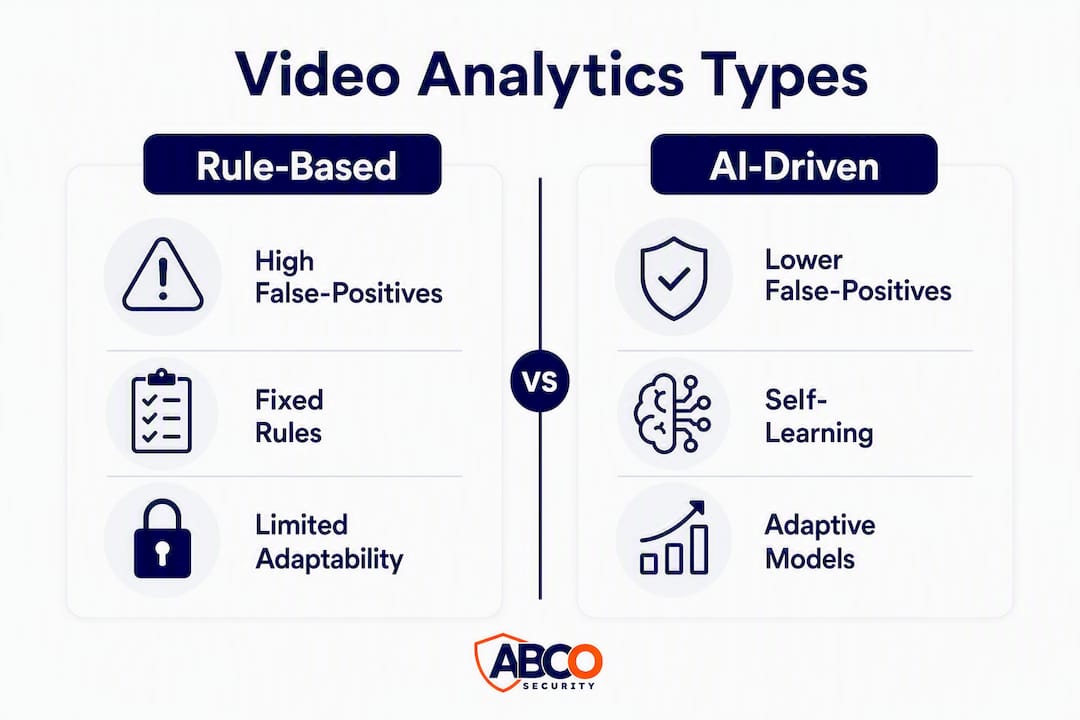
Self-learning AI models trained on local environment data produce materially lower false-positive rates than rigid rule sets, which is the primary reason most enterprise deployments are now moving away from purely rule-based engines.
A practical alert flow for an AI-driven system:
- Camera captures footage and sends the stream to an edge device or analytics server.
- The analytics engine runs inference, classifying objects and behaviours frame by frame.
- Metadata (object type, confidence score, timestamp, zone) is written to the VMS database.
- When a defined condition is met (a person in a restricted zone after hours, for example), an alert is pushed to the monitoring centre operator.
- The operator reviews the flagged clip, confirms or dismisses the event, and escalates if required.
How a video analytics system operates: architecture and integration
The architecture sits across four layers: the camera, the processing layer, the management layer, and the response layer. Where the processing happens determines latency, resilience, privacy exposure, and cost.
Edge processing runs inference directly on a smart camera or an attached edge device. Alerts fire in milliseconds, raw footage never leaves the site, and the system keeps working during a WAN outage. The trade-off is limited compute for complex models and a higher per-device hardware cost.
On-premise servers centralise processing within the facility. You get more compute headroom for demanding models (crowd analytics, LPR at speed) and full data sovereignty, but you carry the capital cost and maintenance burden of the server infrastructure.
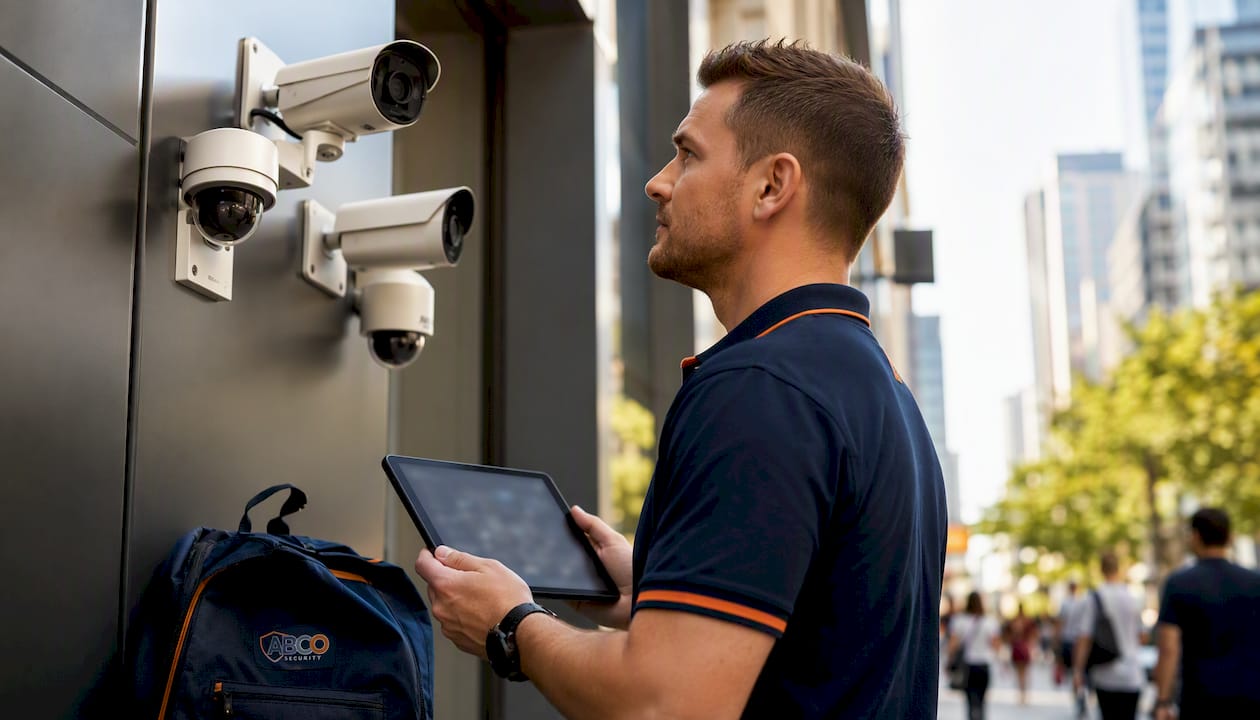
Cloud processing offloads inference to a hosted platform. This suits organisations that want to avoid on-premise hardware and need rapid deployment across many sites, but it introduces latency, bandwidth costs, and data-sovereignty questions that require careful vendor scrutiny under the Privacy Act.
Hybrid architectures combine edge pre-processing (filtering out irrelevant frames) with cloud or on-premise deep analysis of flagged events. This is increasingly the default for Australian enterprise deployments because it balances performance with compliance.
Integration touchpoints matter as much as architecture. The analytics engine needs to connect to your VMS via an API or SDK so that metadata and alerts appear in the same operator interface as live feeds. Access control and alarm systems should receive analytics events so that a zone-breach alert can automatically lock a door or escalate to a guard dispatch. Time synchronisation across all devices is non-negotiable for evidential integrity.
Pro Tip: Choose edge or hybrid processing for any site handling sensitive personal information. Keeping raw footage on-site and discarding it after metadata extraction limits your privacy exposure and reduces the blast radius of a data breach.
Common types of video analytics used in CCTV systems
Not every analytics type suits every site. Match the type to a documented security problem before you commit to a deployment.
- Facial recognition — Matches faces against a watchlist or database. This is the highest-risk analytics type under Australian law.
Legal callout — facial recognition in Australia. The OAIC has found that deploying facial recognition without adequate notification and governance can breach the Australian Privacy Principles. The Kmart investigation (2025) concluded that collecting sensitive biometric information without clear notification and policy constitutes an APP breach. Before deploying facial recognition anywhere, you need a completed PIA, explicit signage, a documented purpose, and a legal basis for processing biometric data.
How video analytics improves security operations
The operational case rests on three measurable shifts: faster detection, reduced review burden, and stronger evidence capture.
Manual CCTV monitoring is inherently reactive. An operator watching 16 screens will miss events, and reviewing hours of footage after an incident is slow and error-prone. AI video security changes both dynamics. Alerts fire on defined events rather than waiting for an operator to notice, and post-incident review narrows to tagged clips rather than raw footage.
Detection latency drops from the minutes it takes a fatigued operator to notice an anomaly to the seconds it takes an analytics engine to classify and alert. For high-risk sites, that gap is the difference between intercepting an intruder and reviewing their exit footage.

Footage review time is where the efficiency gains are most tangible. Instead of scrubbing through hours of recording, investigators retrieve clips by event type, zone, time, and object attribute. A search that previously took two hours can take minutes.
Evidence capture also improves. Metadata timestamps and zone logs create an auditable record that is more defensible in court than an operator’s recollection. LPR logs, occupancy records, and behaviour event trails all contribute to a richer incident picture.
Analytics complements operators, not replaces them. The system surfaces events; a trained operator confirms, contextualises, and escalates. Removing the human from that loop entirely introduces risk, particularly for ambiguous events where context matters.
Privacy, law and governance in Australia before you deploy
Australian organisations deploying video analytics that processes personal information must comply with the Privacy Act 1988 and the Australian Privacy Principles. Biometric data, including facial geometry, is sensitive information under the Act and attracts stricter obligations. The OAIC recommends conducting a Privacy Impact Assessment before deploying facial recognition or any high-risk automated processing.
PIA checklist for video analytics deployments:
- Purpose specification — Document the specific security problem the analytics is designed to address. Vague purposes (“general security”) will not satisfy the OAIC’s necessity and proportionality test.
- Retention settings. Set automated deletion schedules. APP 11 requires organisations to take reasonable steps to destroy or de-identify personal information no longer needed.
Pro Tip: Configure edge devices to run inference and discard raw footage automatically after metadata extraction. This privacy-by-design control limits the personal information footprint on your network and reduces the scope of any potential breach.
Performance, accuracy and false-alarm reduction: what to measure
A deployment that generates constant false alarms will be ignored within weeks. Measuring performance rigorously before scale-up is the single most important step in a successful rollout.
| KPI | Description | Target |
|---|---|---|
| Detection rate (recall) | Proportion of real events correctly detected | High in complex or changing scenes |
| False-positive rate | Alerts triggered by non-events as a proportion of total alerts | <10% in operational conditions |
| Confidence threshold | Minimum model confidence score to trigger an alert | Manual threshold adjustment per camera |
| Alert latency | Time from event onset to alert reaching the operator | <5 seconds for intrusion/zone breach |
| Edge CPU utilisation | Processing load on edge device during peak activity | Materially lower after local training |
Testing checklist before sign-off:
- Run the model against labelled test footage from the target site before going live.
- Conduct a live pilot on a subset of cameras for several weeks to capture environmental variation.
- Test across lighting conditions: dawn, dusk, artificial light, and direct sun if applicable.
- Introduce seasonal variation testing if the site has significant vegetation or weather changes.
- Define acceptance criteria in writing before the pilot starts, not after reviewing results.
Pro Tip: Local training or fine-tuning on site-specific footage is the most reliable way to reduce false alarms. A model trained on generic datasets will misclassify environmental features specific to your site, such as shadows from a particular structure or regular vehicle movements. Even a modest labelled dataset from your own cameras produces a measurable improvement.
Deployment considerations: hardware, network, storage and integration
The most common procurement mistake is treating video analytics as a software-only decision. Infrastructure choices determine whether the system performs as specified.
Processing location trade-offs:
- Edge: lowest latency, highest resilience, best privacy posture, highest per-device cost, limited model complexity.
- On-premise: full data sovereignty, good compute headroom, capital-intensive, requires server maintenance.
- Cloud: fast deployment, no on-premise hardware, introduces latency and data-sovereignty obligations, ongoing OPEX.
- Hybrid: best balance for most enterprise sites; edge handles pre-filtering, on-premise or cloud handles complex inference.
Integration checklist:
- Confirm camera resolution, frame rate, and codec compatibility with the analytics engine before purchase.
- Verify VMS API support for the analytics platform; proprietary integrations create lock-in.
- Synchronise NTP time across all cameras, edge devices, and servers to maintain evidential integrity.
- Calculate storage growth from metadata and flagged clip retention; analytics increases storage demand compared with raw CCTV alone.
- Implement role-based access control (RBAC) and audit logging from day one.
- Test alarm and access control integration in a staging environment before live deployment.
Hardware-agnostic analytics platforms that overlay on existing CCTV infrastructure deliver faster return on investment than rip-and-replace strategies. Validate false-positive reduction during the pilot before committing to full-site rollout. For guidance on commercial video security systems that support analytics integration, Abcosecurity covers the full stack from camera selection through to monitoring centre connection.
Typical implementation timeline and main cost drivers
A realistic phased timeline prevents scope creep and gives stakeholders clear decision points.
- Discovery phase involves site survey, risk assessment, camera audit, VMS compatibility check, PIA initiation, and requirements documentation.
- Pilot design includes selecting a pilot zone with multiple cameras, defining acceptance criteria, procurement, and configuration.
- A live pilot runs analytics on live feeds, collects labelled event data, tunes thresholds, and measures KPIs against acceptance criteria.
- Evaluation phase reviews KPIs, false-positive rates, operator feedback, and PIA findings to make go/no-go decisions.
- Phased rollout expands camera coverage, integrates with monitoring centre workflows, and trains operators.
- Ongoing optimisation includes retraining models on new data, reviewing retention policies, auditing access logs, and updating the PIA as scope changes.
Primary cost drivers to budget for:
- Number of cameras in scope and whether edge devices are required per camera.
- Edge vs cloud choice: edge has higher upfront hardware cost; cloud has ongoing per-camera licence fees.
- Labelling and local model training, which requires time from security staff or a specialist.
- VMS integration effort, particularly for legacy systems without modern APIs.
- Monitoring centre integration and operator retraining.
- Ongoing support, SLA coverage, and model maintenance.
Pro Tip: Size your pilot to at least 10 cameras across two distinct environments (indoor and outdoor, or two different risk zones). A single-camera pilot produces insufficient data to validate model performance or justify scale-up to a board or procurement committee.
Practical use cases in Australia by sector
Retail
People counting and occupancy analytics give retail operators real-time floor traffic data for staffing decisions. Loitering detection in fitting rooms and high-value product zones supports loss prevention without requiring a guard on every aisle. Post-incident review using object and behaviour metadata cuts investigation time significantly. For video analytics for retail, the combination of people counting and loitering detection typically delivers the fastest return on investment.
Construction
Intrusion detection on construction sites after hours is one of the highest-value use cases in Australia, where plant theft and materials loss are persistent problems. Zone-breach alerts for exclusion zones around heavy machinery protect both assets and worker safety compliance. LPR at site gates logs contractor and vehicle access automatically, replacing manual sign-in sheets.
Transport
Public safety AI platforms built for transport hubs combine crowd density monitoring, behaviour detection, and LPR into a centralised operational picture. Crowd analytics at stations and terminals flags dangerous density levels before they become incidents. LPR integrates with access control for bus depots and rail yards.
Healthcare
Restricted-area alerts prevent unauthorised access to medication storage, server rooms, and clinical areas. Patient safety applications include fall detection and wandering alerts in aged care and dementia wards. Occupancy monitoring supports infection control protocols by flagging overcrowding in waiting areas.
Critical infrastructure
Zone-breach and perimeter intrusion detection are the primary applications for utilities, data centres, and government facilities. Object-left detection at entry points adds a layer of threat detection. For government building security, analytics integrated with access control and alarm monitoring creates a layered response capability.
Procurement checklist: how to evaluate video analytics vendors responsibly
Vendor selection is where most deployments succeed or fail. A technically capable platform with poor governance support or a closed architecture will create problems that outlast the contract.
Evaluation checklist:
- Data ownership. Confirm in writing that all footage, metadata, and trained model weights remain the property of your organisation.
- Model explainability. The vendor must be able to describe, in plain language, what triggers an alert and what data the model uses. Unexplainable black-box outputs create compliance and liability exposure.
- RBAC and audit trails. Role-based access control and immutable audit logs are non-negotiable for evidential integrity and APP compliance.
- SLA on model performance. Require a contractual SLA covering detection rate and false-positive rate, not just system uptime.
- Incident response and patching. Confirm the vendor’s process for security vulnerabilities in the analytics software and the timeline for patches.
- Local training support. Verify that the platform supports fine-tuning on your own data and that you retain the resulting model.
- PIA support documentation. Ask for a data flow diagram and a data processing agreement before signing.
RFP question bank:
- Where is raw footage and metadata processed and stored, and under what jurisdiction?
- What encryption standards apply to data in transit and at rest?
- How does the platform handle model drift over time, and who is responsible for retraining?
- What is the process for a false-match review in facial recognition deployments?
- Can the platform integrate with existing VMS and alarm monitoring via open API?
- What certifications does the platform hold (ISO 27001, SOC 2, or equivalent)?
- How are access logs retained, and for how long?
- What is the SLA for alert delivery latency?
- How does the vendor support Privacy Act compliance, including data subject access requests?
- What is the exit process for data and model portability at contract end?
Risk red flags: closed systems with no API documentation; inability to provide local testing or a pilot environment; unclear or absent data retention and deletion policies; vendors who cannot name the jurisdiction where your data is processed.
How Abcosecurity implements video analytics for Australian clients
A mid-sized logistics operator in New South Wales faced persistent after-hours intrusion across three facilities, with manual CCTV review consuming significant investigator time and producing limited actionable evidence. Abcosecurity conducted a site risk assessment, identified the highest-risk perimeter zones, and designed a pilot covering 15 cameras across two facilities using edge-based intrusion and zone-breach analytics. The pilot ran for eight weeks, during which alert thresholds were tuned against labelled site data. By the end of the pilot, after-hours intrusion alerts were reaching the monitoring centre within seconds of zone breach, and post-incident review time dropped substantially. The third facility was added to the rollout following evaluation.
Abcosecurity’s capabilities for video analytics deployments include:
- PIA and governance support — Assistance preparing Privacy Impact Assessments and documenting data flows for OAIC compliance.
For construction site security specifically, Abcosecurity combines analytics-driven perimeter detection with mobile patrols and 24/7 monitoring, creating a layered response that addresses both the detection and the physical response gap.
Key takeaways
AI-driven video analytics security delivers measurable operational gains for Australian organisations, but only when deployed against specific documented risks, with a completed PIA, and on infrastructure that supports local model training and privacy-by-design controls.
| Point | Details |
|---|---|
| Complete a PIA first | OAIC guidance requires a Privacy Impact Assessment before deploying facial recognition or any high-risk analytics. |
| Prioritise local model training | Self-learning models tuned on site-specific data produce materially lower false-positive rates than generic rule sets. |
| Use edge or hybrid architecture | Edge processing limits personal information exposure and maintains performance during network outages. |
| Validate performance before scale-up | Define detection rate and false-positive rate acceptance criteria before the pilot starts, not after reviewing results. |
| Abcosecurity for end-to-end delivery | Abcosecurity provides risk assessment, pilot design, PIA support, VMS integration, and 24/7 monitoring for Australian sites. |
The gap between what video analytics promises and what actually gets deployed
Most organisations that struggle with video analytics deployments share one pattern: they bought a capability before they defined a problem. A vendor demonstrates impressive object detection in a controlled environment, the procurement team is convinced, and six months later the system is generating hundreds of alerts a day that operators have learned to ignore.
The technology is genuinely capable. The failure mode is almost always governance and scoping, not the analytics engine itself. A system deployed to “improve security” with no specific threat model will optimise for nothing in particular and deliver noise. A system deployed to detect after-hours intrusion in three defined zones, with acceptance criteria written before the pilot starts and operators trained on the alert workflow, will deliver measurable results.
The privacy dimension is equally misunderstood. Many security managers treat the PIA as a compliance checkbox rather than a design tool. Done properly, a PIA forces you to articulate why each analytics type is necessary, what data it collects, and how long you need it. That discipline produces better-scoped deployments and fewer regulatory problems. The Kmart determination is a useful reminder that the OAIC will investigate, and that “we didn’t think it was a problem” is not a defence.
Workforce impact is the third underestimated factor. Operators who feel that analytics is monitoring their performance, rather than supporting their work, will find ways to dismiss alerts. Involving operators in threshold tuning and alert workflow design from the pilot stage produces better acceptance and, ultimately, better detection outcomes.
Abcosecurity’s video analytics and monitoring services
Abcosecurity has delivered integrated security solutions across construction, healthcare, retail, corporate, and government sectors for over 15 years, holding ISO 9001 and ISO 30000 certifications. For organisations ready to move from passive CCTV to active intelligence, Abcosecurity offers pilot packages that cover site assessment, analytics configuration, PIA documentation support, and connection to 24/7 camera monitoring services from day one.
The service model is built around documented outcomes: defined acceptance criteria before the pilot starts, KPI reporting during the evaluation phase, and a clear go/no-go framework before full-site rollout. That means you are not committing to a full deployment until the pilot data justifies it.
To request a pilot scoping session or discuss your site’s analytics requirements, contact Abcosecurity directly. The team will conduct an initial risk assessment, identify the highest-value analytics use cases for your environment, and outline a pilot design with realistic timelines and cost estimates.
Useful sources and further reading
These resources are directly relevant to Australian deployments and PIA preparation:
- Facial recognition technology: a guide to assessing the privacy risks (OAIC) — the primary reference for PIA methodology and necessity/proportionality assessment for biometric analytics.
- Guide to securing personal information (OAIC) — covers APP 11 obligations for storage, access control, and destruction of personal information collected through surveillance systems.
- Guidance on privacy and the use of commercially available AI products (OAIC) — sets out due diligence expectations for organisations adopting AI products that process personal information, including video analytics platforms.
- Security cameras (OAIC) — plain-language summary of Privacy Act obligations for organisations using CCTV and surveillance devices.
- Privacy Act 1988 (legislation.gov.au) — the primary legislative text covering APP obligations, including APP 11 on security of personal information.
- Commissioner initiated investigation into Kmart Australia Limited (AICmr 155, 2025) — the most instructive recent determination on facial recognition governance failures and APP breach consequences.
- TS 00050:1.0 Video Surveillance System Architecture (Transport for NSW) — the TfNSW technical standard for video surveillance system architecture, useful for transport sector deployments and as a reference architecture for enterprise VMS integration requirements.
When preparing a PIA or procurement brief, use the OAIC facial recognition guide as the primary framework, cross-reference APP 11 obligations from the Privacy Act text, and review the Kmart determination for concrete examples of what constitutes inadequate governance. The TfNSW standard is worth reviewing even for non-transport sites as a benchmark for VMS interoperability and analytics integration requirements.
FAQ
What is video analytics security?
Video analytics security is the automated analysis of CCTV footage to extract metadata and trigger alerts when defined events occur, turning passive cameras into an active detection layer. AI-driven systems use machine learning to classify objects and behaviours in real time, reducing manual review and improving detection speed.
Is facial recognition legal in Australia?
Facial recognition is not prohibited outright, but it is high-risk under the Privacy Act 1988. The OAIC requires a Privacy Impact Assessment before deployment, and the 2025 Kmart determination confirmed that collecting biometric data without adequate notification and governance constitutes a breach of the Australian Privacy Principles.
What is the difference between edge and cloud video analytics?
Edge analytics processes footage on a device at the camera, delivering low latency, high resilience, and better privacy posture because raw footage stays on-site. Cloud analytics offloads processing to a hosted platform, reducing hardware costs but introducing latency, bandwidth requirements, and data-sovereignty obligations under Australian law.
How do you reduce false alarms in a video analytics system?
The most effective method is local model training: fine-tuning the analytics engine on labelled footage from the specific site reduces misclassification of environmental features unique to that location. Setting confidence thresholds carefully during a live pilot, and testing across varied lighting and seasonal conditions, also reduces false-positive rates significantly.
How long does a video analytics pilot typically take?
A well-structured pilot runs for several weeks, including configuration, live testing, threshold tuning, and evaluation. Discovery and PIA preparation add additional weeks before the pilot starts, making the full pre-rollout phase several months for most Australian sites.
Recommended
about
avada factory
Sempery ultricies nibh at dolor cras urna eleifend nec. Atiam efficitur tempor.