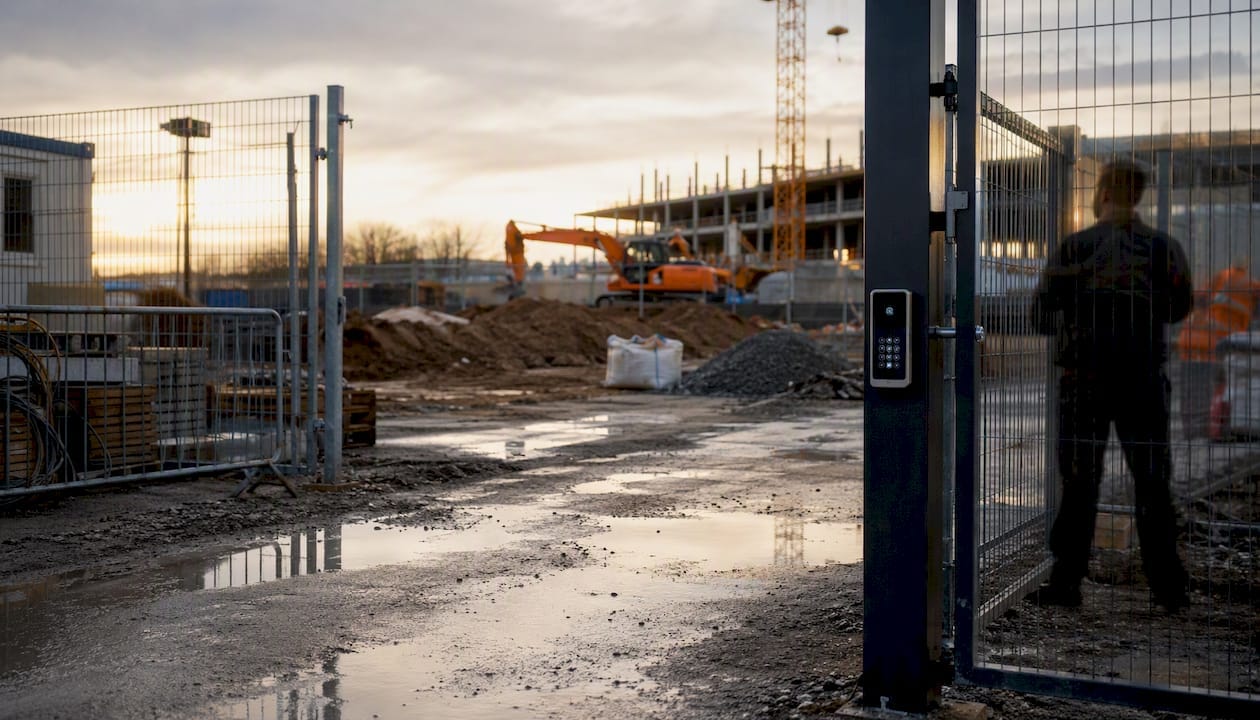
Use a perimeter-first strategy that combines appropriate fencing, controlled vehicle gates and electronic entry for personnel. That is the single most defensible approach under Australian WHS law, and it is the starting point every site manager should work from before anything else gets installed or contracted.
Model WHS Regulation 298 places the duty squarely on the person with management or control of a construction workplace to secure it from unauthorised access, so far as is reasonably practicable. That duty does not disappear when the site is unattended overnight, and it does not transfer to a subcontractor unless that transfer is documented and agreed.
Your three immediate actions:
- Complete a site-specific risk assessment that maps hazards accessible to an unauthorised person (open excavations, live services, scaffolding, stored plant and materials).
- Establish a secure perimeter with compliant fencing or hoarding before any other work begins on site.
- Draft a temporary credential plan covering all workers, subcontractors and visitors, linked to your induction process.
The SafeWork NSW site security checklist and the WorkSafe WA information sheet on Regulation 298 are the two most practical starting references for Australian site managers. Read both before you finalise your access-control plan.
Pro Tip: Regulation 298 is deliberately non-prescriptive. A documented, site-specific decision process is your primary evidence of compliance. If a regulator asks why you chose a particular control, your written reasoning matters as much as the control itself.
Table of Contents
- Why does access control matter on a construction site?
- What are the core components of a construction site access-control system?
- What fencing, signage and gates should you install?
- Which electronic access-control systems work best on construction sites?
- What are your legal duties under Australian WHS law?
- How do you implement construction site access control step by step?
- How do you keep the system working day to day?
- How does Abcosecurity approach construction access-control projects?
- What should site managers do next?
- Key takeaways
- What site managers often get wrong about access control
- Abcosecurity’s construction security services
- Useful sources and further reading
- FAQ
Why does access control matter on a construction site?
The answer is not just about keeping trespassers out. Unauthorised access to a live construction site creates immediate life-safety risks: open excavations, unguarded scaffolding, exposed electrical services, stored hazardous chemicals and unsecured plant are all capable of killing someone who has no idea they are there. Children are the most common victims of after-hours trespass incidents, and the consequences for a principal contractor can include prosecution, civil liability and project shutdown.
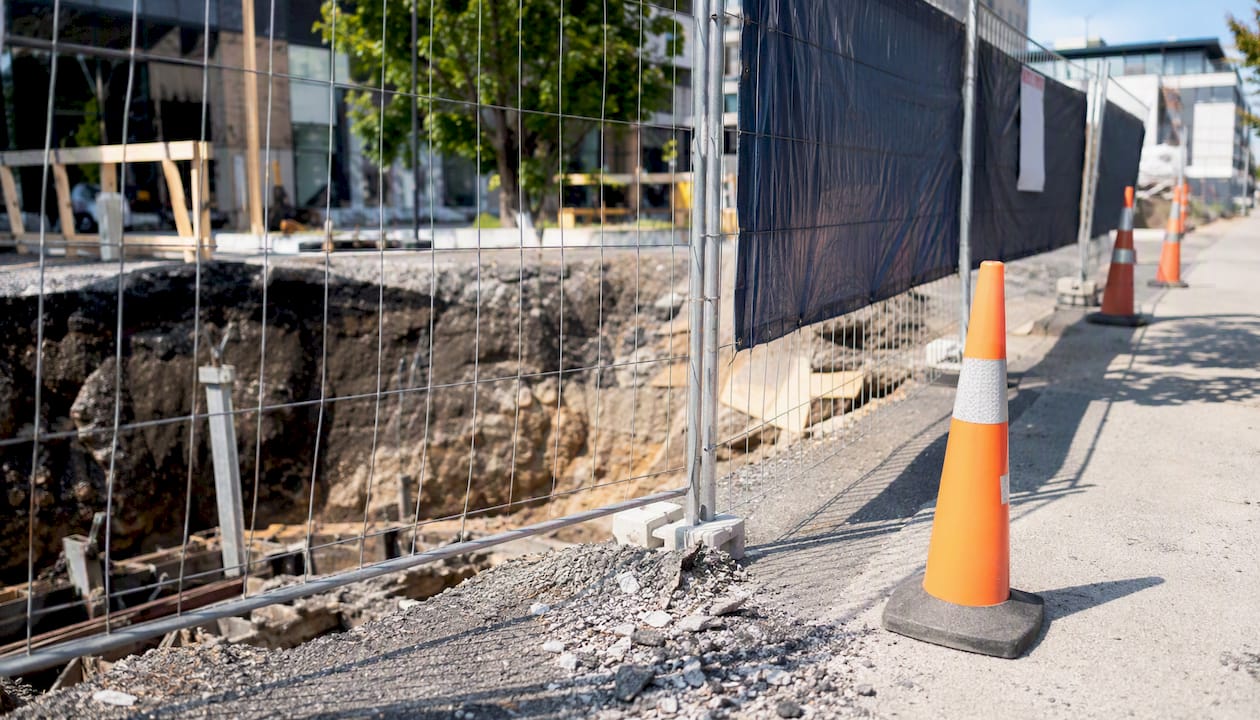
Beyond safety, the legal duty under Model WHS Regulations Chapter 6 is not optional. Principal contractors on sufficiently large projects carry specific responsibilities, including erecting fencing where required and maintaining site security throughout the project lifecycle.
Operational benefits are equally real:
- Theft and vandalism of materials, plant and tools is a persistent cost on Australian construction sites. Controlled access points reduce opportunistic theft by limiting who can enter and when.
- Labour tracking becomes far more accurate when entry and exit are logged electronically. That data feeds directly into time-and-attendance systems and simplifies payroll reconciliation.
- Induction compliance improves when access is physically linked to credential status. Workers who have not completed their site induction simply cannot enter.
- Handover documentation is cleaner when you have an auditable access log showing who was on site, when, and for how long.
When a site cannot be fully secured by perimeter fencing alone, the duty holder must isolate specific hazards, such as covering open excavations and removing scaffold access ladders, and document how each residual risk is controlled. That documentation is your legal backstop.
What are the core components of a construction site access-control system?
No single product or measure is sufficient on its own. Effective construction site access control is a layered system, and the components you choose should match the site’s risk profile, duration and surrounding environment.
Perimeter controls
Temporary fencing, permanent hoarding, gates and screening form the first layer. Their job is to deter casual entry and signal clearly that the site is controlled. Hoarding is generally preferred over mesh fencing in urban areas because it also limits visibility of materials and plant, reducing the temptation for theft.
Personnel entry controls
| Control type | Best for | Limitation |
|---|---|---|
| Manned gate / static guard | High-risk or high-volume sites | Ongoing labour cost |
| Card / RFID reader | Medium-to-large sites with regular workforce | Cards can be shared or lost |
| Mobile credential (app-based) | Sites with smartphone-equipped workforce | Requires reliable mobile coverage |
| Biometric (fingerprint / facial) | High-security or high-value sites | Privacy obligations under Australian law |
| Turnstile (full-height) | Urban sites, multi-storey projects | Installation cost, space requirement |
| Turnstile (half-height) | Lower-risk sites, temporary deployments | Easier to defeat than full-height |
Vehicle entry controls
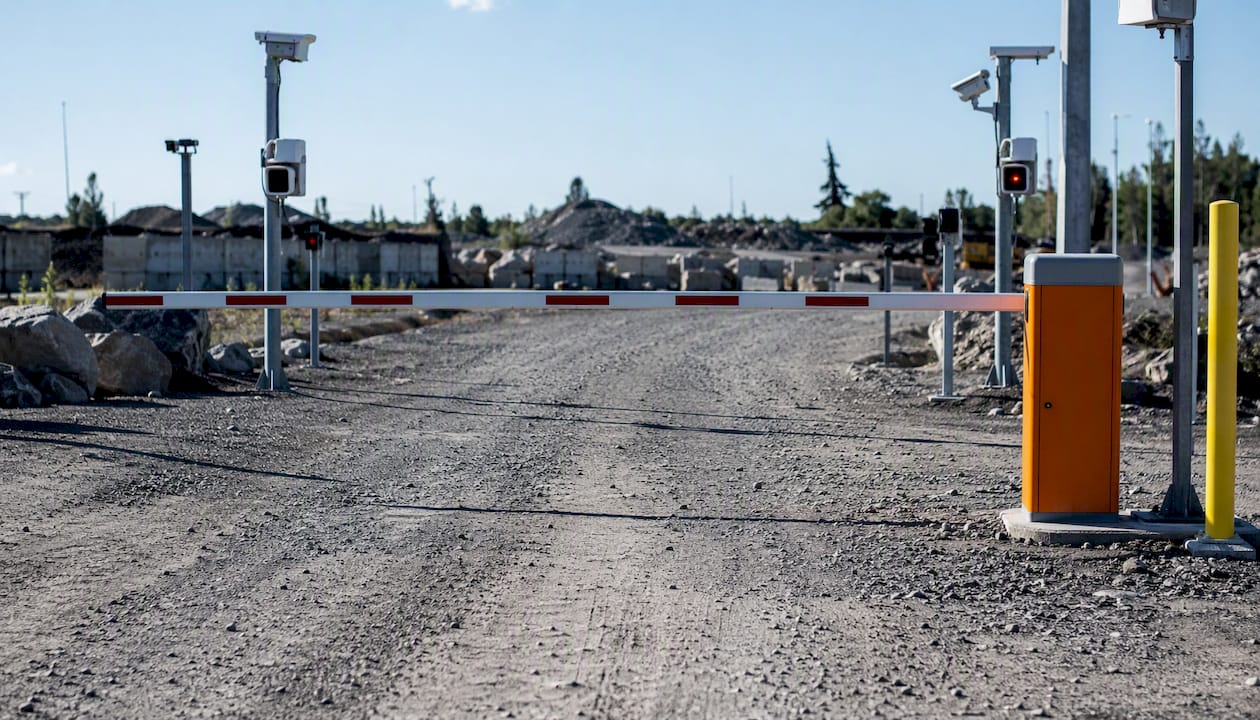
Boom gates, loop detectors, radar sensors and safety beams manage vehicle flow. On sites with heavy plant movements, a staffed gate combined with a boom gate gives you both physical control and a human check on load documentation and driver credentials.
Surveillance and detection
CCTV coverage of all entry and exit points is standard practice. Motion sensors and photoelectric (PE) beams add after-hours detection capability. These systems are most effective when integrated with a monitored alarm, so that a breach triggers a response rather than just a recording.
Administrative systems
Digital induction platforms, visitor management software and time-and-attendance integration are what turn physical controls into auditable records. Platforms like HammerTech and SafetyCulture are widely used on Australian construction sites to manage inductions, SWMS sign-offs and contractor credentials. Linking access credentials to induction status means a worker whose induction has lapsed automatically loses entry rights.
Pro Tip: Do not treat administrative systems as an add-on. The access log generated by your entry system is a compliance record. Make sure it is backed up, timestamped and retained for the duration of the project plus any applicable limitation period.
What fencing, signage and gates should you install?
Fencing standards and acceptable types
WorkSafe Tasmania’s security fencing guidance sets out the key physical requirements: fencing must be of adequate height to deter entry, difficult to climb, prevent access underneath, stable under wind loads, and free of weak points at gates and joints. These are not aspirational standards. They are the minimum expected of a duty holder.
Acceptable fencing types generally include:
- Solid hoarding panels (timber or steel) at a minimum of 1.8 metres
- Chain-link or weld-mesh fencing with anti-climb topping where children or public are nearby
- Temporary panel fencing with weighted or concrete-filled feet and no gaps at joins
Fencing that is likely to be insufficient:
- Barrier mesh (plastic or fabric) on star pickets alone, particularly near schools, parks or pedestrian routes
- Reinforcing mesh sheets without capping or anti-climb features
- Any fencing with gaps at the base exceeding 100 mm or joints that can be pushed open
Star pickets used as fence posts must be capped to prevent impalement injury. This is a basic site safety requirement that is frequently missed on short-duration works.
Signage requirements
Every construction site must display, at each entry point:
- The principal contractor’s name and ABN
- A 24-hour emergency contact number
- The location of the site office
- Visible warnings that the site is a construction zone and unauthorised entry is prohibited
Signage must be legible from the public boundary, weatherproof and replaced promptly if damaged or removed.
Inspection schedule
| Inspection type | Frequency | What to check |
|---|---|---|
| Visual perimeter walk | Daily (before leaving site) | Fencing intact, no gaps, gates locked, signage legible |
| Post-weather check | After storms or high winds | Panels displaced, posts leaning, gates damaged |
| Post-plant-movement check | After heavy plant enters or exits | Ground disturbance near fence line, gate hinges intact |
| Full perimeter audit | Weekly | All of the above plus anti-climb features, lighting, lock condition |
| Formal documented inspection | Monthly | Written record with photos, signed by site manager |
Log every inspection. A site manager who can produce dated, signed inspection records is in a far stronger position if an incident occurs than one who relied on informal checks.
Which electronic access-control systems work best on construction sites?
Turnstiles
Full-height turnstiles provide the strongest physical barrier for pedestrian entry and are the right choice for urban high-rise projects, multi-storey residential builds and any site where tailgating is a real risk. Half-height turnstiles are faster to deploy and cheaper, but they are easier to defeat and better suited to lower-risk or shorter-duration sites.
Both types should be specified with weatherproof enclosures rated for outdoor use. On dusty or unsealed sites, sealed bearing assemblies and stainless steel construction are worth the additional cost.
Card, RFID and mobile credentials
RFID cards and fobs remain the most common credential type on Australian construction sites. They are fast, inexpensive per unit and integrate with most induction and time-and-attendance platforms. The main operational risk is credential sharing. Pairing RFID with a PIN or a photo-verification step at the reader reduces this significantly.
Mobile credentials (delivered via smartphone app) are gaining ground on larger projects. They eliminate the cost of card production and replacement, and they can be revoked instantly when a worker leaves the project. The dependency on mobile coverage is a genuine constraint on remote or underground sites.
Biometrics
Fingerprint and facial recognition systems offer the strongest identity assurance and eliminate credential sharing entirely. On high-value or high-security sites, the investment is justified. The legal consideration in Australia is the Privacy Act 1988 and the Australian Privacy Principles (APPs), which classify biometric templates as sensitive information. Before deploying biometric access control, you need a privacy impact assessment, a clear data retention and deletion policy, and worker consent. Avoid biometrics on short-duration projects where the administrative overhead outweighs the benefit.
Vehicle control hardware
Rotech Automation and other Australian hardware suppliers recommend sealed electronics for boom gates and sensor combinations using both PE beams and radar for dusty, high-traffic construction environments. PE beams alone can be defeated by dust or debris; radar sensors are more reliable in those conditions but require careful positioning to avoid false triggers from nearby plant movement.
Loop detectors embedded in the road surface are the standard for vehicle detection at boom gates. On unsealed sites, surface-mount radar sensors are a practical alternative where cutting into the ground is not feasible.
Integration
The real value of electronic access control comes from integration. Link your access system to:
- Your CCTV and alarm monitoring platform (so an access breach triggers a camera review and alert)
- Your induction platform (HammerTech, SafetyCulture or equivalent) so credential status reflects induction currency
- Your time-and-attendance system for accurate labour records
- Your construction site security monitoring provider for 24/7 response capability
Pro Tip: Specify power-fail behaviour before you purchase any electronic access-control hardware. On a construction site, power interruptions are common. Decide in advance whether gates should fail-open (for evacuation safety) or fail-secure (for high-value areas), and document that decision in your site access-control plan.
What are your legal duties under Australian WHS law?
The duty holder and Regulation 298
Regulation 298 places the primary duty on the person with management or control of the construction workplace. In practice, that is the principal contractor on most projects. The duty is to secure the workplace from unauthorised access, so far as is reasonably practicable. “Reasonably practicable” means you must weigh the likelihood and severity of harm against the cost and availability of controls. A documented risk assessment is your evidence that you did that weighing properly.
On projects valued above $250,000, a principal contractor must be appointed and carries specific fencing and site-security duties. Below that threshold, the PCBU (person conducting a business or undertaking) retains the duty.
What belongs in your site access-control plan
Your site access-control plan should record:
- The hazards accessible to an unauthorised person and the controls selected for each
- The fencing or hoarding type chosen and why it is adequate for the site’s risk profile
- Credential types in use, who can issue them and how they are revoked
- Zones within the site and the access level required for each
- Emergency access procedures (see the implementation section below)
- Inspection and maintenance responsibilities and cadence
SWMS and access control
Safe Work Method Statements (SWMS) for high-risk construction work under Chapter 6 of the Model WHS Regulations must identify hazards and describe controls. Where access to a high-risk work area is a control measure (for example, restricting entry to the zone around a live excavation), that restriction should be referenced in the relevant SWMS.
Consulting subcontractors
Principal contractors must consult with subcontractors about securing areas under their control. If a subcontractor is responsible for a specific zone, the access-control arrangements for that zone should be agreed in writing, including who holds keys or credentials and how the area is secured when unattended.
Proximity factors that increase your obligation: sites adjacent to schools, parks, residential areas or pedestrian routes require more robust controls than isolated industrial sites. Document your assessment of the surrounding environment as part of your risk assessment.
How do you implement construction site access control step by step?
Phase 1: Site survey and risk assessment (Days 1–3)
The site manager and principal contractor conduct a perimeter walk, map all hazards accessible to an unauthorised person, and identify the surrounding environment (schools, public paths, traffic). A site constraints assessment at this stage can surface planning and environmental factors that affect your perimeter design. Document findings and proposed controls.
Phase 2: Design and zoning (Days 3–7)
Define site zones (public boundary, general site, high-risk work areas, plant storage) and specify the access level required for each. Select fencing or hoarding type, gate locations, credential system and surveillance coverage. Engage a licensed security integrator for electronic systems. Prepare a procurement checklist covering:
- Fencing type, height and anti-climb specification
- Gate hardware (boom gate, turnstile or manned gate) and power supply
- Credential system (RFID, mobile, biometric) and integration requirements
- CCTV camera positions and recording retention period
- Alarm monitoring provider and response time SLA
Phase 3: Temporary controls and procurement (Week 1–2)
Install temporary fencing and signage before any other work begins. Issue temporary credentials to workers already on site. Place orders for permanent or semi-permanent electronic systems. For guidance on selecting access control systems, review procurement criteria including warranties, integration capabilities and power-fail behaviour.
Phase 4: Installation and testing (Weeks 2–6, depending on site size)
| Site size | Estimated installation time |
|---|---|
| Small (under a few workers) | 1–2 weeks |
| Medium (moderate number of workers) | 2–4 weeks |
| Large (100+ workers) | 4 weeks or more |
Testing and acceptance criteria must include: emergency exit behaviour under power failure, integration with induction platform, alarm trigger on forced entry, and CCTV recording confirmation.
Phase 5: Commissioning and handover (Final week of installation)
The security integrator, site manager and principal contractor sign off on the system. Train all gate operators and site supervisors. Confirm monitoring is active. Issue final credentials linked to induction status.
Pro Tip: Build a construction site security plan before you engage any vendor. A written plan gives you a scope document for procurement, a compliance record for regulators, and a handover reference for new site managers.
How do you keep the system working day to day?
Daily and weekly checks
Before leaving site each day, the site manager or nominated delegate should confirm:
- All gates are locked and no fencing panels are displaced
- Signage is fixed, legible and undamaged
- Plant is secured and keys removed or stored
- Utilities are isolated where required
- Scaffold access ladders are removed or secured
The SafeWork NSW site security checklist provides a practical template for these daily checks. Weekly checks add a full perimeter walk with written records.
Monthly and quarterly maintenance
- Test all electronic readers, boom gates and turnstile mechanisms for correct operation.
- Check CCTV camera alignment, lens cleanliness and recording continuity.
- Inspect sensor calibration (PE beams, radar) and clear any obstructions.
- Review access logs for anomalies (entries outside working hours, duplicate credential use, failed attempts).
- Confirm all active credentials belong to currently inducted workers.
- Conduct a full perimeter audit with photos and a signed inspection report.
Quarterly, schedule a vendor service visit for electronic systems. Include in your service SLA: response time for faults, parts availability, firmware update schedule and a written service report after each visit.
Incident handling
When an unauthorised entry, theft or equipment fault occurs:
- Secure the area and preserve evidence (do not reset access logs before extracting the relevant records).
- Review CCTV footage and access logs to establish timeline and identity.
- Log the incident with date, time, location, description, persons involved and actions taken.
- Notify the principal contractor and, where required, the relevant WHS regulator.
- Review whether the control that failed needs to be upgraded or replaced.
Records to maintain
Keep the following for the duration of the project plus any applicable limitation period:
- Signed inspection records (daily, weekly, monthly)
- Maintenance logs and vendor service reports
- Access logs (timestamped entry and exit records)
- Contractor induction records and credential issuance/revocation history
- Incident logs and corrective action records
How does Abcosecurity approach construction access-control projects?
Abcosecurity’s construction security work typically begins with a site audit that maps the perimeter, identifies hazard zones and assesses the surrounding environment before any hardware is specified. On a mid-size urban residential project, for example, the typical scope includes solid hoarding with a staffed entry gate during peak hours, RFID readers for after-hours access, full-perimeter CCTV with 24/7 monitored alarm response, and integration with the site’s digital induction platform. The outcome is a layered system where physical deterrence, electronic logging and human response work together rather than in isolation.
Abcosecurity holds ISO 9001 and ISO 30000 certifications, operates with licensed security personnel across Australia, and provides 24/7 monitoring through its own operations centre. For construction clients, that means a single point of accountability for both the installed system and the ongoing response capability.
Handover and first 30-day checklist:
- All credentials issued and linked to induction records
- Access logs confirmed as active and backed up
- CCTV recording verified and monitoring centre connected
- Emergency access procedure documented and tested
- Site manager and supervisors trained on system operation
- First scheduled inspection completed and logged
- Vendor service SLA signed and first service date confirmed
Pro Tip: The most common mistake Abcosecurity sees on new projects is treating access control as a one-time installation task. The system degrades without scheduled maintenance and credential hygiene. Build a 30-day review into your commissioning plan and assign a named owner for ongoing checks.
What should site managers do next?
Three-step immediate action plan
Within 24–72 hours:
- Complete your site-specific risk assessment and document the hazards accessible to an unauthorised person.
- Confirm compliant temporary fencing and signage are in place at all entry points.
- Identify your duty holder (principal contractor or PCBU) and confirm access-control responsibilities in writing.
Within 1–2 weeks:
- Finalise your site access-control plan, including zones, credential types and inspection cadence.
- Engage a licensed security integrator for electronic systems if your site risk or project value warrants it.
- Link your credential system to your induction platform so access and induction status are managed together.
Within 1–3 months:
- Commission all electronic systems, complete testing and sign off on acceptance criteria.
- Conduct your first monthly perimeter audit and retain the signed record.
- Schedule quarterly vendor maintenance and confirm your monitoring SLA is active.
When to engage Abcosecurity or a licensed integrator: any site with electronic access control, 24/7 monitoring requirements, biometric systems or a project value above $250,000 warrants professional installation and ongoing support. Temporary fencing and basic signage on a short-duration, low-risk site can be managed in-house, provided the duty holder documents the decision.
The most important single record to keep is your site-specific risk assessment and the access-control decisions it supports. That document is your primary evidence of compliance with Regulation 298.
Key takeaways
Effective construction site access control requires a documented, layered approach that combines compliant perimeter fencing, controlled entry points, induction-linked credentials and scheduled inspections to satisfy Regulation 298 and protect everyone on and around the site.
| Point | Details |
|---|---|
| Perimeter first | Install compliant fencing and signage before any other work begins; this is your primary legal obligation under Regulation 298. |
| Document every decision | A written risk assessment and access-control plan is your primary evidence of compliance if a regulator or insurer investigates. |
| Link credentials to inductions | Workers whose inductions have lapsed should automatically lose site access; platforms like HammerTech and SafetyCulture support this integration. |
| Inspect on a schedule | Daily pre-departure checks, weekly perimeter walks and monthly formal audits keep the system defensible and effective. |
| Abcosecurity for integrated delivery | Abcosecurity provides site audits, licensed guards, RFID and CCTV installation, and 24/7 monitored response for construction projects across Australia. |
What site managers often get wrong about access control
The conventional wisdom treats construction site access control as a compliance checkbox: put up a fence, hang a sign, tick the box. That framing is wrong, and it is the reason so many sites fail their first post-incident audit.
Regulation 298 is a performance-based duty, not a prescriptive standard. The regulator does not care whether you installed a full-height turnstile or a manned gate. They care whether you assessed the risk, chose a control proportionate to it, and documented your reasoning. A site with a $50,000 electronic access system but no written risk assessment is in a weaker legal position than a site with a well-maintained temporary fence and a signed inspection log.
The second thing managers consistently underestimate is credential hygiene. Access logs fill up with ghost credentials: workers who left the project three months ago, subcontractors whose inductions lapsed, visitors who were issued a day pass and never had it revoked. On a site with 80 active workers, it is not unusual to find 120 or more active credentials in the system. That is not a technology problem. It is a process problem, and it requires a named person with a weekly task to audit and revoke.
The third gap is emergency access. Most sites have a detailed plan for keeping people out. Very few have a tested plan for getting emergency services in quickly when the boom gate is locked and the site manager is not answering their phone. Write the emergency access procedure, laminate it, and fix it to the gate.
Abcosecurity’s construction security services
Abcosecurity delivers the full stack of construction site security, from the initial site audit through to ongoing 24/7 monitored response, with licensed personnel and ISO-certified processes. For site managers who need more than a fence and a padlock, that means one provider accountable for physical controls, electronic systems and the human response layer.

Services relevant to construction sites include: site security audits and risk assessments, integrated access control installation (RFID, biometrics, boom gates, turnstiles), CCTV installation and camera monitoring, licensed static guards and mobile patrols, and 24/7 alarm monitoring with documented response SLAs.
When you are speaking to any security integrator, ask for: written warranties on hardware and installation, a service SLA with defined response times for faults, confirmation of how the system behaves on power failure, evidence of integration with your induction platform, and a written privacy handling policy if biometrics are in scope.
For a full picture of how Abcosecurity structures integrated security solutions for construction clients, the service guide covers audit methodology, system design and ongoing management. To request a site audit or quote, contact Abcosecurity directly through the website.
Useful sources and further reading
The sources below are the primary references for Australian construction site security compliance. Each is listed with the topic it is most useful for.
| Source | Best for |
|---|---|
| WorkSafe WA — Regulation 298 information sheet | Understanding the legal duty and what “reasonably practicable” means in practice |
| WorkSafe Tasmania — Security fencing guidance | Fencing specifications, acceptable types and principal contractor responsibilities |
| SafeWork NSW — Site security checklist | Daily and ongoing inspection checklists for unattended sites |
| Model WHS Regulations — Chapter 6 | SWMS requirements, designer duties and principal contractor obligations |
| AustLII — Regulation 298 text | Primary statutory text for legal reference and compliance documentation |
| Rotech Automation — Construction access-control hardware | Hardware specifications for turnstiles, boom gates and sensors on Australian sites |
Abcosecurity internal resources:
- Focus on compliance – Construction site security: Unauthorised access: Information sheet – WorkSafe
- Security fencing: Making construction sites secure against unauthorised access – WorkSafe Tasmania
- Site security checklist | SafeWork NSW
- Work Health and Safety Regulations 2011 (consolidated) – Chapter 6 Construction work
- WORK HEALTH AND SAFETY REGULATIONS 2011 – REG 298 Security of workplace
- Building site access control & safety solutions – Rotech Automation
This article provides general information about construction site security and WHS compliance in Australia. It is not legal advice. Confirm current regulatory requirements with the relevant state or territory WHS regulator or a qualified legal professional before making compliance decisions.
FAQ
What does Regulation 298 require of a construction site manager?
Regulation 298 of the Model WHS Regulations requires the person with management or control of a construction workplace to secure it from unauthorised access, so far as is reasonably practicable. A documented risk assessment and written access-control plan are the primary evidence of compliance.
When must a principal contractor be appointed for site security purposes?
A principal contractor must be appointed on construction projects valued above $250,000, and that person carries specific duties including erecting fencing where required and maintaining site security throughout the project.
Can biometric access control be used on Australian construction sites?
Yes, but biometric templates are classified as sensitive information under the Privacy Act 1988. Before deploying fingerprint or facial recognition systems, you need a privacy impact assessment, a data retention and deletion policy, and documented worker consent.
How often should construction site fencing be inspected?
A visual check should occur daily before leaving site, a full perimeter walk weekly, and a formal documented inspection monthly. Additional checks are required after storms, high winds or heavy plant movements near the fence line.
What is the fastest way to improve site entry control on an existing project?
Audit your active credentials immediately and revoke any that belong to workers who have left the project or whose inductions have lapsed. Pair that with a daily pre-departure checklist covering gates, fencing and signage. These two steps cost nothing and close the most common compliance gaps within 24 hours.
Recommended
about
avada factory
Sempery ultricies nibh at dolor cras urna eleifend nec. Atiam efficitur tempor.