
Access control integrations connect your access control platform to other security and operational systems, creating a unified environment where a single credential event can trigger a camera recording, update an HR record, or lock down a floor. For Australian organisations, the operational case is straightforward: integrated systems cut incident response times, produce complete audit trails, and remove the manual provisioning work that creates security gaps. They move from optional to essential the moment your site has more than one system that needs to share identity or event data.
Immediate next steps for an Australian deployment:
- Inventory every system that touches identity or physical access (HR, VMS, BMS, alarms, visitor management).
- Map credential lifecycle: who provisions access, who deprovisioners it, and how quickly.
- Confirm data residency: where will integrated logs and biometric identifiers be stored, and does that meet your Privacy Act obligations?
- Identify your compliance gates (AS/NZS standards, sector-specific requirements, ISO alignment).
- Brief your IT security lead, facilities manager, and HR system owner before scoping begins.
- Contact a licensed integrator such as Abcosecurity early to validate your architecture before procurement locks you in.
Pro Tip: Run a one-page systems map before your first vendor meeting. It takes an hour and saves weeks of scope creep.
Key takeaways
Integrated access control systems deliver measurable security and operational outcomes only when the architecture, protocols, and compliance obligations are resolved before procurement begins.
| Point | Details |
|---|---|
| Start with video and HR | ASIS data shows many organisations integrate video first; it delivers the fastest measurable return. |
| Require open architecture | Around 92% of security professionals rate open architecture as important; it reduces vendor lock-in and long-term TCO. |
| Resolve data residency early | Biometric and access log data held offshore may create Privacy Act obligations; confirm residency before signing cloud contracts. |
| Test failover, not just function | Acceptance criteria must include a test that access control operates standalone if the integration link drops. |
| Abcosecurity for managed integration | Abcosecurity designs, installs, and monitors integrated access control systems nationally, with ISO credentials and 15+ years of deployment experience. |
Table of Contents
- Why integrate access control? Core benefits and business outcomes
- Which systems are commonly integrated with access control?
- What technical protocols and methods do access control integrations use?
- Project checklist for scoping and rolling out access control integrations
- Security, privacy, and compliance for Australian access control integrations
- Operational runbook: monitoring, testing, and maintaining integrations
- Abcosecurity case study: integrated access control in a multi-site deployment
- Build versus buy: Abcosecurity’s perspective on integration decisions
- Abcosecurity’s integrated security services across Australia
- Sources
- FAQ
Why integrate access control? Core benefits and business outcomes
The primary value of access control integrations is not convenience. It is speed and completeness. When your access control platform shares data with video surveillance, HR, and alarm systems, your security team can verify an incident in seconds rather than cross-referencing three separate interfaces. Provisioning a new contractor becomes a single workflow rather than four separate logins.
The operational benefits that matter most to facility and IT teams:
- Automation: access rights provisioned and revoked automatically when HR records change, eliminating orphaned credentials.
- Faster incident response: a door-forced alarm that simultaneously pulls the associated CCTV clip cuts mean time to verify (MTTV) from minutes to seconds.
- Unified audit trail: a single log of who accessed what, when, and what the camera saw, which satisfies both internal governance and external audit requirements.
- Occupancy-driven BMS actions: access events trigger HVAC, lighting, and lift controls, reducing energy waste in partially occupied buildings.
- Visitor and contractor workflows: pre-registered visitors receive time-limited credentials automatically; contractors are deprovisioned the moment their engagement ends in the HR system.
The ASIS 2023 access control research report found that A significant portion of organisations had integrated video surveillance with access control, with visitor management and time and attendance also commonly integrated. Organisations that integrated video reported higher confidence in their overall access control effectiveness.
Business outcomes worth measuring once integrations are live: mean time to revoke credentials after offboarding, audit log completeness rate, provisioning cycle time, failed access attempt rates, and energy savings from occupancy-linked BMS controls.
Pro Tip: Tie your integration business case to a specific metric your CFO already tracks, such as contractor onboarding cost or audit preparation hours. Abstract security benefits rarely win budget; concrete time savings do.
Which systems are commonly integrated with access control?
Video surveillance and VMS
Access control CCTV integration is the most common and highest-value connection. When a door event fires, the VMS automatically bookmarks the corresponding clip, so operators search events rather than footage. The primary data exchanged is door event timestamps and camera identifiers. The main constraint is ensuring your VMS supports ONVIF Profile A or a vendor-specific API; older analogue systems often need a hardware encoder or gateway before they can participate.

Visitor management
Visitor management integration pre-provisions a time-limited credential when a host approves a visit, then revokes it automatically at the scheduled end time. The data exchanged is visitor identity, host details, and access zone permissions. This is largely software-only once both platforms have REST APIs, though some older access control panels need a middleware layer.
SSO, Active Directory, and LDAP
Connecting access control to your identity provider (Microsoft Entra ID, Okta, or on-premises Active Directory via LDAP) means a single user record drives both logical and physical access. When an employee is terminated in the directory, their building access is revoked within the same workflow. Vendor API documentation shows how directory services, CRMs, and coworking platforms can be connected to automate credential sharing and revocation programmatically.
HR, time and attendance, and payroll
HR integration automates the full credential lifecycle. A new hire triggers provisioning; a resignation triggers revocation. Time and attendance data flows from the access control reader to payroll, removing manual timesheets for shift workers. This integration typically requires middleware or a purpose-built connector because HR platforms rarely share a native API with access control panels.
Building management systems (BMS)
BMS integration turns access events into building automation triggers. The first badge-in of the day activates HVAC for that zone; the last badge-out powers it down. For large commercial buildings, this is one of the strongest ROI cases for integration investment.

Alarm and central monitoring station (CMS)
Alarm integration means a door-forced or duress event is simultaneously logged in the access control platform and escalated to your CMS for response. Abcosecurity’s commercial alarm monitoring services describe how monitored alarm integration fits into a broader security architecture. The data exchanged is event type, zone, timestamp, and priority level.
Analytics, PSIM, and SIEM
Physical Security Information Management (PSIM) and Security Information and Event Management (SIEM) platforms aggregate events from access control, video, alarms, and IT systems into a single operational picture. This is the most complex integration tier and typically requires a purpose-built connector or a command-centre platform. The payoff is cross-system correlation: an IT login anomaly matched against a physical access event at an unusual hour.
“Consultants and system integrators add the most value when they align access control with CCTV, alarms and HR systems, and when they address compliance, training and operational handover as part of the same engagement.” Access control consultants: enhancing security for modern businesses
Pro Tip: Start with video and HR integrations. They deliver the fastest measurable return and build the internal confidence needed to justify the more complex PSIM or BMS tiers.
What technical protocols and methods do access control integrations use?
Common protocols and standards
| Protocol / Standard | Primary purpose | Security properties | Typical use case |
|---|---|---|---|
| Wiegand | Reader-to-controller credential transmission | Unencrypted, no mutual auth | Legacy card readers; widely deployed but vulnerable to eavesdropping |
| OSDP v2 | Reader-to-controller communication | Encrypted, mutual authentication, bi-directional | Modern reader upgrades; supports biometric access systems |
| ONVIF Profile A/G | IP camera and VMS interoperability | TLS transport; profile-defined access | Access control CCTV integration across multi-vendor environments |
| REST API | System-to-system data exchange | HTTPS/TLS; OAuth or API key auth | Cloud access control, visitor management, HR connectors |
| LDAP / Active Directory | Directory service queries | LDAPS (TLS) recommended | SSO and identity synchronisation |
| SAML / SCIM | Federated identity and user provisioning | Token-based; HTTPS transport | Enterprise SSO, automated user lifecycle management |
| MQTT | Lightweight event messaging | TLS; broker-based | IoT-adjacent edge devices, BMS event triggers |
| SDK / Webhooks | Custom integration and event-driven automation | Depends on implementation | Bespoke connectors, platform SDK development |
Connector types and architecture patterns
Native integrations are built directly into the access control platform and require no middleware. They are the lowest-effort option but limit you to the vendor’s approved partner ecosystem.
Middleware and ESB connectors sit between systems and translate data formats. Tools like Zapier demonstrate how middleware connectors can link access control events to business applications without bespoke engineering, though enterprise deployments typically need more control over data routing than a consumer automation platform provides.
Cloud-to-cloud connectors suit organisations already running cloud access control platforms. Latency is higher than on-premises, but the operational overhead is lower and updates are managed by the vendor.
PSIM and command-centre integration aggregates feeds from multiple systems into a single operator interface. This architecture suits large multi-site deployments where operators need correlated situational awareness across physical and logical security.
Hybrid gateway architectures place an edge device on-premises to handle low-latency door decisions while syncing identity and event data to a cloud platform. This is the preferred pattern for sites with intermittent connectivity or strict data residency requirements.
The IFSEC Global / ASSA ABLOY integrated access control whitepaper found that the vast majority of surveyed professionals consider open architecture and interoperability important for integration success. Open standards lower long-term total cost of ownership and reduce vendor lock-in across building-wide deployments.
Access enablement platforms take a different approach: they act as a software overlay that delivers mobile wallet credentials and street-to-seat experiences without replacing existing hardware, which matters significantly for budget-constrained building portfolios.
Pro Tip: If you have a Wiegand estate you cannot replace immediately, install an OSDP-capable edge gateway between the reader and controller. You get encrypted communication and audit capability without a full hardware refresh. Prioritise OSDP for any new reader procurement from this point forward.
Project checklist for scoping and rolling out access control integrations
Pre-project scoping
- Build a stakeholder map: IT security, facilities, HR, legal/privacy, and operations all have a stake in integration decisions.
- Complete a systems inventory: document every platform that holds identity or access data, its API capability, and its support status.
- Map the credential lifecycle: define who creates, modifies, and revokes access rights, and what triggers each action.
- Document data flows and residency: identify where integrated logs, biometric identifiers, and personal data will be stored and processed.
- Confirm compliance gates: Privacy Act obligations, sector-specific requirements (healthcare, government), and any ISO or AS/NZS standards that apply.
Procurement considerations
- Require documented API availability and versioning policy from every vendor.
- Confirm firmware support timelines; a panel with end-of-life firmware cannot be patched and should not be integrated into a live security network.
- Prefer open architecture platforms. The 92% figure cited above reflects industry consensus, not a niche preference.
- Assess change-management cost: custom middleware is an ongoing engineering liability, not a one-time cost.
- Review SLAs for API uptime; a cloud connector that goes offline takes your integration with it.
Rollout steps
- Lab proof-of-concept: validate the integration in an isolated environment before touching production systems.
- Pilot site: deploy at one low-risk location, measure against acceptance criteria, and document issues.
- Staged rollout: expand site by site with a defined go/no-go gate at each stage.
- Training and communications: brief operators, security staff, and HR administrators before each stage goes live.
- Rollback plan: document the steps to revert each integration independently without taking the whole system offline.
Testing and acceptance criteria
| Test type | What to verify | Acceptance threshold |
|---|---|---|
| Functional | Door events trigger correct downstream actions (VMS clip, HR update) | All defined event types trigger correctly in test |
| Security | API traffic encrypted; credentials not exposed in logs | Zero plaintext credentials in transit or at rest |
| Performance | Event-to-action latency under load | Sub-3-second end-to-end for alarm-triggered events |
| Failover | Integration failure does not prevent door decisions | Access control operates standalone if integration link drops |
| Audit | All events logged with correct timestamps and user identifiers | High log completeness rate during test window |
Experienced integrators add measurable value at the procurement and testing stages by aligning system design with operational processes and compliance needs. For large or multi-site deployments, the complexity of coordinating vendors, testing environments, and staged rollouts typically justifies engaging a specialist from the outset. Abcosecurity’s access control systems guide covers integration with workforce management and emergency management solutions in the Australian context.
Security, privacy, and compliance for Australian access control integrations
Australian organisations integrating access control systems handle personal information as defined under the Privacy Act 1988 (Cth). Biometric identifiers, such as fingerprint or facial recognition data used in biometric access systems, are sensitive information under the Act and attract higher obligations around collection, storage, and disclosure. This is general information, not legal advice; confirm your obligations with a qualified privacy professional or the Office of the Australian Information Commissioner (OAIC).
Key compliance and security actions:
- Data residency: confirm that integrated logs and biometric data are stored in Australia or in a jurisdiction with equivalent protections. Cloud access control platforms with offshore data centres may create Privacy Act exposure.
- Encryption in transit: all API traffic between integrated systems must use TLS 1.2 or higher. Mutual TLS is preferred for system-to-system connections where both endpoints can hold certificates.
- Credential and key management: API keys and service account credentials must be stored in a secrets manager, rotated on a defined schedule, and never embedded in application code or configuration files.
- Provisioning and deprovisioning controls: define maximum provisioning latency (how quickly a new employee gets access) and maximum deprovisioning latency (how quickly a terminated employee loses it). The latter is the higher-risk gap.
- Audit log retention: retain access event logs for a minimum period aligned with your sector’s audit requirements. Healthcare and government sites in Australia typically require longer retention periods than commercial offices.
- Staff awareness: human error in access provisioning remains a leading cause of unauthorised access. Security awareness training that covers access control procedures reduces this risk materially.
Pro Tip: When integrating legacy systems that cannot support modern encryption, place a network segment boundary between the legacy hardware and the rest of your integration architecture. A gateway device handles protocol translation and encryption on the modern side; the legacy hardware never touches your corporate network directly. Tokenise identifiers where possible so the legacy system never holds a raw biometric or personal identifier.
Operational runbook: monitoring, testing, and maintaining integrations
Integrations degrade silently. A firmware update on one platform can break an API contract; a certificate expiry can silently drop event forwarding. The following schedule keeps integrations reliable.
Daily and continuous monitoring
- Monitor device heartbeats: every integrated panel, reader, and gateway should report a health status on a defined interval. An absence of heartbeat is an alert, not a silence.
- Track API availability: set up synthetic transaction monitoring for each integration endpoint. A failed synthetic transaction at 2 AM is better than a failed door event at 8 AM.
- Watch failed authentication rates: a spike in failed access attempts is both a security signal and an integration health indicator.
- Review alarm-to-response latency: if your CMS integration is working, this metric should be consistent. Drift indicates a problem.
Weekly and monthly maintenance
- Review provisioning and deprovisioning queues for stuck or failed transactions.
- Confirm backup and restore procedures for access control databases and integration configuration files.
- Check firmware and software update advisories for every integrated platform.
- Review credential audit: identify accounts with access rights that have not been used in 30 days.
Quarterly
- Full firmware and patch review across all integrated devices.
- Penetration test or vulnerability scan of integration API endpoints.
- Credential lifecycle audit: verify that deprovisioning triggers are firing correctly for all HR-linked accounts.
- Test rollback procedures for at least one integration.
Suggested KPIs
- Integration uptime per connector (target: 99.5% or above for security-critical links).
- Mean time to revoke credentials after offboarding trigger.
- Failed access attempt rate (baseline and trend).
- Audit log completeness rate.
- Patch currency: percentage of integrated devices running current firmware.
Large-scale integrated deployments demonstrate that end-to-end service capability, covering design, integration, and ongoing managed services, is what separates a reliable long-term integration from one that works at go-live and drifts thereafter.
Abcosecurity case study: integrated access control in a multi-site deployment
Project summary
Client sector: Commercial construction and corporate facilities across multiple Australian states.
Scope: Integration of access control with CCTV/VMS, HR and time and attendance systems, alarm/CMS, and visitor management across 12 sites.
Abcosecurity’s role: System design, hardware supply and installation, integration configuration, 24/7 monitoring, and operational handover.
Implementation highlights
Protocol choices: OSDP v2 for all new reader installations; legacy Wiegand readers retained at two sites with edge gateways providing encrypted upstream communication.
VMS integration: ONVIF Profile A used to link door events to camera bookmarks across a multi-vendor camera estate, enabling operators to retrieve video evidence from a single access event search.
HR integration: REST API connector between the HR platform and access control system automated provisioning for new starters and triggered same-day deprovisioning for leavers.
Staging: lab proof-of-concept at Abcosecurity’s integration bench, followed by a two-site pilot, then staged rollout across remaining sites over 10 weeks.
Stakeholder coordination: joint workshops with IT, HR, and facilities teams at each client organisation before each site stage.
Outcomes
| Metric | Before integration | After integration |
|---|---|---|
| Credential provisioning time | 2–3 business days (manual) | Same business day (automated) |
| Incident video retrieval time | 15 minutes (manual search) | Under 2 minutes (event-linked) |
| Deprovisioning on termination | 24 hours average | Under 4 hours (HR-triggered) |
| Audit log completeness | Partial (siloed systems) | Unified log across all sites |
Abcosecurity holds ISO 9001 and ISO 30000 certifications and has over 15 years of national deployment experience. For readers assessing integrated security for construction sites, the construction site security technology guide covers sector-specific integration considerations. For office environments, the access control systems for office buildings guide addresses visitor and contractor flow integration in detail.
Build versus buy: Abcosecurity’s perspective on integration decisions
The build-versus-buy question in access control integrations is not really about cost. It is about risk, time, and who owns the problem when something breaks.
Prefer off-the-shelf connectors and native integrations when:
- Your platforms are from vendors with documented, maintained integration partnerships.
- Your use case is standard (HR deprovisioning, VMS event linking, visitor management).
- You need to be operational within weeks, not months.
- Your internal team does not have the capacity to maintain custom code.
Consider bespoke middleware or custom integration when:
- You have a legacy system with no native API and a replacement is years away.
- Your security sensitivity requires data to stay on-premises and no cloud connector meets that requirement.
- Your workflow is genuinely non-standard and no off-the-shelf connector maps to it.
- You have the internal engineering resource to own the maintenance burden long-term.
Managed integration services sit between these options. An experienced integrator designs, builds, and maintains the connectors on your behalf, typically under a service agreement. This transfers the maintenance risk and keeps your internal team focused on operations rather than middleware debugging.
Abcosecurity’s procurement guardrails: require API documentation before signing any access control contract; confirm the vendor’s integration partner list covers your HR and VMS platforms; and never accept a verbal commitment about future integration capability. If it is not in the contract and documented in the API reference, it does not exist yet.
The total cost of ownership for a custom integration includes not just build cost but ongoing maintenance, regression testing after every platform update, and the cost of failure when an update breaks the connector at 3 AM on a Monday. For most Australian organisations, a managed integration service or a well-supported native connector is the lower-risk path.
Abcosecurity’s integrated security services across Australia
Abcosecurity delivers end-to-end integrated security solutions for Australian organisations that need more than a product install. The real difference is that Abcosecurity’s team handles design, hardware supply, installation, integration configuration, and 24/7 camera monitoring under a single managed service agreement, so you are not coordinating three separate vendors when an integration fails at midnight.
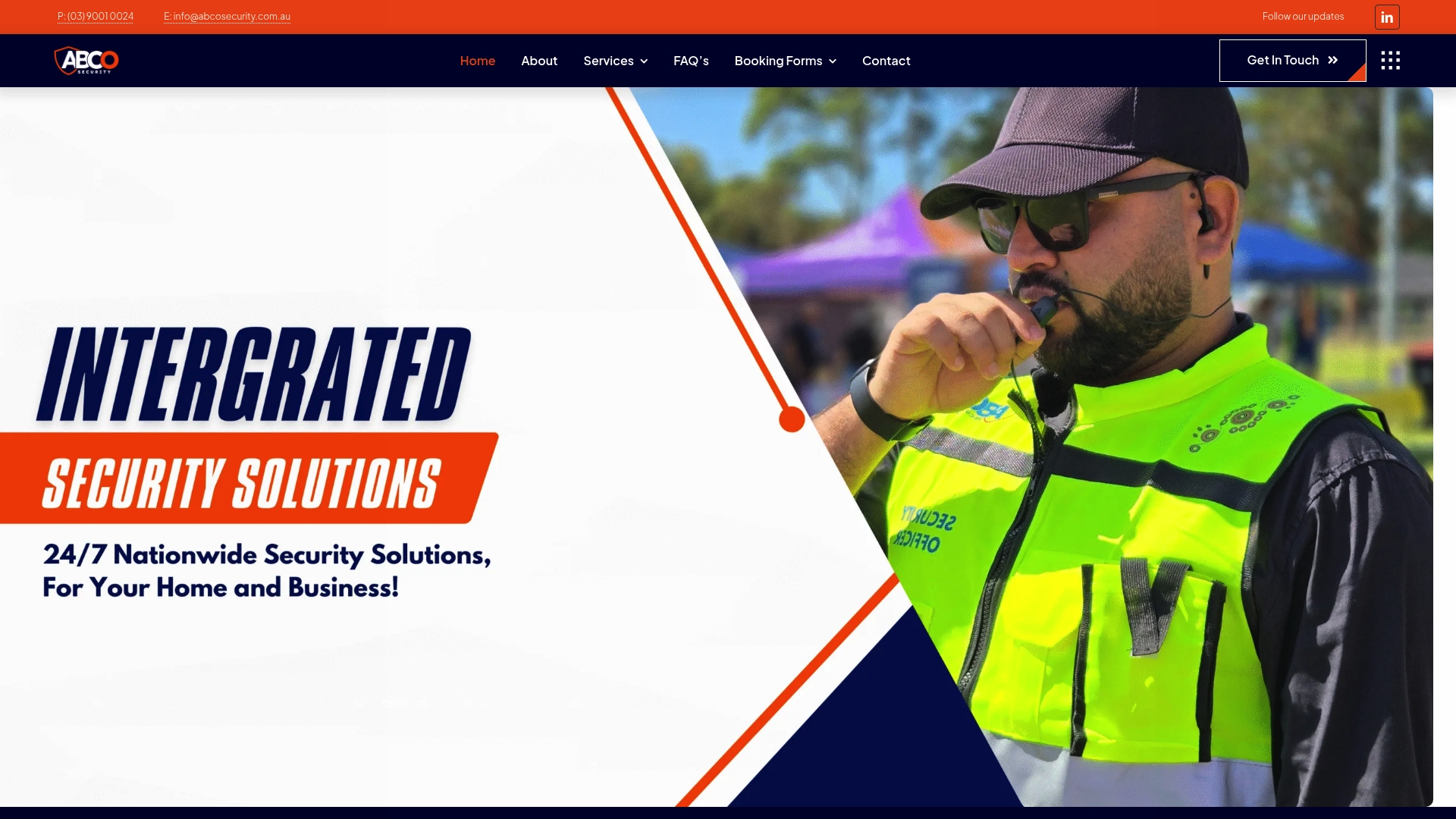
For facility managers and IT decision-makers who have read this far, the next step is a scoping conversation, not a product demo. Abcosecurity’s licensed security professionals assess your existing systems, map your credential lifecycle, and identify the integration architecture that fits your compliance obligations and operational requirements. With ISO 9001 and ISO 30000 certifications and over 15 years of national deployment experience across construction, healthcare, corporate, and government sectors, Abcosecurity brings the technical depth and operational accountability that complex integration projects require. Contact Abcosecurity to book a site assessment or integration scoping session.
Sources
The following sources support the technical, regulatory, and industry claims in this guide:
- The rise of access enablement in a world of access control | Facility Management
- Kisi integrations on Zapier
- Access control consultants: enhancing security for modern businesses
- Eaton Integrated Security Solutions (EISS) | Eaton Australia
FAQ
What is an access control integrator?
An access control integrator is a licensed specialist who designs, installs, and connects access control systems to other security and operational platforms such as CCTV, HR, alarms, and building management systems. They manage the full project lifecycle from scoping and procurement through to testing, training, and ongoing maintenance.
What are the four types of system integration?
The four common integration types are point-to-point (direct API connections between two systems), middleware or ESB (a translation layer between multiple systems), cloud-to-cloud connectors (vendor-managed links between SaaS platforms), and PSIM or command-centre integration (aggregating multiple system feeds into a single operational interface).
What are the four types of access control?
The four main access control models are discretionary access control (DAC), mandatory access control (MAC), role-based access control (RBAC), and attribute-based access control (ABAC). Most enterprise and facility deployments use RBAC, where access rights are assigned by job role rather than individually.
What are the 5 Ds of access control?
The 5 Ds are deter, detect, deny, delay, and defend. They describe the layered physical security strategy that access control integrations support: deterring unauthorised entry, detecting attempts, denying access to unauthorised individuals, delaying forced entry, and defending assets once a breach is detected.
How does the Privacy Act affect biometric access control in Australia?
Under the Privacy Act 1988 (Cth), biometric templates are sensitive information and attract stricter collection, storage, and disclosure obligations. Organisations must have a clear legal basis for collection, limit data to what is necessary, and apply security measures appropriate to the sensitivity. Confirm your specific obligations with the OAIC or a qualified privacy professional.
Recommended
about
avada factory
Sempery ultricies nibh at dolor cras urna eleifend nec. Atiam efficitur tempor.