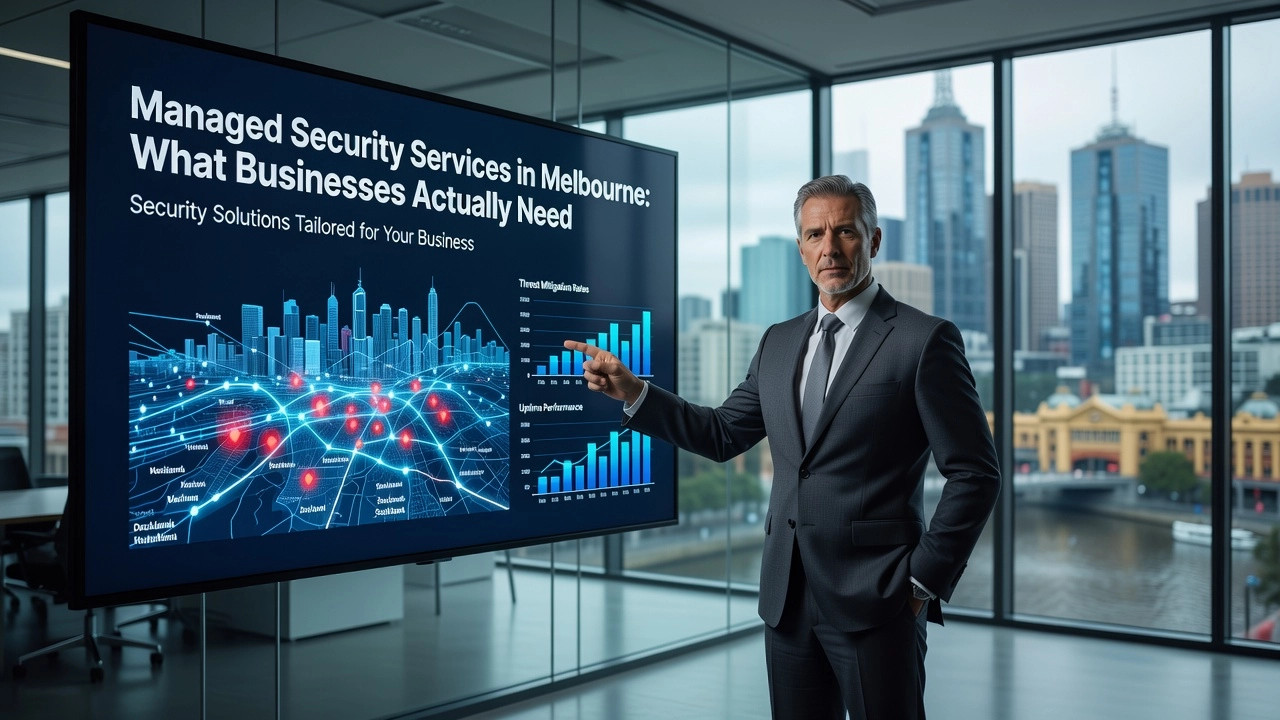
Cyber threats are no longer a concern reserved for large corporations. Melbourne businesses of every size are facing increasingly sophisticated attacks, and the pressure to stay protected has never been greater. The question is not whether you need security support, but which approach will actually work for your organisation.
Managed security services have become the go-to solution for businesses that want enterprise-grade protection without the overhead of building an in-house security team. But with so many providers and service models available in Melbourne, knowing what you actually need, versus what you are being sold, can be genuinely difficult to navigate.
This post cuts through the noise. We will compare the core types of managed security services available to Melbourne businesses, break down what each one delivers, and help you identify which combination of services aligns with your risk profile and budget. Whether you are evaluating providers for the first time or reconsidering your current setup, you will walk away with a clearer picture of what genuine security coverage looks like in today’s threat landscape.
What ‘Managed Security Services’ Actually Covers
Managed security services split into two distinct operational lanes, and confusing them costs Melbourne businesses time, budget, and protection gaps.
The first lane is physical security management: static guards, mobile patrols, alarm monitoring, event security, and construction site protection. The second is cyber-focused managed security, commonly called MSSP services, covering SOC monitoring, MDR, SIEM/SOCaaS, firewall management, and incident response. Most search results default to the cyber definition, which creates real confusion for bricks-and-mortar operators who actually need boots on the ground.
Two Lanes, One Term
| Category | Physical MSS | Cyber MSS (MSSP) |
|---|---|---|
| Core Services | Static guards, mobile patrols, alarm monitoring, event security | Threat detection, incident response, SIEM, SOCaaS, MDR |
| Primary Focus | People, property, physical assets | Networks, endpoints, cloud environments, data |
| Response Type | On-site presence, guard dispatch | Remote remediation, containment, forensics |
| Typical Clients | Retail, construction, warehouses, events | Finance, healthcare, government, any IT-heavy org |
| Integration Bridge | CCTV and alarm monitoring | Access logs feeding into SIEM |
ABCO Security sits firmly in the physical lane. I’ve found that the CCTV and alarm monitoring service is the clearest crossover point between electronic surveillance and physical response management. Live feed oversight, alarm trigger response, and rapid guard dispatch operate as a unified system, not just a camera feed sitting unattended on a server.
Why Physical Comes First
For most Melbourne businesses with a physical premises, physical threats materialise before digital ones do. Theft, vandalism, unauthorised access, and trespassing are daily operational risks that no firewall addresses. I’ve observed that organisations rushing to implement a cyber stack without securing their physical environment leave themselves exposed at the most basic level.
Australian cyber MSSPs serve a genuine and growing need. The Australian MSS market hit approximately USD 1.115 billion in 2025, projected to reach USD 3.2 billion by 2034. That growth reflects real demand driven by ransomware, regulatory pressure, and skills shortages. But those services are built for managing IT security infrastructure, not for protecting a warehouse in Dandenong or a construction site in Footscray.
Most people overlook how much time gets wasted when a business approaches the wrong provider category. Engaging a cyber MSSP when you need mobile patrols means starting the scoping process over entirely. Get the physical foundation right first, then layer the digital controls on top.
Pro Tip: When scoping any security program, ask the provider one direct question: “Do your personnel physically attend site?” If the answer is no, you are talking to a cyber MSSP, not a physical security manager. Know which problem you are solving before you sign a contract.
Why Melbourne Businesses Are Outsourcing Security Right Now
The numbers alone explain the shift. The Australian managed security services market hit USD 1.115 billion in 2025 and is tracking toward USD 3.2 billion by 2034 at a 12% CAGR, outpacing the global average of 11%. That trajectory signals one thing clearly: businesses are voting with their budgets, and outsourcing is winning.
The incident data reinforces why. 68% of Australian businesses were affected by enterprise security incidents in recent reporting periods, and in-house teams repeatedly proved unable to absorb the volume, complexity, or speed required to respond. When your security model depends on a small internal roster, a single gap, whether from staff illness, a shift change, or an unexpected event surge, becomes an open window.
I’ve found that most businesses don’t calculate the true cost of self-managed security until their first serious incident. Recruitment, licensing, 24/7 rostering, ongoing training, and incident response overhead are each a line item that compounds quietly. By the time you factor in turnover and surge coverage, the in-house model frequently costs more than a contracted provider, with less consistency.
Compliance pressure is accelerating this trend. Australian businesses now navigate obligations under the Privacy Act, the Notifiable Data Breaches scheme, workplace safety legislation, and insurance requirements tied to site security standards. A credible outsourced provider absorbs that compliance layer as part of the contract, rather than leaving it as an internal burden.
The most predictable failure point in self-managed programs is 24/7 coverage. Shift handovers, sick leave, and unplanned demand spikes create gaps that any determined threat, physical or otherwise, will find. Providers like ABCO Security’s mobile patrol service and CCTV and alarm monitoring are structured specifically to absorb those variables, maintaining consistent coverage without the operational overhead falling on the client.
Pro Tip: Before benchmarking provider costs, build a full internal cost model first. Include recruitment, training hours, licensing, after-hours rostering, and one realistic incident response scenario. Most businesses find the gap between perceived and actual in-house cost changes the conversation entirely.
What a Managed Physical Security Program Should Include
A complete managed physical security program is not a roster of warm bodies assigned to posts. The best programs deliver documented, auditable outcomes, mirroring exactly what mature cyber MSSPs now sell to enterprise clients.
Here is the core service checklist every program should cover:
- Security guards: Uniformed officers at fixed posts for access control, visitor management, deterrence, and first response. For Melbourne businesses, this remains the highest-demand component across commercial, industrial, and mixed-use sites.
- Mobile patrols: GPS-tracked vehicle and foot patrols with real-time reporting, covering perimeter checks, alarm response, and lock/unlock runs across single or multi-site operations.
- Concierge/front-of-house security: Hybrid roles combining professional customer service with access control, particularly suited to corporate offices and residential towers.
- Electronic security: 24/7 CCTV monitoring and alarm response functions as the always-on detection layer, directly analogous to a SOC in cyber environments. Verified alarm protocols reduce false dispatches and enable remote visual assessment before any physical response.
The Two Components Most Businesses Get Wrong
Most people overlook event security and construction site security when scoping a managed program. Both are high-liability, time-bound engagements. A festival or corporate function carries the same crowd management and emergency response complexity as a permanent site; a construction site adds theft exposure, unauthorized access risk, and shifting site conditions daily. Treating these as one-off bookings rather than integrated program components creates briefing gaps and inconsistent standards. Provider continuity across all engagements is what closes that gap.
Outcomes, Not Just Headcount
I’ve found that clients who demand outcomes-based accountability get measurably better programs. That means GPS-verified patrol routes, timestamped digital incident reports with photographic records, response time KPIs, and patrol compliance rates reviewed monthly. This structure supports insurance requirements, satisfies compliance obligations, and gives operations managers the same reporting transparency they expect from IT service providers.
How to Evaluate a Managed Security Provider
Not all security contracts are created equal, and the gap between a genuine managed security program and a basic staffing arrangement is wider than most buyers realise.
The 5-Point Evaluation Checklist
1. Current Victorian licensing. Under the Private Security Regulations 2025, all providers must hold valid Victoria Police-issued licences at both the individual operator and business level, with full transition required by June 2026. Verify licence status directly through police.vic.gov.au/private-security before engaging any provider. Non-compliance is an immediate disqualifier, full stop.
2. Documented 24/7 response capability with SLAs. Most people overlook SLA specificity. A contract that states “24/7 availability” without defined response time guarantees is a staffing arrangement, not managed security. Require measurable targets: critical incidents acknowledged within 15 minutes, containment actions initiated within the hour. Anything vaguer than that reflects a provider selling headcount, not outcomes.
3. Technology stack. Confirm real-time GPS patrol tracking with time-stamped, geotagged verification reports, integrated CCTV and alarm monitoring, and a centralised digital incident reporting platform with client dashboard access. If a provider cannot produce sample patrol verification reports on request, walk away.
4. Verifiable site-specific experience. Request documented case studies and references from environments matching yours, whether retail, construction sites, corporate facilities, or events. Tenure claims without verifiable incident outcomes carry no weight.
5. Transparent SLA with escalation procedures. The contract must define response and resolution timelines, escalation matrices tiered by incident severity, performance penalties, and scheduled review cycles. Availability claims without accountability structures are not SLAs.
Red Flags and the One Question That Matters
Screen out any provider showing these warning signs: no written incident response procedure, inability to provide GPS patrol verification logs, guards without documented site-specific risk briefings, or contracts with zero performance metrics.
Before signing anything, ask one question: “What happens in the first 15 minutes of a confirmed intrusion at my site?” Expect a precise sequence covering detection, acknowledgement, triage, escalation, and client notification. Vague answers disqualify the provider regardless of price point.
For Melbourne businesses specifically, differentiators worth weighting include ASIAL-recognised membership and Victoria Police-approved status, demonstrated vertical expertise across your industry, and national operational coverage for businesses operating beyond Victoria.
Pro Tip: Request a sample GPS patrol verification report and a copy of a redacted incident response procedure before signing. Providers who hesitate to share operational evidence during the sales process will not improve after contract execution.
Frequently Asked Questions
What is included in managed security services?
Physical managed security services cover on-site guards, mobile patrols, 24/7 CCTV monitoring, alarm response, access control management, and coordinated incident response. Cyber-focused providers add SOC operations, Managed Detection and Response (MDR), SIEM monitoring, threat intelligence, and vulnerability management. The two lanes are increasingly converging, but they remain operationally distinct. ABCO’s scope is physical managed security, delivering guards, patrols, electronic security, and CCTV and alarm monitoring across Melbourne and nationally.
How much do managed security services cost in Melbourne?
There is no flat-rate answer, and any provider quoting one without a site assessment should be treated with caution. Mobile patrol programs typically cost less than dedicated static guard deployments. Full managed programs, integrating patrols, 24/7 monitoring, alarm response, and structured reporting, command a premium because the accountability and technology infrastructure are priced into the contract. Key variables include site size, coverage hours, risk profile, specialist staffing requirements, and contract duration. The right comparison is total cost versus total risk reduction, not hourly rate alone.
What is the difference between a managed security service and a security guard company?
A standard guard company fills shifts. A managed security service delivers outcomes. The distinction comes down to SLAs with defined response times, regular performance reporting, 24/7 monitoring accountability, and technology integration. With ad-hoc guard hire, the client absorbs coordination, oversight, and performance risk. With a managed program, the provider owns those outcomes contractually. I’ve found that most businesses only recognise this gap after an incident that a managed program would have caught earlier.
Do managed security services include CCTV monitoring?
Yes, integrated CCTV and alarm monitoring is a core component of any complete physical managed security program. Monitoring centres actively verify alarms, conduct virtual patrols, and dispatch responses in real time, which reduces false alarm costs and accelerates incident response. This connects directly to electronic security infrastructure; cameras and sensors feed a managed monitoring function rather than sitting as passive, unreviewed assets.
How do I choose a managed security services provider in Australia?
Use five criteria: licensing verification (all personnel must hold valid operator licences under the relevant state Private Security Act); SLA specificity, with clear response time commitments and reporting obligations; technology capability across CCTV, alarms, and access control; demonstrated experience in your industry sector with verifiable references; and documented 24/7 response procedures with defined escalation paths. Most people overlook the SLA detail until a provider underperforms with no contractual remedy available.
Pro Tip: Request a written site assessment before signing any managed security contract. Providers who skip this step are selling a generic package, not a program built around your actual risk profile.
Pro Tip: The One Question That Separates Real Managed Security from a Staffing Contract
Before signing any managed security contract, request a documented incident response procedure, not a brochure. Ask specifically: “What happens in the first 15 minutes of a breach or intrusion at my site?” If the answer is vague or defaults to “we’ll call the manager,” keep looking. Legitimate managed programs maintain tested playbooks covering immediate containment, notification chains, and escalation protocols. Staffing contracts rarely can answer that question with any precision.
The Australian MSS market is growing at 12% annually for a reason. Businesses are absorbing the real cost of reactive security the hard way, through incident remediation, compliance penalties, and emergency contractor callouts that dwarf what a properly scoped managed program would have cost from the start.
If you’re evaluating managed physical security in Melbourne, run your current coverage through the 5-point checklist outlined earlier before speaking to a single vendor. That gap analysis gives you leverage and clarity. Services like mobile patrol coverage and CCTV and alarm monitoring are measurable starting points for identifying where unmanaged exposure currently sits.
Common Pitfall to Avoid: Accepting a “security proposal” that lists personnel hours and shift schedules but contains no incident response documentation. Hours on-site is not the same as managed protection. A staffing contract tells you who shows up. A managed security program tells you exactly what happens when something goes wrong.
Conclusion
Cyber threats in Melbourne are real, evolving, and targeting businesses of every size. The right managed security services do not have to be overwhelming or out of reach. Here is what matters most: understand your risk profile before choosing a provider, prioritise services that offer continuous monitoring over reactive fixes, and ensure your solution scales with your business rather than locking you into unnecessary complexity.
Not every business needs the same security stack, but every business does need a clear plan.
If you are ready to move beyond guesswork and build a security posture that actually protects your operations, start with a conversation. Speak with a Melbourne-based managed security provider who will assess your needs honestly, not just sell you a package. The right protection is out there. Taking that first step today is what separates prepared businesses from vulnerable ones.
about
avada factory
Sempery ultricies nibh at dolor cras urna eleifend nec. Atiam efficitur tempor.