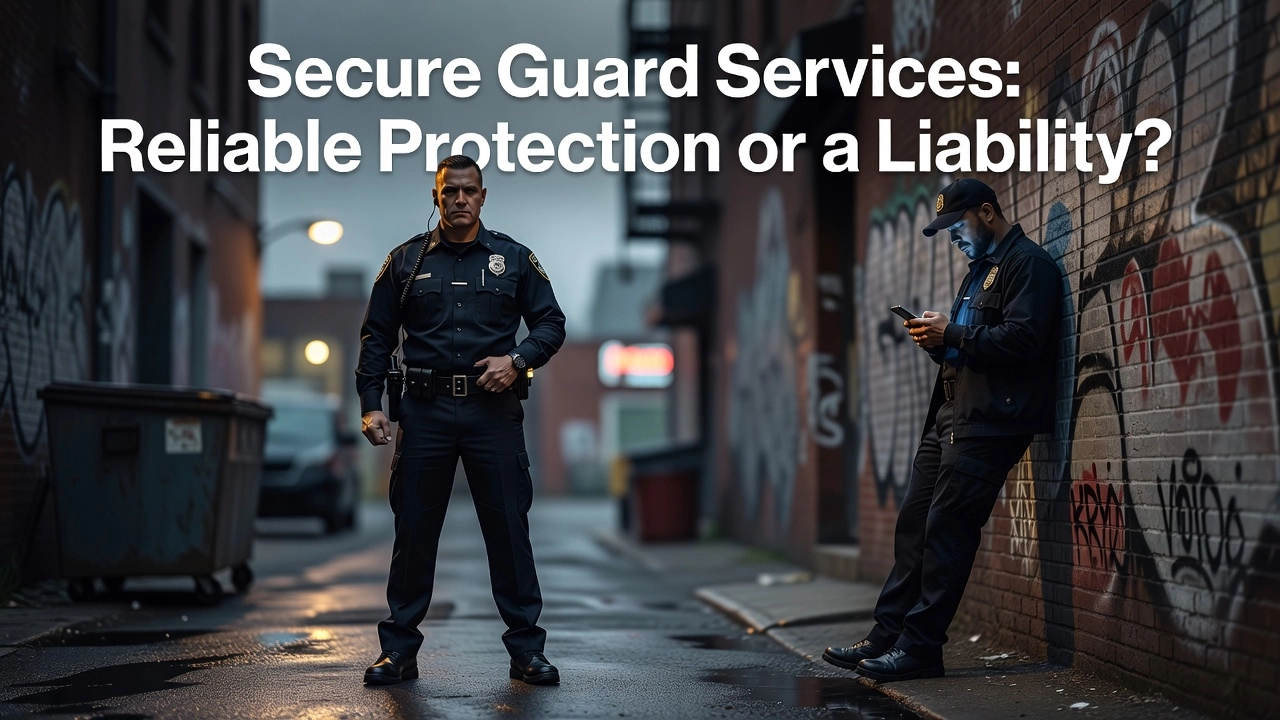
Every business owner, property manager, or event coordinator faces the same critical question at some point: can you truly trust the people responsible for keeping your assets and people safe? The security industry has grown significantly in recent years, and with that growth comes a wide range of providers promising top-tier protection. But not all of them deliver.
Secure guard services have become a cornerstone of modern safety strategies, used across industries from retail and healthcare to corporate campuses and residential communities. Yet despite their widespread adoption, these services come with a complex set of trade-offs that many organizations fail to evaluate properly before signing a contract.
In this post, we break down the real value of professional guard services against the potential risks they introduce. You will learn what separates a high-performing security provider from a liability waiting to happen, what key factors to assess during the vetting process, and how to make an informed decision that aligns with your specific security needs. If you are considering hiring or upgrading your current security setup, this comparison is essential reading.
What Makes a Guard Service Genuinely Secure
Secure guard services go beyond a uniform at the door. The difference between reliable protection and a liability comes down to licensing, certified training, and integrated response protocols.
Australia’s private security industry employs 180,000+ people and generates AUD $11 billion annually, yet with nearly 150,000 individual licence holders operating across the country, quality varies dramatically between providers. That scale creates a dangerous illusion of equivalence. Not every licensed guard represents equal capability, and not every security firm operates to the same standard.
A genuinely secure guard service holds current state-issued licences, carries adequate public liability and professional indemnity insurance, and operates under a documented quality management framework. These are non-negotiable baselines, not differentiators. In Victoria, licensing requirements fall under the [Private Security Act 2004](https://www.police.vic.gov.au/private-security), with equivalent legislation enforced across every state and territory.
The real differentiators sit above compliance. ISO 9001 (quality management systems) and ISO 28000 (security management systems) are credibility benchmarks most operators skip entirely. They require audited controls, documented risk assessments, and measurable improvement cycles. ABCO Security holds certifications in these frameworks, alongside CM3 pre-qualification, which signals a commitment to audited operational excellence that most providers simply cannot demonstrate.
I’ve found that most businesses don’t ask for certification proof until after an incident. By then, it’s too late.
Before signing any contract, request licence copies, insurance certificates, and ISO documentation directly. Verify licence status through your state’s public register. A provider that hesitates on any of these requests is telling you something important about how they operate.
Types of Guard Services and When to Use Each
Not all protection needs look the same, and choosing the wrong service type costs you money without closing your actual risk gaps. The table below cuts through the noise.
| Service Type | Best For | Coverage Model | Tech Integration Level | Typical Use Case |
|---|---|---|---|---|
| Static Guards | Commercial, healthcare, retail, government | Fixed-post, 24/7 or scheduled shifts | Medium (access control, visitor logging) | Permanent deterrent at a single location |
| Mobile Patrols | Multi-site, warehouses, after-hours coverage | Roaming via vehicle or foot, randomised routes | High (GPS tracking, real-time digital reports) | Cost-effective deterrence across multiple sites |
| Event Security | Festivals, corporate functions, sporting events | Temporary, scalable deployment | Medium-High (CCTV, bag screening, incident logs) | Crowd control, access management, VIP protection |
| Construction Site Security | Active builds, infrastructure projects | Hybrid: static, mobile, remote CCTV | High (AI motion detection, GPS, digital access logs) | Equipment protection, contractor access, fire watch |
Static guards suit environments requiring a constant, visible human presence at a fixed point. Think hospital entrances, retail flagship stores, or government lobbies where access control and immediate incident response are non-negotiable.
Mobile patrols work harder per dollar on sprawling or multi-location sites. Randomised routes actively disrupt opportunistic threats rather than allowing criminals to map a predictable guard schedule.
Event security is a specialist discipline, not a scaled-up version of standard guarding. With Australia’s event security market projected to reach USD 9.32 billion by 2033, operators are investing heavily in trained crowd management and emergency response personnel for good reason.
Construction site security addresses a specific theft and vandalism problem. High-value plant equipment, copper wiring, and materials make active builds prime targets, and demand for dedicated site protection is rising nationally.
Most people overlook the fact that mobile patrols and static guards are not interchangeable. The right call depends on three factors: site layout (single fixed point versus a large perimeter or multiple locations), risk profile (access control versus broad deterrence), and operational budget. I’ve found that many sites actually benefit from a hybrid approach, combining a static presence at the primary entry point with scheduled mobile patrols covering the broader perimeter.
Pro Tip: Before committing to a service type, request a formal site risk assessment from your provider. A reputable operator will identify coverage gaps that a standard quote template will miss entirely.
5 Things to Verify Before Hiring a Security Provider
Before you sign anything, run every prospective provider through this checklist. Treat it as non-negotiable due diligence, not a courtesy exercise.
Licence Verification
You should confirm that both the security firm and every individual guard assigned to your site hold current, state-issued licences. In Victoria, this is governed by the Private Security Act 2004, administered by Victoria Police’s Licensing and Regulation Division. Recent changes commencing June 2025 introduced mandatory refresher training and first aid certification as renewal conditions. Other states have equivalent regulators; ASIAL’s licensing guidance covers each jurisdiction. Request physical copies and verify directly with the regulator, since licences can be suspended without notice.
Insurance Coverage
You should confirm a current Certificate of Currency covering public liability and workers’ compensation before any guard sets foot on your premises. Public liability covers third-party injury or property damage claims; workers’ compensation is mandatory across all Australian states. Non-compliance creates direct financial exposure for your business if an incident occurs and the provider cannot absorb the claim.
ISO Certifications
You should confirm whether the provider holds ISO 9001, which audits quality management processes including incident reporting, guard supervision, and complaint resolution. ISO 30000 addresses security management specifically. Few providers hold both, which makes dual certification a genuine differentiator worth probing for.
Response Time SLAs
You should confirm written, contractual commitments on response times for incidents, alarms, and after-hours calls. Verbal assurances are unenforceable. Ask for sample incident logs to validate stated benchmarks against real performance. Providers offering mobile patrol or CCTV and alarm monitoring should have documented SLA frameworks already in place.
Technology Integration
You should confirm that the provider operates with current technology. In 2026, a guard service running without digital reporting, integrated alarm response, or remote CCTV monitoring capability is behind the standard. AI-powered video analytics, cloud-based surveillance, and unified reporting dashboards are now baseline expectations, not premium add-ons.
In my experience, providers who resist providing documentation for any of these five points rarely improve once they are on-site. Resistance at the proposal stage is a reliable indicator of how they handle accountability under contract.
Pro Tip: Ask for a sample incident report from a current client engagement. The quality of that document tells you more about operational discipline than any sales pitch will.
How Technology Is Changing Guard Services Right Now
The Australian physical security market was valued at USD 2,780.7 million in 2025 and is projected to reach USD 4,451.6 million by 2034, reflecting a CAGR of 5.21%. That investment is not going into more boots on the ground. It is going into smarter systems that make every guard more effective.
AI Analytics and Unified Platforms
Platforms from Gallagher Security and Pelco now deploy deep-learning video analytics that detect loitering, perimeter breaches, and crowd anomalies in real time, triggering instant alerts rather than waiting for a guard to notice something on a monitor. I’ve found that this exception-based approach cuts false alarm rates dramatically and allows a smaller team to maintain coverage across larger sites without sacrificing response speed.
Cloud-based unified platforms take this further by consolidating guard reports, live CCTV feeds, access control logs, and alarm events into a single dashboard. For multi-site operators, this means genuine oversight from one interface with complete audit trails, which matters when an incident requires documented evidence or insurance reporting.
Integrated Monitoring and Electronic Layers
CCTV and alarm monitoring integrated with 24/7 response is now the standard expectation, not an upgrade. It creates a verifiable incident timeline that standalone guarding simply cannot produce. Most people overlook how critical that documentation becomes during post-incident reviews.
Electronic security systems layered alongside physical guards, including access control, intruder detection, and ANPR, have become the baseline for commercial clients in healthcare, retail, and critical infrastructure. Neither approach alone matches the deterrence and response capability of both working together.
For multi-site operators specifically, remote monitoring paired with rapid-response mobile patrols offers a cost-efficient alternative to static guarding at every location. Centralized monitoring handles continuous surveillance while mobile units deploy only when triggered, reducing fixed labor costs without creating coverage gaps.
Pro Tip: When evaluating providers, ask specifically how their technology stack integrates with their physical response capability. A provider running advanced analytics through a platform like Gallagher but dispatching guards through a separate, disconnected system defeats the efficiency gains entirely.
Frequently Asked Questions
What Licences Should a Secure Guard Service Hold in Australia?
Every individual security guard must hold a current state-issued security licence. The contracting firm must also hold a master licence or security firm licence. In Victoria, licensing is governed by the Private Security Act 2004, administered by Victoria Police’s Licensing and Regulation Division. Reforms effective mid-2025 introduced refresher training requirements, first-aid certification, and fingerprinting for renewals. Always verify licence status directly with the relevant state regulator before engagement.
What Is the Difference Between a Static Guard and a Mobile Patrol?
A static guard is deployed at a fixed post for continuous on-site presence, providing access control and immediate deterrence at high-risk entry points. A mobile patrol covers multiple locations on scheduled or randomised routes, making it significantly more cost-efficient for after-hours or multi-site scenarios. I’ve found that most mid-sized commercial clients benefit from combining both: static coverage at primary entry points and mobile patrols across the wider perimeter.
How Do I Know If a Security Provider Is ISO Certified?
Request the provider’s current ISO certificate of registration, including the certificate number, scope, issue date, and issuing body. ISO 9001 applies to quality management systems; ISO 28000 covers security management specifically. Verify validity through a JAS-ANZ accredited certification body. Certification is voluntary, so pair it with licensing checks and client references.
Do I Need Event Security for a Small Corporate Event?
If your event involves public access, alcohol, or more than 100 attendees, licensed event security is strongly recommended and may be legally required under venue conditions or liquor licensing rules. The standard starting benchmark is one licensed guard per 100 attendees, adjusted by formal risk assessment.
What Should a Contract Include?
A compliant contract must specify guard qualifications, licensing requirements, response time SLAs, public liability and workers’ compensation insurance, incident reporting protocols, and escalation procedures. It should also address sub-contracting arrangements and audit rights. Any provider who resists committing these terms in writing is a red flag, not a negotiating position.
Pro Tip: Cross-reference every licence number against your state regulator’s public register before the contract is signed. Fraudulent or lapsed licences are more common than most clients expect, and the liability for an unlicensed guard on your site can fall back on you.
Pro Tip Before You Sign Any Security Contract
Request a site-specific security risk assessment before signing any contract. A provider worth hiring offers this as standard practice, not an add-on.
Australia’s security sector employs over 180,000 people, with more than 11,000 licensed security firms operating nationally. That volume makes due diligence non-negotiable. I’ve found that most incidents trace back not to a lack of guards on-site, but to a mismatch between the threat environment and the service deployed. A documented risk assessment closes that gap before a single guard is rostered. It also gives you a written baseline, which matters if you ever need to demonstrate due diligence to insurers, regulators, or stakeholders.
Choosing a provider based on price alone is the fastest way to inherit a liability rather than resolve one. Compliance gaps, undertrained personnel, and inadequate incident response don’t show up on a quote sheet; they show up after something goes wrong.
Providers with genuine operational maturity carry verifiable proof of standards. ISO 9001 certification confirms quality management processes are embedded across operations. ISO 30000 signals structured security management. Fifteen-plus years of active service across Melbourne, Sydney, Brisbane, Perth, and Adelaide reflects the kind of multi-environment experience that generic operators cannot replicate on paper.
For tailored security guard services covering Melbourne and nationwide requirements, ABCO Security’s profile outlines the full scope of integrated options available.
Pro Tip: When you request a risk assessment, note whether the provider conducts it on-site or sends a generic questionnaire. An on-site assessment means they are evaluating your actual exposure. Anything less tells you exactly how they will handle your contract once it is signed.
Conclusion
Choosing the right secure guard service is one of the most consequential decisions your organization can make. The key takeaways are clear: not all providers are equal, vetting matters more than price, and the wrong choice can transform your greatest asset into your biggest liability. A trustworthy security partner brings verified training, transparent accountability, and a proven track record that holds up under scrutiny.
Do not leave this decision to chance. Review your current provider against the criteria outlined in this post, ask the hard questions, and demand documented evidence of compliance and performance. If gaps exist, it is time to act.
Your people and assets deserve protection that actually works. Start your evaluation today, and make security a strategic advantage rather than an afterthought. The right partner is out there. Go find them.
about
avada factory
Sempery ultricies nibh at dolor cras urna eleifend nec. Atiam efficitur tempor.