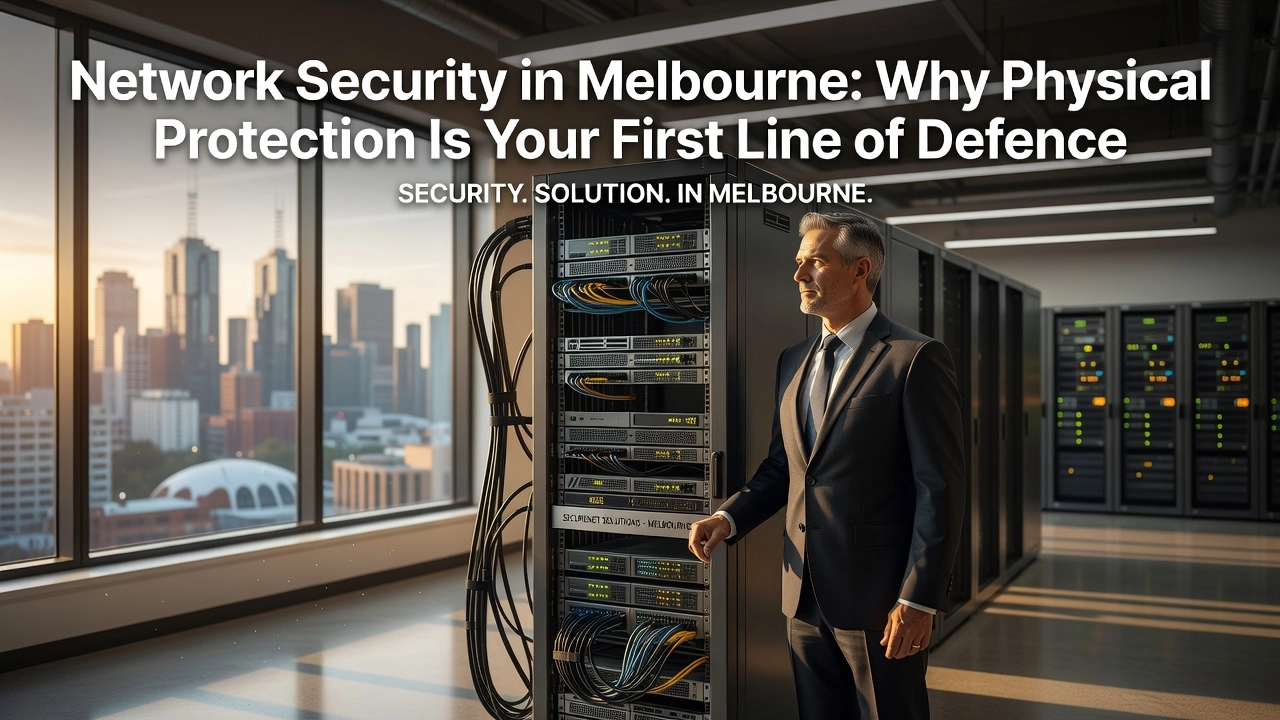
Most organisations pour resources into firewalls, encryption protocols, and intrusion detection systems, yet leave the physical layer of their infrastructure surprisingly vulnerable. In Melbourne’s fast-growing business landscape, this oversight is more common than you might expect, and the consequences can be severe.
Network security is rarely a single-point solution. It operates as a layered system, and that system is only as strong as its weakest component. When cybersecurity conversations focus exclusively on digital threats, physical access points often go unexamined. Unlocked server rooms, unsecured cable infrastructure, and poorly managed hardware can hand attackers everything they need, often without triggering a single digital alert.
This analysis examines why physical protection deserves to sit at the foundation of any serious network security strategy, particularly for Melbourne businesses navigating an increasingly complex threat environment. You will gain a clearer understanding of the specific physical vulnerabilities that put networks at risk, how local factors in Melbourne can influence those risks, and what practical measures organisations at an intermediate security maturity level can implement to close the gaps that software alone cannot address.
The Threat Landscape Australian Businesses Face Right Now
Network security failures in Australia are accelerating, and the numbers behind that statement are no longer abstract. The reported incidents represent a fraction of what is actually happening across the economy.
The ACSC responded to over 1,200 cybersecurity incidents in 2024-25, up 11% year-on-year. Australia recorded 47 million data breaches in 2024 alone, ranking 11th most affected country globally. These are the reported cases. The actual exposure is significantly higher, given that most SMEs lack the internal capability to detect, let alone report, a breach in progress.
The Cost Is Rising Faster Than Defences
The average cost of cybercrime per report has climbed 23% in recent ACSC reporting cycles. That figure hits SMEs disproportionately hard, because a mid-size Melbourne business absorbs the same breach costs as a larger enterprise but without the recovery infrastructure to match. In my experience, most business owners discover their exposure after an incident, not before.
AI-assisted threats are compressing response windows in ways that traditional security frameworks were never designed to handle. In 2025, 87% of organisations globally encountered AI-powered attacks. These attacks exploit vulnerabilities up to 10 times faster than conventional methods, shrinking response time from hours to minutes. The WEF Global Cybersecurity Outlook 2026 identifies three macro forces driving this shift: AI supercharging the cyber arms race, geopolitical fragmentation creating hybrid threat environments, and widening cyber inequity between large organisations and smaller ones.
The Gap Nobody Is Talking About
Most people focus on firewalls. I’ve found the gap is almost always physical, and it is the gap no one is talking about. Unsecured server rooms, unmonitored network closets, and unchecked physical access to communications equipment remain primary vectors for compromise. USB drops, hardware tampering, and tailgating into restricted areas bypass even well-configured digital defences entirely.
The CrowdStrike 2025 Global Threat Report documents how adversary breakout times continue to compress, reinforcing that speed of detection and physical access control are now inseparable priorities. Businesses that invest in electronic security systems and professional mobile patrol services are addressing the physical layer that digital tools cannot reach.
Pro Tip: Audit your physical access points before your next firewall review. A rogue device inserted into a network port in an unmanned comms room will defeat six-figure cybersecurity software in under two minutes.
The Physical Attack Vectors Most Businesses Ignore
Most cybersecurity content treats network security as a purely digital problem. That framing leaves a critical gap that attackers exploit every day.
In my experience, the most devastating breaches start with someone walking through an unsecured door, not a phishing email. USB hardware drops, keystroke loggers planted between a keyboard and workstation, cable taps on exposed network runs, and direct server room tampering all require one thing: physical proximity. These aren’t theoretical scenarios. They are documented cybersecurity blind spots that organisations consistently underinvest in while spending heavily on firewalls and endpoint detection.
The shift toward Zero Trust architecture reflects a fundamental rethinking of how access is granted digitally: never trust, always verify. Physical access control is the offline equivalent. Every entry point to a building, network closet, or equipment bay should require authenticated access, not a borrowed keycard or an unmonitored door. Organisations that apply Zero Trust logic to their software stack but leave server rooms accessible to any staff member have a blind spot that no amount of digital security tooling will close.
Integrated electronic security systems and physical access protocols address exactly this gap. So does deploying mobile patrol services for after-hours intrusion deterrence, particularly across multi-site or construction environments where network infrastructure is dispersed.
| Threat Scenario | Digital-Only Security | Integrated Physical-Digital Security |
|---|---|---|
| Unauthorised server room access | Relies on network authentication after entry | Keycard/biometric access, CCTV, access logging |
| USB hardware drop | Software-based port blocking | Physical port locks plus endpoint controls |
| Network closet tampering | Anomaly detection post-compromise | Locked cabinets, tamper-evident seals, audit trails |
| Ransomware via phishing | Email filtering, EDR, user training | Same, plus physical workstation controls |
| After-hours intrusion | SIEM alerts on off-hours logins | Alarm systems, motion detection, security patrols |
Unauthorised Access to Network Infrastructure
Server rooms, communications closets, and data centre floors are physical assets sitting inside buildings that people can walk into. Digital monitoring tools cannot stop a person who is already standing in front of your core network hardware.
The physical attack methods used against network infrastructure are straightforward and effective. A USB device loaded with malware, dropped near a workstation or inserted directly into a server, executes its payload automatically on connection. A hardware keystroke logger installed on a workstation captures credentials before any encryption layer ever sees them. A passive cable tap on an unmonitored network switch intercepts traffic without leaving a single entry in your logs. According to research on the top network security threats in 2026, unauthorised physical access remains a recognised enabler of wider digital compromise, precisely because it bypasses software-based controls entirely.
Most people overlook how badly access control degrades over time. A shared keypad code that has not been rotated in three years is not a security measure; it is a known combination circulating among former staff, contractors, and anyone who watched someone type it in. Stale credentials and unmonitored entry points are among the leading contributors to physical-layer security failures. The convergence of cyber and physical attack vectors in 2026 means threat actors are actively combining both approaches, using physical access to establish the foothold that digital attacks then expand.
The direct countermeasure is equally straightforward. Professional guarding for business premises paired with monitored access control at entry points to network infrastructure closes vectors that no firewall can address. A trained static guard cannot be bypassed by a spoofed credential or a tailgating attempt the way an unmanned keypad can.
Pro Tip: Treat your server room door like an external perimeter entry. Log every access event, rotate credentials on a fixed schedule, and place it under the same guarding standard you apply to your building’s front entrance.
Construction Sites and Temporary Network Infrastructure
Active construction sites are a network security blind spot that most IT teams never audit, and attackers have noticed.
Modern build sites run a surprisingly dense technology stack. Site offices carry Wi-Fi routers, cloud-connected project management terminals, and CCTV systems that feed back to head office. The physical security protecting all of that hardware is often a padlock. Connected construction sites now rely on Wi-Fi, Bluetooth, and cellular networks for real-time data exchange, alongside IoT sensors for equipment monitoring and safety management. That digital density creates a broad attack surface sitting behind minimal physical controls.
The temporary nature of the infrastructure compounds every risk. Equipment rotates between projects, subcontractors bring personal devices onto shared networks, and firmware rarely gets updated between deployments. Default credentials on site routers are common, open wireless networks are standard, and after-hours supervision is minimal or completely absent. I’ve found that site-level network hygiene gets treated as someone else’s problem, sitting in the gap between the IT team and the site manager.
Most people overlook the lateral threat this creates. A compromised router on a build site is not an isolated incident; it is a bridgehead. Construction firm IT environments layer legacy systems, subcontractor integrations, and cloud platforms together, which means a single tampered node can traverse network boundaries directly into head-office infrastructure. Cloud-first construction operations mean site connections carry authenticated access to project financials, client records, and shared data environments.
Hardware tampering is the mechanism. Physical access to a site router, achieved in minutes after hours, can redirect traffic, install packet capture tools, or create persistent backdoor access. Deploying on-site security personnel for construction environments addresses both vectors simultaneously, deterring hardware interference and controlling after-hours site access before a digital intrusion ever begins.
Common Pitfall to Avoid: Treating construction site network security as an IT-only responsibility. The physical access controls on site are the first line of defence. If the router can be touched, it can be compromised.
The 2026 Trend Connecting Physical and Cyber Resilience
Both the WEF and Gartner have stopped treating physical-digital convergence as a future concern. It is a current, active threat configuration that requires an immediate operational response.
Gartner’s February 2026 cybersecurity priorities report names AI-driven SOC transformation and post-quantum cryptography readiness as the two most urgent technical frontiers for security teams. Most people overlook the foundational dependency sitting underneath both: neither works if the physical environment is compromised. A post-quantum cryptography deployment is only as strong as the physical security protecting the hardware running it. An AI-driven SOC is only as effective as the integrity of the network infrastructure it monitors. Threat actors who understand this will bypass sophisticated digital defences entirely by targeting the physical layer first.
Resilience Has Replaced Prevention as the Operational Model
The industry has made a decisive shift. Pure prevention is no longer the standard. The model that Gartner, PwC, and the WEF all describe in their 2026 reporting is resilience: detect, respond, recover. I’ve found that this framing changes how organisations should evaluate physical security investment. 24/7 alarm monitoring and CCTV surveillance is not a passive deterrent; it is a real-time detection and response capability at the building level, directly mirroring the resilience model applied digitally inside the SOC.
Zero Trust Stops at the Front Door Without Physical Controls
Zero Trust architecture is built on one principle: no unchallenged access, for anyone, anywhere. Applied digitally, that means continuous identity verification across every system. Applied physically, it means every person approaching network infrastructure, whether a server room, a comms closet, or a data centre floor, must be authenticated before gaining access. Access cards, CCTV-validated entry logs, and monitored checkpoints constitute the physical layer of Zero Trust. Without them, a threat actor can walk past every digital control you have deployed.
Australia’s network security market is forecast for sustained growth through to 2034 according to IMARC Group. Businesses investing in integrated physical and cyber security infrastructure now are not reacting to a single incident cycle; they are building compounding, long-term resilience that will remain commercially and operationally sound across the next decade.
Pro Tip: Cross-reference your physical access logs against your network access logs weekly. Unexplained gaps between who badged into the server room and who authenticated to the network at that same time is one of the clearest early indicators of an insider threat or credential compromise.
What Melbourne SMEs Should Do Right Now
You don’t need an enterprise budget. You need the right priorities. Melbourne SMEs face identical threat vectors to large organisations, with a fraction of the security resources to counter them. Small businesses now account for 43% of all reported cybercrime in Australia, with the average incident costing AU$46,000. The gap is not technical complexity; it is sequencing.
Start With Physical Access, Not Software
Before reviewing firewall configurations or password policies, walk your premises and locate every piece of network infrastructure: routers, switches, patch panels, servers, and network storage devices. For each location, ask a direct question: who has unmonitored access to this equipment? Cleaning contractors, shared-building occupants, and unsupervised visitors represent genuine exposure points that no software control addresses. I’ve found that most Melbourne SMEs cannot answer this question accurately on the first attempt.
Physical intrusion risk peaks after hours, when premises are unmanned and response times are slowest. Implementing after-hours mobile patrols for business premises closes this window with a visible, responsive deterrent during the highest-risk period of the day.
The Compliance Angle Most People Miss Entirely
Most people overlook the regulatory dimension of physical infrastructure security. Australia’s Privacy Act obligations for small businesses extend beyond software and passwords; they include the “reasonable steps” standard for protecting personal information physically held on-site. If your server room or network cabinet is accessible to unauthorised individuals, your data governance obligations may already be breached, regardless of how strong your digital controls are.
The 2026 Privacy Act updates have tightened this further, narrowing the small business exemption that previously shielded many operators. Non-compliance carries real financial exposure that scales with the severity of the breach.
Per the COSCA 2026 SME cybersecurity guidance, small businesses that take targeted, prioritised action on both physical and digital security close the gap with larger competitors faster than those waiting for a comprehensive solution. Act on what is auditable and fixable today.
Pro Tip: Lock your network cabinet before you update your firewall policy. Physical access is the foundational layer everything else depends on, and it is the one most frequently left unaddressed.
Frequently Asked Questions
What is the biggest network security threat to Melbourne businesses in 2026?
AI-assisted attacks are the primary threat. The ACSC responded to over 1,200 cybersecurity incidents in 2024-25, an 11% year-on-year increase, and 87% of organisations globally encountered AI-assisted threats in 2025. What most Melbourne businesses miss is the physical access gap: an attacker who can reach your server room or network closet bypasses every digital control you have in place.
How does physical security protect network infrastructure?
Physical security enforces the first barrier. Controlled access to server rooms through keycard or biometric systems prevents unauthorised entry. Hardware tamper seals on switches and patch panels create an audit trail for any interference. After-hours mobile patrol coverage closes the window when premises are unstaffed and digital monitoring alone cannot stop someone already inside the building.
What is the difference between cyber security and network security?
Cyber security covers the broad discipline of protecting digital systems and data. Network security is a specific subset focused on protecting the infrastructure, devices, and communications that carry data across your organisation. Critically, network security encompasses both digital controls (firewalls, access policies) and physical protection of the hardware those controls run on.
Do small businesses need physical security for their network equipment?
Yes. Nearly half of all cyber-attacks target SMEs, and smaller organisations have fewer resources to absorb the impact of a breach. A single act of hardware theft or USB tampering can cause data loss that takes months to recover from. The disproportionate cost of a physical breach on an SME makes electronic security controls a practical necessity, not a luxury.
How does 24/7 security monitoring support cyber resilience?
The detect-respond-recover framework depends on continuous visibility. CCTV and alarm monitoring provides real-time alerts for after-hours intrusion attempts targeting communications infrastructure. Physical response to triggered alarms closes the gap that digital-only monitoring leaves open, ensuring that an attempt to access network equipment outside business hours results in an immediate on-site response rather than a log entry reviewed the next morning.
Common Pitfall to Avoid
The most expensive network security mistake I see isn’t a misconfigured firewall. It’s a shared key code on a comms cabinet that nobody has changed since 2022.
Organisations invest heavily in next-generation firewalls, endpoint detection platforms, and Zero Trust architecture, then leave the physical network stack completely exposed. A router, switch, or comms cabinet accessible via a static PIN known to current staff, former contractors, and half the facilities team sits entirely outside every Zero Trust control above it. No software framework compensates for that.
I’ve seen six-figure cyber insurance claims trace back to exactly this scenario: a physical access failure, not a software vulnerability. An unlocked server room or a shared code known to ex-staff is all an attacker needs to bypass every layer of digital security protecting the network above it. Insurers are tightening requirements on access control reviews precisely because this pattern keeps recurring.
The fix is not complicated. Before the end of this quarter, conduct a physical audit of every location where network equipment lives: server rooms, comms cabinets, branch office racks, and any co-location sites. Document who currently holds access, when credentials were last rotated, and whether former employees or third-party contractors retain knowledge of active codes. That single audit closes more real-world risk than most software upgrades will.
For Melbourne businesses without the internal resources to run that process independently, ABCO’s integrated electronic security assessment covers physical and network-layer vulnerabilities in a single structured review. Pair that with a mobile patrol schedule across sites where network infrastructure sits unattended overnight, and you have closed the gap that no firewall vendor will ever address.
Conclusion
Effective network security begins long before a firewall rule is written. Physical protection is not a secondary consideration; it is the foundation everything else depends on. Melbourne businesses that secure their server rooms, manage hardware access, and audit their physical infrastructure close vulnerabilities that no software solution can address alone.
The key takeaways are straightforward: unlocked physical access points create serious risk, digital defences cannot compensate for physical oversights, and a layered security strategy must account for both dimensions equally.
Now is the time to act. Conduct a physical security audit of your network infrastructure, identify gaps in access control, and treat your hardware environment with the same rigour you apply to your digital systems. Organisations that close the physical gap first build a stronger, more resilient security posture from the ground up.
about
avada factory
Sempery ultricies nibh at dolor cras urna eleifend nec. Atiam efficitur tempor.