Most organizations understand they need stronger cybersecurity, but far fewer understand what they are actually paying for when they bring in outside help. The gap between expectation and reality can be costly, both financially and operationally.
A managed security service provider promises to strengthen your defenses, monitor your environment, and respond to threats on your behalf. But what does that actually look like in practice? What specific functions are covered, what remains your responsibility, and how do you measure whether the relationship is delivering real value?
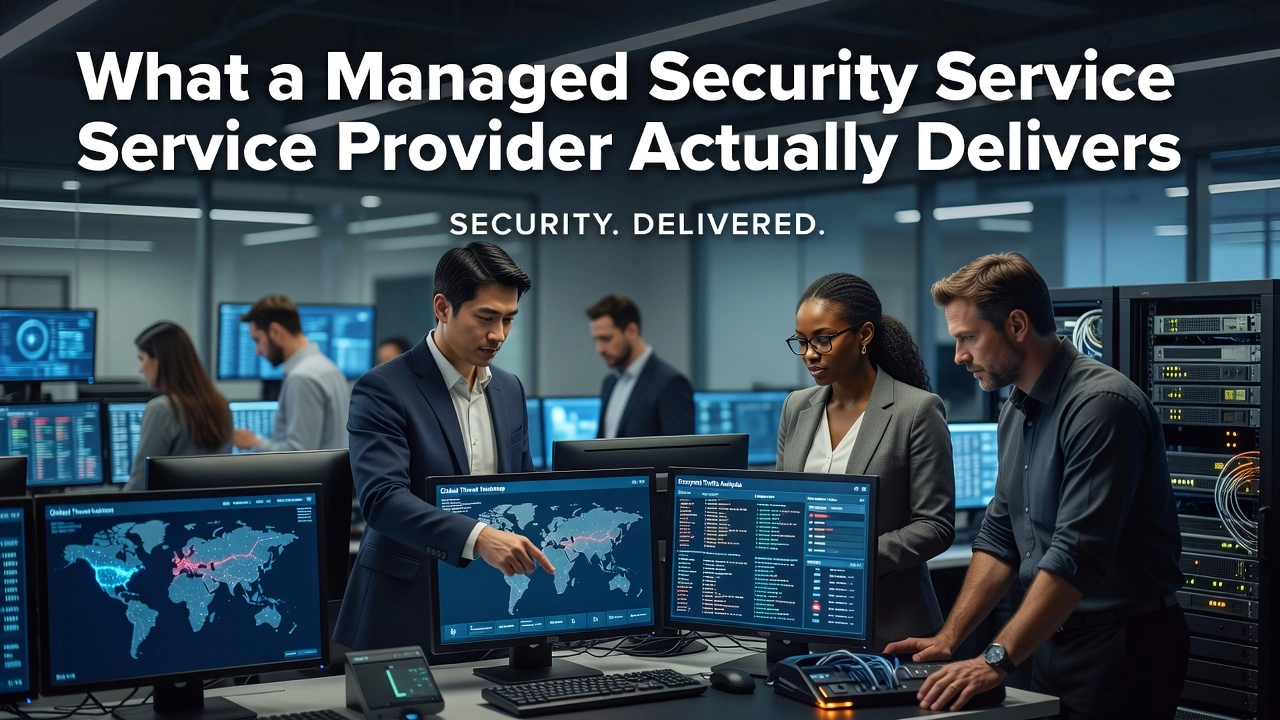
This analysis breaks down the core deliverables you should expect from a managed security service provider, from continuous monitoring and threat detection to incident response and compliance reporting. It also examines where providers commonly fall short and what separates a capable partner from one that simply generates alerts without meaningful action. Whether you are evaluating your first MSSP engagement or reassessing an existing contract, understanding what genuine service delivery looks like will help you ask sharper questions, set clearer benchmarks, and ultimately get more from your security investment.
What Is a Managed Security Service Provider?
A managed security service provider (MSSP) is a company that delivers outsourced, end-to-end security operations — including monitoring, staffing, and incident response — so businesses don’t have to manage it internally. In the physical security context, an MSSP like ABCO Security handles everything from on-site guards and mobile patrols to CCTV monitoring and access control across Melbourne.
Most searches for “managed security service provider” return cybersecurity results; firewalls, SIEM platforms, threat detection. That framing, while accurate, is incomplete. As Fortinet defines it, an MSSP is fundamentally an outsourced provider delivering continuous security management on a client’s behalf. The operational model, not the technology, is the defining characteristic.
That same model applies directly to physical security. The logic is identical: a third party assumes accountability for coverage, staffing, monitoring, and incident response, so the client organisation does not have to build that capability internally.
I’ve found that most businesses underestimate how demanding that internal build actually is. Recruiting licensed guards, maintaining 24/7 rosters, managing CCTV infrastructure, coordinating patrol routes, and staying compliant with Victorian Security Industry regulations is not a part-time administrative task. It requires operational depth most organisations simply do not have.
This is precisely the problem the managed services model solves, in cyber and on the ground. According to the Cloud Security Alliance, the core MSSP value proposition is continuous coverage backed by specialist expertise, not ad hoc staffing.
ABCO Security operates at that tier. This is not a guard-booking platform. It is a credentialled managed provider with event security, static guarding, mobile patrol, and electronic security delivered under a single, accountable service relationship across Melbourne.
What Makes a Provider Managed and Not Just a Guard Company
Most people overlook the difference between booking a guard and engaging a managed security provider. The distinction is not cosmetic. It is structural, contractual, and operationally significant.
A managed provider delivers security as a continuous, governed function. That means SLA-backed response times, 24/7 operational coverage, rostered staff with built-in redundancy, and documented incident escalation chains. A guard booking delivers a person on-site for a shift. When that shift ends, so does the accountability.
I’ve found that buyers only recognize this gap after an incident occurs and there is no report, no escalation record, and no one accountable for the response failure.
| Ad-Hoc Guard Booking | Managed Security Provider |
|---|---|
| Single officer, single shift | Rostered multi-officer coverage with redundancy |
| No documented escalation chain | Structured incident escalation as a contractual standard |
| No real-time reporting | GPS-tracked mobile patrols with audit trails |
| Compliance left to the client | Licensing, WHS, and insurance compliance managed by the provider |
| SLAs absent or vague | Response time SLAs contractually enforced |
The parallel to IT is direct. Outsourcing your physical security to a managed provider follows the same strategic logic as outsourcing a SOC to a cyber MSSP. You get depth, continuity, and institutional knowledge you cannot replicate through casual staffing. Research on managed security service providers versus in-house security confirms that end-to-end accountability, not headcount, is the defining value of the managed model.
For businesses requiring integrated coverage across electronic security systems and physical guarding, that accountability structure is what separates a genuine managed provider from a rebranded staffing agency.
Pro Tip: When evaluating any provider, ask for their SLA documentation and escalation procedure in writing before signing. If they cannot produce both within 24 hours, they are not a managed provider.
Why Melbourne Businesses Are Moving to Managed Security in 2026
Gartner forecasts Australia’s information security spending will exceed AUD $7.5 billion in 2026, a figure that confirms security has moved from line-item budget to boardroom priority. For Melbourne businesses, this national trajectory is not background noise. It is a direct indicator of how competitors, clients, and regulators are treating risk management right now.
The global managed security services market is growing at a CAGR of 7.1% through 2033, and IMARC Group’s dedicated forecast window for the Australian market runs from 2026 to 2034. This is not a short-term procurement trend driven by a single incident cycle. It reflects a structural rethinking of how organisations resource their security function over the long term.
I’ve found that the businesses still resistant to outsourcing typically underestimate three compounding pressures: the true cost of 24/7 in-house coverage, the speed at which threat environments evolve, and the gap between what a salaried team can monitor versus what a managed provider delivers at scale. Scalable contract models have also removed the enterprise-only barrier. Smaller Melbourne businesses across hospitality, healthcare, and construction can now access mobile patrol services and electronic security systems under flexible managed arrangements that would have been financially out of reach five years ago.
Technology is accelerating this shift further. AI-assisted patrol monitoring, smart access control, and automated incident reporting are entering physical security delivery at pace. Providers not investing in these capabilities are already falling behind client expectations. Most people overlook that the technology gap between a reactive guard booking and a proactive managed security arrangement widens every quarter.
Pro Tip: When evaluating managed security providers, ask specifically what their reporting automation looks like. Manual incident logs are a 2019 solution. In 2026, real-time dashboards and automated escalation protocols are the baseline, not the premium tier.
Industries That Need a Managed Physical Security Provider
Not every business faces the same risk profile, but certain industries share a common requirement: security coverage that cannot afford gaps, inconsistency, or under-trained personnel.
Banking and financial services sit at the top of that list. Vaults, ATMs, and cash-handling areas represent concentrated, high-value targets that require credentialled, background-verified guards on a consistent schedule. Compliance obligations under frameworks like APRA CPS 234 add further weight; providers must document protocols, not just show up.
Government agencies demand verified licensing, cleared personnel, and documented access control procedures. Perimeter security and sensitive site management require a provider that can demonstrate chain-of-custody accountability at every shift handover.
Healthcare is where staffing continuity directly affects safety outcomes. Hospitals and clinics run 24 hours and face real risks of patient aggression, after-hours trespassing, and drug theft. Casual shift fill-ins are not an acceptable model here; the on-site security guard presence must be consistent and briefed on facility-specific protocols.
Construction sites face peak exposure during unmanned overnight periods. Equipment theft, material stripping, and unauthorised access to hazardous zones create both financial and liability risk. Purpose-built construction site security programs address these specific windows rather than applying a generic patrol schedule.
Events and hospitality require specialist deployment. Crowd management, access screening, and emergency coordination at concerts, sporting events, or private functions demand trained personnel familiar with dynamic environments. General-purpose guards are a liability in high-density settings; event security services require dedicated resourcing and pre-event planning.
Retail and commercial operators running multiple sites benefit most from the centralised reporting that a managed model provides. Consistent loss prevention protocols, after-hours monitoring, and staff safety coverage become far easier to maintain when a single provider delivers standardised procedures across every location.
Pro Tip: If your business operates across more than two sites, centralised reporting is not a convenience feature. It is the primary mechanism for identifying repeat incident patterns that site-level guards will never flag on their own.
What a Managed Physical Security Contract Actually Covers
A managed physical security contract is not a bundle of separate services with one invoice. It is a single operational framework where every component, from personnel to technology, is accountable under one agreement.
| Service Component | Ad-Hoc Provider | Managed Provider (ABCO) |
|---|---|---|
| Guards | Per-shift, inconsistent rostering | Rostered and consistent personnel |
| Patrol Coverage | On request only | Scheduled and GPS-tracked |
| CCTV/Alarm Monitoring | Separate vendor, separate contract | Integrated under one contract |
| Incident Reporting | Manual, often delayed | Real-time and fully documented |
| Compliance | Variable; licensing not guaranteed | ASIAL-credentialled and licensed |
| 24/7 Coverage | Not guaranteed | Standard inclusion |
Most people overlook the operational cost of vendor fragmentation. When an alarm triggers at 2am and your CCTV vendor, patrol provider, and guard company are three separate entities, response time degrades because each party waits on the other to act. A single managed contract removes that gap entirely. One point of accountability means one escalation path, one incident log, and one responsible party when things go wrong.
Mobile patrol coverage forms a core layer of any managed contract, particularly for multi-site operations or properties where a static guard is not cost-justified after hours. Scheduled, GPS-tracked patrol routes provide verifiable proof of service delivery, not just a verbal assurance that someone drove past.
The technology layer supporting 24/7 oversight is CCTV and alarm monitoring embedded within the same agreement. Integrated monitoring eliminates inter-vendor communication delays and produces an auditable record that directly supports insurance claims and compliance obligations under Australia’s Security of Critical Infrastructure Act.
Managed contracts are also designed to scale without re-tendering. A business can begin with patrols and monitoring, then add static guards and access control as risk profiles evolve. Service continuity is preserved because the provider already knows the site, the personnel are already vetted, and the reporting structure is already in place.
Pro Tip: Before signing any managed security contract, request the provider’s current ASIAL membership number and state security licence details in writing. Compliance variability is a genuine operational risk with ad-hoc arrangements, and a credentialled provider will provide this without hesitation.
How ABCO Operates as a Managed Security Provider in Melbourne
I’ve found that clients underestimate how much staff turnover costs them when they manage security in-house. Recruitment, vetting, licensing verification, induction, and then replacement when someone leaves — that cycle runs continuously and invisibly in an in-house model. A managed provider absorbs every one of those costs and obligations within the contract fee.
Continuous Coverage Without Roster Administration
ABCO maintains 24/7 operations across Melbourne without transferring any workforce management burden to the client. Shift scheduling, leave cover, emergency callouts, and last-minute replacements are handled internally. The client receives uninterrupted coverage under a single service agreement, with no obligation to track rosters or manage personnel continuity.
Sector-Matched Deployment
ABCO does not apply a generic guard model across all engagements. A retail deployment is structured around crowd movement and loss prevention. A construction site engagement prioritises after-hours perimeter control and asset protection. Healthcare and government facilities require access management and incident response protocols specific to those environments. Service composition is built from the client’s industry, site type, and assessed risk profile.
The staffing backbone behind every engagement is ABCO’s licensed security guard personnel, trained and deployed according to Victorian Private Security Act 2004 requirements. ASIAL membership adds a further layer of professional accountability, separating ABCO from unlicensed contractors operating outside industry codes of conduct.
Technology Integration in 2026
AI-assisted incident reporting, smart access control, and electronic security integration position ABCO’s managed model within the defining 2026 MSSP technology trend: the convergence of human and automated security functions into a single, measurable programme. Outcome-based delivery, supported by real-time data, replaces the traditional headcount model.
SME vs. Enterprise: Which Managed Security Model Fits Your Business
The right managed security model depends entirely on where your business sits in terms of size, site count, and risk exposure. These are not the same decision.
SMEs: Start Lean, Cover the Gaps That Matter
For smaller Melbourne businesses, the practical starting point is mobile patrol coverage combined with CCTV and alarm monitoring. This combination covers after-hours vulnerability without the overhead of full-time on-site personnel. You get documented response, deterrence, and incident reporting at a fraction of what an in-house guard roster costs. NMS Consulting’s 2026 IT Managed Services data identifies SMEs as a fast-growing segment in outsourced managed coverage, and I’ve found the same pattern holds in physical security: smaller Melbourne operators are increasingly recognising that professional managed coverage is not a luxury reserved for large corporates.
Enterprise: Integration Across Every Layer
Multi-site or high-risk operations require a different architecture entirely. Static guard deployment combined with access control, integrated CCTV, and formal incident response protocols is the standard for enterprise-grade managed security. Every layer connects to a documented audit trail, which matters for compliance and liability management at scale.
The Budget Objection, Addressed Directly
In-house security appears cheaper until you account for recruitment, vetting, licensing, training, payroll oncosts, uniforms, and coverage gaps during turnover. These costs are unpredictable and compound over time. A managed contract consolidates every one of those line items into a single monthly figure. According to Gartner Peer Insights, cost predictability consistently ranks as a primary driver for businesses moving away from internal security models.
The scalability advantage is equally significant. As your business adds sites, staff, or enters higher-risk environments, a managed contract adjusts without requiring you to re-tender, re-hire, or rebuild your security structure from scratch.
Pro Tip: Before pricing any managed security arrangement, map your actual risk windows first: after-hours exposure, access points, and any compliance obligations specific to your industry. That gap analysis tells you exactly where to start and prevents you from over-investing in coverage you do not yet need.
Frequently Asked Questions
What is a managed security service provider in physical security?
A managed physical security provider delivers outsourced, end-to-end security operations under a single SLA-backed contract. For ABCO, that means security guards, mobile patrols, CCTV and alarm monitoring, and access control managed as one coordinated operation, not separate bookings.
How is a managed security provider different from hiring a security guard directly?
Direct hiring gives you one person for one shift. A managed provider takes ownership of the entire security operation: rostered staff coverage, vetted replacements when someone calls in sick, incident documentation, compliance tracking, and technology integration. I’ve found that most businesses don’t realise how exposed they are until a single guard no-show leaves a site unprotected at 2am. A managed contract eliminates that single point of failure.
What industries does ABCO serve as a managed security provider in Melbourne?
ABCO works across banking, government, healthcare, retail, hospitality, events, and construction. These sectors share one common requirement: security that cannot have gaps, inconsistency, or compliance failures. They are also the verticals identified in 2026 market forecasts as driving the strongest demand for managed physical security contracts in Australia.
How much does managed security cost for a Melbourne business?
Pricing is scoped by site count, coverage hours, and service mix. ABCO structures contracts according to enterprise size and operational requirements, so a single-site retail operation and a multi-site government facility are quoted differently. Contact ABCO directly for a site-specific assessment.
Is ABCO Security ASIAL accredited?
Yes. ABCO Security holds full Australian Security Industry Association Limited (ASIAL) membership and all relevant Victorian security licences. ASIAL membership signals industry compliance, adherence to a professional code of conduct, and proper insurance obligations, giving clients a verifiable standard to hold their provider against.
Pro Tip Before You Sign Any Managed Security Contract
Before signing anything, request the provider’s incident response SLA in writing. Specifically, ask for the guaranteed response time for after-hours alarms and the documented escalation chain if the first-assigned responder is unavailable. Professional MSSPs commit to critical event notification within one hour as standard practice, with 24x7x365 coverage explicitly defined in the agreement. Any credentialled provider will produce this documentation without hesitation; if they can’t, that is a disqualifying signal, not a minor administrative gap.
Also verify three things before executing any contract: Victorian security licence numbers for all staff deployed to your site (cross-check these against the regulatory register), ASIAL membership status as a baseline credentialing checkpoint, and confirmation that the provider carries public liability insurance appropriate for your specific site type. Retail, construction, and healthcare sites carry materially different risk profiles, and insurance coverage must reflect that.
Pro Tip: Request a site-specific security assessment from ABCO before selecting any service configuration. The right combination of security guards, mobile patrols, and CCTV alarm monitoring depends on your operational risk profile, not a generic package. That assessment is where the correct managed service configuration gets established.
Conclusion
Choosing a managed security service provider is one of the most consequential decisions your organization will make. The right partner delivers continuous monitoring, meaningful threat response, and compliance support that strengthens your security posture over time. The wrong one generates noise without action, leaving you exposed while creating a false sense of protection.
The key takeaways are straightforward: understand exactly what is covered before you sign, define measurable outcomes from day one, and hold your provider accountable to results rather than activity reports. A capable MSSP should function as a true extension of your team, not simply a vendor fulfilling a contract.
Start by auditing your current security gaps and requesting a detailed scope of services from any provider you consider. Your organization deserves security that actually works. Demand nothing less.
about
avada factory
Sempery ultricies nibh at dolor cras urna eleifend nec. Atiam efficitur tempor.