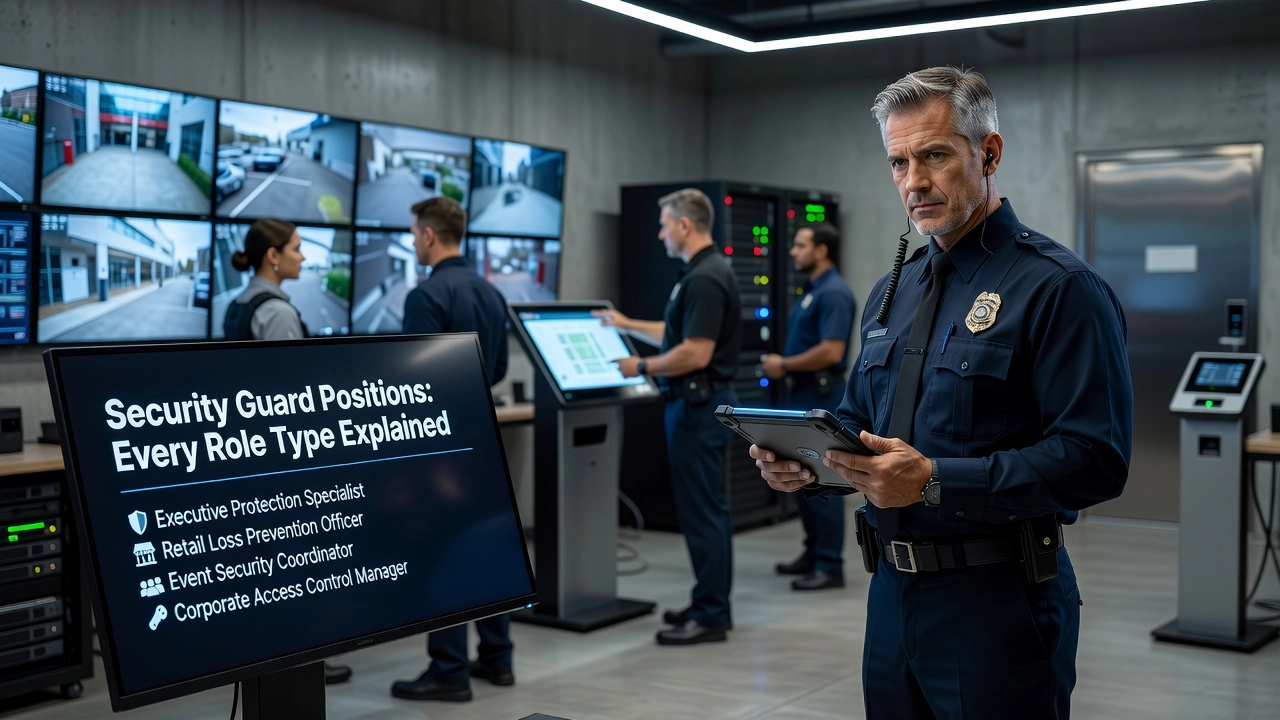
Every day, thousands of professionals step into roles that keep businesses, people, and properties safe. But most people outside the industry have no idea just how many different security guard positions actually exist. If you think security work means standing at a door or watching a monitor, you are only seeing a small fraction of what this field has to offer.
Whether you are considering a career in security, hiring guards for your organization, or simply curious about how professional protection works, understanding the full range of available roles is essential. Each position comes with its own set of responsibilities, required skills, and work environments, making this one of the most diverse fields in the workforce.
In this guide, we break down every major type of security guard position you need to know about. From armed patrol officers to event security specialists, you will get a clear and complete picture of what each role involves. By the end, you will have the knowledge to make informed decisions, whether that means choosing a career path or building a security team from the ground up.
What Are Security Guard Positions?
Security guard positions cover a wide range of specialised roles, including static guards, mobile patrol officers, concierge security, event guards, and construction site security. Every role in Victoria requires a current security licence issued under Victoria Police before you can legally work on the floor.
“Security guard” is not a single job title. It is a broad category covering distinct environments, responsibilities, and required skill sets. A static guard protecting a construction site operates under completely different protocols than a concierge officer managing access at a corporate tower or an event security officer managing crowd control at a live venue. Each role carries its own duties, physical demands, and licensing requirements.
The scale of this profession is significant. The global security services market is projected to reach $154.3 billion by 2035, and the industry generates over 162,300 new job openings per year in the U.S. alone, driven almost entirely by turnover rather than headcount growth. That consistent churn means opportunities remain steady for trained, licensed candidates.
In my experience, the most common mistake candidates make is applying for roles without knowing which licence tier that specific position requires. Showing up underprepared on licensing wastes everyone’s time and can disqualify you before the interview starts.
This guide breaks down each major position type with its duties, typical environment, and licensing context, so you can identify which role genuinely suits your background before you apply.
Pro Tip: Before browsing any unarmed patrol or entry-level security listings, confirm which licence class the role requires. Applying without the correct credentials is the fastest way to get filtered out automatically.
Security Guard Positions at a Glance
Here is a side-by-side breakdown of the five core security guard positions in Victoria. I’ve found this format cuts through the confusion faster than any written description for candidates just starting out.
| Position | Work Environment | Core Skill Required | Typical Shift Pattern | Licence Tier (Victoria) |
|---|---|---|---|---|
| Static Guard | Fixed post: retail, offices, industrial sites | Access control, observation, incident reporting | Day and/or night shifts (fixed hours) | Class 1 Licence |
| Mobile Patrol Officer | Vehicle-based, multiple client sites per shift | Route monitoring, alarm response, situational awareness | Rotating shifts including nights and weekends | Class 1 Licence |
| Concierge Security | Corporate and residential lobbies | Customer service combined with security screening | Business hours plus after-hours cover | Class 1 Licence |
| Event Security | Venues, festivals, sporting events, concerts | Crowd control, conflict de-escalation | Casual and event-based, evenings and weekends | Class 1 Licence |
| Construction Site Security | Active build sites | Asset protection, site access management, hazard awareness | Overnight and weekend shifts | Class 1 Licence |
All roles listed require at minimum a Certificate II in Security Operations (CPP20218) plus a Victoria Police security licence before employment can commence.
Most people overlook one critical detail: the licence tier listed above is the entry baseline only. Event security roles in Victoria often require a separate crowd controller endorsement under the Licensing & Regulation Division, so verify your specific role requirements before enrolling in training. For a full walkthrough of the licensing process, the Jobs and Skills Australia occupation profile for Security Officers and Guards is the most reliable current reference. You can also review how to become a full-time security officer for a step-by-step pathway through both training and Victoria Police licensing.
Pro Tip: Construction site roles frequently require a General Construction Induction (White Card) on top of your security licence. Confirm this with the site principal before your first shift; arriving without it will result in being turned away from the site entirely.
Static Guard
A static guard is assigned to one fixed location and stays there for the duration of their shift. That location could be a retail store, corporate office, industrial warehouse, or residential complex. The core mandate covers three areas: controlling who enters and exits, deterring criminal behaviour through visible presence, and responding to incidents as they occur.
What the Role Actually Involves Day-to-Day
Duties go beyond standing at a door. On a typical shift, a static guard monitors entry and exit points, conducts bag checks where authorised, writes detailed incident reports, and contacts police when a situation escalates beyond their authority to resolve. Most people overlook that these roles increasingly require operating CCTV systems and alarm panels as part of the standard workday. The Security Services Industry Award MA000016 formally classifies control room operators alongside physical guards, which tells you something important: tech literacy is no longer optional on many sites.
Know Your Environment Before You Accept the Role
Static positions range from low-traffic corporate lobbies to high-footfall shopping centres, and the risk profile differs significantly between them. Before accepting a placement, ask about shift length, site-specific hazards, and whether the role includes lone worker periods. Pay under the Award is structured across five levels. Entry-level guards typically start at Level 1, with base rates confirmed annually via Fair Work Australia’s current pay guide. These rates sit above the national minimum wage and include penalty loadings for nights, weekends, and public holidays.
For employers and candidates looking for professionally managed placements, ABCO’s professional static guard services cover a range of fixed-site deployments across Melbourne with 24/7 operational support built in.
Mobile Patrol Officer
A mobile patrol officer covers multiple client sites in a single shift using a dedicated patrol vehicle, running both scheduled rounds and randomised checks to maximise deterrence. Core duties include perimeter surveys, alarm response, access point verification, and submitting digital patrol reports after every site visit. How security guard roles are evolving in 2025 confirms that GPS route tracking and real-time mobile reporting apps are now standard tools in this role, replacing paper logs entirely.
This position is physically demanding and operationally independent. You need a clean driver’s licence, strong situational awareness across varied environments, and the confidence to make judgment calls at 2am without a supervisor reachable. I’ve found that mobile patrol consistently attracts guards who want variety over repetition; no two shifts cover the same ground in the same sequence, which is a deliberate deterrence strategy, not just scheduling convenience.
The contract security model is the structural backbone here. Contract security grew 50% globally between 2014 and 2022, from $22 billion to $33 billion, meaning almost every mobile patrol officer in Australia works for a contracted firm rather than directly in-house for a client. That structure matters for job seekers because your employer is the security company, not the sites you protect each night.
For anyone pursuing this pathway professionally, ABCO’s mobile patrol services outline what a contracted patrol operation looks like in practice across Melbourne, which is useful context before applying.
Pro Tip: Always ask a prospective employer how many sites you’ll cover per shift and whether patrol routes are GPS-verified. High site counts with no route accountability is a red flag for both workload and professional standards.
Concierge Security
Concierge security officers work from fixed posts inside corporate lobbies, residential high-rises, and hotels, functioning as the first point of contact for anyone entering the building. Unlike a static guard whose primary focus is deterrence, the concierge officer blends access control, customer service, and emergency response into a single role. I’ve found that candidates who underestimate the customer-facing side of this position consistently struggle in the first 90 days.
The interpersonal demands here are genuinely higher than most other security guard positions. Daily responsibilities include managing visitor logs, operating intercoms and integrated security systems, responding to lift entrapments or medical incidents, and coordinating directly with emergency services when situations escalate. Strong verbal communication and conflict de-escalation are non-negotiable, not optional extras.
Hiring trends support this shift toward more polished professionals. Leadership-level recruitment across security-adjacent sectors rose 31% year-on-year as of early 2026, and that appetite for supervisory-capable, composed professionals filters directly into concierge hiring decisions. According to Trust Consulting Services’ 2026 security skills guide, effective security personnel now need to combine observation, communication, technology awareness, and independent judgement simultaneously.
Presentation standards in concierge roles are noticeably stricter than other guard positions. Some Melbourne employers require prior hospitality or customer-facing experience alongside a valid security licence. Grooming, attire, and professional demeanour are assessed at interview. Candidates moving from retail security or event security into concierge roles tend to transition most smoothly, given the overlap in public-facing skills.
Pro Tip: Before applying for concierge roles, get a First Aid certificate and any formal customer service training documented on your resume. Employers in premium residential and hotel environments treat these as differentiators, not bonuses.
Event Security
Event security officers work at concerts, sporting events, festivals, corporate functions, and private gatherings. The role centres on three core tasks: managing crowd flow, screening entry points, and de-escalating conflict before it escalates. It is a physically demanding, high-pressure environment where composure and quick judgment matter more than almost any other skill.
Shifts are casual and event-based, which makes this one of the more flexible entry points in the industry. Candidates building hours toward full-time employment, or those who simply need a schedule that adapts to other commitments, consistently gravitate toward event work for this reason.
The Licence Detail Most Candidates Miss
Most people overlook that working as a crowd controller in Victoria requires a separate licence class, distinct from a standard security guard licence. Yarra City Council’s official event planning guidelines confirm this directly: a security guard licence alone does not authorise someone to work as a crowd controller. Candidates must verify their licence class covers the specific event type before accepting a shift.
Crowd management and conflict de-escalation are the two competencies employers screen hardest for during hiring. Completing dedicated training in both areas, through a registered provider before applying, gives your application a measurable edge. Victoria’s event security regulatory environment has matured significantly, and employers now expect candidates to arrive licence-ready and operationally aware.
For candidates looking for event security shifts with an established Melbourne provider, ABCO’s event security team is worth contacting directly.
Pro Tip: Apply during Melbourne’s peak event calendar, typically October through March, when demand for licensed crowd controllers spikes and casual rosters open fastest.
Construction Site Security
Construction site security officers protect active build sites from theft, vandalism, and unauthorised access. Most of this work happens overnight and on weekends, when contractors are off-site and the risk of intrusion is highest. I’ve found that beginners underestimate how physically demanding and isolated this role actually is: you are patrolling large, unlit perimeters, often alone, across uneven terrain with heavy machinery on all sides.
What the Role Actually Requires
Core responsibilities include monitoring access gates, conducting documented perimeter patrols, operating on-site CCTV and surveillance systems, and completing detailed shift logs for the site manager each morning. Equipment familiarity matters here; guards who cannot operate surveillance systems or log incidents accurately become a liability rather than an asset.
Asset theft from construction sites is a persistent, expensive problem for Melbourne builders. Materials, tools, and machinery are high-value targets that can be quickly resold, making this one of the most consistently in-demand construction site security positions year-round, not just during peak building seasons. In Victoria, you must also hold a current security licence under the Private Security Act 2004 before working any site.
The duties of a construction site security officer go beyond deterrence; they include emergency first response, trespasser management, and reducing the builder’s liability exposure from injuries on site.
Pro Tip: Before applying for construction site roles, get comfortable reading a basic CCTV control panel. Candidates who can demonstrate surveillance system familiarity during interviews consistently get shortlisted faster than those who cannot.
Victoria Licensing: What You Need Before You Apply
In Victoria, working as a security guard without a current licence is illegal, and both the individual and their employer face significant penalties under the Private Security Act 2004, administered by Victoria Police.
The standard licensing pathway has two steps: complete the Certificate II in Security Operations (CPP20218) through a registered training organisation, then submit your licence application through Victoria Police’s eligibility and training portal. Providers such as ASSET Education and TAFE Victoria offer the CPP20218 with flexible delivery options suited to working adults. NSTA Central (RTO 32292) in West Footscray is another confirmed Melbourne-based provider delivering this qualification.
Your application requires fingerprints, 100 points of certified identification, proof of completed training, a National Police Check, and payment of the applicable fee. Processing typically runs four to eight weeks, so plan ahead.
Most people overlook this detail: crowd controller is a separate authorisation class in Victoria. If you are targeting event security roles, confirm your licence application explicitly covers that activity. An interstate crowd controller licence does not automatically transfer under mutual recognition unless the Victorian equivalent class is included.
I’ve found that candidates who lodge their licence application while actively job searching, rather than waiting for an offer first, avoid the single most common delay in starting work. Employers cannot legally deploy you until the licence is issued. Start the process immediately after completing your Certificate II.
For a complete overview of professional security guard services and the roles available, review what licensed guards are expected to deliver on day one before you apply.
Pro Tip: Book your fingerprint appointment the same week you finish your CPP20218 training. It is a mandatory application requirement and appointment availability can add days to your timeline if left until the last minute.
Frequently Asked Questions
What licence do I need to work as a security guard in Victoria?
You need a Victoria Police security licence issued under the Private Security Act 2004. Before applying, you must complete the Certificate II in Security Operations (CPP20218) through a registered training organisation. The licence application fee is approximately AUD $258.60, with a three-year renewal of around AUD $138.80.
How much do security guards earn in Melbourne?
The average base rate sits around AU$25.17 per hour in 2026, with total annual pay ranging from AU$47,000 to AU$71,000 depending on role and shift pattern. Rates are governed by the Security Industry Award (MA000016); use the Fair Work Pay and Conditions Tool to calculate exact entitlements including night and weekend loadings.
What types of security guard jobs are available in Melbourne?
The five core positions are static guard, mobile patrol, concierge security, event security, and construction site security. Each role carries distinct duties, environments, and licensing considerations.
Can I apply without experience?
Yes. Entry-level static and event roles require only a current Victoria Police licence. Backgrounds in hospitality, retail, or the military are advantageous but not mandatory.
Do I need different licences for different roles?
The Class 1 unarmed guard licence covers most positions. Crowd controller registration is a separate authorisation class required specifically for event security roles in Victoria.
Pro Tip: Apply for your crowd controller registration at the same time as your Class 1 licence if you plan to work events. Processing both together saves weeks of waiting.
Common Pitfall to Avoid
The single most disqualifying mistake I see from candidates is submitting an application without a current, valid Victoria Police security licence. No reputable firm, including established Melbourne providers like ABCO Security, can legally roster an unlicensed guard. This is not a preference or a soft requirement; it is a legal obligation under the Private Security Act 2004, and both the employer and the individual face serious penalties for breaching it.
If you have completed your CPP20218 Certificate II in Security Operations but are still waiting on your licence, be transparent. As of July 2026, Victoria Police is processing new applications submitted as far back as 15 January 2026, meaning backlogs now exceed six months. Disclose your submission date upfront and provide your expected approval timeline. Submitting an application and hoping an employer will hold the position is not a strategy; it wastes goodwill and burns the relationship before it starts. For a deeper breakdown of common licensing errors, this guide on security guard licence mistakes in Australia is worth reading before you apply.
A secondary pitfall is applying for the wrong position type. A standard guard licence does not authorise crowd control work. Sending a generic application to an event security employer when you hold no crowd controller registration signals poor industry awareness and guarantees rejection.
Before submitting any application, run this check:
- Confirm your exact licence class against the Victoria Police public register
- Match that class to the specific role requirements
- Attach a National Police Check dated within the last 12 months
Conclusion
The security industry is far more diverse and specialized than most people realize. Whether you are exploring a career path, building a security team, or evaluating your organization’s protection needs, understanding the full landscape of available positions gives you a clear advantage.
Here are the key takeaways to remember: security roles vary widely in responsibilities, environments, and required skill sets; each position serves a specific purpose within the broader safety ecosystem; and the right role depends entirely on matching expertise to the unique demands of the situation.
Now that you have a complete picture of every major security guard position, take the next step. If you are job seeking, identify the roles that align with your strengths and pursue the proper certifications. If you are hiring, use this knowledge to build a smarter, more effective security team. Your safety goals are within reach.
about
avada factory
Sempery ultricies nibh at dolor cras urna eleifend nec. Atiam efficitur tempor.