Most people assume that having a security system means they are protected. The reality is far more nuanced. A camera on your doorstep or a sensor on your window is only as valuable as the system watching over it, interpreting the data, and responding when something goes wrong.
This is where security monitoring becomes the defining factor between a false sense of safety and genuine, reliable protection. Professional monitoring is not simply an add-on service; it is the operational backbone of any serious security strategy. Yet many homeowners and business owners still do not fully understand what it involves, how it works, or what separates a mediocre provider from an exceptional one.
In this analysis, we break down what professional security monitoring actually looks like in practice. You will learn how modern monitoring centers operate, what response protocols look like behind the scenes, which technologies drive real-time threat detection, and how to evaluate whether your current setup is truly working for you. If you have ever wondered whether your protection is as solid as it should be, this is the place to start.
Direct Answer: What Security Monitoring Actually Is
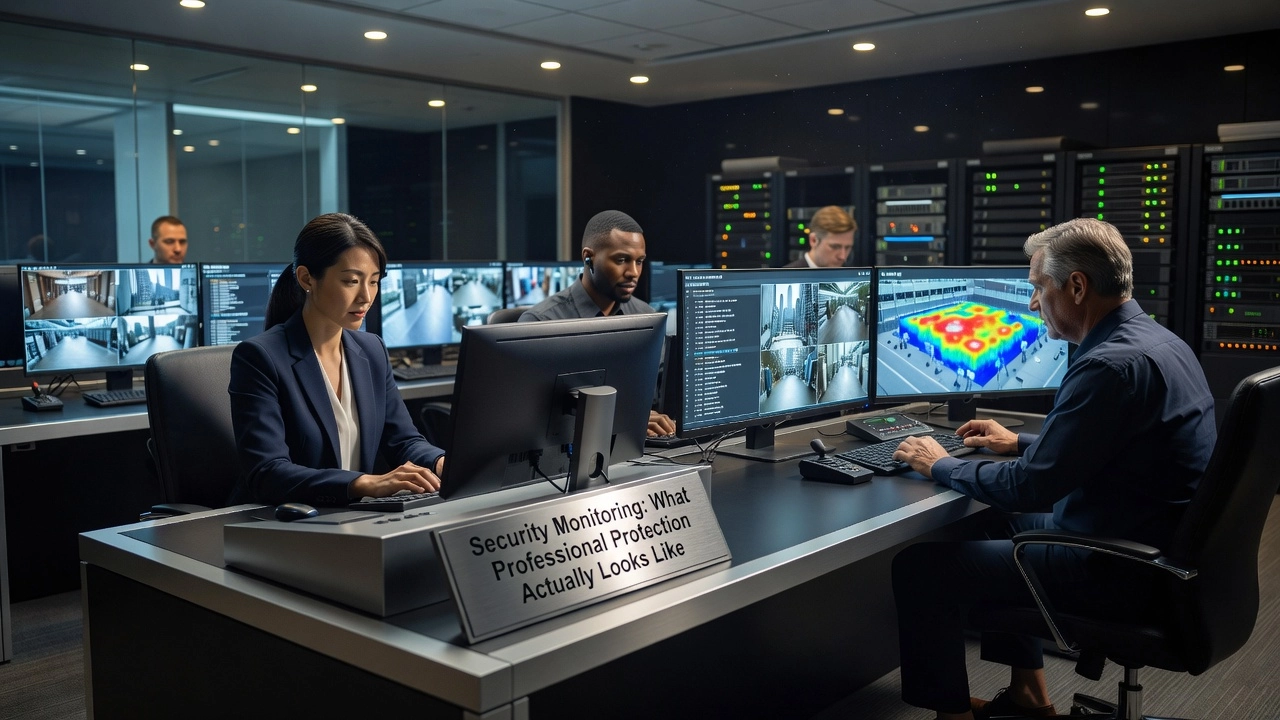
Security monitoring is the active, real-time oversight of your property by trained operators at a staffed, licensed response centre, not a camera recording footage for later review. The critical differentiator is human intervention: when a verified threat is detected, a professional acts immediately rather than an app notification waking a business owner at 2am who must then decide what to do next.
This article is not a CCTV explainer. It is a practical decision-making guide for Melbourne businesses weighing professional monitoring against automated or self-managed camera systems. Those are fundamentally different products, and choosing the wrong one has real consequences.
Live video monitoring works by combining intelligent analytic cameras with a staffed centre whose operators review alerts, verify threats, issue audio warnings through onsite speakers, and can dispatch authorities without any input from the business owner. That chain of response happens whether you are in a meeting, asleep, or interstate.
Self-monitoring shifts that entire burden onto you. Your phone receives an alert, you assess the footage, you decide whether to call police. That process takes minutes you may not have, and it assumes you are available at the exact moment something happens. Most people overlook how often incidents occur during the hours they are least reachable.
The question Melbourne businesses should be asking is not whether to install cameras or an alarm system, but whether any component in their setup is being actively monitored by a licensed, accountable party. A 4K camera with cloud storage is an evidence-collection tool. Professional CCTV and alarm monitoring is a response infrastructure.
What Security Monitoring Actually Covers
Security monitoring spans four operational layers, and most businesses only think about one of them.
The four core components are: CCTV alarm monitoring, alarm verification and dispatch, mobile patrol integration, and access control oversight. Each layer depends on the others. A camera feed without verified response is just footage. An alarm without patrol backup is just a notification. The model only works when all four are connected under a single managed system.
Australia’s security market reflects exactly this shift. The broader sector is projected to grow from AUD 4.38 billion to AUD 8.94 billion by 2035 at a 7.4% CAGR, and the growth isn’t coming from hardware purchases. It’s coming from businesses demanding integrated, managed protection rather than fragmented equipment.
What AI Actually Does in 2026
Modern monitoring platforms now layer AI across the camera feed before a human operator ever looks at a screen. In my experience, the capabilities that change response quality most are: facial recognition against watchlists, behavioural anomaly detection, vehicle/person differentiation to cut false triggers, and pre-recording buffers that capture footage seconds before a motion event registers. That last feature is consistently undervalued; most incidents begin before the trigger point.
Where AI Stops and Professionals Start
Here’s the limitation most vendors won’t say plainly: AI detects and flags. It does not decide or act. A trained operator reviews the verified event, assesses context, and determines whether to dispatch. A licensed guard responds physically and makes judgment calls that no algorithm can replicate. This is precisely where professional CCTV alarm monitoring with verified response earns its cost; it closes the gap between a flagged event and a resolved one.
Most people overlook access control oversight as part of this picture. Door-held alerts, credential anomalies, and after-hours entry events feed directly into the monitoring centre alongside camera data, giving operators a complete site picture rather than isolated triggers.
Common Pitfall to Avoid: Buying each component from a different vendor. Without a unified escalation chain, verified response breaks down at the handoff point, and that is exactly when incidents escalate.
Professional Monitoring vs. Automated Systems: What Melbourne Businesses Need to Know
Most people overlook the compliance dimension entirely when comparing professional monitoring to a DIY camera setup from JB Hi-Fi. I’ve found that Melbourne business owners often treat this as a feature comparison when it’s actually a regulatory and liability question.
The 9.7% annual growth in security hardware is flooding retail shelves with capable-looking devices from Arlo, Eufy, and Reolink. Meanwhile, the professional installation and monitoring segment grows at just 1.4% annually through 2026. That gap explains the marketing noise, but it does not change the risk calculus for a commercial or construction site operator.
The Compliance Gap DIY Products Cannot Bridge
Consumer-grade systems are designed and assessed at residential grade. Under Victoria’s Private Security Act 2004, monitoring centres must hold the appropriate licence issued through Victoria Police Licensing and Regulation Division. A Reolink camera pushing notifications to your phone does not satisfy that obligation. It also does not meet Australian Standard AS 2201, which governs intruder alarm system design and monitoring grades for commercial installations. For construction sites specifically, the intersection of WorkSafe Victoria requirements and commercial insurance conditions makes unlicensed DIY setups a genuine liability exposure, not just a technical shortfall.
| Feature | Professional Monitoring (ABCO) | AI/DIY Systems (Arlo, Eufy, Reolink) |
|---|---|---|
| 24/7 Human Response | Staffed monitoring centre | App notification only |
| False Alarm Verification | Operator-verified before dispatch | AI detection, owner decides |
| Mobile Patrol Integration | Contracted patrol dispatch | Not available |
| Regulatory Compliance (Vic) | Licensed under Private Security Act 2004 | Residential-grade, unlicensed for commercial |
| Incident Documentation | Timestamped operator logs, evidentiary-grade | Cloud footage only, retention-limited |
| Suitability: Commercial/Construction | Purpose-built | Not suitable |
| Cost Model | SLA contract, scalable | Hardware purchase + optional cloud subscription |
Where the ROI Argument Actually Sits
Consumer resistance to monthly monitoring subscriptions is real and well-documented across the home security segment. For residential users, that pricing sensitivity is reasonable. For commercial operators, the ROI case for a professional SLA-based contract rests on response capability and liability management, not on feature count.
Professional monitoring generates timestamped operator logs and verified dispatch records that support insurance claims and, where required, evidentiary use. A consumer cloud subscription with a 30-day footage retention limit does not. When an insurer asks for documented incident response records after a break-in, the difference between the two becomes financially concrete. For sites requiring mobile patrol integration, the equation is even clearer: no DIY platform dispatches a physical guard under a contracted SLA window. That capability exists only within a professional monitoring ecosystem.
Pro Tip: Before signing any monitoring contract, confirm the provider holds a current licence under Victoria Police LRD and ask specifically whether their monitoring centre is graded to AS 2201. If they cannot answer both questions immediately, keep looking.
The 3 Business Types That Need Professional Monitoring Most
Construction Sites
I’ve found that construction project managers consistently underestimate monitoring requirements until their first equipment theft event. At that point, reactive CCTV footage documents what was stolen but cannot recover it, trigger a response, or prevent a repeat incident. The lesson is always learned after the financial damage is done.
Construction sites combine high-value portable assets, including tools, plant equipment, copper cabling, and fuel, with zero fixed wired infrastructure and extended unoccupied periods overnight and on weekends. Solar-powered CCTV towers and wireless monitoring are the only practical deployment model because perimeters shift as builds progress. Purpose-built construction site security with wireless CCTV addresses exactly this need, with systems that reposition as site layouts evolve. When a live alert triggers at 2am, footage alone achieves nothing without a physical response. Mobile patrol units dispatched in real time convert a monitoring event into on-ground deterrence, closing the gap between detection and action.
Retail and Commercial Premises
The highest-risk window for retail and commercial premises sits between 10pm and 6am. During this period, staff are absent, alarm activations go unwitnessed, and response time depends entirely on whether a professional monitoring centre is watching. Self-monitored app notifications are functionally useless if the owner is asleep.
Professional monitoring with verified alarm response also reduces false dispatch costs directly. Australian police jurisdictions apply attendance penalties or cost-recovery levies to premises with repeated unverified activations. Beyond operational savings, commercial insurers increasingly link premium reductions to verified professional monitoring, making this a compliance requirement, not just a security preference.
Events and High-Footfall Venues
Crowd management, perimeter monitoring, and incident response at events require coordinated human decision-making measured in seconds. A smartphone push notification cannot provide that. By the time an owner reads an alert, assesses footage, and contacts someone, the response window has closed.
Professional monitoring centres maintain continuous human oversight, enabling simultaneous coordination with on-ground personnel, venue management, and emergency services. This command-and-control function is structurally absent from self-monitored setups regardless of camera quality. For events requiring roving coverage across multiple zones, professional event security integrated with live monitoring provides the layered response that a single camera feed and a mobile app simply cannot replicate.
Common Pitfall to Avoid: Deploying cameras without a verified response protocol. Recording an incident is not the same as preventing or interrupting one. All three of these business types share that single failure point.
What to Demand From a Security Monitoring Provider
I’ve found that most businesses only ask about price when evaluating a provider. They never ask for documented response time SLAs. That is the metric that matters when an incident occurs, not the monthly fee.
The Five Non-Negotiable Criteria
Before signing any monitoring contract, every Melbourne business should verify these five points in writing:
- 24/7 staffed monitoring centre: A human operator must be reachable at all hours. Automated-response-only systems do not constitute professional monitoring.
- Mobile patrol integration: The provider should dispatch a licensed patrol officer on alarm, not simply notify police or send you an SMS. ABCO’s mobile patrol service operates precisely this way.
- Alarm verification before dispatch: Verification reduces unnecessary callouts and protects you from false alarm costs with Victoria Police.
- Victorian licensing: Every provider must hold a current Private Security Business Licence under the Private Security Act 2004 (Vic). Security alarm monitoring is explicitly a prescribed licensed activity. Verify any provider’s status on the Victoria Police public register before committing.
- Documented response time SLAs: Written, contractually binding commitments stating average response time in minutes, not vague “available 24/7” language.
Victorian Compliance Has Sharpened Significantly
The regulatory context tightened on 19 June 2025 when the Private Security and County Court Amendment Act 2024 came into force. All business registrations are being converted to full Private Security Licences, with the industry-wide transition deadline set for 19 June 2026. Engaging a provider that has not completed this transition exposes your business to direct compliance and insurance liability. The requirement for providers of security equipment to hold a valid licence is not administrative formality; your insurer may void a claim if a non-licensed provider was operating your system at the time of an incident.
The SLA Question Most Businesses Never Ask
A credible provider states average alarm response time in minutes. If a provider cannot give you a specific figure, that absence of transparency is itself useful information. A proper SLA includes defined response tiers, escalation procedures, and reporting obligations, not just a promise of availability. Ask specifically: “How many operators staff your centre between 2am and 5am on a weeknight?” That question separates genuine 24/7 operations from skeleton-crew setups.
The ROI Case Is Concrete
Professional CCTV alarm monitoring generates three measurable returns. First, alarm verification before dispatch eliminates unnecessary police callout costs and reduces the risk of placement on a false alarm register. Second, a monitoring contract from a licensed, SLA-bound provider strengthens your insurer’s risk assessment; bring the contract to your next premium review. Third, timestamped event logs from a professional monitoring system directly support WorkSafe Victoria incident reporting obligations and internal investigations, providing a defensible audit trail when it matters most.
Pro Tip: Request a sample SLA document before signing. If a provider hesitates or cannot produce one, move on. Any operation running a credible 24/7 staffed centre has this documentation ready.
How AI Is Changing Monitoring in 2026 and What It Cannot Replace
The technology improvements in 2025 and 2026 are genuine and worth acknowledging. Integrated security platforms, real-time anomaly detection, pre-recording buffers that capture footage seconds before a motion trigger fires, and cloud-based alert management have meaningfully improved monitoring infrastructure. These are not marketing claims; they represent real operational upgrades.
Australia’s smart home security segment is growing at 13.0% CAGR, and AI-driven hardware is accelerating fast within that space. However, commercial-grade monitoring requirements sit in a completely different category. Residential AI systems are not engineered for the redundancy, audit trail integrity, or response-time standards that enterprises and government operators require. The gap between a consumer-grade AI camera and a professionally monitored electronic security platform is not a price difference; it is an engineering and accountability difference.
The Context Problem AI Cannot Solve
Here is where most AI monitoring discussions fall apart. Algorithms identify motion, shapes, and movement patterns. A trained monitoring operator reads context. I’ve seen this play out in practice: a contractor arriving at 11pm with a work order is an authorised access event; the same person without one is a trespass situation. An AI system logs both as “person detected near entry point.” A human operator asks why.
The market shift from reactive to proactive security is real, but “proactive” is being misused. A faster push notification to your phone is not a proactive response. In professional monitoring, proactive means a mobile patrol dispatch triggered by human operator judgment, not an automated alert waiting for you to act.
Most people overlook that Australian enterprises and government agencies are not replacing physical security with AI; they are integrating both. On-premises systems held 68.75% revenue share in AI surveillance in 2025, driven by military, defence, and critical infrastructure operators who require data sovereignty. That figure tells you where high-security end-users actually stand on the “AI replaces everything” narrative.
Pro Tip: When a vendor pitches you an AI-only monitoring solution, ask one question: who makes the dispatch decision when the algorithm flags an event? If the answer is not “a licensed human operator,” the system is an alert tool, not a monitoring service.
Common Pitfall to Avoid
Most businesses evaluate security monitoring providers the same way they buy a TV: they compare specs. Camera resolution, sensor range, device brand. That is solving the wrong problem entirely.
Monitoring value is determined by what happens after the alert fires, not before it. A 4K camera connected to an unstaffed app is a recording device. A professionally monitored site with documented alarm-to-dispatch response times is a response system. Those are not the same product.
Before signing anything, ask every provider for three things: their verified alarm-to-dispatch time in writing, the specific Melbourne suburbs and postcodes within their guaranteed patrol coverage radius, and their current Victorian Security Industry licence credentials issued under the Private Security Act 2004 (Vic). A credible provider produces all three without hesitation.
The cost difference is real. Professional monitoring with contracted SLAs costs more than a Reolink or consumer-grade setup. It is also the only option that holds up under a WorkSafe Victoria audit, supports a legitimate insurance claim, or produces an auditable response chain for a police handover. Consumer-grade systems produce footage. Professional response systems produce accountability. Insurers, WorkSafe inspectors, and police investigators know the difference. Make sure your provider does too.
Pro Tip: Request a sample SLA document before the sales conversation ends. If the provider cannot produce one on request, that tells you everything about how they operate when an incident actually occurs.
Frequently Asked Questions
What Is Professional Security Monitoring and How Does It Differ from CCTV Cameras Alone?
Professional security monitoring, often called back-to-base monitoring, connects your property’s alarm and camera systems to a staffed response centre operating around the clock. Trained operators receive real-time alerts detailing which sensor triggered, which zone was affected, and the exact time of activation. CCTV cameras alone are passive recording tools; they capture footage but take no action. A monitored system creates an active communication link, meaning an operator can review live footage, verify whether a threat is genuine, and dispatch a response, all within minutes of an alarm trigger. The practical difference is the gap between evidence gathered after a break-in and an incident prevented before one occurs.
Do Melbourne Businesses Need a Licensed Security Monitoring Provider?
Yes. In Victoria, security providers operate under the Private Security Act 2004, administered by the Security Industry Regulatory Unit (SIRU). Any company providing commercial alarm monitoring or guard response services must hold the appropriate licence. Beyond legal compliance, look for membership with ASIAL (Australian Security Industry Association Limited), the peak industry body, as a minimum quality baseline. I’ve found that businesses which skip this verification often discover their provider subcontracts monitoring to an unlicensed third-party centre, which creates liability gaps. Always ask for licence numbers upfront, not after you’ve signed a contract.
How Quickly Should a Security Monitoring Provider Respond to an Alarm Trigger?
Industry best practice sets operator acknowledgment at 30 to 60 seconds from the moment an alarm signal is received. From there, the operator contacts nominated keyholders or dispatches mobile patrol services according to your pre-agreed response protocol. Patrol arrival times vary by suburb and time of night, but reputable providers will commit to documented SLA windows in writing. If a provider cannot give you a written response time guarantee, treat that as a disqualifying factor. Response speed is the metric that separates functional monitoring from monitoring that only looks good on paper.
Can Security Monitoring Integrate with Mobile Patrols?
Directly, yes. This integration is one of the most operationally valuable features of a properly structured monitoring contract. When an operator verifies an alarm as a credible threat, they can immediately dispatch a licensed patrol to the premises rather than waiting for a keyholder to respond. For sites like warehouses, retail premises, or construction zones, this creates a seamless escalation from remote detection to physical presence on-site. ABCO’s CCTV and alarm monitoring service operates alongside mobile patrol teams, meaning both functions are coordinated through a single provider rather than two separate companies that need to communicate with each other during an active incident.
What Types of Businesses Benefit Most from 24/7 Security Monitoring in Melbourne?
The highest-demand categories are retail, hospitality, healthcare, warehousing, and construction. Retail premises face consistent theft and after-hours break-in risk. Construction sites carry high-value plant and materials with no permanent occupants overnight. Healthcare and hospitality facilities operate around the clock with staff who need real-time support, not a recorded incident report the next morning. For businesses running event security operations or managing temporary high-footfall venues, integrated monitoring provides situational awareness that static staffing alone cannot cover. Cost efficiency is also a genuine factor; monitored systems frequently deliver broader coverage at lower overall cost than expanding on-site guard hours.
Pro Tip: Before signing any monitoring contract, request a copy of the provider’s central station grading certificate. Monitoring centres in Australia are graded by ASIAL, and a Grade A1 or A2 centre is the standard you should require for commercial premises. Anything lower means your alarm signal may not be treated with the response priority your business risk level demands.
Conclusion
True security is not about the hardware on your walls; it is about the intelligence and response capability behind it. Professional monitoring transforms passive equipment into an active defense system. The key takeaways are clear: monitoring centers provide round-the-clock human oversight, response protocols determine how quickly threats are neutralized, and the technology driving real-time detection separates reliable protection from mere reassurance.
Equally important is knowing how to evaluate your current provider against meaningful standards, not just marketing promises.
Do not wait for a security failure to reveal the gaps in your setup. Review your monitoring provider today, ask hard questions about their response times and verification processes, and demand transparency about their capabilities. Your safety deserves more than a blinking light. It deserves a system that is genuinely, consistently working for you.
about
avada factory
Sempery ultricies nibh at dolor cras urna eleifend nec. Atiam efficitur tempor.