
ISO 31000 is a non-certifiable, organisation-level risk management framework you use to identify, assess and treat security risks alongside every other risk your business carries. It gives you principles, a framework and a repeatable process, not a checklist to pass an audit against. Read it as a common language: ISO 31000:2018 for the core guidance, AS ISO 31000:2018 if you need the Standards Australia adoption for local governance references, and ISO 31010 when you get to the technique-selection stage of a security risk assessment.
Three things to do this week if you’re starting from scratch:
- Set the scope: decide whether you’re running this for one site, one business unit, or the whole organisation.
- Run a two-hour risk identification workshop with security, facilities and IT in the room together.
- Pull a free security risk assessment template so you’re not building a risk register from a blank spreadsheet.
Key Takeaways
ISO 31000 works for security risk because it supplies principles, a framework and a repeatable process rather than a fixed checklist, letting you treat physical, cyber and personnel risk under one system.
| Point | Details |
|---|---|
| Not certifiable | ISO 31000 is guidance; pair it with ISO/IEC 27001 if you need a certifiable technical standard. |
| Eight principles anchor practice | Human and cultural factors are often the deciding principle in whether security treatments hold up. |
| Seven-stage process | Run establish context through communicate and consult, using ISO 31010 for technique selection. |
| Domain mapping matters | Map risk sources and controls separately for physical, cyber and personnel security. |
| Abcosecurity delivers hands-on | Abcosecurity applies 15 years of licensed security experience to build and run ISO 31000 aligned risk assessments. |
Table of Contents
- What is ISO 31000 and what does it actually cover?
- What are the eight ISO 31000 principles?
- What are the ISO 31000 framework components for security governance?
- How do you run the ISO 31000 risk management process for security?
- How does ISO 31000 apply to physical, cyber and personnel security risks?
- What mistakes derail ISO 31000 implementation for security teams?
- Is ISO 31000 certifiable, and what standards work alongside it?
- What tools, templates and training actually help implementation?
- Why human and cultural factors decide whether security risk treatment works
- What I’d prioritise if I were running this program
- Get help building an ISO 31000 aligned security risk program
- Sources
- FAQ
What is ISO 31000 and what does it actually cover?
ISO 31000 defines risk as “the effect of uncertainty on objectives” — deliberately broader than “something bad might happen.” That framing matters for security teams because it captures upside risk too (a new access control system might create efficiency gains you hadn’t planned for) alongside the obvious downside scenarios.
The standard is generic by design. It doesn’t care whether your risk is a ransomware attack, a disgruntled contractor with a keycard, or a supply chain disruption at a construction site. The same principles, framework and process apply. That’s deliberate: ISO 31000 is intentionally non-prescriptive, built to be customised rather than followed like a recipe.
Here’s the part people get wrong most often:
ISO 31000 is guidance, not a certifiable management system standard. You cannot get “ISO 31000 certified” the way you can get certified to ISO/IEC 27001 or ISO 9001. Auditors can assess whether your risk practices align with it, but there’s no certificate to frame on the wall.
If you want the full text rather than summaries, the ISO standard page is the authoritative source, with AS ISO 31000:2018 as the local adoption and ISO 31010 as the companion document for technique selection.
What are the eight ISO 31000 principles?
The principles sit at the centre of the standard’s “onion diagram” for a reason. Skip them and your framework becomes a paperwork exercise. Here’s each one with a practical security check attached.
- Integrated — Security risk shouldn’t live in a silo. Check: does your risk register feed into enterprise risk reporting, or does it sit in a folder only the security manager opens?
- Structured and comprehensive — Your process needs consistent method, not ad hoc judgement calls. Check: do different sites or teams assess risk the same way?
- Customised — The framework must fit your context, not a generic template. Check: does your risk criteria reflect your actual threat environment (a hospital differs from a construction site)?
- Inclusive — Stakeholders with relevant knowledge need a seat at the table. Check: are frontline guards and site supervisors consulted, or only management?
- Dynamic — Risk changes, and your assessment should keep pace. Check: when did you last update your register after an incident or a new threat emerged?
- Best available information — Decisions rest on the best data you can get, with its limits acknowledged. Check: are you using incident data and threat intelligence, or gut feel?
- Human and cultural factors — People shape how risk is actually managed day to day. This one is often decisive in security specifically: a brilliant CCTV upgrade means nothing if staff prop doors open out of habit.
- Continual improvement — Risk management should get sharper with experience. Check: do you review what worked after every treatment plan closes out?
What are the ISO 31000 framework components for security governance?
The framework is the scaffolding that keeps the process from becoming a one off exercise. It has five working parts: leadership and commitment, integration into governance, adequate resourcing, clear accountability, and embedding risk activity into existing processes like budgeting, planning and reporting.
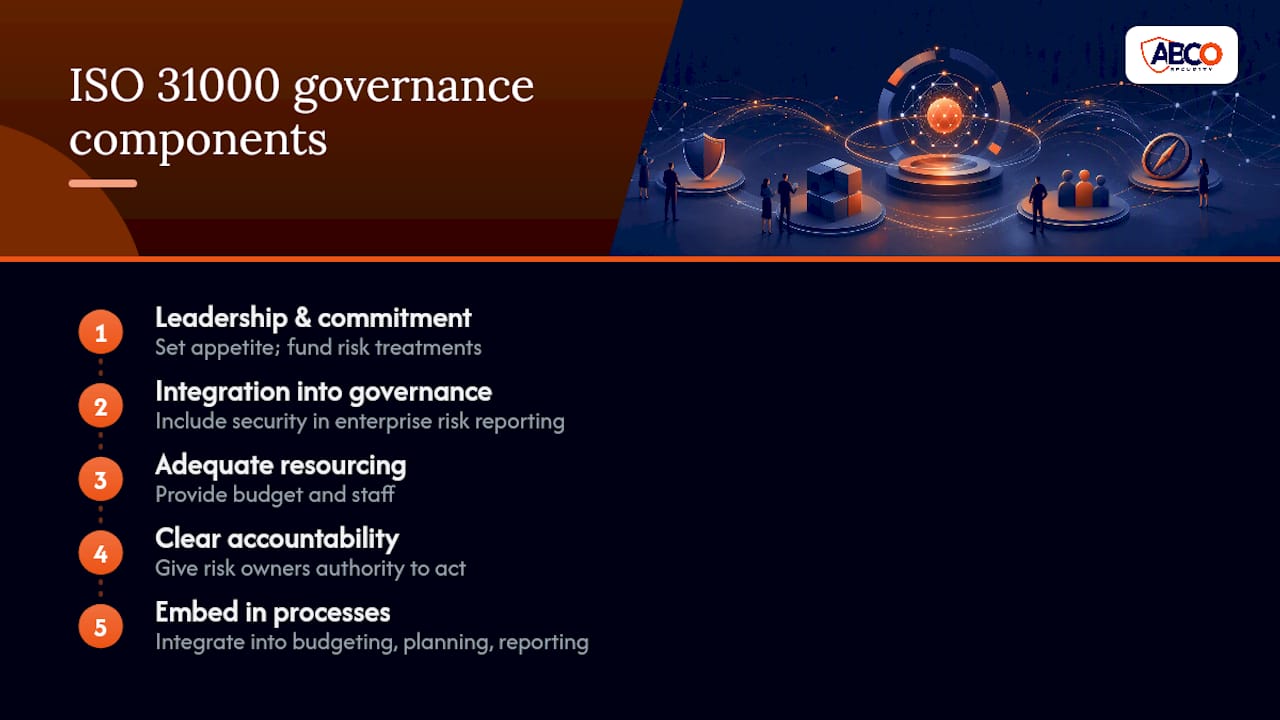
Roles matter more than most implementations admit. Senior leadership needs to set risk appetite and actually resource the treatments that follow, not just sign off on a policy document. Risk owners (often facility managers or site leads) need authority to act, not just visibility. Security teams supply the technical assessment and monitoring. Enterprise risk management, where it exists, keeps security risk sitting alongside financial and operational risk in the same reporting line rather than off in its own silo.
A simple framework diagram helps more than a lengthy policy document. Draw governance at the top, your risk management process in the middle, and the specific security risk activities (site assessments, access reviews, incident data) feeding in from the bottom. If you already run ISO 9001 quality management systems, you can slot this framework alongside it rather than building parallel governance structures.
Pro Tip: Put risk review on the same meeting cadence as your existing operations review. A framework that requires a separate standing meeting rarely survives its first busy quarter.
How do you run the ISO 31000 risk management process for security?
The process is the engine room. It runs in seven stages, and skipping any one of them tends to surface later as a gap in your treatment plan.
- Establish the context — Define internal factors (organisational objectives, risk appetite) and external factors (threat environment, regulatory obligations). Deliverable: a short context statement.
- Identify risks — List sources of risk across physical, cyber and personnel domains. Deliverable: a populated risk register.
- Analyse risks — Understand likelihood and consequence for each identified risk. Deliverable: analysed entries with supporting evidence.
- Evaluate risks — Compare analysed risk against your criteria to decide what needs treatment first. Deliverable: a prioritised risk list.
- Treat risks — Select and implement controls. Deliverable: a treatment plan with owners and dates.
- Monitor and review — Track whether treatments are working and whether new risks have emerged. Deliverable: a review log.
- Communicate and consult — Run throughout, not as a final step. Deliverable: stakeholder sign off and updated documentation.
Which technique you use for analysis depends on maturity and stakes:
- Qualitative methods (risk matrices, expert judgement) work well for a fast start or lower-stakes risks.
- Quantitative methods (loss estimates, probability modelling) suit high-value assets or regulatory-driven assessments.
- Hybrid approaches combine both, common in mature security programs juggling physical and cyber risk together.
ISO 31010 is the reference document for choosing between these, and it’s worth reading before you commit to one method across an entire program.
Your risk register should map impact categories to confidentiality, integrity and availability (the CIA triad) wherever the risk touches information systems, alongside physical impact categories like life safety and asset loss. Abcosecurity’s risk assessment process guide walks through building a register that covers both.
How does ISO 31000 apply to physical, cyber and personnel security risks?
The process is identical across domains. What changes is the source of risk and the controls available.
- Physical security: sources include unauthorised site access, perimeter breaches and equipment theft. Controls typically include access control systems, CCTV, and licensed patrol coverage.
- Cyber security: sources include phishing, ransomware and misconfigured systems. Controls typically include network segmentation, monitoring and incident response plans.
- Personnel security: sources include insider threat, inadequate vetting and poor offboarding. Controls typically include background checks, access reviews tied to role changes, and clear termination procedures.
A short worked example: a construction site identifies “unauthorised after hours access” as a risk during the identification stage. Analysis shows moderate likelihood (previous minor incidents, an unmonitored gate) and high consequence (theft of plant equipment, safety liability). Evaluation places it in the “treat now” category. Treatment combines a gate access control upgrade with mobile patrol checks during vulnerable hours. Monitoring tracks incident frequency for the following quarter. That’s the full loop, run in a matter of weeks rather than months.
One applied case study of information-system risk management used ISO 31000 alongside STRIDE threat modelling and the CIA triad to build a prioritised risk register and treatment plan for a manufacturing organisation, which shows the framework’s process holds up even when combined with more technical, cyber-specific methods.
Where your risk touches information systems specifically, pairing ISO 31000 with ISO/IEC 27001 or ISO 27005 gives you the technical control detail that ISO 31000 deliberately leaves generic. Integrated fire and security solutions for facility managers show what that coordination looks like in practice, matching technical systems to a documented risk process rather than installing hardware in isolation.

What mistakes derail ISO 31000 implementation for security teams?
Most failures aren’t technical. They’re organisational.
- Treating it as a checkbox — Running one workshop and calling the framework “done.” Remedy: schedule the monitor and review stage into the calendar before you finish stage one.
- Missing leadership commitment — Risk registers built by security teams with no executive sponsor to fund treatments. Remedy: get a named executive risk owner before you start identification.
- Poor context definition — Skipping straight to identification without agreeing scope or risk appetite. Remedy: a one page context statement, signed off, before workshops begin.
- Weak stakeholder consultation — Only management input, no frontline voice. Remedy: include at least one operational staff member in every identification session.
- Over-reliance on technical tools — Buying a GRC platform and assuming the culture will follow. Remedy: pair any new tool rollout with a short briefing on why the process matters, not just how to log entries.
Pro Tip: Measure cultural embedding, not just documentation completeness. Track how many risk items were raised by frontline staff versus management. That ratio tells you more about real adoption than a completed register ever will.
Abcosecurity’s industry best practices guide covers several of these pitfalls from the operational side, worth a read alongside your own gap analysis.
Is ISO 31000 certifiable, and what standards work alongside it?
ISO 31000 is guidance, not a certifiable management system standard. There’s no certificate, and no accredited body issuing one. What auditors can assess is whether your risk practices align with its principles and process, which is a different (and honestly more useful) exercise than chasing a badge.
That distinction shapes which standards you pair it with:
- AS ISO 31000:2018 — the Standards Australia adoption, useful when your governance documentation needs a locally recognised reference.
- ISO/IEC 27001 — certifiable, technical, information-security specific. Use when you need audited controls for information systems.
- ISO 27005 — technique guidance specifically for information security risk assessment, often integrated with ISO 31000 in agile development and IT contexts.
- ISO 31010 — your technique-selection reference across any risk domain, not just information security.
For audit evidence, use ISO 31000’s process stages as your documentation skeleton (context statement, register, treatment plan, review log) and let ISO/IEC 27001 or sector-specific standards supply the certifiable technical detail on top.
What tools, templates and training actually help implementation?
Start with a risk register template that already has impact categories, likelihood scales and treatment fields built in. Building one from scratch burns weeks you don’t need to lose. Abcosecurity’s risk assessment process guide and downloadable template suit a quick start; more mature programs tend to graduate to dedicated GRC software once the register grows past a few hundred lines.
For training, look for three tiers: general ISO 31000 awareness training (a day, suits anyone touching the risk register), risk assessment technique workshops covering ISO 31010 methods (suits analysts doing the actual evaluation work), and specialist ISO 27005 integration courses if your risk load is heavily information-security weighted. When evaluating a course, check whether it uses your actual industry’s risk examples or generic case studies. Generic training rarely translates well to a construction site’s threat profile.
If you’d rather skip the template-building step entirely, download Abcosecurity’s free security risk assessment template and start populating it directly against your own sites.
Why human and cultural factors decide whether security risk treatment works
Technical controls fail quietly when the culture around them is weak. A card access system means nothing if staff prop doors for convenience. A monitoring platform means nothing if alerts get ignored because no one owns the response. Practitioners consistently point to human and cultural factors as the make-or-break element in security risk treatment, not the sophistication of the tools deployed.
You can measure cultural adoption with a handful of concrete indicators: whether cross-functional risk meetings actually happen on schedule, whether frontline staff raise risks unprompted, and whether your risk maturity score improves year on year rather than plateauing after the first assessment cycle.
Sustainable risk treatment depends less on the control you choose than on whether the people operating around it understand why it exists.
Abcosecurity has spent over 15 years delivering integrated security programs across construction, healthcare and corporate environments, work that consistently shows the same pattern: technology paired with trained, licensed personnel and clear governance outperforms technology deployed alone.
Pro Tip: If your risk maturity score has flatlined for two review cycles, the problem is almost never the framework. It’s usually that the same three people are doing all the risk thinking.
What I’d prioritise if I were running this program
Scope and governance come before tools, every time. Get a named risk owner and an honest context statement before touching a risk matrix template. The real trade-off you’ll face is speed against rigour: a fast, workshop driven identification exercise gets you moving, but centralising ownership under one accountable role beats spreading it thin across a committee that meets quarterly. Quick wins matter for momentum, but they only stick when someone senior is actually accountable for the treatment plan closing out.
Get help building an ISO 31000 aligned security risk program
Reading the standard is one thing. Running a live risk workshop across a construction site, a hospital, or a multi tenant corporate building with 15 years of licensed security delivery behind it is another. Abcosecurity is the practical alternative to building this in house from scratch: our teams have already run risk assessments across construction, healthcare, and corporate environments, so you get an assessment grounded in real incident patterns rather than a generic template filled in blind.
If you manage a construction site, our construction site security technology guide and construction site security management guide show how ISO 31000 thinking translates into actual site controls. For readers still building their register from zero, download the free security risk assessment template today and get your first workshop scheduled within the fortnight.
Sources
- ISO 31000:2018 – Risk management — Guidelines
FAQ
How does ISO 31000 define risk?
ISO 31000 defines risk as the effect of uncertainty on objectives, a broader framing than “something bad happening” that also captures upside uncertainty.
What are the 8 principles of ISO 31000?
The eight principles are integrated, structured and comprehensive, customised, inclusive, dynamic, best available information, human and cultural factors, and continual improvement.
What is the ISO 31000 risk management framework?
It’s the governance scaffolding around the process: leadership commitment, integration into organisational governance, adequate resourcing, clear accountability, and embedding risk activity into existing planning and reporting.
Where can I find an ISO 31000 risk management course?
Look for providers offering tiered training, general awareness, ISO 31010 technique workshops, and ISO 27005 integration courses, and check whether the course uses examples from your actual industry rather than generic case studies.
Is ISO 31000 the same as ISO/IEC 27001?
No. ISO 31000 is a generic, non-certifiable risk framework, while ISO/IEC 27001 is a certifiable, technical information-security standard often used alongside it.
Recommended
about
avada factory
Sempery ultricies nibh at dolor cras urna eleifend nec. Atiam efficitur tempor.