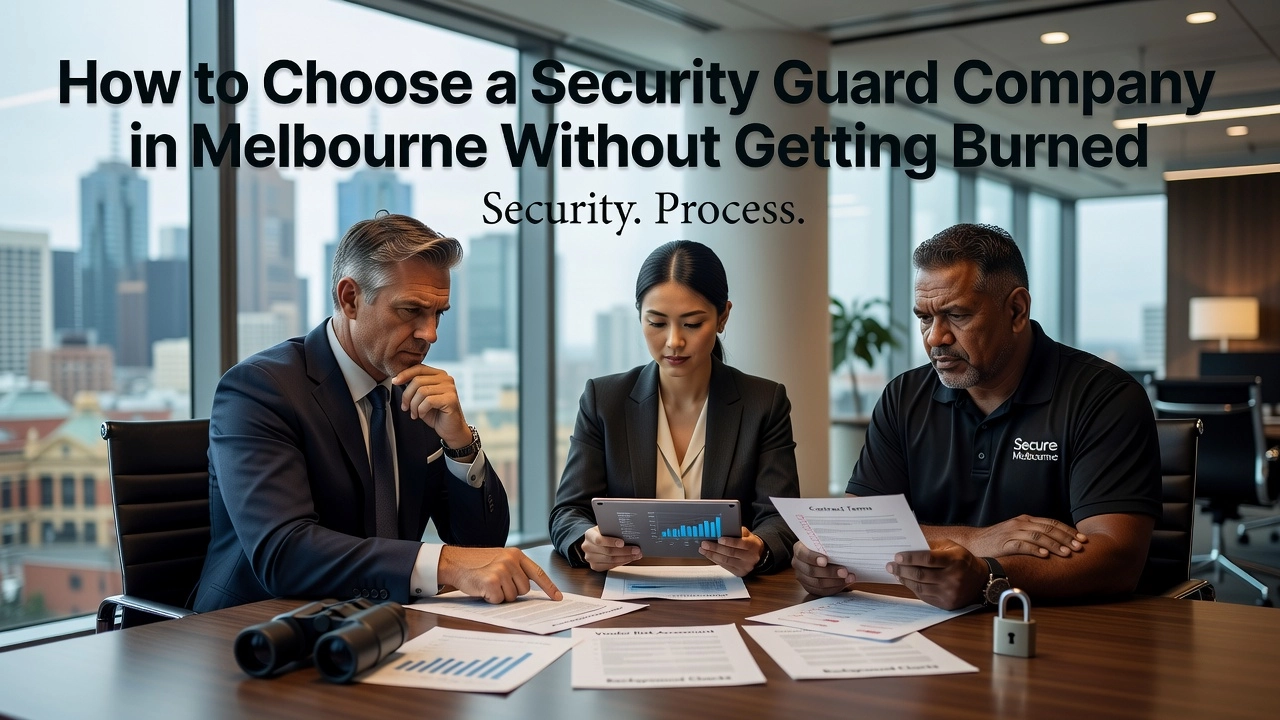
Every year, Melbourne businesses and property owners hand over thousands of dollars to security guard companies, only to discover the hard way that not all providers deliver what they promise. Unreliable guards, hidden contract fees, and inadequate licensing are just a few of the pitfalls waiting for those who rush the selection process.
Choosing the right security partner is not simply a matter of finding the cheapest quote or the most persuasive sales pitch. It requires a clear understanding of what separates a professional, accountable provider from one that will leave you exposed when it matters most.
In this analysis, you will learn exactly what to look for when evaluating security guard companies operating in Melbourne. We will break down the critical factors that influence service quality, including licensing compliance, staff training standards, insurance coverage, and contract transparency. By the time you finish reading, you will have a practical framework to make a confident, well-informed decision, one that protects your people, your assets, and your bottom line without any unpleasant surprises down the track.
The Direct Answer
Not all security guard companies carry full ASIAL licensing, integrated service capability, or 24/7 coverage. In Melbourne’s fragmented market, choosing the wrong one creates operational risk, not protection.
The criteria that separate a capable provider from a compliant-on-paper one are specific: verified licensing status, genuine service integration, contractually defined response time SLAs, and demonstrated vertical experience. I’ve spent over a decade evaluating security vendors across construction, corporate, retail, and events, and the procurement mistakes I see repeatedly come from buyers treating this as a general services decision rather than a risk management one. This article is a decision framework, not a directory.
Start your evaluation at ASIAL’s licensing verification portal and cross-reference with Victoria Police’s private security eligibility requirements. Never rely on a provider’s self-reported credentials. With 6,727 security businesses operating nationally and Victoria holding 19% of master licences, the Melbourne market has volume, but volume does not equal quality or fit.
Most people overlook the difference between a company holding a master licence and that same company having the operational depth to service your specific risk profile. Those are different things entirely, and conflating them is where buyer decisions go wrong.
Melbourne’s Security Market Is Fragmented by Design
Australia’s Investigation and Security Services industry comprises 6,727 businesses as of 2025, generating $13.9 billion in revenue for 2024–25 (IBISWorld). That scale sounds reassuring until you map what those businesses actually do. The market is dense at the commodity end, where undifferentiated guard-hire firms compete on hourly rate, and thin at the integrated end, where providers combine physical guarding, monitoring, and electronic security under a single operational framework.
Most providers are structured around one discipline. Crowd control specialists work events. Shopping centre firms run static posts. Others focus purely on mobile patrol rounds or construction site access control. Victoria’s licensing framework under the Private Security Act 2004 reinforces this pattern by separating licence categories, which structurally encourages niche specialisation rather than full-spectrum capability.
I’ve found that buyers consistently misread scale as a proxy for suitability. A firm deploying 500 guards across metropolitan Melbourne is not automatically a better fit than a mid-size operator with tighter supervision ratios and sector-specific protocols. Guard volume tells you nothing about incident reporting quality, supervisor-to-guard ratios, or whether the provider’s SLAs match your actual risk profile.
The real problem 6,727 options creates is a qualification gap, not an abundance of choice. Most buyers lack a structured framework for evaluating providers beyond price and licence status. There is no centralised quality rating system in Australia’s security sector, so procurement defaults to lowest-cost tendering, which consistently underserves complex risk environments.
For operations that need consistent, professional deployment, reviewing what purpose-built security guard services actually include at a service level is the better starting point than comparing hourly rates across fragmented suppliers.
Common Pitfall to Avoid: Treating a security provider’s guard headcount as a measure of capability. Depth of supervision, compliance documentation, and integrated service coverage matter far more to your actual risk outcome.
The 5 Criteria That Separate Good Providers from Risky Ones
1. ASIAL Licensing Compliance
Licensing is your first filter, not your last. In Victoria, any company providing security services must hold the appropriate licence category under the Private Security Act 2004 (Vic). A crowd control licence does not authorise static guarding. A guarding licence does not cover alarm installation. Most people overlook this distinction when reviewing provider credentials, and that oversight transfers legal and insurance liability directly to the client engaging the non-compliant operator. Verify the specific licence category matches your service requirement before any contract is signed. ASIAL’s licence lookup tool is publicly accessible and takes under two minutes to use.
2. Integrated Service Capability
I’ve found that the highest-risk moment in any security program is not the incident itself; it is the gap between detection and response. When guarding and monitoring are managed by separate vendors, that handoff gap is where incidents escalate. A provider offering mobile patrol coverage that connects directly to electronic security integration eliminates the procedural delay that fragmented vendor arrangements create. Integrated capability is a structural advantage, not a marketing claim.
3. Vertical-Specific Experience
Sector credentials do not transfer automatically between environments. A provider with strong retail security experience understands loss prevention, after-hours access controls, and patron management. That background does not prepare a team for construction site security, where contractor access protocols, plant movement coordination, public interface risks, and WHS obligations create an entirely different risk profile. Ask prospective providers to name comparable sites they have managed in your specific vertical, and request incident reports or client references to verify the claim.
4. Response Time SLAs in Writing
Verbal commitments are operationally worthless. “24/7 coverage” is a marketing phrase unless the contract specifies documented response benchmarks, maximum guard replacement timeframes, and escalation protocols by incident severity. I’ve reviewed contracts where “rapid response” had no defined time window attached. That ambiguity becomes a liability the moment a serious incident occurs. Require SLAs in writing, with specific metrics. If a provider resists documenting response commitments, treat that resistance as a disqualifying signal.
5. Technology Stack
As of 2026, GPS-tracked patrols, geofenced attendance, NFC checkpoint scanning, and real-time incident reporting with photo and timestamp capture are baseline expectations, not premium features. Security guard software platforms reviewed for 2026 confirm that offline capability for remote or underground sites is also now a standard requirement. Providers still operating on paper-based patrol logs or manual incident reports are behind the operational standard the market expects. Cloud-based CCTV and alarm monitoring should integrate directly into this stack, giving clients live visibility across all sites from a single dashboard. Ask prospective providers which platform they use and request a live demonstration before signing.
Pro Tip: Request a redacted sample contract from any provider you are seriously evaluating. The quality of the SLA language, the specificity of licence references, and the presence of technology accountability clauses will tell you more about operational standards than any sales conversation will.
What the 2025 Market Data Actually Tells Buyers
The numbers behind Australia’s security market tell a specific story that most buyers miss when comparing quotes.
| Metric | Australia | Global |
|---|---|---|
| CAGR (2025–2030) | 8.4% | 7.2% |
| Market Size 2025 | USD $6.76B | USD $154.3B (by 2035) |
| Projected Size 2030 | USD $10.1B | USD $151.5B (physical security) |
| Industry Businesses | 6,727 | — |
Australia’s 8.4% CAGR outpaces the global average by a meaningful margin. That gap matters beyond the headline figure. Faster market growth increases demand for qualified, licensed personnel at the same time supply remains constrained. I’ve found that buyers who treat security procurement as an annual review process are the ones scrambling when their incumbent provider loses key staff or loses their licence. Locking in a capable, integrated provider now is a procurement decision, not just a compliance one.
Contract Security Is a Structural Shift, Not a Cycle
Global contract security grew 50% from $22 billion in 2014 to $33 billion in 2022. That trajectory reflects a deliberate business decision playing out across industries: organisations have progressively stopped trying to manage physical risk in-house and moved to specialist providers. This is not a post-pandemic rebound or a temporary budget trend. The security services market data from Fact.MR confirms manned guarding remains the dominant service segment globally, with sustained demand running well beyond 2030.
AI and Cloud Monitoring Are Already Running
Most people overlook that AI-driven threat detection and cloud-based monitoring are not on Australian providers’ roadmaps; they are already operational. Leading providers are running real-time anomaly detection, automated incident alerts, and edge analytics today. Buyers should ask prospective vendors what platforms they currently operate, not what they plan to adopt. If a provider cannot answer that question specifically, that is a capability gap worth noting.
The IMARC Group security market forecast covering 2026 to 2034 identifies sustained structural demand across healthcare, government, retail, and construction verticals. These are not growth sectors that will consolidate quickly. For buyers in those industries, the case for engaging a provider with genuine integrated electronic security and monitoring capability alongside physical guarding is grounded in where the market is already heading, not where it might go.
Integrated vs. Fragmented Security: The Operational Risk Nobody Talks About
Here is a scenario that plays out more often than vendors will admit: a static guard finishes their shift, a revised access protocol is in effect, and the separate monitoring vendor never receives the update. For the next several hours, an incident window sits open between two vendors who each assume the other has it covered. No single party owns that gap, and no single party closes it.
Integrated providers eliminate this structurally. A unified command structure means one reporting chain across guarding, mobile patrols, and monitoring. Protocol updates move through a single communication layer, not across separate vendor account managers with separate escalation procedures. As Oakwood Risk and Resilience identified in April 2026, true convergence requires explicit accountability for the spaces between disciplines, not just within them. That accountability only exists when one provider owns the full stack.
In high-density event security environments, fragmented vendor coordination is not just inefficient; it is a direct liability. Crowd dynamics, access control, and remote monitoring must function as a single system. The operational tempo of a live event leaves no margin for inter-vendor communication delays. When those three functions run through separate contracts, the coordination gap is built into the deployment before the first guard takes a post.
I’ve found that consolidated billing and unified reporting from a single integrated provider consistently reduces total cost of ownership, even when the headline contract rate looks higher. Administrative overhead across three separate vendor accounts, duplicated incident reports, and delayed response coordination all carry real costs that never appear in a line-item quote comparison.
The Security Industry Association’s Security Megatrends reporting identifies physical-cyber convergence as a defining market force. Providers who have not moved toward integration are not just behind a trend; they are behind the operational standard their own market has already set.
Pro Tip: When evaluating a provider’s integration claim, ask one direct question: does your monitoring team receive real-time updates from your guarding shifts through a shared system, or through a phone call? The answer tells you everything about whether integration is structural or just a sales position.
Red Flags to Identify During the Shortlisting Process
Most buyers skip due diligence at exactly the wrong stage. By the time a contract is signed, these five warning signs are expensive to unwind.
No verifiable ASIAL licence number is an immediate disqualifier. The ASIAL public register is accessible and takes under two minutes to cross-reference. If a provider cannot supply their licence number on request, or if that number returns no match, stop the process there. As of 2026, federal procurement processes, including the NDIA’s national security guarding tender PROC-7725, treat credential verification as a baseline requirement, not a formality.
Inability to produce incident report samples or a written SLA when asked directly signals operational immaturity. A provider who cannot show you what accountability looks like in practice is telling you something important. Demand both before shortlisting progresses.
Paper-based reporting in 2026 is a structural failure. Digital, timestamped incident reporting is now a baseline expectation across credible providers, not a premium add-on. Platforms like GuardTek and Silvertrac are widely adopted. A company still logging manually cannot give you audit-ready documentation when you need it.
Undisclosed subcontracting is more common than most buyers realise. I’ve found that clients assume the team they meet during the pitch is the team on site. That is frequently not the case. Under Victorian and NSW private security legislation, licence obligations follow the individual guard. If the head contractor cannot confirm directly employed, licensed personnel on your specific site, escalate that question before signing.
Absence of vertical-specific experience matters more than overall company size. Construction site security involves live hazard environments, White Card compliance, and site induction requirements that a residential mobile patrol background does not address. Ask for documented case studies matched to your site type, not a general capability statement.
Pro Tip: Request a sample incident report and proof of ASIAL registration in the same initial email. How fast and how completely a provider responds tells you more about their operational standards than any sales conversation will.
Frequently Asked Questions
What licences should a security guard company hold in Victoria?
Under the Private Security Act 2004 (Vic), any company delivering security services must hold a Security Business Licence, and every individual guard must carry a current personal security licence. A significant update took effect on 19 June 2025 under the Private Security and County Court Amendment Act 2024, expanding the scope so all private security activities are now classified as licensed, with additional obligations on existing holders. Crowd controllers require a separate licence category, which is directly relevant when engaging event security services. ASIAL membership sits above this baseline; members must meet minimum training standards, maintain adequate insurance, and adhere to a formal code of conduct.
How do I verify a security company is legitimately licensed?
Use the Victoria Police Licensing and Regulation Division public register, searchable by company name or licence number. All current holders appear regardless of renewal stage. The ASIAL member directory provides a second verification layer for association-level compliance. Red flags include companies that cannot immediately supply a licence number, no licence details on their website, and pricing that significantly undercuts the market, often a signal of unqualified staff and no insurance coverage.
What is the difference between static guards and mobile patrols?
Static guards are deployed at a fixed post for continuous, high-visibility deterrence. Mobile patrols conduct scheduled or random-interval checks across multiple sites, typically by vehicle, making them more cost-efficient for lower-risk or after-hours coverage where constant presence is not required.
What should a security SLA include?
A well-structured SLA must specify: response time benchmarks for alarm activation and incident escalation; incident reporting timelines with documented patrol logs; escalation protocols detailing the communication chain during active incidents; guard replacement guarantees covering missed or short-notice shifts; and real-time communication channels so deployed guards can reach management immediately. I’ve found that most service failures trace back to SLAs that omit guard replacement terms entirely.
Are integrated security providers more expensive than specialists?
Not necessarily. Uniformed guards in Melbourne typically cost $35 to $55 per hour. When you add separate monitoring contracts, electronic security vendors, and CCTV and alarm monitoring providers, consolidated billing and unified reporting under a single integrated provider frequently reduces total cost of ownership. Eliminated handoff failures alone justify the comparison before pricing even enters the conversation.
Pro Tip: Before signing any contract, request the provider’s current licence number and verify it directly against the Victoria Police LRD register. As of mid-2026, the LRD is processing applications with notable lead times; factor at least 30 days when onboarding a new provider that may be mid-renewal.
Pro Tip: The Two Questions That Eliminate 80% of Underqualified Providers
Before any site visit, any proposal, and any reference check, ask two questions: What is your ASIAL licence number? and Which services do you deliver in-house versus subcontracted?
A legitimate provider answers both immediately and in writing. I’ve found that roughly half of shortlisted providers either hesitate on the licence question or give a vague non-answer on subcontracting. That hesitation is your answer.
Cross-reference the licence number directly on the ASIAL public register before any further conversation. This takes under two minutes and immediately confirms whether the company is operating under a valid, current licence or not.
The subcontracting question matters just as much. Documented cases in Australia show that some large operators broker work to third parties whose guards have no idea which company they are actually working for, with no visible business licence, no insurance, and no formal induction. When you ask which services are in-house, an accountable provider maps it clearly: guarding is direct-employed, monitoring is operated through their own control room, patrols run on their own fleet. Vague answers signal you are hiring a middleman, not a security company.
Most people overlook the written requirement. Verbal assurances carry no accountability weight in a regulated industry with documented enforcement gaps. Require both answers in writing before any formal evaluation proceeds. A company unwilling to put either answer on paper is telling you precisely how they operate once the contract is signed.
Common Pitfall to Avoid: Do not treat the licence check as a formality after you have already committed to a shortlist. Run it first. It costs nothing and removes non-compliant providers before they consume your evaluation time.
Conclusion
Choosing the right security guard company in Melbourne comes down to four non-negotiables: verified licensing, rigorous staff training, comprehensive insurance coverage, and transparent contract terms. Cutting corners on any one of these factors puts your property, people, and investment at serious risk.
The good news is that with the right checklist in hand, you hold the power to ask the right questions, spot the warning signs early, and hold any provider accountable from day one.
Do not wait until an incident exposes the gaps in your current security arrangement. Start by requesting licensing documentation and proof of insurance from every company you consider. Compare contracts carefully before signing anything.
Your security partner should give you confidence, not anxiety. Take what you have learned here and make your next security decision one you will never regret.
about
avada factory
Sempery ultricies nibh at dolor cras urna eleifend nec. Atiam efficitur tempor.