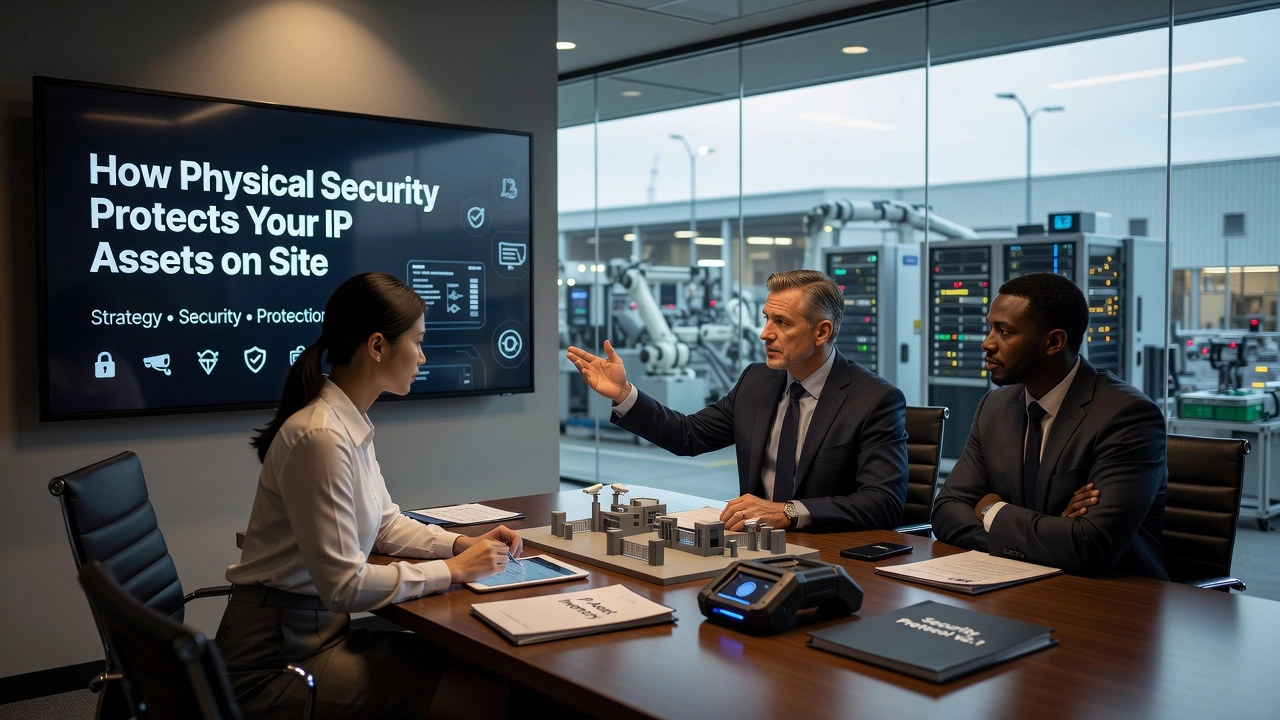
Every year, businesses lose billions of dollars to intellectual property theft, and a surprising amount of it happens not through cyberattacks, but through physical breaches on-site. A sophisticated firewall means nothing if someone can walk into your server room, photograph proprietary documents, or walk out with a hard drive full of trade secrets.
IP protection is often framed as a digital challenge, but the physical layer of your security strategy is equally critical. Unauthorized access to your facilities, unsecured workstations, and poorly managed visitor policies can expose your most valuable assets to theft, corporate espionage, or accidental leakage.
In this guide, you will learn how to build a physical security framework specifically designed to safeguard your intellectual property on-site. We will cover access control systems, surveillance best practices, secure document handling, and employee protocols that work together to create a layered defense. Whether you manage a small office or a large enterprise facility, these actionable strategies will help you identify vulnerabilities and close the gaps before they become costly breaches.
The Direct Answer
IP protection means securing your registered patents, trade marks, and proprietary data from theft or misuse — and in 2026, that threat is as physical as it is digital. Your on-site premises are where IP assets live, which makes physical security your first line of defence.
Every IP law firm, legal commentator, and trade mark consultant responding to the Australian IP Report 2026 has focused exclusively on registration strategy and legal enforcement. Not one Australian security provider has connected this data to physical premises protection. That gap matters, because the numbers are significant: trade mark applications in scientific and technological services, including AI, grew by more than 23%, and approved designs by Australian applicants grew by more than 10%. More Melbourne businesses than ever now hold registered IP assets, and those assets sit inside physical buildings, server rooms, R&D labs, and document archives that require active, layered security, not just legal coverage.
I’ve found that most business owners treat IP protection as a purely legal exercise. Register the trade mark, file the patent, brief the lawyers. What they overlook is that the physical environment housing those assets is often completely unguarded against the most direct threat: unauthorised access. According to IP Australia’s 2026 findings, businesses that register a trade mark see income gains of around 78% compared to unregistered equivalents. If that asset is compromised through a physical breach, the financial consequence is not administrative. It is catastrophic.
Pro Tip: Insider threats account for a significant share of IP theft. Employees and contractors with legitimate site access are frequently the vector. Layered access control, monitored entry points, and restricted zones are not optional extras; they are the operational baseline for any business holding registered IP.
Why Your Premises Are an IP Risk Zone
Most businesses spend thousands hardening their digital perimeter while leaving the server room door propped open with a fire extinguisher. I’ve found that businesses with strong digital security but weak physical site controls are the easiest targets for corporate espionage, and the pattern repeats across industries with alarming consistency.
The reason is straightforward: your most valuable IP does not live exclusively in the cloud. Source code repositories, R&D documentation, hardware prototypes, proprietary manufacturing equipment, and customer data platforms all have a physical presence on your premises. A threat actor who can walk into your facility bypasses your firewall entirely. Physical and cybersecurity convergence is now a defining enterprise risk, not a theoretical edge case.
Abion’s IP Trends 2026 report frames this precisely: web security and physical security are now effectively the same fight. CISA reinforces this in its Cybersecurity and Physical Security Convergence Action Guide, warning that siloed security functions leave organisations exposed to threats that operate across both vectors simultaneously.
Most people overlook the physical vector because it feels less sophisticated than a cyberattack. It isn’t. A disgruntled contractor photographing R&D drawings, a competitor’s plant walking out with a prototype, or an unsecured server room accessible to unvetted visitors each represents the same category of IP risk as a phishing campaign. The asset lost is identical; only the method differs.
Cybersecurity has escalated to board-level scrutiny in 2026, and that scrutiny now extends to physical access controls, on-site guarding protocols, and visitor management systems. Boards are asking whether the organisation can demonstrate systemic, auditable protection across both domains. If your electronic security systems and on-site guarding protocols are not integrated, the honest answer to that question is no.
Common Pitfall to Avoid: Treating physical security and IT security as separate budget lines managed by separate teams. In 2026, that organisational split is itself a vulnerability.
The Physical Vectors Most Businesses Miss
Most people overlook the gap between a business’s digital security investment and its physical access controls. The WEF’s Global Cybersecurity Outlook 2026 warns that hybrid threats are escalating and testing traditional defences, yet physical entry points remain the least audited part of most security programs.
After-hours access is the most exploited vector I’ve seen. Cleaning crews, contractors, and late-running visitors routinely enter server rooms, R&D labs, and design studios outside business hours with no supervision and no logged access trail. Without dedicated security guard oversight, these interactions go entirely unrecorded.
Construction sites are acutely exposed. Patented building designs, specialised equipment, and proprietary materials sit on open sites overnight, often with no manned presence. A single uncontrolled access event can compromise months of protected R&D.
Tailgating at front-of-house is underestimated. Without trained concierge or reception security, a visitor who enters behind a staff member can reach restricted areas unchallenged within minutes.
Loading docks and delivery points are a persistent blind spot. Physical documents, hardware prototypes, and proprietary stock change hands here daily, often outside camera coverage and without a formal chain-of-custody process.
Internal threat actors are the hardest to detect. Employees or contractors removing printed documents, USB drives, or physical prototypes rarely trigger alerts. I’ve found that businesses with no exit screening or mobile patrol presence have no reliable way to identify this until the damage is done.
Common Pitfall to Avoid: Treating after-hours access logs as an IT function. Physical access records belong in your security protocol, reviewed weekly, not buried in a system administrator’s queue.
Mapping Security Services to IP Protection Outcomes
Not every security service addresses the same IP vulnerability. The table below maps each physical security layer to the specific threat it neutralises and the measurable protection outcome it delivers.
| Security Service | IP Threat Addressed | Protection Outcome |
|---|---|---|
| Static Security Guards | Unauthorised on-site access, tailgating, internal theft | Physical deterrence and incident response at point of entry |
| Mobile Patrols | After-hours site intrusion, perimeter breaches | Unpredictable patrol patterns that disrupt pre-planned IP theft attempts |
| Construction Site Security | Theft of patented designs, specialised equipment, proprietary materials | 24/7 monitored access control for high-value build sites |
| Electronic Security and Access Control | Unlogged access to server rooms, R&D labs, restricted areas | Auditable access records that satisfy compliance and duty-of-care obligations |
| CCTV and Alarm Monitoring | Undetected after-hours intrusion, evidence gaps | Real-time monitoring with documented incident trails |
I’ve found that businesses treat these services as isolated purchases rather than a coordinated IP defence stack. That’s where exposure accumulates. A static guard at reception stops tailgating. Mobile patrols close the after-hours window that a static guard cannot cover. Electronic access control generates the auditable logs that matter when a trade secret dispute reaches litigation, since protecting IP as a business asset requires demonstrating reasonable operational steps, not just legal registration.
Construction sites carry a specific risk most operators underestimate. Patented structural designs, proprietary material specifications, and pre-market product prototypes are physically present on site long before any digital record is secured. Monitored access control at the perimeter is the only reliable layer at that stage.
Pro Tip: Request a site-specific IP risk assessment before selecting services. The right combination depends on your asset type, operating hours, and whether your premises house R&D, physical prototypes, or server infrastructure.
How to Build a Physical IP Protection Layer
Start with an honest audit before spending a single dollar on security hardware or personnel.
Step 1: Map Every IP Asset Location
Walk every square metre of your premises and document where proprietary data, prototypes, documentation, and equipment physically exist. Server rooms, filing cabinets, R&D workbenches, even a whiteboard with a product roadmap sketched on it. A physical security audit treats every storage and access point as a potential exposure, not just the obvious ones. Most businesses are surprised how many locations they uncover once they look systematically.
Step 2: Identify Your Highest-Risk Access Points
Flag every area accessible to third-party contractors, delivery personnel, or visitors. Server rooms, R&D labs, executive offices, and loading docks consistently top the risk list. These are the zones where an outsider with five unsupervised minutes can cause disproportionate damage. Physical access control for data centres now ties directly to compliance standards, making access point identification a regulatory requirement, not just a best practice.
Step 3: Match a Security Service to Each Risk Point
Assign protection based on what the audit revealed, not on assumption. Static security guards at primary entry points intercept unauthorised access before it reaches restricted zones. Electronic access control at server rooms and R&D areas creates a credential-based barrier. Mobile patrols cover the perimeter and after-hours vulnerability windows that static deployments cannot.
Step 4: Establish Auditable Access Logging
Electronic security systems generate timestamped access records that become critical evidence in insurance claims, compliance audits, and legal proceedings. In 2026, cloud-integrated access logs can feed directly into corporate compliance reporting frameworks. Set retention policies before an incident occurs, not after.
Step 5: Brief Your Security Provider Properly
I’ve found that the businesses that suffer the most from on-site IP theft are those that never communicated the value of what they were protecting to the people on the ground. A guard briefed on high-value proprietary assets applies a fundamentally different level of scrutiny to a contractor request than one treating the site as standard commercial premises. Provide your provider with a written site brief covering asset sensitivity, restricted zones, and escalation protocols.
Pro Tip: Reassess your access point risk map every time your business changes, whether that is a new contractor arrangement, a premises expansion, or a product development cycle kicking off. Facilities change faster than security configurations do, and that gap is where IP walks out the door.
2026 Trend: When Physical and Digital IP Defence Merge
Physical and digital security are no longer parallel disciplines. They are the same discipline. Genetec’s State of Physical Security 2026 report, drawing on 7,368 security professionals globally, dedicates an entire section to “where unification meets cyber risk,” confirming that the boundary between IT security and physical guarding has operationally dissolved.
I’ve found that Melbourne businesses are still treating these as separate budget lines, separate vendors, and separate conversations. That gap is now a liability.
AI-assisted surveillance, integrated access control, and real-time CCTV monitoring are the 2026 baseline, not premium upgrades. The global physical security market sits at USD 131.80 billion in 2025, with video surveillance commanding roughly 47% of revenue share. Insurers are actively tying premium reductions to verified surveillance and access-control deployments. The financial case for convergence is no longer theoretical.
APAC compliance expectations are tightening in lockstep. Organisations must now demonstrate systemic risk management and auditable physical security protocols, not just reactive incident response. Zero trust architecture and AI-driven threat response are the dominant APAC security leadership priorities heading into 2026, per Tech Week Singapore’s regional briefing. Physical surveillance data is simultaneously being repositioned as strategic business intelligence, feeding operational decisions, not just security logs.
Australian security professionals are being asked to hold cross-competency skills spanning physical guarding and cyber-awareness. The skills wall between a guard on a gate and an IT security analyst is coming down at the workforce level.
Melbourne businesses in tech, advanced manufacturing, and renewables are the most exposed cohort. IP Australia’s 2026 report records 10%+ growth in approved designs and 23%+ growth in tech and AI trade mark applications nationally. These businesses are filing more, building more, and protecting less. Pairing access control systems with trained security personnel is the first-mover advantage most are leaving on the table.
Pro Tip: Request a written security protocol from any provider you engage. If they cannot produce a documented, auditable physical security plan, they are not equipped to meet 2026 APAC compliance expectations, regardless of the hardware they install.
Frequently Asked Questions
Does physical security actually protect intellectual property?
Yes. Prototypes, proprietary documentation, specialised equipment, and trade secret materials all exist in physical form, stored on physical premises. Every person who walks through an unsecured door is a potential IP exposure event. Physical access control is not a supplement to IP protection; it is a core component of it.
What type of security service is best for protecting IP on a business site?
It depends on the site’s layout, risk profile, and the nature of IP assets stored there. In my experience, the most effective approach is layered. Static security guards control entry points and deter opportunistic threats during business hours. Electronic access control restricts movement into high-sensitivity zones such as R&D labs, server rooms, and document storage areas. Mobile patrols cover the after-hours window, which is when most physical IP theft occurs. No single service closes all the gaps.
How does construction site security protect IP?
Construction sites routinely hold patented building designs, proprietary engineering schematics, and specialised plant and equipment. Without monitored, 24/7 access control, these assets are exposed to both opportunistic theft and targeted corporate espionage. Dedicated construction site security provides documented access management that creates accountability for every person on site, at every hour.
Can CCTV monitoring help with IP protection compliance?
Yes. Timestamped footage and electronic access logs produce an auditable evidence trail. That trail supports insurance claims when theft occurs, strengthens legal proceedings when IP misappropriation is alleged, and satisfies APAC compliance reporting requirements that increasingly demand demonstrable, systemic risk controls. CCTV and alarm monitoring services provide exactly that documented continuity.
How do I know if my business needs IP-focused physical security?
If your business holds registered patents, trade marks, or designs, and operates from premises where proprietary assets are stored or accessed, cyber controls alone are not sufficient. As guidance on physically protecting business IP makes clear, physical protection measures are a distinct and necessary layer; they are not covered by firewalls or encryption. Registration creates legal rights. Physical security defends them.
Pro Tip: WIPO’s trade secrets framework requires businesses to demonstrate “reasonable steps” to maintain secrecy. If you face a trade secret misappropriation dispute and cannot show documented physical access controls, your legal position weakens significantly, regardless of how strong your registration is.
Pro Tip: Brief Your Guards Like You Brief Your IT Team
Most businesses brief their IT team on exactly which systems hold sensitive IP. They document access tiers, flag restricted directories, and ensure every technician knows which server contains what. That same conversation almost never happens with the physical security provider.
It should.
A security guard who knows that a specific server room, R&D lab, or storage area contains high-value proprietary assets will treat access attempts with appropriate scrutiny. One who has never been told will treat it like any other room. The difference in outcome, during an after-hours access event or an unscheduled contractor visit, can be significant.
As noted in research on physical security and cybersecurity convergence, someone who gains physical access to a server room can install malicious hardware or steal data without touching a network remotely. Your guards are the layer that stops that access from happening. But only if they know the room matters.
The fix is straightforward. Share your IP asset map with your security provider. Specify which areas require strict access logging, which contractors must never be left unescorted, and what an anomalous after-hours access event looks like on your site. Pair this with a mobile patrol schedule that prioritises those zones during high-risk hours.
Treating your physical security provider as an informed partner rather than a physical deterrent is the single most overlooked upgrade available to IP-holding Melbourne businesses right now.
Pro Tip: Your guards cannot protect what they don’t know exists. Brief them with the same detail you’d give your IT team, and your physical security layer finally starts doing the job it’s capable of.
Conclusion
Protecting your intellectual property is not solely a digital challenge. It demands a strong physical security foundation as well. By implementing layered access controls, maintaining vigilant surveillance, enforcing secure document handling, and training employees on proper protocols, you create an environment where your most valuable assets are genuinely difficult to reach or compromise.
The threats are real, and they are happening to businesses of every size. Waiting until a breach occurs is far too costly a lesson.
Start today by auditing your current physical security measures, identifying your vulnerabilities, and prioritizing the gaps that put your IP at greatest risk. Even small improvements compound into significant protection over time. Your innovations, trade secrets, and competitive advantages deserve the same level of defense you give your digital infrastructure. Build that defense now, before someone else exploits the opportunity you left open.
about
avada factory
Sempery ultricies nibh at dolor cras urna eleifend nec. Atiam efficitur tempor.