
A fit-for-purpose visitor management policy does four things without exception: it accounts for every person on site during an emergency, controls where visitors can go and with whom, records enough detail to survive an audit, and collects no more personal data than it needs. Before anything else, check that your policy covers sign-in, a short induction, a visible pass or badge, and a written retention schedule. If any one of those four is missing, the policy has a gap.
TL;DR:
- Visitor management policies must ensure all visitors are accounted for during emergencies and only collect the personal data necessary for safety and security.
- Different categories of visitors, such as contractors, suppliers, and clients, require tailored entry controls and pre-qualification for higher-risk access.
- Reception must follow a strict, documented check-in and induction process, including verification, safety briefing, badge issuance, and sign-out procedures.
- Records should include full name, host, times, and induction acknowledgment, kept securely for a minimum of two years, with clear privacy guidelines.
- Policy enforcement requires clear responsibilities assigned to PCBUs, reception staff, hosts, and contractors, with regular audits starting from a pilot program.
Table of Contents
- What should a visitor management policy actually cover?
- Which visitor categories need different entry rules?
- How should reception handle check-in and induction?
- What records must you keep, and for how long?
- How do you control where visitors can go?
- Are visitors accounted for in your emergency plan?
- Who is responsible for enforcing the policy?
- How do you roll out and audit the policy?
- What do most workplaces get wrong on visitor policy?
- Sources
- FAQ
What should a visitor management policy actually cover?
A workable policy follows the same logic as most workplace procedures: purpose, scope, policy statement, then the operational detail. The purpose section should say plainly that the policy exists to protect the health and safety of everyone on site, including “other persons” who aren’t employees. That phrasing matters because model WHS guidance treats visitors as being in scope of a PCBU’s duties, not as an afterthought bolted onto a security procedure.
Scope should name every site the policy applies to, list any exceptions (public reception areas, loading docks with separate rules), and state clearly who can authorise a visitor’s entry. Charles Sturt University’s contractor and visitor safety procedure is a solid example of this structure in practice, with distinct sections for induction, supervision and responsibility.
Your policy statement should cover:
- Who may approve visitor access and under what conditions escorting is mandatory
- A one-line commitment to collecting only the personal data needed for safety and security
- Where the retention schedule and privacy notice sit within the document
- How the policy connects to existing access control policies and reception procedures
Which visitor categories need different entry rules?
Not every person walking through your door carries the same risk, so treating them identically wastes effort and misses real hazards. Break visitors into categories and match controls to each:
- Contractors — require pre-qualification (licences, insurance, SWMS) before arrival, especially on construction sites
- Suppliers and deliveries — usually low risk, but still need sign-in and a defined drop-off zone
- Job candidates — light-touch handling, but still logged and escorted to interview rooms
- Clients and general visitors — standard sign-in, badge and host escort
- Volunteers — may need the same induction as staff if they’ll be on site regularly
- Former employees — treat as visitors, never as staff with residual access
Background checks or extra documentation are reasonable when a visitor will access restricted areas, handle sensitive information, or work unsupervised near vulnerable people, such as in healthcare settings.
How should reception handle check-in and induction?
The front desk is where most policy failures actually happen, usually because the process depends on memory rather than a fixed sequence. Build the procedure around these steps:
- Pre-registered visitors get a fast-track check: confirm identity, issue a badge, notify the host automatically.
- Walk-ins go through full verification, including checking who they’re there to see before any access is granted.
- Induction takes 5 to 10 minutes and covers emergency exits, restricted zones and any PPE requirements, with the visitor acknowledging they’ve received it.
- Badge issuance happens after induction, with a photo captured for higher-risk sites.
- Departure sign-out closes the loop, and any missing sign-out triggers a same-day follow-up call to the host.
A short, documented induction holds up well in safety audits precisely because it’s brief enough to actually happen every time, rather than a lengthy orientation that gets skipped when reception is busy.
Pro Tip: Build the missing sign-out follow-up into your daily reception checklist, not just your emergency procedure. Catching it same-day is what actually prevents the awkward call during a fire drill.
Reception teams also benefit from clear escalation rules, something covered in more detail in reception security priorities for facility managers.
What records must you keep, and for how long?
Every visitor log needs a minimum set of fields to be useful in an audit or an emergency: full name, host name, arrival and departure times, and confirmation the induction was completed. A simple sign-in template covering these fields supports insurance claims and contractor tracking as well as day-to-day safety.
Retention periods vary by context, but records tied to construction sites or active incidents often need to be kept for at least two years, longer where litigation or insurance claims are live.
Privacy-by-design keeps this manageable:
- Write a one-sentence purpose statement for every field you collect
- Set a retention period and a deletion trigger, not just a vague “as needed”
- Store records securely, with access limited to people who need it
- Publish a short privacy notice at the sign-in point itself
The Privacy Act doesn’t set a fixed retention number, but it does require you to justify how long you keep personal information, which is exactly what a documented schedule gives you.
How do you control where visitors can go?
Badges should tell reception, hosts and other staff at a glance what a visitor is and isn’t allowed to do. A colour-coded system, temporary badges for escorted-only access versus a different colour for self-navigating visitors, removes the guesswork.
- Link sign-in data to electronic door access wherever practical, so a badge only opens the doors a visitor is cleared for
- Keep a paper fallback log at reception for when the kiosk or access system goes offline
- Test that fallback quarterly, not just when something breaks
- Vet any kiosk supplier’s data handling before deployment, since digitising sign-in expands your privacy footprint
Our guide to visitor management systems covers how to weigh kiosk features against these governance requirements.
Are visitors accounted for in your emergency plan?
Visitors who aren’t in the muster count during an evacuation are the people wardens can’t account for, and that’s precisely the scenario AS 3745 muster planning exists to prevent.
- Give wardens live access to the current visitor list, not yesterday’s printout.
- Cross-reference the sign-in log against the muster point tally during every drill, not just real emergencies.
- Treat mismatches as a policy failure, not a one-off, and investigate why the record didn’t match reality.
- Scale the process for events or multi-building sites by assigning a muster coordinator per zone who reports back to a single point of truth.
Our emergency evacuation procedures guide walks through how visitor records should feed directly into your broader muster plan.
Who is responsible for enforcing the policy?
A policy without named owners doesn’t get enforced, it gets ignored the first time reception is short staffed. Assign accountability clearly:
- PCBUs and officers carry the primary duty to manage risks to visitors under model WHS obligations, and that duty can’t be delegated away entirely
- Reception staff own check-in, induction delivery and badge issuance
- Hosts are responsible for supervision once a visitor is on their floor or in their meeting
- Contractors answer for their own crew’s compliance with site rules, on top of the site’s induction
Training should happen at onboarding and again annually, with a short competence check, can staff explain the induction content, do they know the escalation path for an unescorted visitor, rather than a passive slideshow nobody remembers.
How do you roll out and audit the policy?
Start with a pilot at one site or one floor, and get sign-off from reception, facilities and whoever owns WHS compliance before you scale it. Trying to launch everywhere at once is how gaps get baked in permanently.
- Track induction completion rate as your first KPI, since a low number usually means the process is too slow, not that staff are careless
- Monitor missing sign-outs weekly, not monthly, so patterns show up before they become habits
- Log access exceptions (doors propped open, badges shared) as their own category
- Record privacy incidents separately from safety incidents, since they need different remediation
Pro Tip: Review your policy every time you have an incident, not just on a fixed annual schedule. A near-miss with a contractor is worth more to your next revision than a calendar reminder.
Treat every sign-in record as a piece of audit evidence, timestamps, induction acknowledgements and badge returns each map to a specific KPI you can report on monthly.
What do most workplaces get wrong on visitor policy?
The most common failure isn’t a missing document, it’s a policy that exists on paper but doesn’t match what reception actually does under pressure. We see the same three gaps repeatedly: induction gets skipped when the desk is busy, badges get issued before the induction is finished instead of after, and nobody follows up on a missing sign-out until someone asks where a visitor went.
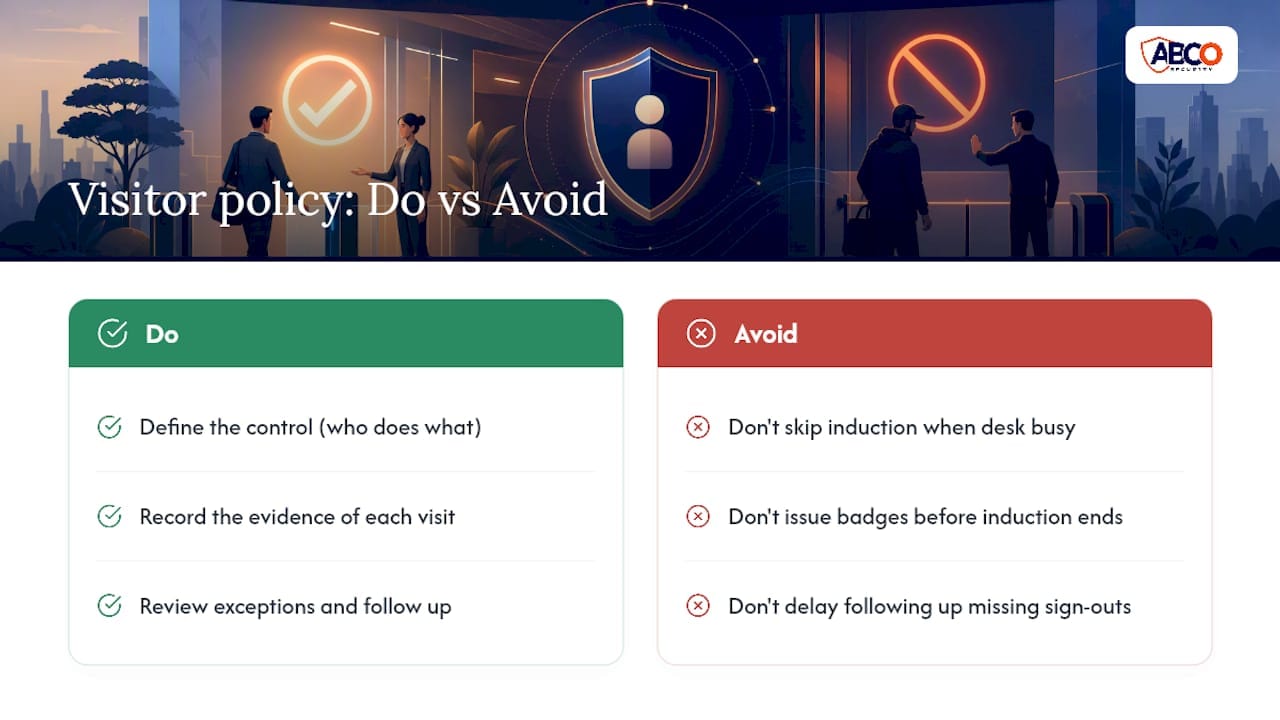
Effective visitor processes follow the logic that underpins ISO 9001 style quality management: define the control, record the evidence, review the exceptions, rather than treating visitor sign-in as a formality. Combined with extensive experience running static guarding, reception security and monitoring contracts across construction, healthcare and corporate sites, this approach helps turn a policy document into something that survives an actual audit.
If your organisation is weighing up how visitor controls fit alongside broader physical security, from key management policy to site-wide monitoring, security experts can review your current procedures and flag the gaps before an auditor does. Explore our construction site security management guide for a related look at how access control and visitor procedures work together on active sites.
— Abco
Sources
For drafting and audit evidence, start with Safe Work Australia’s model WHS guidance, the OAIC’s Privacy Act guidance, and a visitor log template you can adapt directly. An ISO certification checklist is useful for aligning documentation with formal audit standards.
- Effective inductions (WorkSafe WA)
- Guide to the model WHS Act (Safe Work Australia)
- The Privacy Act (Office of the Australian Information Commissioner)
- Visitor log template (MapTrack)
FAQ
What Is a Visitor Management Policy?
It’s a documented set of rules covering how visitors are identified, inducted, tracked and accounted for on site, built to satisfy WHS duties and privacy obligations at the same time.
How Long Should You Keep Visitor Sign-In Records?
Retention often runs to at least two years, longer for construction sites or where an incident, insurance claim or litigation is involved.
Do Visitors Need a Formal Induction?
Yes. A 5 to 10 minute induction covering emergency exits and restricted areas, with a recorded acknowledgement, is considered an effective and defensible safety control.
What Data Can You Legally Collect at Sign-In?
Only what you need for safety and security purposes, name, host, times and induction status, with a stated purpose and retention period under the Privacy Act.
Who Is Responsible for Visitor Safety Under WHS Law?
The PCBU carries the primary duty, since model WHS guidance places visitors and other persons at the workplace within scope of that duty.
Recommended
about
avada factory
Sempery ultricies nibh at dolor cras urna eleifend nec. Atiam efficitur tempor.