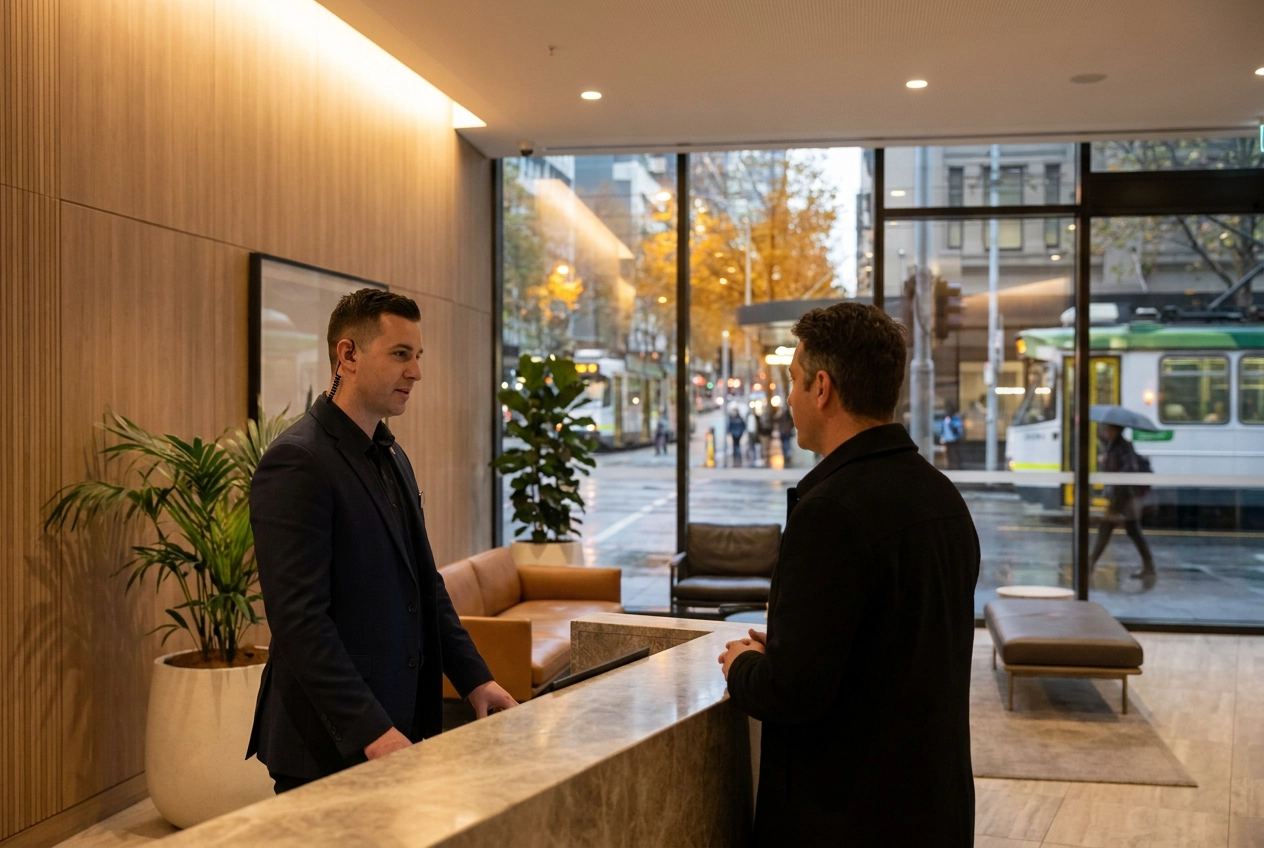
A mixed-use strata building in Melbourne is not simply a residential tower with a café on the ground floor. It is two distinct threat environments sharing the same entry points, the same lifts, and the same liability exposure. Commercial foot traffic floods through the lobby during business hours. Overnight, that same lobby becomes the primary vulnerability for residential floors above. Most owners corporations treat this as a single security problem. It is not.
Deploying a concierge security service without a role specification built for mixed-use conditions leaves critical gaps: undefined access zones, inconsistent after-hours protocols, and no clear escalation chain when an incident crosses the commercial-residential boundary. Generic residential guard rosters were not designed for this operational complexity, and the cost of that mismatch shows up in tailgating incidents, untracked contractor access, and parcel theft in shared lobbies.
This analysis defines exactly what a concierge security role must cover in a mixed-use Melbourne building. You will find a zone-by-zone access taxonomy, a shift-based duty matrix, an incident escalation framework, and the precise specification language your owners corporation needs to engage a provider with clear contractual expectations.

The Direct Answer
A concierge security guard in a mixed-use strata building must manage two legally distinct access environments: commercial retail traffic during business hours and residential access vulnerability overnight. A single residential brief does not cover both, and that gap is where most owners corporations get their scope wrong.
Mixed-use buildings have two threat profiles running in sequence across every 24-hour period. That demands a role specification built around access zones and shift-based duties, not simply a guard rostered to a desk.
This piece skips the definitional basics. If you need an overview of how different security guard positions are structured and what each role actually involves, that groundwork is covered elsewhere. What follows is the operational specification layer: the access zones, shift duties, and escalation structure that a concierge brief for a mixed-use Melbourne building must define to be enforceable.
Why a Standard Residential Roster Fails a Mixed-Use Building
A purely residential roster serves one visitor profile: credentialled residents plus occasional guests. Mixed-use buildings carry two profiles simultaneously. During business hours, ground-floor retail pulls in deliveries, customers, and contractors, all uncredentialled with no resident relationship. Overnight, the threat shifts to tailgating, unattended parcels, and after-hours entry attempts targeting a building whose ground floor was publicly accessible hours earlier.
Tailgating is a documented pressure in residential strata, where residents hold doors open for strangers. Add high-volume retail and that vulnerability compounds. Retail traffic bleeds into shared lobbies and lift cores with no natural barrier between a customer leaving a ground-floor shop and the residential lift lobby metres away.
That framing gap carries real operational and legal exposure. The commercial tenancy introduces a separate access profile with distinct visitor log requirements, contractor access controls, and escalation contacts that a residential-only brief does not address. Collapsing it into a residential brief produces a role that is technically staffed but operationally unspecified for half the building it covers.
Access Zone Taxonomy: The Four Zones Every Concierge Guard Must Own
That visitor flow problem maps directly to physical space. A mixed-use building contains four distinct access zones, each with a different threat profile that a concierge security role must address explicitly.
- Zone 1 (Public Retail Entrance): Adjacent to the residential lobby; the guard monitors for retail customers and delivery drivers drifting past the tenancy boundary into residential access points.
- Zone 2 (Shared Lobby and Lift Core): The highest-risk crossover point. Credential checks and tailgating prevention apply at all hours, not just after the retail tenancy closes.
- Zone 3 (Service Corridors and Loading Dock): E-commerce growth has pushed parcel volumes significantly higher. Uncontrolled loading dock access is now a direct theft vector and an unsupervised back-of-house entry point.
- Zone 4 (Basement Car Park): No natural surveillance, 24/7 exposure. Treat it as a separate threat surface with its own patrol schedule, not an extension of lobby coverage.
Without zone mapping, guards default to lobby presence only, leaving service corridors and car parks unmanaged because no duty was ever assigned to them.
Best practice requires each zone to have three defined elements: an access credential standard (key fob, PIN, biometric, or supervised entry), a monitoring method (CCTV, scheduled patrol, or fixed post), and a named escalation contact specific to that zone.
Shift-Based Duty Matrix: Business Hours vs. After-Hours Protocols

Knowing your four zones is half the work. The other half is knowing what changes when the clock shifts.
| Zone | Day Shift (Business Hours) | Night Shift (After-Hours) |
|---|---|---|
| Zone 1 – Public Retail Entrance | Monitor bleed-through foot traffic; coordinate with retail staff on peak periods | Zone sealed to non-residents; flag any attempted retail entry |
| Zone 2 – Shared Lobby & Lift Core | Credential checks for residents and visitors; tailgating prevention | Resident-only access enforced; zero visitor pass-through without verification |
| Zone 3 – Service Corridors & Loading Dock | Contractor access logging; parcel receipt and secure storage sign-off | No contractor access permitted; lone-worker check-in protocol active |
| Zone 4 – Basement Car Park | Periodic patrols during delivery windows | Scheduled patrol frequency documented in post orders; CCTV handoff confirmed |
Day shift is volume management. Night shift is access restriction. A single generic post order cannot serve both.
Night-shift concierge guards in mixed-use buildings are often under-briefed on retail after-hours alarms, leaving unclear whether a triggered alarm is their responsibility to escalate or the retail tenant’s, an ambiguity that costs critical response minutes.
After-hours protocols must name the handoff point explicitly: where the concierge guard’s responsibility ends and where mobile patrol coverage begins. That boundary must be written into the brief, not implied.
Integrated access control platforms allow guards to enforce zone-based credential rules from a single desk terminal, supporting access discipline during low-traffic overnight hours without requiring additional physical patrols. For owners corporations matching security services to your specific needs, this capability is worth specifying as a minimum requirement rather than a vendor bonus.
Incident Escalation: Who Reports to Whom in a Mixed-Use Building
The duty matrix defines what the guard does by zone and shift. This defines who they call when something goes wrong, and that is where most briefs fail.
Undefined escalation ownership is the most dangerous gap in mixed-use buildings. When an incident hits the retail entrance or shared lobby, the concierge guard cannot pause to determine whether the primary contact is the retail tenancy manager, strata manager, or emergency services.
Build a three-tier structure into the brief:
- Tier 1: Concierge guard direct action (contain, document, secure)
- Tier 2: Internal contact, zone-dependent (retail tenancy manager or strata manager)
- Tier 3: External services (police, ambulance, or after-hours mobile patrol)
Retail incidents go to the retail tenancy manager first, then police. Residential incidents escalate to the strata manager, with police as Tier 3. Shared zone incidents are the most legally complex; any gap in continuous presence must be filled by documented static coverage, not informal arrangements. The same zone-contact logic applies when considering event security guard services for shared areas.
The Spec Language Owners Corporations Actually Need
Once escalation ownership is documented, the next failure point is the brief itself.
Most owners corporations commission concierge security with language like “front desk presence, 8am to 10pm.” That creates no enforceable duty standard. The Owners Corporations Act 2006 prescribes zero concierge security minimums, so a vague brief produces a vague performance standard. For how Victorian legislation frames body corporate obligations more broadly, the security rules owners corporations can actually enforce covers the compliance baseline worth reading alongside any security brief.
A defensible mixed-use brief requires five elements:
- Access zone definitions with mapped boundaries for all four zones
- Credential standards per zone and per shift
- Duty matrix aligned to day and night shifts across all zones
- Escalation contact list with zone-to-contact mapping
- Handoff protocol to after-hours mobile patrol or CCTV alarm monitoring coverage
Add a contractor access register: a live log capturing who entered the service corridor, which area they accessed, and when they left. Untracked contractor movement is the most consistent gap in mixed-use briefs.
The spec must also distinguish two functions. Concierge security guard duties cover active access management, visitor logging, and incident response. Ambient functions cover CCTV, intercom management, and patrol routes. Bundling these without separation creates a role accountable for everything and measurable against nothing. Guards should never be the sole monitoring mechanism; electronic security systems underpin the role, not a supplementary add-on.
Common Pitfall to Avoid
The core scoping error, the residential brief with retail hours bolted on, is what this section operationalises.
The retail ground floor carries its own visitor profile, its own escalation contacts, and its own after-hours alarm responsibility. Bundling it into a residential concierge brief without zone and shift differentiation produces a guard who is physically present but operationally undefined, with no clarity on who owns the retail alarm at 2am or whether a shopfront disturbance is their incident to manage.
Each of those elements has a dedicated section above; the pitfall is treating any one of them as optional.
Understanding what security services actually cover and how to define scope is the step most owners corporations skip entirely.
Any hours not covered by on-site concierge must be closed by documented mobile patrol, not left as an informal fallback.
Frequently Asked Questions
What does a concierge security guard do in a mixed-use strata building? A concierge security guard manages access across commercial and residential zones: logging visitors, enforcing credentials at the lobby and lift core, monitoring service corridors and car park entry, and escalating incidents to the correct contact depending on which zone is affected.
How is building security different in a mixed-use strata property? Retail trading hours create high-volume, low-credential access that residential-only guards are not briefed to manage. Escalation chains split by zone, see the Incident Escalation section for full routing.
What after-hours protocols should a concierge security service include? Resident-only lobby access enforcement, a documented retail alarm handoff procedure, scheduled mobile patrol coverage for unmonitored zones, and uninterrupted CCTV continuity through an alarm monitoring platform.
What should an owners corporation include in a concierge security brief? The five elements detailed in the Spec Language section above, zone definitions, credential standards, duty matrix, escalation contacts, and a contractor access register, are collectively non-negotiable. Before engaging any provider, reviewing what separates a reliable Melbourne security company from a costly mistake is worthwhile groundwork.
Does Victorian strata legislation specify concierge security requirements? No. The Owners Corporations Act 2006 sets no concierge security minimums for mixed-use buildings. The duty standard is entirely what the owners corporation defines contractually. A vague brief produces a vague performance standard.

Conclusion
Mixed-use buildings demand mixed-use thinking. A concierge security role that works in a purely residential tower will fall short the moment retail foot traffic, service contractors, and split escalation chains enter the picture.
Owners corporations bear full contractual responsibility for setting the performance standard, the zone map, duty matrix, and escalation contacts detailed above are the instruments for doing so.
Victorian legislation will not do this work for you. Your brief will.
If your current security arrangement was written for a simpler building, now is the time to revise it. Audit your duty matrix, pressure-test your escalation contacts, and engage a provider who understands the specific demands of mixed-use strata. Precision at the brief stage prevents failure at the front desk.
about
avada factory
Sempery ultricies nibh at dolor cras urna eleifend nec. Atiam efficitur tempor.