
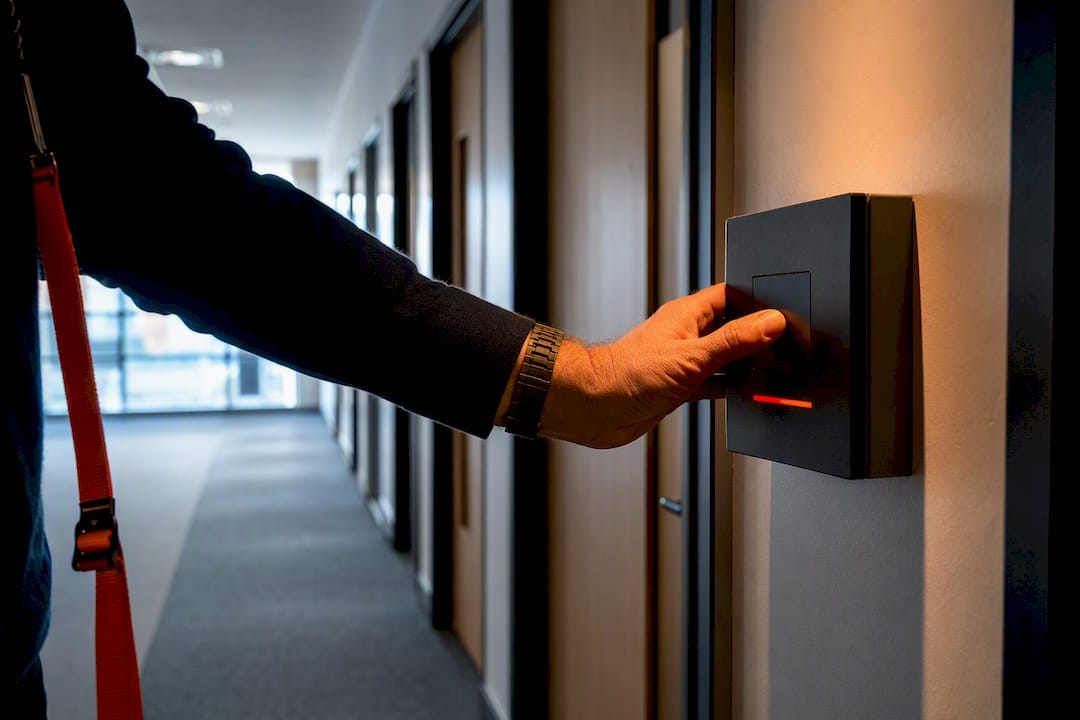
A school lockdown is the response to an immediate threat, either on the grounds or close enough nearby that leaving the building is riskier than staying put. The moment it’s called, three things happen in order: staff secure the space by locking and barricading doors, everyone goes silent and out of sight of windows and gaps, and then a headcount confirms every student is accounted for. Nothing else matters until those three are done. The rest, from the site’s Emergency Management Plan to the termly drill schedule, exists to make sure that response is automatic rather than improvised.
TL;DR:
- Schools must conduct lockdown drills at least once each term, including different times of day and settings, to ensure comprehensive preparedness.
- Lockdown responders should be familiar with distinct trigger signals, such as PA tones or alarm buttons, tested regularly during drills.
- The Emergency Control Organisation, led by the principal or delegate, assigns clear roles to minimize response confusion and ensure rapid action.
- Schools should review and update their Emergency Management Plan annually, documenting lessons learned and fixing identified gaps promptly.
- External staff and visitors need briefings on lockdown procedures, and security systems like monitored alarms significantly enhance safety during emergency responses.
Table of Contents
- What are the lockdown drill steps for the first few minutes?
- How is a lockdown activated, and will everyone recognise the signal?
- Who is responsible for what during a lockdown?
- How often should schools run lockdown drills?
- Who talks to whom during a lockdown?
- How do you keep the Emergency Management Plan current?
- What templates should every school have ready?
- What do security professionals see go wrong in real drills?
- Where professional security support fits into a school’s lockdown plan
- Sources
- FAQ
What are the lockdown drill steps for the first few minutes?
The first three minutes decide whether a lockdown works. Here’s the order that matters:
- Lock and secure. Lock the door, close it fully, and barricade with furniture if the room allows it. Close blinds and cover any window that faces a corridor or the outside.
- Get out of sightlines. Move students away from doors and windows, keep them low against an internal wall, and stay there until told otherwise.
- Go silent. Phones onto silent or aeroplane mode, no talking above a whisper, no opening the door for anyone without the agreed all clear signal.
- Take roll. Call the roll quietly and report any missing student through the school’s nominated method, radio, app or runner, whichever is designated in the EMP.
- Log the time. Note when the lockdown started. This detail matters later for the after-action review and for emergency services.
Corridors, toilets, and outdoor classes need their own plan. A teacher caught between rooms should move to the nearest secure space, not try to reach their usual classroom. Assembly halls and specialist rooms (science labs, gyms, workshops) often lack lockable doors, so these need a rehearsed alternative, like moving into an adjoining office or storeroom. Visiting adults, tradespeople, relief teachers, should be briefed on arrival, not left to guess.
How is a lockdown activated, and will everyone recognise the signal?
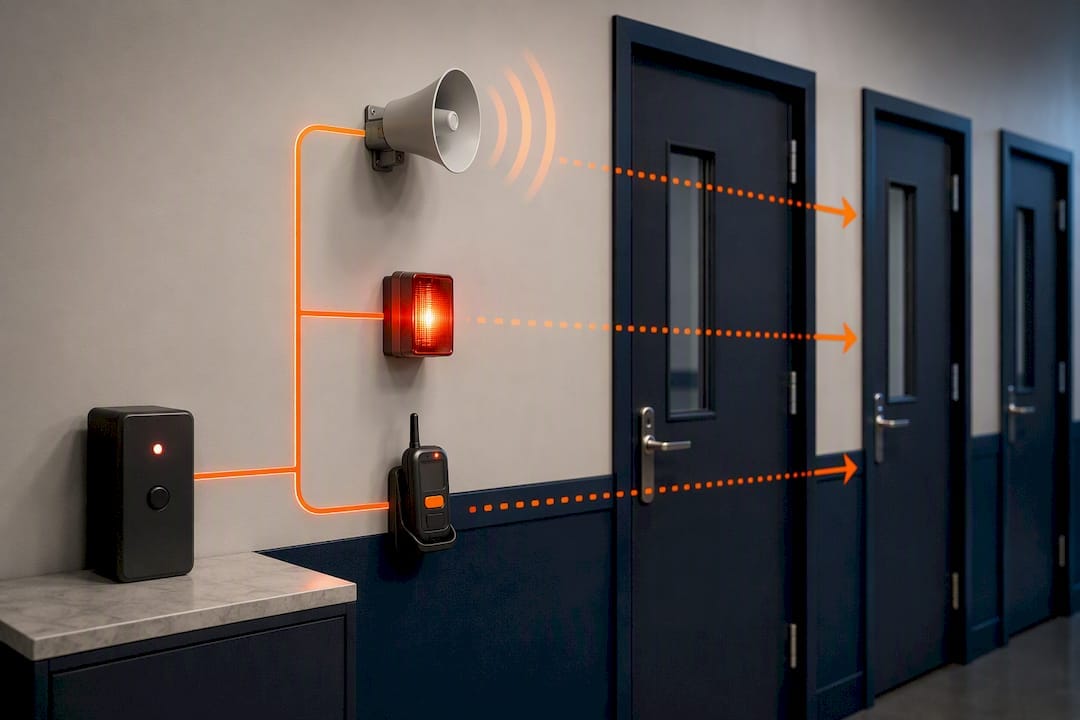
A lockdown only works if the trigger is unmistakable. Most schools use one of three methods: a distinct PA tone paired with a spoken code, a dedicated lockdown button wired into the alarm system, or a nominated verbal code issued directly by the principal or a member of the Emergency Control Organisation. Department policy requires a pre-defined activation trigger and mandates that every staff member, including new hires and casual relief staff, is inducted into what that trigger sounds like and what they’re expected to do when they hear it.
That induction can’t stop at permanent staff. Contractors on site for the day, canteen volunteers and visiting specialists all need a two-minute briefing on arrival covering the trigger and where to go.
- PA tone and coded phrase, tested every drill.
- A physical duress or lockdown button, ideally linked to monitored alarm infrastructure.
- Verbal code from the principal or a delegated ECO member, used when the PA is unavailable.
- Fallback communication: handheld radios or a phone cascade list for when the PA system fails.
Signage in staff rooms and near office phones showing the current code (updated each term) removes guesswork under stress.
Who is responsible for what during a lockdown?
Confusion about roles is the single biggest cause of slow lockdown response. The Emergency Control Organisation, led by the Chief Warden (usually the principal or a senior delegate), makes the activation call and coordinates the overall response. Deputy wardens take defined zones so no single person is a bottleneck.
- Chief Warden / ECO lead: calls the lockdown, liaises with emergency services, authorises the all clear.
- Deputy wardens: cover assigned zones, report status back to the Chief Warden, and step in if the lead is unreachable.
- Classroom staff: secure the room, keep students calm and quiet, maintain a line of communication (text, app, or radio) with the office.
- Office and admin staff: call 000 if required, log every action with a timestamp, and send parent notifications only once authorised.
- Grounds and specialist staff: account for anyone in transit, on excursion, or in outdoor lessons, and redirect them to the nearest secure space.
Pro Tip: Print role cards and laminate them. In a real lockdown nobody wants to be flicking through a 40-page EMP to remember whether they’re a deputy warden or not.
How often should schools run lockdown drills?
Drills aren’t optional paperwork. Policy requires every school to run emergency response drills, lockdowns included, at least once per school term, with the schedule documented in the site EMP. One drill a term is the floor, not the target. A school that only ever drills at 10am on a Tuesday hasn’t tested anything close to a real scenario.
- Vary the time and setting. Run at least one drill during recess or lunch, when students are spread across the grounds rather than seated in classrooms.
- Rehearse at different times of day, including right before dismissal, when supervision is thinnest.
- Debrief immediately. Gather staff for ten minutes straight after the drill while details are fresh, not the next week.
- Log observations formally. Record what worked, what didn’t, and who is responsible for fixing each gap.
- Plan for extended duration. A drill lasting five minutes teaches you nothing about what happens after forty.
The EMP guide specifically flags extended lockdown implications like toilet access and the value of rehearsing lockdowns at different times of day as areas most schools underplay. A student with a medical condition requiring medication on a schedule, or a class with high support needs, can’t be an afterthought discovered mid incident. Build hydration, toilet access, and supervision for students with disabilities into the plan before you need it, not during.
Who talks to whom during a lockdown?
Communication breaks down fastest under stress unless it’s scripted in advance. The office, not individual classrooms, should be the one calling emergency services, giving the school’s address, the nature of the threat, and the current status in that order.
- Emergency services: office staff call 000 with location, threat type, and student/staff numbers on site.
- Regional authorities: principals contact regional Incident Support and Operations Centres for guidance and approval on closures or dismissals.
- Parents and carers: notify once the situation is stable, using calm, factual language, avoiding speculation about the cause.
- Media: defer entirely to regional communications officers. Frontline staff shouldn’t be fielding press calls mid incident.
How do you keep the Emergency Management Plan current?
An EMP that sits untouched in a shared drive is worse than useless, because it gives false confidence. Policy requires principals to review and formally approve the EMP annually, and to update it immediately after any drill or real incident that exposes a gap.
- Record everything from the exercise, including the drill record, observer notes, and a timestamped response log.
- Assign owners to each gap. A finding with no name attached to it never gets fixed.
- Set deadlines before the next drill. Corrective actions need to be closed out, not carried over term after term.
- Sign off formally. The principal’s approval on the updated EMP is what makes the changes official, not just a note in a meeting.
Treat this as a cycle, not a filing exercise: mitigation, preparedness, response, recovery, then back to mitigation with whatever you just learned folded in.
What templates should every school have ready?
A handful of one-page tools do more for lockdown readiness than a lengthy policy document nobody reads under pressure.
- A single printable classroom checklist covering lock, silence, sightlines, and roll call, laminated and stuck near the door.
- Role cards for the Chief Warden, deputy wardens, and office staff, each limited to one line of responsibility.
- A simple observer template for drills, three columns: what happened, when, and who owns the fix.
- Accessibility prompts on the checklist itself, so students needing mobility support or medication aren’t forgotten in the rush.
- A reminder to brief after-hours users and external hirers, since EMP guidance stresses these groups also need to know shelter-in-place locations.
What do security professionals see go wrong in real drills?
Too many schools treat drills as a compliance formality rather than a genuine stress test. Real gaps show up when you vary the scenario, run it during break time, or test what happens when a class is transitioning between buildings. After-hours users and external hirers get missed constantly, yet they’re on site running programs while staff are on leave. Bring in an outside specialist to run a genuinely unpredictable exercise once a year, but never hand over ownership of the EMP itself. That accountability stays with school leadership.
— Abco
Where professional security support fits into a school’s lockdown plan
Professional security providers can work alongside school EMPs rather than replacing them, adding the technical layer that’s hard to build in-house: monitored duress buttons, alarm response, and realistic external drill facilitation that surfaces gaps a scripted internal exercise might miss. Where a PA system fails or a lockdown button needs to trigger an immediate, monitored response, that’s where a dedicated system earns its place.
Schools already juggling curriculum, compliance, and everyday site management don’t need another system to manage manually. Abcosecurity’s A1 CCTV & Alarm Monitoring service gives you 24/7 monitored alarm response so a triggered duress button reaches a live operator immediately, not a voicemail. For after-hours events, excursions, or extended supervision gaps, Mobile Patrol Services provide rapid on-ground response when your own staff can’t be everywhere at once. Get in touch to talk through where your current setup has gaps, and what a monitored duress system would look like on your site.
Sources
- Emergency and Critical Incident Management Planning: Policy
- Emergency management planning guide (EMP guide)
- CSNSW Emergency Management Plan manual
FAQ
What are the procedures during a lockdown?
Staff lock and secure the room, move students out of sightlines and keep them low, silence all devices, and take a roll to confirm everyone is accounted for. The office notifies emergency services and logs the timestamp, following the steps set out in the site’s Emergency Management Plan.
What are the 5 steps of an evacuation plan?
An evacuation plan generally covers: activate the alarm, move to the nearest safe exit, assemble at the designated point, take a roll call, and report to the warden that all students and staff are accounted for. Lockdown and evacuation are different responses. Lockdown means staying inside and securing the space, while evacuation means leaving the building entirely, so schools need distinct drills for each.
What is a lockdown protocol?
A lockdown protocol is the documented set of triggers, roles, and actions a school follows when there’s an immediate threat that makes staying inside safer than evacuating. It’s built into the school’s EMP and includes the activation signal, staff responsibilities through the Emergency Control Organisation, and the roll call and reporting process.
How long was the longest school lockdown?
Lockdown durations vary enormously depending on the nature of the threat, and there’s no single verified record for the longest one. This is exactly why EMP guidance pushes schools to plan for extended lockdown logistics, including toilet access, hydration, and medication, rather than assuming a lockdown will resolve in minutes.
How often are schools required to run lockdown drills?
Policy sets the floor at least once per school term, with the schedule documented in the site EMP. Schools that only run one drill per term should vary the time of day and scenario so it tests more than a single routine.
Recommended
about
avada factory
Sempery ultricies nibh at dolor cras urna eleifend nec. Atiam efficitur tempor.