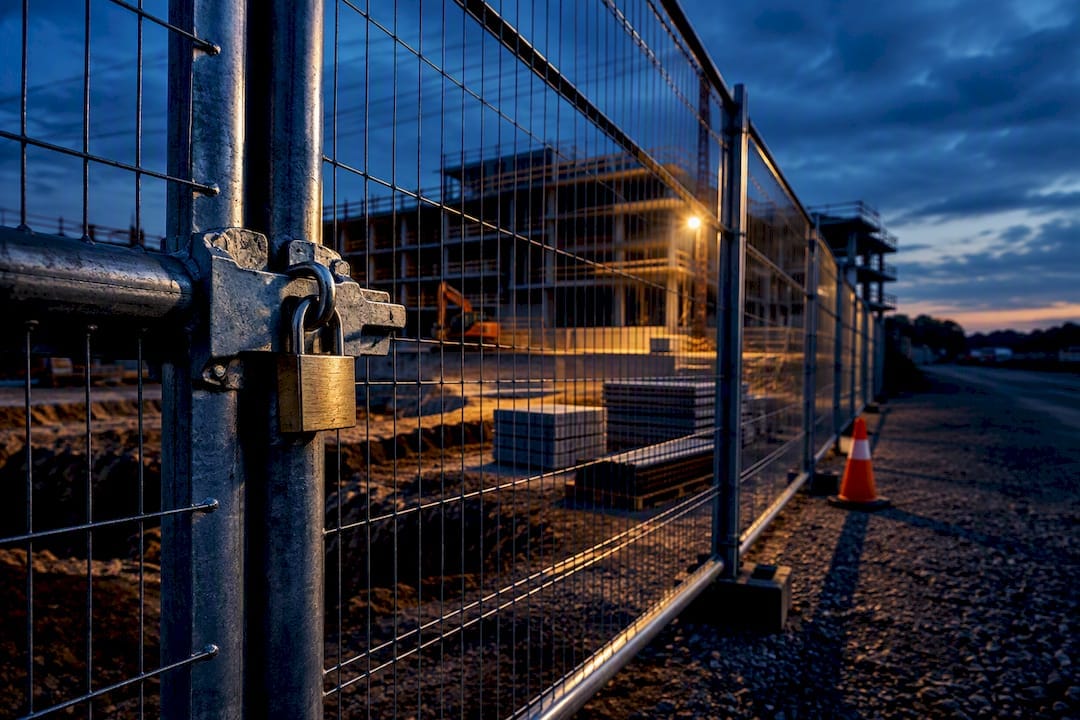
Stopping theft on a construction site comes down to layering perimeter fencing, purpose-built lighting, monitored CCTV, secure storage and controlled access, backed by a human response and documented in your WHS plan. SafeWork guidance treats a site as an unsecured legal liability if these controls aren’t genuinely robust and not just symbolic. Start today: lock every container, collect keys from trades who’ve finished, and put up clear signage.
TL;DR:
- Lock all containers and recover keys promptly from finished subcontractors to prevent unauthorized equipment removal.
- Install solid perimeter fencing appropriate to your site’s risk level, with gates secured by robust locks and clear signage.
- Manage access with sign-in registers, reset codes after subcontractor work, and consider electronic fobs for larger or long-term projects.
- Ensure proper lighting and CCTV coverage at entry points, storage areas, and high-value assets, with monitored systems preferred for real-time response.
- Document all security measures, incidents, and asset records to support insurance claims and demonstrate due diligence in theft prevention efforts.
Table of Contents
- Quick checklist: what to fix this week
- Perimeter controls: fences, gates and physical barriers
- Access control and key/code management
- Lighting and surveillance: CCTV, mobile towers and monitoring
- Secure storage, marking and asset management
- Logistics controls: just-in-time delivery and materials scheduling
- Human response: mobile patrols, static guards and community surveillance
- Incident response, evidence preservation and reporting
- Integrating security into WHS and insurance documentation
- ABCO’s practitioner-tested protocols you can adapt
- Editorial note: the case for audit-ready security
- How ABCO can help secure your site
- Sources
- FAQ
Quick checklist: what to fix this week
You don’t need a full security overhaul to make a dent in your losses this week. Some of these are free. Others need a phone call to a supplier or a security provider, but none require a budget submission to your board.
- Lock and pin every container and gang box, and check the padlocks aren’t the cheap ones that snap under bolt cutters.
- Recover keys and access codes from subcontractors who’ve finished their trade package.
- Put up “monitored premises” signage at every entry point, even before cameras go live.
- Photograph and record serial numbers on portable plant and power tools.
- Book a mobile patrol for the coming week while you assess longer-term coverage.
Quick wins are the container locks, key recovery, and signage. Camera installation and fencing upgrades need procurement time. Tell your trades and neighbours about any new patrol schedule or gate hours. A one-page notice at the site office avoids confusion at 6am when the concreter turns up to a locked gate.
Perimeter controls: fences, gates and physical barriers
Perimeter fencing is the first genuine barrier between your site and an opportunistic thief, and the type you choose should match your actual risk, not just habit. Police SA’s construction site theft guidance recommends solid perimeter fencing as a baseline for any active site holding plant or materials.
- Chain-mesh panels suit low-risk, short-duration sites where speed of setup matters more than resistance to a determined climb.
- Hoarding (solid timber or Colorbond panelling) works best on urban sites where you also need to block sightlines into valuable storage areas.
- Rigid, anchored fencing with anti-climb design is worth the extra cost on sites holding copper, cabling or fit-out materials, which attract organised theft rather than opportunists.
Gates need the same scrutiny as the fence line. A weak padlock on a strong gate defeats the purpose entirely, and stacked materials, bins or pallets near the fence line give climbers a leg up you didn’t intend to provide.
SafeWork guidance is direct about this: a site counts as “secured” only when the barrier genuinely prevents access. SafeWork SA’s site security guidance specifically rules out bunting or plastic strip fencing as adequate, because it stops nobody. That threshold matters more once you’re adjacent to excavations, public playgrounds or footpaths, where WHS exposure and theft risk overlap.
Pro Tip: Walk your own perimeter at dusk once a month. You’ll spot the gaps, low spots and climb aids a daytime inspection always misses.
Access control and key/code management
Every person who sets foot on your site should be recorded, and every key or code issued should have a known expiry. Insider risk is a bigger factor than most managers admit, and Police SA’s guidance on construction theft flags key management as one of the most common failure points.
- Run a visitor sign-in register with ID checks for anyone outside your regular trades.
- Fold site security expectations into your site induction, not just fall protection and PPE.
- Track every key or fob issued against a name, with a return date.
- Rekey locks or reset codes whenever a subcontractor finishes their scope, not “eventually.”
Electronic access, whether that’s fobs, PIN pads or deactivatable Bluetooth credentials, earns its cost on larger or longer-running sites because you can revoke a single person’s access instantly rather than rekeying the whole gate. On a six-week fit-out, a physical key system with a strict sign-out sheet is usually enough. On a twelve-month build with rotating trade crews, electronic credentials pay for themselves the first time you don’t have to rekey the entire compound because one labourer lost a key. The access control guide for site managers covers how to set the review cadence for larger builds.
Lighting and surveillance: CCTV, mobile towers and monitoring
Darkness is doing half the thief’s job for them, so lighting is not optional extras. Pole-mounted floodlights beat tripod units for coverage and stability, and solar-powered units are now genuinely viable for sites without a permanent power connection. Placement matters as much as brightness: a bright light behind a stack of materials just creates a darker shadow in front of it.
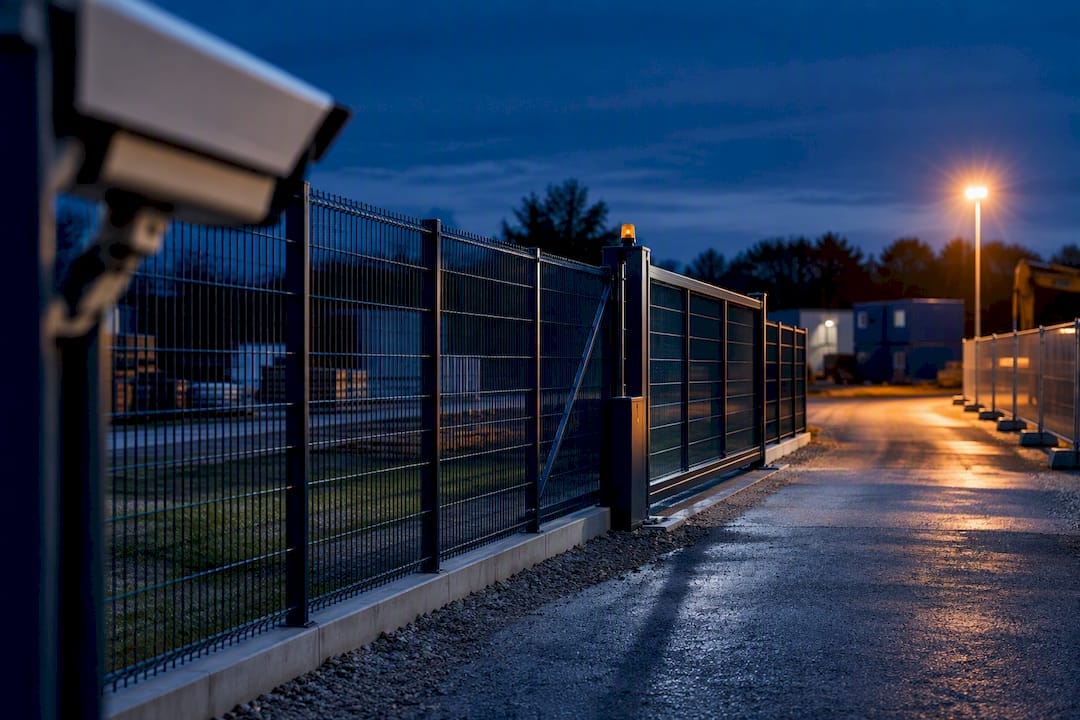
Cameras should cover entry points, gates and wherever you store high-value materials or plant, not just a wide shot of the compound. Pan-tilt-zoom cameras add real value when you need to track movement across a large yard rather than watch a fixed frame.
- Place at least one camera covering each gate and each container or lock-up.
- Use PTZ units on larger sites where a fixed camera can’t cover the whole storage zone.
- Add audible warning speakers where budget allows, they interrupt an attempt in progress.
- Post signage stating the site is under video surveillance, both as a deterrent and to meet privacy obligations.
Monitored CCTV is the meaningful upgrade over an app-only camera you check when you remember to. Police SA notes that monitored systems can feed real-time information straight to police, while an unmonitored app camera only gives you footage after the fact. Industry guidance from GS Industries backs this up: mobile CCTV towers with remote monitoring are a genuinely cost-effective substitute for a static guard on many temporary sites, provided blind spots are covered by patrols too.
Pro Tip: Test your camera’s night vision in real conditions before you rely on it. Plenty of units that look sharp in daylight footage turn to grey mush after 9pm.
For a deeper look at system-level choices, the construction site security systems guide walks through camera and lighting specifications in more detail.
Secure storage, marking and asset management
A lockable container is only as good as what’s inside it and how well that gear is identified if it ever leaves the site without permission. Gang boxes, wheel locks and hitch locks on trailers, and steering or cab locks on plant all raise the physical effort required to walk equipment off site.
- Store portable power tools and small plant inside lockable containers overnight, never left on benches or in open sheds.
- Engrave or permanently mark tools with your ABN or a unique site ID, which discourages resale through legitimate channels.
- Photograph serial numbers on every major asset and keep that record off-site, not in the container that might get stolen with the tools.
- Fit affordable tracking tags to high-value portable items like generators or compactors.
Police SA’s guidance points out that marked and registered tools have a meaningfully better recovery rate, because pawnbrokers and resellers are less willing to touch obviously identifiable gear. An auditable asset register, updated as equipment arrives and leaves site, turns a vague “we think something’s missing” into a specific claim your insurer and police can actually act on. One practical example: sites that pair a strict check-in process with locked overnight storage report noticeably fewer disappearing power tools, precisely because the opportunity window shrinks to nothing. The tool theft prevention guide walks through that check-in and locked-storage combination in more detail.
Logistics controls: just-in-time delivery and materials scheduling
The single best way to stop a whitegoods or hot-water system theft is to make sure it’s never sitting unattended on site long enough to steal. Police SA specifically recommends just-in-time delivery for high-value items, and it’s one of the cheapest controls on this list because it costs coordination, not capital.
- Talk to suppliers about staged delivery timed to installation, not delivery to a schedule that suits the truck.
- Use off-site staging or a supplier’s own yard for materials that don’t need to be on-site more than a day or two before fitting.
- Delay ordering or delivering high-value fixtures (ovens, hot-water units, cabling) until the trade that installs them is confirmed and ready.
- Log every delivery on arrival: check it against the order, photograph condition, and move it straight into secure storage rather than leaving it at the gate.
Owners sometimes push back on delayed fixture installation because they want to see progress. It’s worth explaining that a stolen appliance costs more in delay than a week’s wait ever will.
Human response: mobile patrols, static guards and community surveillance
Technology deters the opportunist, but a determined thief who’s scouted your site needs a human response to actually stop them. GS Industries’ analysis of effective site security makes the point plainly: physical and electronic measures alone leave gaps that only a person on the ground can close.
Mobile patrols suit most active construction sites, checking gates, locks and lighting on a scheduled or randomised drive-by. Static guards make sense on high-value sites, major fit-outs or anywhere with continuous public access risk, like inner-city builds. Monitored CCTV response sits between the two, useful where a control room can dispatch someone the moment an alert triggers.
- Brief patrol staff on exactly what to check: gate integrity, container locks, lighting faults, unusual vehicles.
- Set a clear escalation pathway: patrol staff contact the control room, which decides whether to call police.
- Match patrol frequency to site value: a fit-out with fixed cabinetry and appliances needs tighter cover than an early-stage slab pour.
- Log every patrol visit, even when nothing’s wrong, it builds the audit trail your insurer will eventually ask for.
Mobile patrol services are usually the most cost-effective starting point before you commit to a static guard roster.
Incident response, evidence preservation and reporting
What you do in the first ten minutes after discovering a theft affects whether police can act and whether your insurer pays out. Panic and cleanup destroy evidence faster than the thief did.
- Secure the area first, don’t let trades wander through where the break-in or theft occurred.
- Photograph everything before you touch it: broken locks, disturbed containers, tyre tracks, anything out of place.
- Log exactly what’s missing, including serial numbers and approximate value, while it’s fresh.
- Pull CCTV footage immediately and hand a copy, along with serial numbers, to police and your insurer.
- Rekey affected locks and review who had access before the incident, then debrief with your team on what let it happen.
The Law Handbook’s guidance on security officers is worth reading before an incident, not after. Security staff and private citizens have real legal limits: a citizen’s arrest only holds up if the person detaining someone actually witnessed the offence, and security personnel exist mainly to preserve evidence and liaise with police, not to act as enforcers. Understanding that boundary now avoids a bad situation getting worse later.
Integrating security into WHS and insurance documentation
Security isn’t a side project to your WHS Management Plan, it’s part of it. SafeWork guidance treats site security as a live legal obligation, not a nice-to-have, and SafeWork SA is explicit that measures have to be genuinely effective to count as “secured” at all.
- Write your fencing, lighting, CCTV and access controls directly into your Safe Work Method Statement, not a separate document nobody reads.
- Reference the specific standard you’re using (fence height, lock rating, camera coverage) so it’s auditable, not aspirational.
- Keep an incident log even for near misses and attempted break-ins, not just successful thefts.
- Store CCTV footage and access records for a set retention period so they’re available if a claim arises weeks later.
GS Industries’ guidance notes that documented security plans and incident logs directly support insurance claims, because they demonstrate due diligence rather than a vague assurance that “we had a fence.” An insurer assessing a claim wants to see what you had in place, not what you meant to install eventually.
ABCO’s practitioner-tested protocols you can adapt
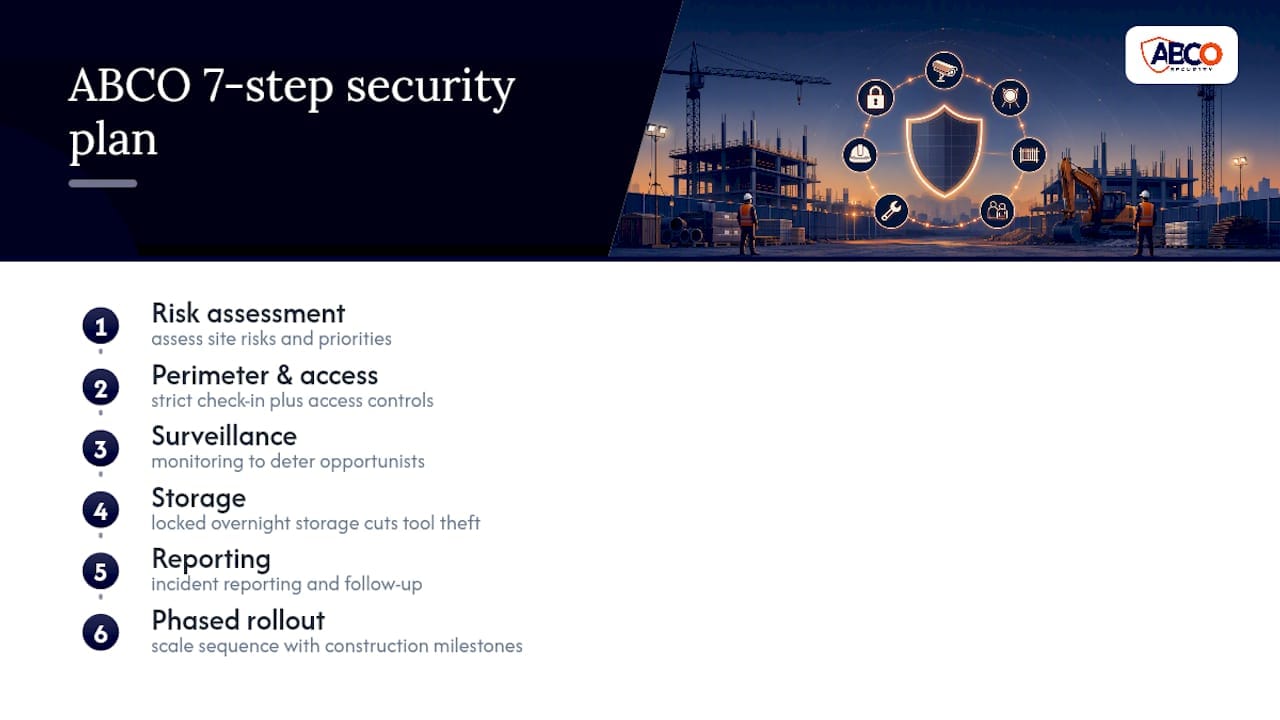
ABCO Security’s 7-step construction site security plan sets out a practitioner-tested sequence covering risk assessment, perimeter and access controls, surveillance, storage and reporting. It also includes seven quick actions specifically aimed at copper theft, one of the most common and costly losses on fit-out and services-heavy sites.
A recurring pattern across client sites is straightforward: pairing a strict check-in process with locked overnight storage cuts tool theft noticeably, because it closes the exact window opportunists rely on. The check-in and locked storage guide breaks down how that combination plays out in practice.
None of this needs to be applied wholesale on day one. A small residential build might only need the storage and access steps from ABCO’s 7-step plan. A multi-stage commercial project will need the full sequence, phased alongside construction milestones, so the security scope grows with the site rather than lagging behind it.
Editorial note: the case for audit-ready security
Layered security isn’t the expensive option, it’s the one that saves money over the life of a project. Auditable measures, logged incidents, WHS-aligned documentation, cost less in the long run than the alternative: a claim denied because nobody can prove what was actually in place when the theft happened.
The mistake we see most often isn’t skipping security, it’s bolting it on after the slab’s poured instead of budgeting for it at the planning stage, when phased deployment is genuinely cheap.
— Abco
How ABCO can help secure your site
A key advantage over a patchwork of DIY cameras and a padlock from the hardware store is having one provider covering the full layer, from physical barriers to monitored response, instead of you coordinating five suppliers and hoping they talk to each other.
Our Construction Site Security Services cover perimeter assessment, access control and on-site protocols tailored to your build stage, backed by A1 CCTV & Alarm Monitoring that puts a real response behind every camera rather than footage you check after the fact. Where a full guard roster isn’t warranted yet, Mobile Patrol Services give you scheduled, logged checks without the cost of a static presence. Get in touch for a site security assessment and we’ll map the right combination of controls to your project’s actual risk and budget, not a generic package.
Sources
- SafeWork SA – Site security (construction)
- Police SA – Construction site theft
- GS Industries – Construction site security measures that work
- Law Handbook – Police security officers, security guards and others
FAQ
What is the biggest cause of loss on a construction site?
Theft of tools, plant and materials is one of the most common and costly losses builders face, alongside safety incidents. Unsecured perimeters, unattended deliveries and poor key management are the recurring factors behind most losses, which is why SafeWork SA treats site security as a genuine WHS obligation, not an afterthought.
What security measures are legally required on a construction site?
There’s no single fixed checklist, but SafeWork guidance requires that whatever measures you use actually prevent unauthorised access. SafeWork SA explicitly rules out flimsy options like bunting or plastic strip fencing as inadequate, meaning solid fencing, secured storage and controlled access are the practical minimum.
What should I do if tools or equipment are stolen from my site?
Secure the area, photograph everything before touching it, and log exactly what’s missing including serial numbers. Hand your CCTV footage and asset records to police and your insurer promptly, and rekey any affected locks as part of your follow-up, following the process Police SA outlines.
What are the most effective strategies for preventing site theft?
A layered approach works best: perimeter fencing, purpose-built lighting, monitored CCTV, secure storage and tight access control, backed by a human response like mobile patrols. Abcosecurity’s 7-step construction site security plan sequences these controls in a practical order for site managers to adopt.
How much does construction site security cost?
Costs vary depending on site size, duration and risk level, so there’s no single figure that applies across every project. Abcosecurity’s Night Owl monitoring service starts from $5.45 per day, while guarding, patrols and electronic security are quoted per site after an assessment.
Recommended
about
avada factory
Sempery ultricies nibh at dolor cras urna eleifend nec. Atiam efficitur tempor.