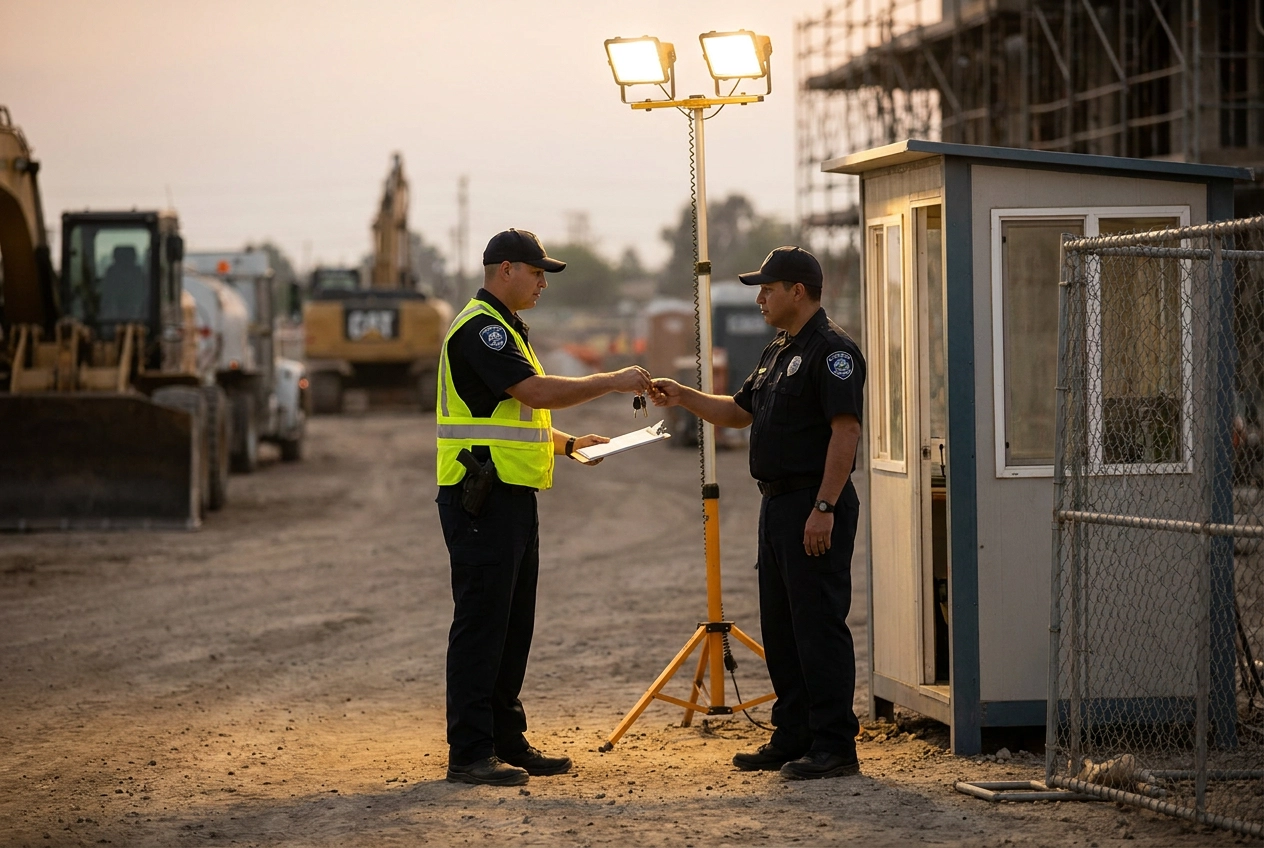
Every construction site theft prevention strategy eventually circles back to the same question: where does protection actually break down? The answer, more often than not, is not a gap in fencing or a missing padlock. It is the 15 minutes when one construction site security guard hands responsibility to the next.
Shift changeover is the highest-risk window on any active construction site, yet most security contracts say nothing meaningful about how it should be managed. Asset statuses go unconfirmed, zone boundaries shift without documentation, and incident history from the previous shift disappears into a verbal summary that neither guard can be held accountable for. Theft and unauthorised access risk is highest in that window, and project managers rarely have the contractual leverage to address it.
This post gives you a concrete framework to close that gap. You will learn why changeover creates a structural vulnerability, what compliant handover actually looks like in practice, a four-step protocol you can implement immediately, and exactly what language to include in your security contract before work begins.
The Changeover Window Is Where Sites Get Hit

Guard shift changeover is the single highest-risk theft window on a construction site. A written handover protocol covering zone status, incident history, and dual sign-off is the only reliable way to close it.
Construction site theft spans excavators, skid steers, utility trailers, copper wiring, power tools, and appliances. Insurance costs for construction site theft have been climbing, and the majority of stolen equipment is never recovered.
Most guidance points to asset controls: GPS trackers, equipment immobilisation, die-stamping. But the gap that gets sites hit repeatedly is not a technology gap. It is a process gap in what transfers between outgoing and incoming guards.
Project managers who specify handover protocol requirements in their construction site security contract reduce their exposure during the first and last hour of each shift. That is exactly when changeover risk peaks: the outgoing guard’s attention is winding down, the incoming guard has no confirmed picture of asset status or recent incidents. The overlap creates a window that opportunistic and organised theft can exploit.
As covered in what Melbourne construction security guards actually do on site, the exposure is procedural, not numerical. Closing it requires specifying what information transfers at every changeover, in writing, every shift.
Why Shift Changeover Creates a Predictable Security Gap
The mechanics are straightforward, and most project managers miss them entirely. That gap is predictable, repeatable, and exploitable.
Site type determines exposure severity. Capital builds, hospitals, office towers, enclosed commercial structures, have defined perimeters and single-entity management, which limits changeover risk. Decentralised residential developments are a different problem. With unfenced boundaries, multiple active builders, and no single point of control, a residential estate at 5am during rotation is almost undefended, with no clear picture of active zones, access points in use, or materials left exposed.
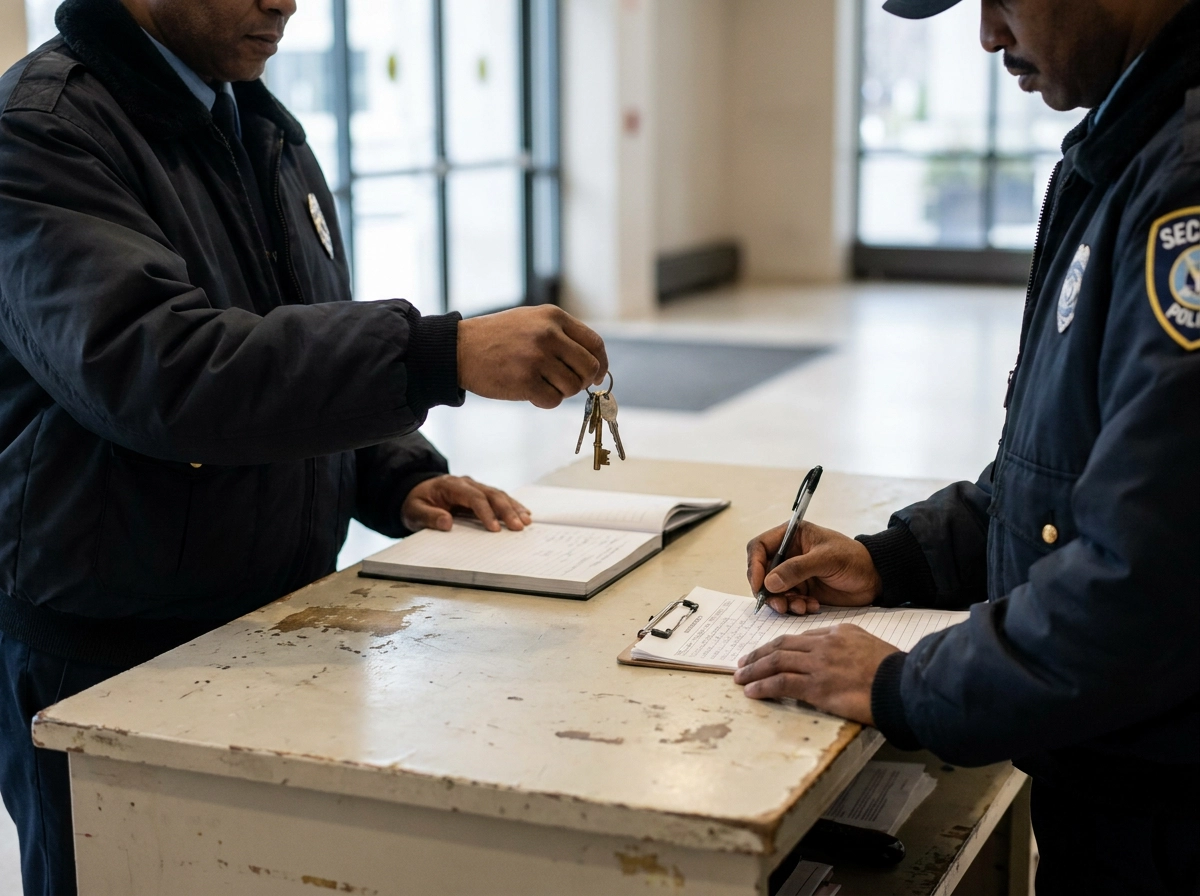
Most verbal briefings are brief. No asset status is confirmed, no boundary changes communicated, no vehicle observations transferred. An unfamiliar ute near copper storage at 2am disappears entirely if it wasn’t written down.
The deeper issue is contractual. Most construction security service agreements are silent on handover procedures, so sites default to informal verbal pass-overs at every rotation. If you’re unsure how your contract handles this, reviewing how termination and transition clauses manage coverage gaps is a practical starting point.
Inadequate vs. Protocol-Compliant Handover: What the Difference Looks Like
The gap between these two approaches isn’t a matter of preference. It’s measurable exposure.
| Practice | Standard Handover (Verbal Only) | Protocol-Compliant Handover |
|---|---|---|
| Incident Log | No written record | Written log with timestamps |
| Zone Status Confirmation | No zone walk | Completed zone walk before sign-off |
| Asset Check | Assumed from prior shift | Physical spot-check against logged status |
| Sign-Off | No signature | Dual signature, outgoing and incoming guard |
| Escalation Trigger | No defined path | Threshold set for site supervisor notification |
Every row in the left column is a blind spot the incoming guard inherits without knowing it. A verbal-only handover doesn’t just transfer incomplete information; it transfers false confidence.
This is why handover requirements belong in your construction site security plan and security contract from day one. Specifying them costs nothing at the contract stage. Omitting them costs significantly more when a discrepancy surfaces two shifts later with no documentation trail.
ABCO Security’s construction site security service builds handover accountability into the operational model rather than leaving it to individual guards to improvise.
The 4-Step Handover Protocol Framework for Construction Sites
Here is how to implement it on your site.
Step 1: Written Incident Log Completion
Before the outgoing guard signs off, every incident, observation, and anomaly must be entered into a dated, timestamped log. Vehicles near the perimeter, persons challenged, equipment moved, boundary breaches. No verbal-only exceptions. If it isn’t written down, it didn’t happen.
Step 2: Zone Walk with Incoming Guard
Both guards complete a physical walk of active zone boundaries before changeover is finalised. Construction sites are dynamic; a fenced boundary from last week may now be open as works progress. The walk confirms current access points, not assumed ones.
Step 3: Asset Spot-Check Against Prior Log
The incoming guard physically confirms high-value assets (generators, compressors, copper runs, tool storage) against the outgoing log. Any discrepancy triggers an immediate hold on changeover and direct notification to the site supervisor. Immediately.
Step 4: Dual Sign-Off
Both guards sign the completed handover log. Dual sign-off creates a documented chain of custody and shared accountability between outgoing and incoming guards.
Not all security guard positions carry the same responsibilities, and construction site officers require specific process discipline that generalist guards often lack.
For sites where fixed guard coverage has gaps, mobile patrol services can provide an independent verification layer during the changeover window, the period of highest exposure.
What to Put in Your Security Contract Before Work Starts
The 4-step framework only works if it’s contractually required. Retrofitting protocol obligations mid-project creates pushback from the security provider and inconsistency from individual guards.
Get the language in before signing. The agreement should specify:
- Written log format and retention period (30 days minimum, accessible to site management)
- Mandatory zone walk duration (a defined minimum time per site scale, not just “a walk”)
- Asset categories subject to spot-check (generators, compressors, copper runs, tool storage)
- Dual sign-off requirement at every changeover, no exceptions
- Escalation thresholds and named recipients for notifications
Schedule a pre-construction meeting between site management and the security provider to walk the protocol before the first shift.
For decentralised residential sites with multiple active zones and rotating builder access, the contract must name each zone and specify how access changes are communicated between shifts.
Pair the written log with CCTV and alarm monitoring as a complementary evidence layer. When an incident is disputed, two independent sources are stronger than one guard’s notes. This layered verification is also the foundation of a sound industrial warehouse security model.
Frequently Asked Questions
What should a security guard handover include on a construction site? As outlined in the four-step framework above, a compliant handover covers incident logs, zone walk, asset spot-check, and dual sign-off.
How do I reduce theft during shift changes on a construction site? Specify written handover protocols in your security contract before work starts. Verbal briefings transfer almost no usable information, leaving the incoming guard without accurate zone status or incident history.
What is a zone walk protocol for security guards? A zone walk is a physical perimeter check completed jointly before changeover is signed off. It confirms active zone boundaries, current access points, and changes since the prior walk.
Do I need a security officer on a construction site for smaller residential builds? Residential sites are often more exposed than capital builds due to unfenced boundaries and multiple builders on site. A security officer or scheduled mobile patrol with a formal handover protocol reduces exposure on both project types.
How do construction site security guards near me differ in their handover practices? Many providers rely on verbal briefings with no written record requirement in their contracts. Specifying dual sign-off and zone walk requirements in your contract filters for providers with genuine process discipline. Before signing, ask any prospective construction site security provider to show you their existing handover documentation.
Common Pitfall to Avoid
The most dangerous assumption you can make is that a verbal briefing between guards is enough. It is a persistent and underaddressed failure point on construction sites, and most security providers never address it directly.
The handover gap documented earlier in this guide has a straightforward fix: add a one-page handover protocol to your security contract before tender. That single addition closes more exposure than doubling guard hours.
Rising insurance premiums for construction theft reflect an industry still treating this as an asset problem. Stolen generators and copper stripping get reported; the process failure that allowed them goes undocumented. Process controls cost a fraction of a single significant loss and create the paper trail insurers and site supervisors need.
For sites requiring fixed and mobile coverage with built-in handover accountability, ABCO Security’s construction security model is worth reviewing. It is the kind of advanced security management approach that treats process discipline as a core deliverable, not an optional extra.

Conclusion
Shift changeover is not a routine administrative task. It is the highest-risk window on any construction site, and most sites leave it completely unprotected.
The four-step framework in this guide, log, walk, spot-check, sign-off, gives you that structure.
Before your next security contract is signed, add a formal handover protocol to the tender requirements. One page of specification protects everything on site from that point forward.
Construction theft is a process problem, not just a personnel problem. Fix the process, and the losses follow. Start with handover, because that is where the window opens, and where disciplined sites keep it permanently closed.
about
avada factory
Sempery ultricies nibh at dolor cras urna eleifend nec. Atiam efficitur tempor.