
Most server room physical security failures do not begin with a sophisticated breach. They begin with a contract that never specified what “secure” actually means. When a guard waves through an unescorted contractor, or an alarm goes unanswered for twenty minutes, the root cause is almost always the same: vague procurement language that left too much open to interpretation.
For IT managers and facilities teams across Melbourne, tightening that gap starts before a single guard sets foot on site. It starts at the contract stage. Drawing on frameworks including the Australian Government’s cyber security guidelines and Boston University’s concrete data centre security standards, this guide translates abstract server room physical security requirements into clause-level language you can copy, adapt, and enforce.
You will learn how to specify zoned access control with multifactor authentication requirements, draft a visitor escort policy that eliminates tailgating risk, lock in alarm response SLAs with defined timeframes, and mandate audit logging on a verifiable reporting cadence. By the end, you will have a clear reference for procuring security that is measurable and contractually binding, not just promised.
The Contract Gap Most Melbourne IT Managers Miss

Server room physical security failures almost always trace back to under-specified contracts. Before signing any data centre guard contract, Melbourne businesses must specify zoned access controls, visitor escort policies, alarm response SLAs, and audit logging requirements in writing.
The WA Auditor General’s June 2024 audit of 16 non-metropolitan entities found significant access management and environmental hazard protection gaps across Australian public sector facilities. Vague arrangements produced real failures.
Most contracts name a physical security provider but never define what the guard must actually do inside the server room. No response timeframes. No logging obligations. No escort protocols.
This post maps four control requirements to exact clause language that makes them enforceable: zoned access, visitor escort policy, alarm response SLAs, and audit logging.
As covered in how physical security protects your IP assets on site, the server room is often the weakest link once someone is already inside the building.
Common Pitfall to Avoid: Do not accept a contract that references “industry best practice” without naming the specific standard. Best practice is not a clause; it is a disclaimer.
Zoned Access Control: What Your Contract Must Say
The Australian Government Information Security Manual requires server rooms to occupy a dedicated security zone beyond general facility perimeter controls. Boston University’s Data Center Security Standards (May 2026) go further, mandating electronic locks with multifactor authentication at every zoned access point. MFA at the physical layer is now the baseline, not an upgrade.
What your contract must specify:
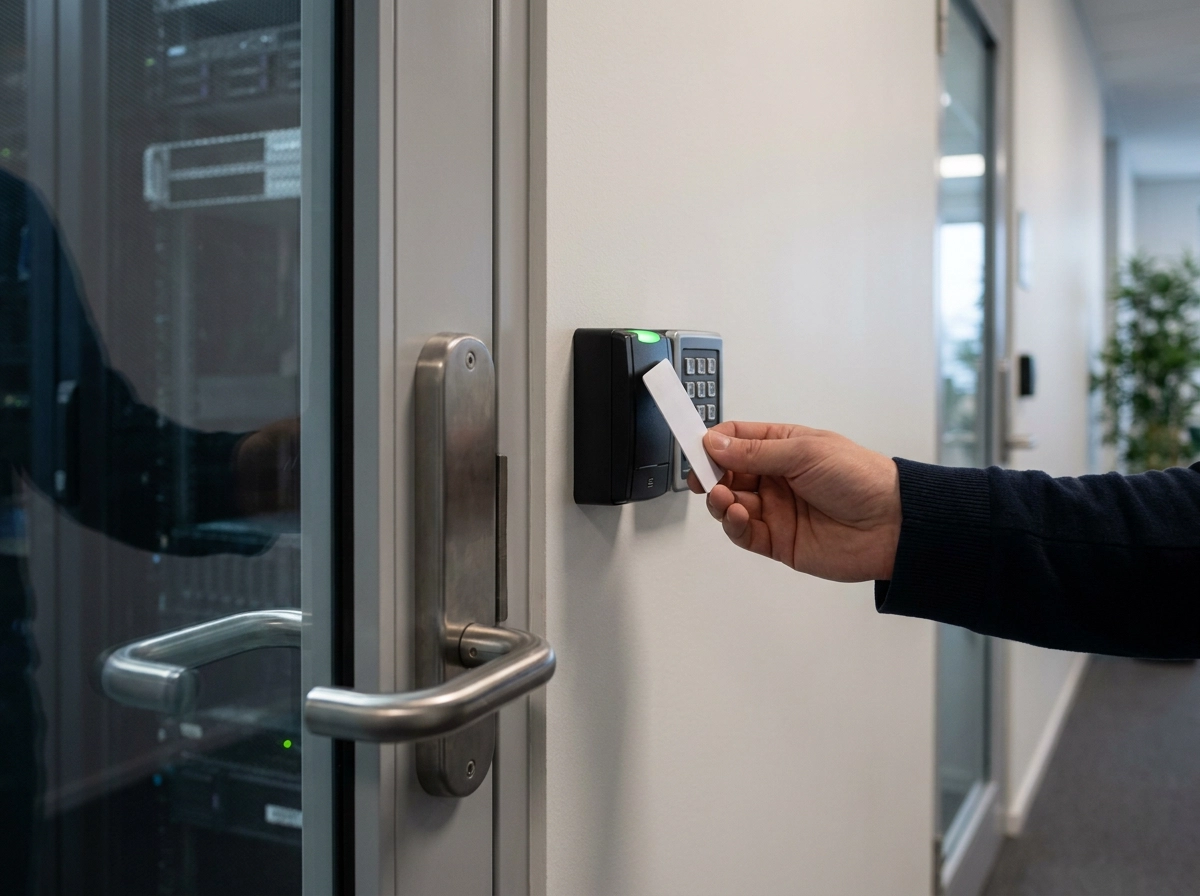
- Authorised individuals by name, not job title. “The IT Manager” changes; a named person with an annual review cycle does not drift silently.
- Daily electronic lock functionality verification, with a written failure-reporting obligation and a remediation timeline to be agreed in the contract.
- Zoning tiers defined explicitly. Perimeter access and server room access are separate authorisation levels; the contract must treat them that way.
Reject the clause language “access control in place” – it confirms nothing about MFA, zone separation, or failure response. Replace it with language naming the authentication method, verification cadence, and reporting window.
For how these obligations translate into day-to-day policy, the key takeaways on access control policy structure are worth reviewing before you draft clause language.
Common pitfall: Contracts referencing access control by brand or system name (for example, “HID card readers installed”) describe hardware, not a standard. Hardware specs belong in a technical schedule; the contract clause must describe the control requirement the hardware must satisfy.
Visitor and Contractor Escort: The Clause That Prevents Tailgating
Escort policy determines what happens when someone without standing authorisation needs access, and it is where most contracts fall apart.
Boston University’s Data Center Security Standards (May 2026) are explicit: no vendor, contractor, or visitor may access server room areas without pre-authorised unescorted clearance or a documented escort. Your contract must reflect this directly.
Minimum contract language for visitor escort:
- All visitors present photographic identification, verified by the guard before entry
- The assigned escort remains within line of sight for the entire visit
- A visitor log records name, organisation, purpose, escort name, entry time, and exit time; retained 12 months and reviewed quarterly
Tailgating must be defined as a reportable security breach, not a procedural note. Without that designation, a guard who observes it has no obligation to escalate.
The escort policy must also cross-reference the zoned access tiers from the previous section. If Zone 2 permits escorted vendor access but Zone 3 does not, the escort clause must state that explicitly. Contradictions between clauses are a liability auditors will find.
Alarm Response SLAs: Pin Down the Numbers
When entry controls fail, response SLAs determine what happens next.
Most guard contracts use phrases like “respond promptly” or “in a timely manner.” Neither is enforceable, and the most damaging gap is a contract that contains no numeric SLA at all, so no breach could ever be logged.
Clause language that holds up:
- Response window: “On-site guard response to any forced-entry or door-held alarm must occur within five minutes of alert confirmation.” Five minutes is a commonly cited target for manned-post response, your contract should name a specific numeric window, not a descriptor.
- Escalation protocol: If the guard cannot respond within the SLA window, the contract must name a specific next-in-chain contact and set a maximum escalation window, for example ten minutes from the original alert.
- Consequence clause: Consider requiring that any missed SLA generate a formal incident report within 24 hours. Silent absorption into a shift log is not acceptable.
One gap Melbourne businesses overlook: guard contracts and alarm monitoring contracts sit with different teams and reference different language. If your monitoring provider logs an alert at 02:14 but your guard contract has no matching timestamp requirement, compliance cannot be measured. Both contracts must reference identical SLA timeframes.
Security Monitoring: What Professional Protection Actually Looks Like outlines what integrated monitoring coverage should deliver and where accountability gaps typically appear.
Common Pitfall to Avoid: Accepting a contract that lists alarm response as a duty without a numeric SLA. A duty without a timeframe is not a commitment; it is a description.
Contract Clause vs. Standard Requirement: A Quick Reference
The four sections above each map to a clause your contract must contain. This table consolidates them into a single reference you can hand to a legal team or security provider.
| Control Area | Standard / Source | Reject This Language | Require This Instead |
|---|---|---|---|
| Zoned Access | ISM / BU May 2026 | “Access controls in place” | “Electronic locks with MFA, daily functionality check, failure reporting window [define in contract]” |
| Visitor Escort | BU May 2026 | “Visitors must be escorted” | “Photo ID verified on entry, line-of-sight escort, log entry with name/org/purpose/times” |
| Alarm Response | Industry benchmark | “Respond promptly to alarms” | “On-site response within 5 minutes (or agreed numeric window); escalation protocol named; incident report for every SLA breach” |
| Audit Logging | Recommended practice (BU May 2026: quarterly review + 12-month retention) | “Logs maintained on file” | “Daily incident report, weekly log summary, monthly compliance attestation [recommended contract requirements]; quarterly visitor log review, 12-month minimum retention [BU May 2026]” |
Critical note: Insert the “Require This Instead” language verbatim into Schedule [X] of the security services agreement. Referencing a policy name in the contract body is not sufficient; if the external document changes or is disputed, your enforceable obligation evaporates.
If you are unsure which clauses belong where, what core clauses every security services contract needs will clarify the structure before you redline a draft.
Audit Logging: The Reporting Cadence Your Contract Must Enforce
Your contract must name reporting obligations explicitly. Boston University’s Data Center Security Standards (May 2026) confirm that quarterly visitor access log reviews and 12-month minimum retention are required. Your contract should also require:
- Daily incident reports for any access event, anomaly, or equipment fault
- Weekly log summaries covering all access activity across the shift period
- Monthly compliance attestations signed by the provider’s supervising officer
The BU-confirmed obligations are:

- Quarterly visitor access log reviews, conducted and documented by the provider
- 12-month minimum retention for all logs, with no deletion without written client approval
Format matters as much as frequency. Unstructured shift notes make it difficult to demonstrate compliance with any structured audit or regulatory review. Each log entry should capture at minimum a timestamp, a user or guard ID, an event type, and a resolution status, define these fields in the contract rather than leaving format to the provider’s discretion.
Add an on-demand access clause specifying read access rights. Most providers default to periodic reporting because no contract clause requires otherwise.
For organisations running integrated electronic security alongside a guard contract, physical access logs and electronic audit trails should feed into the same governance framework. Separate silos make correlating a physical breach with a network event guesswork. Melbourne IT managers should read how network intrusion for Melbourne businesses starts at the physical perimeter.
Common Pitfall to Avoid: Accepting a provider’s proprietary log format without defining required fields. If a compliance audit lands, “we have the notes on file” is not a defence.
Frequently Asked Questions
Q: What are the minimum server room physical security standards in Australia? No single mandatory national standard applies to private businesses. The ASD Information Security Manual (ISM) provides the most authoritative guidance. The WA Auditor General’s June 2024 audit of 16 entities found significant access management gaps, confirming that voluntary standards are routinely under-applied without contractual enforcement.
Q: What should an alarm response SLA specify in a data centre guard contract? A numeric response window (five minutes is a commonly cited target for manned-post response, your contract should name a specific numeric window), a named escalation contact, and a written incident report for every SLA breach. “Respond promptly” is not an SLA.
Q: How long must visitor access logs be retained? Boston University Data Center Security Standards (May 2026) set 12 months as the minimum. ISO 27001 or Privacy Act obligations may require longer depending on your organisation’s context.
Q: Does multifactor authentication apply to physical server room access? Yes. Boston University’s Data Center Security Standards (May 2026) require electronic locks with MFA, and the ASD ISM requires physical access mechanisms to be appropriately controlled. Card-swipe alone should be assessed against whichever standard your organisation references.
Q: What is the most commonly omitted clause in server room guard contracts? The audit logging cadence. Most contracts state that logs will be kept but specify nothing about format, reporting frequency, client access rights, or retention period, making the provision unenforceable.
Common Pitfall to Avoid: Accepting a contract that references “compliance with applicable standards” without naming those standards. If the document does not cite the ISM, BU May 2026, or ISO 27001 by name, the clause is unverifiable and effectively meaningless when a dispute arises.
Before You Sign: One Clause That Changes Everything
If the contract in front of you does not specify SLA timeframes, a reporting cadence with retention periods, MFA-based access controls, and a line-of-sight escort obligation, it is not a server room security contract. It is a general guarding contract applied to a high-risk environment.
Require the provider to redline the draft against the four control areas in the comparison table above before you sign. Refusal to commit to specifics is a risk signal. Any managed security service provider worth engaging will welcome the specificity; it protects them as much as it protects you.
Pro Tip: Add a Schedule of Security Standards naming the reference documents (ASD ISM, BU Data Center Security Standards May 2026) your clauses are drawn from. If a dispute arises, the schedule anchors every clause to an external, auditable standard, not to what either party remembers agreeing to.
Conclusion
Physical security failures in server rooms rarely begin on the floor. They begin in the contract. The clauses you specify before a guard ever badges in determine whether your Melbourne data centre is genuinely protected or simply supervised.
Do not wait for an incident to expose the gaps. Review your current contract against the comparison table in this post, identify what is missing, and require your provider to close those gaps before the next renewal.
about
avada factory
Sempery ultricies nibh at dolor cras urna eleifend nec. Atiam efficitur tempor.