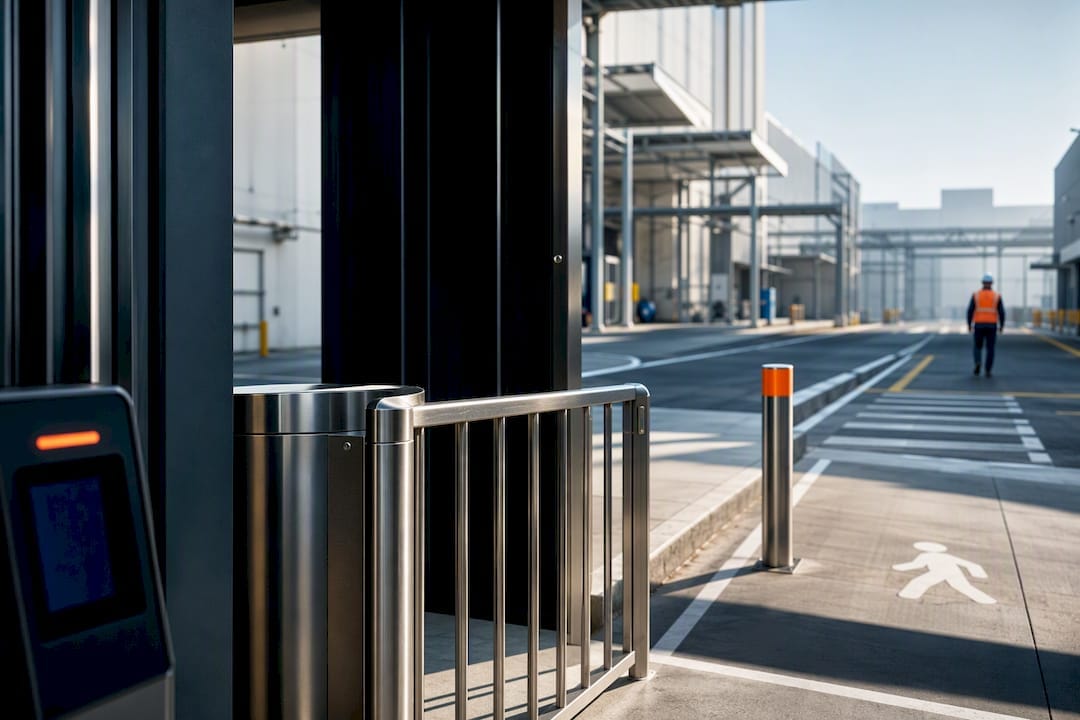
Secure factory access requires AS 1319 compliant signage, physical separation of people and plant, an induction linked access control system and operational lockout procedures. Work health and safety duties require managing unauthorised access to hazardous areas, and privacy law limits how facial recognition or biometric data can be used without clear justification. Get these four elements working together and most factory entry risks fall away.
TL;DR:
- Signage must follow AS 1319 standards and be placed at all primary entry points, intersections, and hazard zones to ensure clear communication and avoid confusion.
- Pedestrian and vehicle access should be physically separated using fences, dedicated gates, and automatic or sliding gates with auto-close features to reduce collision risks.
- Electronic access control must be integrated with a single system that enforces training, certifications, and approvals, while maintaining strict audit trails and regular privilege reviews.
- Privacy obligations require transparent notice, CCTV signage, and cautious use of biometric data, avoiding covert surveillance and ensuring data retention limits align with legal requirements.
- Manual procedures, such as lockout/tag-out and visitor management, need strict enforcement and regular site walk-through audits to prevent safety breaches and unauthorized access.
Table of Contents
- Signage and restricted-area marking: what AS 1319 requires
- Site layout and physical separation: gates, pedestrian routes and vehicle management
- Electronic access control and systems of record
- Privacy and surveillance: CCTV, biometrics and the Privacy Act
- Operational controls: lockout, inductions and visitor management
- Implementation checklist and quick audit for factory managers
- Field experience: common pitfalls and where to draw the line
- How ABCO Security can help you close the gaps
- Key standards, guidance and case studies to read next
- Sources
- FAQ
Signage and restricted-area marking: what AS 1319 requires
Restricted-area signage is the cheapest control you have, and it is also the one factory’s get wrong most often. AS 1319 governs signage classifications, setting out coded shapes, colours and pictograms so a sign’s meaning is understood at a glance, even before anyone reads the words.
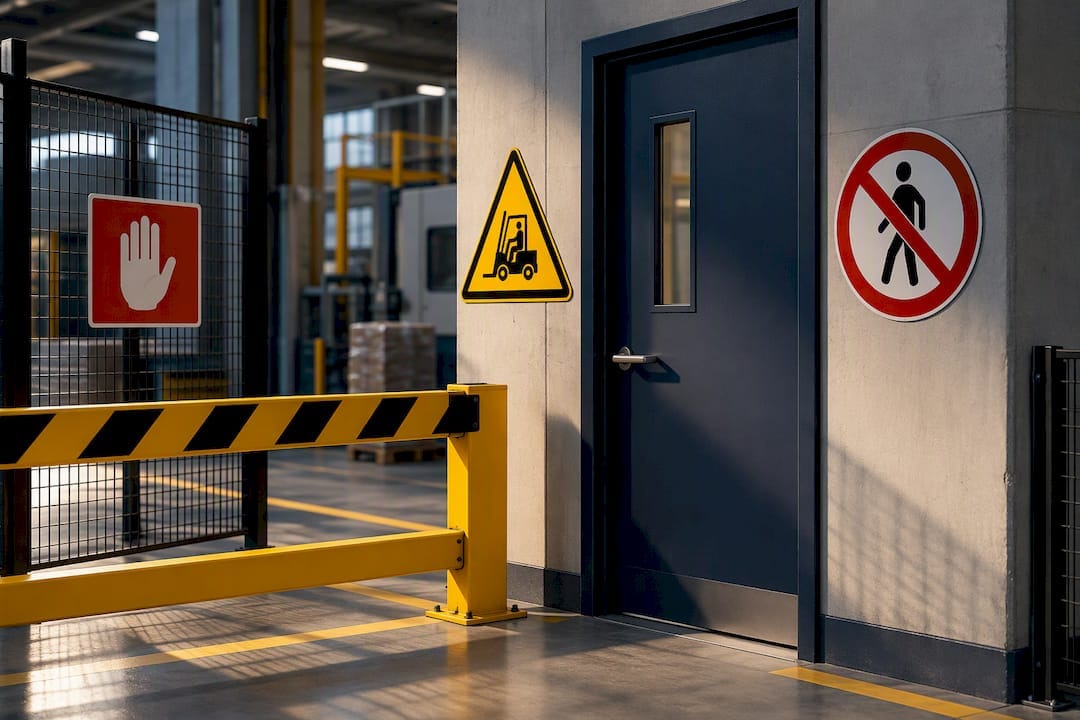
The choice between “no entry” and “authorised personnel only” matters. A prohibition sign tells everyone to stay out; an authorised-personnel sign tells untrained visitors to stay out while letting inducted staff pass. Mixing the two on the same gate confuses both groups and weakens the message.
Placement is where most sites fall short:
- Formal entrances and reception points, where every visitor’s first decision gets made.
- High-traffic intersections where forklifts, AGVs or delivery vehicles cross pedestrian paths.
- Immediate approaches to fixed plant, chemical stores or other single-hazard zones.
- Vehicle entry points, separate from pedestrian gates, with clear directional markings.
Sign size and symbol contrast should hold up under factory lighting, and sites running multilingual workforces often pair pictograms with induction content so the visual cue and the training message reinforce each other.
Site layout and physical separation: gates, pedestrian routes and vehicle management
Pedestrian and vehicle segregation is one of the most consistent ways to cut collision risk on a factory floor, and it is also one of the easiest controls to let slip. Hinged manual gates are a common failure point: they get propped open during busy shifts and never latch again.
Fixing this usually means:
- Fenced pedestrian corridors that run the full length of a route, not just the risky section.
- Dedicated pedestrian gates, separate from vehicle gates, so foot traffic never has to guess.
- Sliding or automatic gates with auto-close mechanisms, removing the human habit of leaving them open.
- Defined safety zones (DSZs) around loading and manoeuvring areas, paired with radio coverage for drivers.
Hyne Timber reduced site risk at its distribution facilities by separating pedestrian and vehicle access, installing remote-controlled electric gates with auto-close, dedicated walkways and CCTV monitoring. At a larger scale, Carlton United Breweries deployed automated guided vehicles alongside exclusion zones and monitoring, removing much of the human and forklift interaction that drives injury rates.
Pro Tip: Walk your own site as a first-time visitor would. Any gate you can push open without a card, code or challenge is a gap, not a formality.
Electronic access control and systems of record
The strongest factory access setups treat one system as the single source of truth. Registration, induction completion, certifications and physical swipe access all live in the same workflow, so a card simply will not open a door if the person behind it has not finished the required training. University facilities teams describe this approach as tying registration, induction and approvals into one enforced system rather than several disconnected checks.
Common electronic options include:
- Card or fob readers linked to a central database rather than standalone door controllers.
- PIN keypads with audit logging, useful for shared equipment rooms or contractor bays.
- Time-bound credentials that expire automatically at the end of a shift, contract or visit.
- Conditional access rules, such as a maintenance credential that only unlocks when a lockout procedure is logged and an induction record is current.
Audit discipline matters as much as the hardware. Review privileged accounts on a set schedule, set forced-door alarms on doors that should never be propped, and design emergency override procedures that still leave a traceable record of who opened what, and when. For a broader look at system types and selection factors, it helps to weigh these against your site’s shift patterns before committing to hardware.
Privacy and surveillance: CCTV, biometrics and the Privacy Act
Once a factory installs cameras or biometric scanners, privacy obligations follow the data, not just the hardware. Organisations covered by the Privacy Act must give people transparent notice of what is collected and why, and covert surveillance or unchecked biometric use can breach the Australian Privacy Principles.
Facial recognition demands the most caution. Necessity and proportionality come before convenience: if a card reader achieves the same result, a face scanner is hard to justify.
- Prefer on-device processing over centralised biometric databases where the technology allows it.
- Ring-fence any biometric store separately from general HR or access records.
- Set automated retention limits rather than keeping footage indefinitely.
- Display clear, plain-language surveillance notices at every camera-covered entry point.
Privacy law and the Privacy Act require documented controls before facial recognition goes live, not after an incident forces a review.
Operational controls: lockout, inductions and visitor management
Physical gates and electronic cards only work if the procedures behind them are followed every shift. Three areas do most of the work:
- Lockout/tag-out physically isolates energy sources before maintenance begins. Mechanical isolation with physical locks removes the re-engagement risk that a software interlock alone can leave behind, which is why high-risk fixed plant needs a physical lock, not just a system flag.
- Induction-linked gating denies access automatically when required training or certification has lapsed, closing the gap that a busy supervisor might otherwise miss.
- Visitor and contractor workflows should run on pre-approval, temporary credentials, an escort where the area warrants it, and prompt revocation the moment the visit or contract ends.
A structured risk management approach ties these three together, so a single missed step in one area does not undo the other two.
Implementation checklist and quick audit for factory managers
A short weekly walk-through catches most of what goes wrong between formal reviews.
- Map every entry point on site, including gates rarely used and loading doors left ajar.
- Check each sign against AS 1319 categories and confirm placement at entrances, intersections and hazard zones.
- Test that automatic gates actually auto-close, not just that they can be opened.
- Pull the access control system’s audit trail and confirm it matches who was on site that day.
- Check CCTV notices are visible and confirm footage retention matches your stated policy.
Once the audit is done, prioritise the fixes. Sign replacement and gate latching are immediate, low-cost jobs. Updating access control rules and linking them to induction records is medium-term work, usually a system configuration task rather than new hardware. Automated guided vehicles and full access control integration belong in longer-term capital planning. A site risk assessment checklist is a practical starting point for turning this list into a documented programme.
Field experience: common pitfalls and where to draw the line
Across factory sites, the same three gaps turn up repeatedly: signage that mixes prohibition and authorised-personnel messages on the same gate, manual gates propped open during peak shifts, and access control systems that grant a card without checking whether the induction behind it is current.
Fixing signage and gate discipline is usually a job a site team can handle in-house within a week. Linking access control to induction records, or introducing biometric surveillance, is where it pays to bring in a professional integrator: the compliance and privacy stakes are higher, and getting the configuration wrong once tends to cost more than getting it right from the start.
— Abco
How ABCO Security can help you close the gaps
Most of the fixes above are procedural, but the electronic and monitoring side of factory access often needs a dedicated technical partner. A professional security provider can work across construction, corporate and industrial sites, combining licensed guards, mobile patrols and 24/7 monitoring with practical, standards-aligned system design.
- Electronic security solutions for access control installation and integration.
- A1 CCTV & Alarm Monitoring for ongoing, privacy-aware surveillance.
- Security guarding and mobile patrols for after-hours checks and physical deterrence.
Key standards, guidance and case studies to read next
- WorkSafe Queensland on managing unauthorised access, covering WHS duties around site security.
- AS 1319 signage guidance from WorkSafe ACT.
- OAIC guidance on the Privacy Act and APPs.
- Hyne Timber traffic separation case study.
- Carlton United Breweries AGV case study.
Sources
- Onsite security and managing unauthorised access — WorkSafe Queensland
- Onsite traffic management project: Hyne Timber case study — WorkSafe Queensland
- Auto guided vehicles case study — Carlton United Breweries (WorkSafe Queensland)
- Signage requirements and AS 1319 guidance — WorkSafe ACT
- The Privacy Act and Australian Privacy Principles (OAIC)
FAQ
What are the three types of access control?
Access control is generally grouped into physical controls (gates, locks, fencing), electronic or logical controls (card readers, keypads, permission-based software) and administrative controls (inductions, visitor policies, lockout procedures). A secure factory typically layers all three rather than relying on one alone.
What are the five steps of access control?
Definitions vary slightly, but a common version covers: identifying who needs access, authenticating that identity, authorising the specific areas or systems they can use, granting the physical or electronic credential, and auditing that access on an ongoing basis. Skipping the audit step is the most common gap on factory sites.
Can you give an example of physical access control?
A fenced pedestrian corridor with a dedicated swipe-card gate, separate from the vehicle entrance, is a straightforward example. Hyne Timber’s approach of remote-controlled gates with auto-close, paired with dedicated walkways, shows how this looks in practice.
How does an access control system fit with CCTV and alarms?
An integrated setup shares data between the door credential system, the alarm panel and the camera network, so a forced door or an after-hours entry triggers both an alarm and a recorded event tied to the same access log. ABCO Security’s electronic security solutions are built around this kind of integration for factory and industrial sites.
How often should a factory review its access control system?
There is no single legislated interval, but reviewing privileged accounts, induction links and signage placement on a regular audit cycle, at minimum quarterly, keeps the system aligned with staff changes and site layout updates. A structured risk assessment is a practical way to formalise that review.
Recommended
about
avada factory
Sempery ultricies nibh at dolor cras urna eleifend nec. Atiam efficitur tempor.