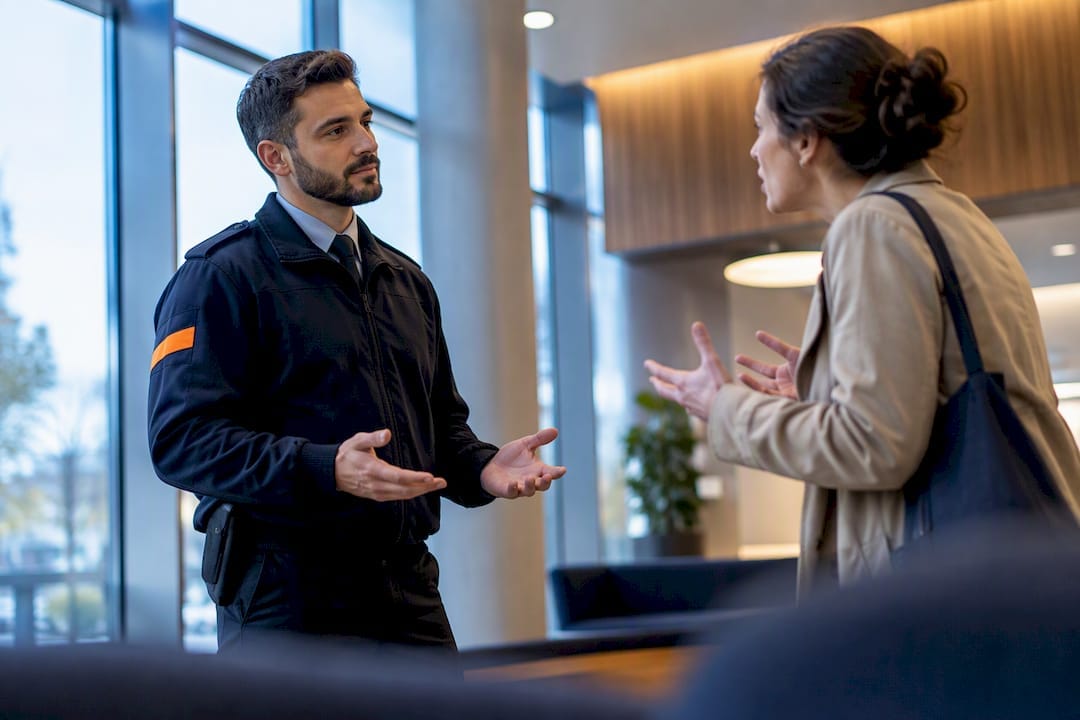
When a situation starts heating up, assess the scene, stay calm, introduce yourself and your role, listen, offer the person real choices, set a clear boundary, then disengage or call for backup if none of that lands. This sequence sits behind the nationally recognised competency units CPPSEC3101 and CPPSEC2101, and it works because it keeps you safe, keeps you lawful, and keeps you inside your site’s standard operating procedures.
TL;DR:
- Proper scene assessment, clear communication, and offering choices are essential steps before disengaging or calling backup to ensure safety and legality.
- Active listening with paraphrasing and maintaining an even tone are more effective for calming tensions than issuing commands or raising your voice.
- Recognizing early warning signs like clenched fists or blocked exits helps officers decide when to withdraw and call for support.
- Training should include scenario-based drills, withdrawal planning, and understanding crowd dynamics to prepare officers for different environments.
- Site design and systemic factors play a significant role in preventing escalation, making it vital to incorporate risk review and effective infrastructure into safety plans.
Table of Contents
- Core techniques that actually reduce risk
- A short on-patrol sequence for the moment it starts
- What to actually say: phrasing that works under pressure
- Reading risk, knowing when to pull back, and staying within the law
- Training that holds up on shift: units, courses and drills
- How ABCO Security applies this across different sites
- What the research actually supports, and what gets overstated
- Where ABCO Security fits into your de-escalation plan
- Sources
- FAQ
Core techniques that actually reduce risk
Most de-escalation failures happen because an officer talks first and listens second. Active listening, where you repeat back what someone has said in your own words, does more to lower tension than any command. An even tone matters more than the words themselves: people mirror the emotional pitch of whoever is speaking to them, so a flat, unhurried voice tends to bring the exchange down with it.
Your body says as much as your mouth. Stand at an angle rather than square on, keep a reactionary gap of a few metres, and avoid sudden hand movements that can read as aggression. CPPSEC2101 treats this non-verbal layer as part of the same communication skill set as speech, not a separate concern.
Choices work because they hand the person a way to back down without losing face. “You can wait here while I check, or we can walk to the office together” gives control back to someone who feels they have none, which is often the actual trigger for aggression.
Cultural context changes all of this. Eye contact, personal space and directness carry different meanings across cultures, and a phrase that sounds firm to you might sound hostile to someone else.
- Match your tone to the person, not the crowd around you.
- Keep your hands visible and away from equipment unless you need it.
- Repeat their concern back before you respond to it.
- Adjust distance and eye contact based on how the person is reacting.
Pro Tip: If someone is pacing or repeating themselves, slow your own speech down first. It’s harder for them to keep escalating against a calm baseline.
A short on-patrol sequence for the moment it starts
Under stress, a short checklist beats a mental model every time. This is the version worth memorising before your next shift.
- Pause and scan the scene for weapons, exits, bystanders and anyone who could back you up.
- Introduce yourself, state your role, and say what you need in one plain sentence.
- Ask a clarifying question, then paraphrase what they tell you before you respond.
- Acknowledge how they feel, even if you disagree with what they’re doing.
- Offer two realistic choices and state the boundary and consequence plainly.
- If tension keeps rising, disengage to a safe distance and call backup or Police.
Each step buys you information. Skipping the pause to jump straight to instructions is the single most common mistake officers make when adrenaline is running.
What to actually say: phrasing that works under pressure
The words you choose in the first ten seconds set the tone for everything after. Short, low-key openers work better than formal warnings: “Can I have a word?” lands softer than “You need to stop that now,” even when the message is the same.
- Use closed questions for safety checks: “Are you carrying anything sharp?”
- Use open questions to find out what’s actually going on: “What happened before I got here?”
- Paraphrase without conceding fault: “So you’re saying you were told to wait, and no one came back to you.”
- With intoxication, keep sentences short and repeat the same simple instruction rather than adding new information.
- With signs of mental health distress, slow down, lower your voice and avoid crowding the person.
- With a language barrier, use plain words, gestures and, where available, an interpreter line or translation app rather than raising your volume.
None of this requires guessing. CPPSEC2101 specifies exactly these communication skills, including recording what was said accurately enough to use as evidence later.
Reading risk, knowing when to pull back, and staying within the law
Escalation rarely comes out of nowhere. Clenched fists, blocked exits, raised volume and a sudden change in breathing are all early warnings worth acting on before things turn physical.
- Reassess the scene continuously, not just at the start of the incident.
- Treat withdrawal as a legitimate control option, not a failure: step back, keep an exit route open, and call for support.
- Apply only the minimum necessary contact, and step down the moment the threat has passed.
- Preserve evidence and write your incident report while the details are fresh.
Safe Work Australia guidance is explicit that verbal de-escalation should only be attempted where it’s safe to do so, and that retreating and contacting Police is the correct call once behaviour tips into assault. Competency units CPPSEC3121 and CPPSEC2106 build on this by requiring officers to actually plan withdrawal options in advance, rather than treating disengagement as an afterthought. For crowd settings specifically, CPPSEC2110 covers reading crowd dynamics and site layout so you can spot a crush or conflict point before it forms. A duress alarm and a clear emergency response procedure matter here too, since the fastest way to de-escalate is often to have backup arrive before things peak.
Training that holds up on shift: units, courses and drills
The competency units named above aren’t box-ticking. CPPSEC3101 covers negotiation and conflict management, CPPSEC2101 covers communication, CPPSEC2110 covers crowd behaviour, and CPPSEC3121/CPPSEC2106 cover physical control and withdrawal planning. Together they map almost exactly onto the sequence in this guide.
- Choose a registered training organisation that runs scenario-based assessment, not just classroom theory.
- Check that the course covers withdrawal planning as its own skill, not a footnote to physical control.
- Confirm your licence conditions match the state you’re working in, since requirements differ by jurisdiction.
A recognised competency framework underpins de-escalation training in the security sector: CPPSEC3101 requires officers to demonstrate negotiation and communication skills as part of managing conflict and security risk, which means the technique isn’t optional guesswork, it’s an assessed skill.
Team drills and after-shift debriefs keep this sharp. A five-minute run-through of what worked and what didn’t after a tense shift does more for long-term skill than an annual refresher course ever will.
How ABCO Security applies this across different sites
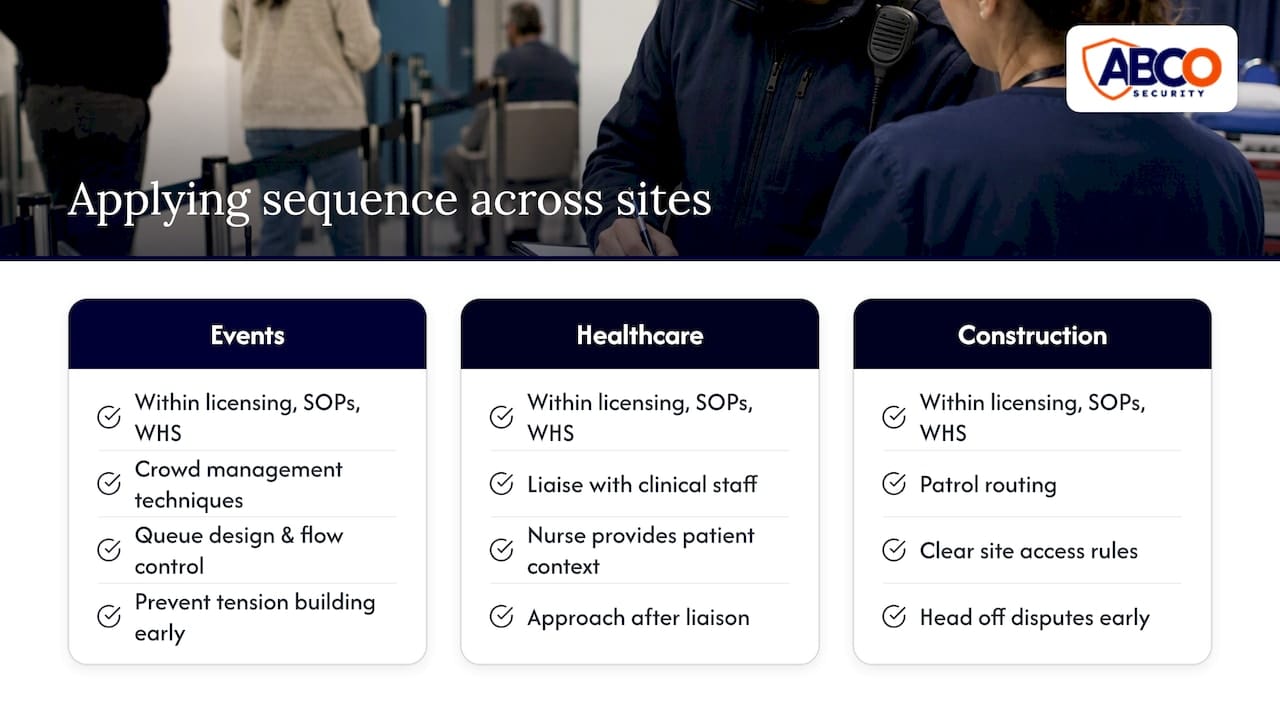
The sequence holds up across settings, but the details shift. At events, ABCO officers lean on crowd management techniques like queue design and flow control to stop tension building before it starts. In healthcare settings, that means liaising directly with clinical staff before approaching a distressed patient, since a nurse often has context an officer doesn’t. On construction sites, patrol routing and clear site access rules head off most disputes before they need a conversation at all. Every adjustment still sits inside licensing conditions, site SOPs and workplace health and safety obligations, because none of this works if it’s improvised.
What the research actually supports, and what gets overstated
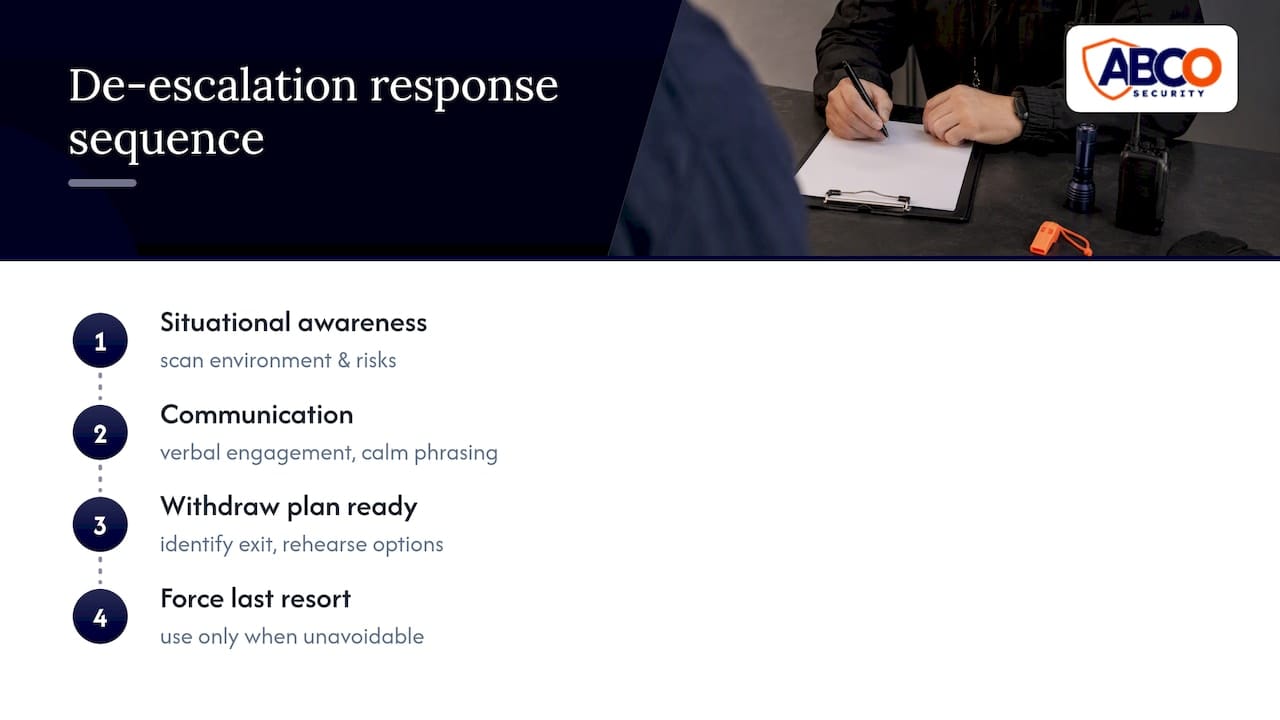
The idea that de-escalation is mostly about finding the right words is only half true. The competency units back a structured process: situational awareness first, communication second, withdrawal always available, force as a last resort. Officers who treat verbal skill as the whole toolkit tend to freeze when talking doesn’t work, because they never planned an exit.
The bigger gap is site design. WorkSafe Queensland frames aggression as partly a systems issue: poor queue design, understaffing and confusing processes generate frustration that no amount of calm phrasing fully offsets. An officer who feeds recurring flashpoints back into a site’s risk review is doing more for long-term safety than one who’s simply good at talking people down.
If you take one thing from this guide, make it withdrawal planning. It’s the least practised skill and the one competency frameworks treat as equally serious as physical control.
— Abco
Where ABCO Security fits into your de-escalation plan
Good technique only goes as far as the systems around it. ABCO Security’s Security Guarding service places trained officers who work within the same risk-assessment and withdrawal principles covered above, backed by Mobile Patrol Services for sites that need rapid backup rather than a fixed post.
- Static or mobile guarding for sites that need trained de-escalation coverage on shift.
- Duress and alarm monitoring through A1 CCTV & Alarm Monitoring so backup arrives faster when withdrawal is the safer call.
- Site-specific security planning for construction, healthcare and event environments through a direct enquiry.
Request a site review or ask about our Night Owl Service, with competitive daily rates, to see how a tailored patrol schedule fits your risk profile.
Sources
The competency units referenced above are listed on training.gov.au, and workplace violence guidance sits with Safe Work Australia. Always confirm your state licensing and your employer’s SOPs before relying on any of it.
- CPPSEC3101 Manage conflict and security risks using negotiation
- Workplace violence and aggression: worker information sheet — Safe Work Australia
FAQ
How do you deescalate a situation as a security guard?
Assess the scene, stay calm, introduce your role, listen and paraphrase, offer real choices, set a clear boundary and disengage or call backup if tension keeps rising. This sequence reflects the skills specified in CPPSEC3101 and CPPSEC2101.
What are the steps of de-escalation?
Most models follow the same core order: assess, establish contact and rapport, listen and clarify, offer choices, set a boundary, and disengage if needed. The exact number of steps varies by training provider, but the underlying skills match those in CPPSEC2101 and CPPSEC3101.
What are the stages of escalation to watch for?
Behaviour typically moves from calm, through triggering events, escalation, crisis, and then de-escalation and recovery. Definitions of the exact stage count vary between frameworks, but early signs like raised volume, clenched fists or blocked exits are consistent early warnings worth acting on.
What should you never do during de-escalation?
Never crowd someone’s personal space, raise your voice to match theirs, or make promises you can’t keep. Safe Work Australia guidance also warns against continuing verbal de-escalation once a situation is no longer safe, since retreating and calling for help is the correct step at that point.
Recommended
about
avada factory
Sempery ultricies nibh at dolor cras urna eleifend nec. Atiam efficitur tempor.