The most effective stance on crane and plant security combines layered physical barriers, immobilisation and monitored surveillance with the operational controls your Work Health and Safety duties already demand. Every measure must respect safe clearance rules around cranes and overhead powerlines. Below, we set out the legal anchors, the physical and procedural controls that work, and a short checklist you can act on today.
TL;DR:
- Installing monitored CCTV combined with physical barriers and adequate lighting significantly deters organized theft attempts on site.
- Maintaining accurate inspection records and conducting regular site hazard assessments are crucial for identifying security weaknesses before incidents occur.
- Protect high-value equipment by locking fuel and key storage and removing keys or isolating batteries at the end of each workday.
- Ensuring site access is controlled through induction, vehicle logs, and authorized personnel lists strengthens the prevention of unauthorized entry.
- Reassessing security measures during each project phase helps adapt controls to changing risks and reduces the likelihood of theft or tampering.
Table of Contents
- Why crane and plant security matters now
- Regulatory anchors: WHS duties, AS1418, AS2550 and safe approach distances
- Physical measures that deter and prevent theft
- Operational controls and procedures that make security stick
- Quick implementation checklist and high-impact fixes
- How a provider like ABCO Security builds these controls in
- Pragmatic priorities for plant managers
- How ABCO Security can help secure your site
- FAQ
- Sources
Why crane and plant security matters now
Heavy machinery theft is a recurring problem on Australian sites, with regional police reports documenting stolen excavators, skid-steer loaders and trailers taken in incidents that typically require a truck or trailer to move, pointing to organised rather than purely opportunistic activity. Fuel theft from idle machinery is common alongside equipment theft itself, often during downtime when a site sits unattended overnight or over a weekend.
Cranes and mobile plant are attractive targets because they are valuable, portable with the right vehicle, and often left with predictable key storage or weak perimeter control. The consequences extend past the stolen asset:
- Project delays while replacement plant is sourced and insurance claims are processed.
- Increased insurance premiums and excess costs after a claim.
- WHS exposure if theft or tampering leaves equipment unsafe for the next operator.
- Reputational and contractual friction when delays cascade to other trades.
Regulatory anchors: WHS duties, AS1418, AS2550 and safe approach distances
Security on a crane or plant site is not separate from your WHS obligations, it sits inside them. Safe Work Australia requires crane and plant inspections to be carried out by a competent person, following AS1418 or AS2550 or the manufacturer’s own specifications, with major inspection records kept for registrable mobile and tower cranes. Those same inspection and maintenance habits that satisfy your legal duty also make tampering, unauthorised starts and unreported damage far easier to spot.
The WHS Code of Practice for managing plant risks sets a hierarchy of controls: eliminate the risk where practicable, then work through substitution, isolation, engineering and administrative controls before relying on personal protective equipment. Security sits comfortably inside this hierarchy as an isolation and administrative control, not as an afterthought bolted on after an incident.
Clearance from overhead powerlines is a separate, non-negotiable constraint. South Australian guidance sets minimum distances that depend on voltage and the controls in place.
Minimum clearance distances range from about 1.0 to 1.5 metres with a spotter or documented risk assessment for low-voltage lines, up to 6.4 to 10 metres without those controls for higher-voltage lines, a gap wide enough that getting it wrong is not a minor miscalculation.
Key duties to build into your site plan including following practical job hazard analysis guidance to document and mitigate risks:
- Document a risk assessment and SWMS before crane or plant work begins.
- Arrange competent-person inspections and keep the records on file.
- Consult the network owner or obtain a permit before working near powerlines where clearance cannot be guaranteed.
Physical measures that deter and prevent theft
Passive deterrents alone rarely stop a determined thief. WorkSafe Queensland’s guidance on mobile plant is blunt about this: bunting and cones are not barriers, and sites need robust physical controls backed by supervision and a documented SWMS.
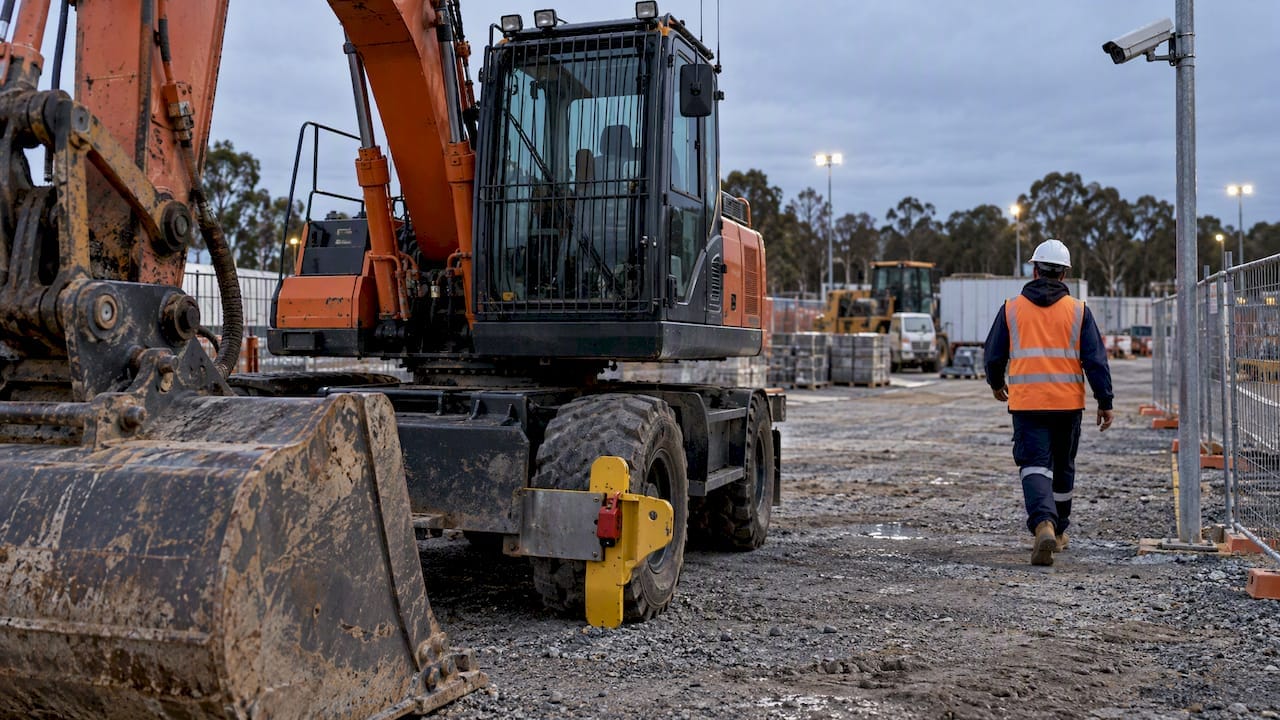
A layered perimeter starts with heavy-duty temporary fencing, concrete or water-filled barriers at vehicle entry points, and a compound design that funnels all traffic through a single controlled gate. On the equipment itself, key control is the baseline: battery isolators, mechanical wheel or starter locks, and engineered lock plates on cabin doors make an opportunistic theft attempt slower and noisier, which is often enough to deter it.
Surveillance adds the detection layer that physical barriers alone cannot provide:
- Monitored CCTV with remote alerts, so an intrusion triggers a response rather than sitting unnoticed on a hard drive.
- Tamper-resistant camera housings positioned to cover immobilisation points, not just gates.
- Thermal or motion sensors where lighting is poor, since most theft attempts to happen after dark.
Lighting across laydown areas, fuel storage and plant parking closes the gaps that cameras alone can miss, and keeping trailers and loose attachments locked or stored out of sight reduces the chance of a quick, opportunistic grab.
Pro Tip: Pair every immobilisation point, key box, battery isolator, lock plate, with a camera angle that covers it; a lock that cannot be watched is a lock that can eventually be defeated unseen.
Operational controls and procedures that make security stick
Hardware only works when the people on site follow a consistent process. Security controls belong inside your SWMS and daily pre-starts, treated as WHS controls rather than a separate checklist nobody reads.
- Build security tasks, key handover, isolator checks, perimeter walk, into the SWMS and pre-start routine for every shift.
- Control site access through induction records, an authorised personnel list and a vehicle sign-in log at the gate.
- Apply lock-out/tag-out and power isolation protocols whenever plant is left unattended, so no machine can be started without a deliberate, recorded action.
- Use registered spotters and follow No Go Zone procedures whenever work brings plant within the approach distances for overhead powerlines, as set out in guidance on operating near overhead electric lines.
- Keep inspection and maintenance records current, both to satisfy the competent-person requirement and to create a paper trail that supports any insurance or police report.
Quick implementation checklist and high-impact fixes
Theft prevention advice from regional police consistently points to CCTV, fencing and lighting as the deterrents that make the biggest difference for the effort involved.
- Remove keys and isolate batteries on all unattended plant at day’s end, site manager, immediate.
- Move high-value plant off-site or into a locked compound overnight, supervisor, same day.
- Deploy temporary monitored CCTV at entry points and immobilisation zones, security provider, within days.
- Reinforce perimeter gates with heavy-duty locks and physical barriers, site manager, within a week.
- Lock fuel and key storage in a dedicated, monitored cage, supervisor, same day.
How a provider like ABCO Security builds these controls in
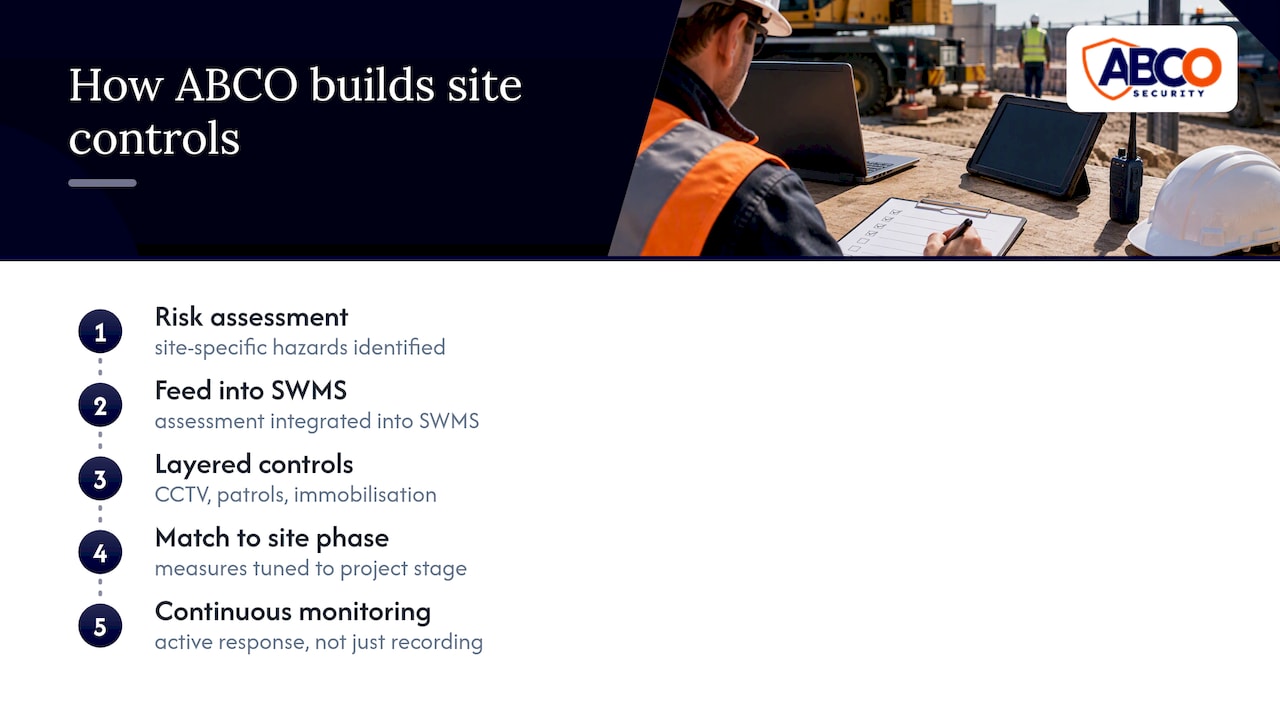
We bring extensive experience to construction site security, working to international standards. A typical engagement starts with a risk assessment that feeds directly into your SWMS, then layers in monitored CCTV, mobile patrols and immobilisation protocols matched to the site’s phase. We run this with continuous monitoring, which is the practical difference between a camera that records and a response that actually shows up.
Pragmatic priorities for plant managers
The controls that cut theft risk are mostly the same ones your WHS duties already require, so there is little excuse for treating security as a separate budget line. A site’s exposure changes as it progresses from earthworks to fit-out, so the security plan needs rechecking at each phase rather than set once and forgotten. A modest spend on immobilisation and monitoring is consistently cheaper than the delay, excess and replacement cost of a single stolen machine.
— Abco
How ABCO Security can help secure your site
A site security survey from our team maps your current gaps against a practical risk register, then matches controls, construction site security patrols, monitored CCTV, or an after-hours Night Owl plan starting from $5.45 a day, to the SWMS you already run. For broader site coverage, our construction site security services and mobile patrol teams work together with your own procedures rather than replacing them.
If you manage a site with cranes or mobile plant on it, the next step is a walk-through: get a quote, a risk register and a plan aligned to your existing SWMS before the next shift starts.
FAQ
What is the 3-3-3 rule for cranes?
The “3-3-3 rule” is not a term defined in Australian standards or Safe Work Australia guidance, and definitions circulating online vary. For crane inspection and operating requirements, refer to AS1418 and AS2550 and the Safe Work Australia crane inspection guide rather than an informal rule.
How can workers stay safe when working near cranes?
Workers stay safe by following the SWMS for the task, keeping clear of exclusion zones, and using registered spotters where crane movements intersect with other site activity. Physical barriers such as para-webbing or water-filled barriers, rather than cones alone, should mark the boundaries, as recommended in WorkSafe Queensland’s mobile plant guidance.
What is the Australian standard for crane inspections?
Crane inspections in Australia follow AS1418 and AS2550, carried out by a competent person according to the manufacturer’s instructions or the competent person’s own specifications. Safe Work Australia requires major inspection records to be kept for registrable mobile and tower cranes.
What is AS1418-1?
AS1418 is the Australian Standard covering the design, construction and safe operation of cranes, hoists and winches, with Part 1 setting out the general requirements that apply across crane types. It underpins the inspection and maintenance obligations described in Safe Work Australia’s crane guidance.
What should I do if plant or a crane is stolen from my site?
Report the theft to police immediately and notify your insurer, keeping your inspection and access records on hand to support the claim. Review your SWMS and physical controls afterwards to close whatever gap allowed the theft, since repeat incidents often share the same root cause.
Sources
- Guide to inspecting and maintaining cranes — Safe Work Australia
- Working safely near overhead powerlines — SA Government
- Managing the risks of plant in the workplace — Code of Practice 2021 (WorkSafe QLD)
- Stolen heavy machinery and diesel — Gympie Police (QLD)
Recommended
about
avada factory
Sempery ultricies nibh at dolor cras urna eleifend nec. Atiam efficitur tempor.