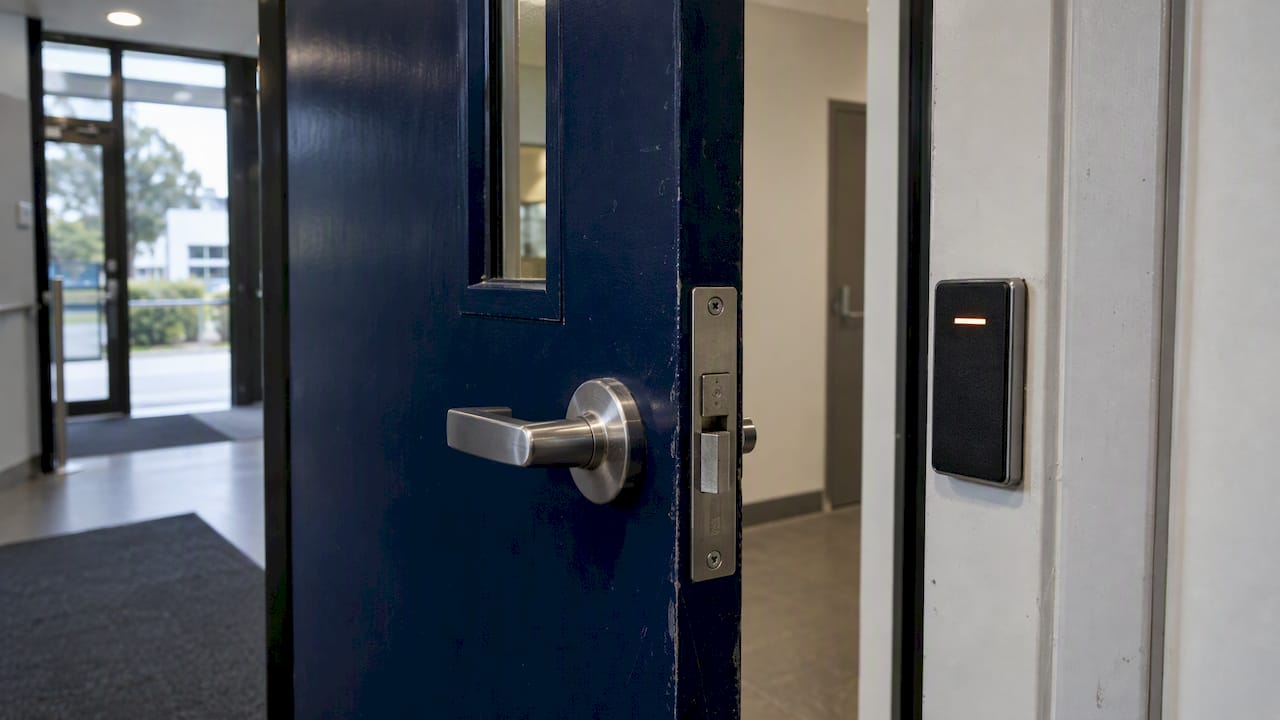
The right door hardware for access control depends on door type and egress function, not brand preference. For most commercial exits, choose between monitored electric strikes, electric mortice locks, maglocks or drop bolts based on whether the door must stay mechanically releasable during a fire event. Every selection has to satisfy NCC D3D26 egress rules before it satisfies a security brief, and the lock, reader and controller must be verified as a tested assembly, not assembled from compatible-looking parts.
TL;DR:
- Strikes retrofit timber or steel doors while preserving mechanical latching; maglocks suit glass entries but need approved fail safe release on fire doors.
- Fail secure locks suit non exit doors; required exits need fail safe fire release, and powered doors need manual force capped at 110 N.
- Fire doors must match their AS 1905.1 tested configuration; a strike replacement can void certification, and FRNSW warns against fire activated retaining devices.
- Verify the lock, reader, and controller as a tested assembly; commissioning should confirm credential release, request to exit operation, door status, and timestamped event logging.
- Before sign off, require assembly test certificates, wiring diagrams, labeled cable runs, maintenance schedules, and a commissioning certificate for the certifier’s records.
Table of Contents
- Types of electrified door hardware and where each is appropriate
- Technical specifications that determine fit: fail-safe, voltage and monitoring
- Compliance and fire and egress constraints shape every decision
- Integration and compatibility: controllers, readers and system-level testing
- Installer selection checklist before you commit to hardware
- Field notes from commissioning access-controlled doors
- Compliance and verification matter more than brand preference
- Getting compliant hardware designed, installed and commissioned
- FAQ
- Sources
Types of electrified door hardware and where each is appropriate
Each hardware class suits a different door and risk profile, and mismatching them is the fastest way to create a compliance problem.
Maglocks hold a door shut through electromagnetic force applied to a plate mounted on the door leaf. They work well on glass doors, aluminium-framed entries and high-traffic portals where a strike’s moving parts would wear out faster. They need a solid mounting surface and a frame that can take the holding plate without flexing, and they are inappropriate on fire doors unless paired with an approved fail-safe release tied to the fire detection system.
Monitored electric strikes replace the fixed keeper on a standard mortice lock, so the door still has a working mechanical latch. They are the easiest retrofit onto existing timber or steel doors because the mechanical lock function stays intact, and the strike simply releases the latch electronically on a valid credential.
Electric mortice locks and electric deadlocks suit doors that must self-latch mechanically on closing, which matters on fire-rated leaves where a dead latch is part of the doorset’s tested performance. Changing to an electric version without checking the doorset test report risks the door’s fire rating.
Electric drop bolts and electric exit devices handle heavy door leaves and high-security portals where a strike’s latch throw isn’t enough holding force.
Digital standalone locks fit low-traffic internal doors, storerooms or single-tenant offices where networked monitoring and audit trails aren’t required. For anything needing centralised credential management, event logging or integration with a fire system, a networked controller-based system is the better fit.
- Maglocks: high holding force, needs fail-safe wiring on fire-rated egress doors
- Monitored electric strikes: retrofit-friendly, preserve mechanical latch function
- Electric mortice locks: suit self-latching fire doors, require doorset-level testing
- Drop bolts and exit devices: for heavy leaves and high-security entries
- Digital standalone locks: low-traffic doors without networked audit needs
Technical specifications that determine fit: fail-safe, voltage and monitoring
Fail-safe hardware unlocks on power loss, which is mandatory wherever fire detection must force a door open for evacuation. Fail-secure hardware stays locked on power loss and holds the door shut, which suits perimeter or high-security doors that are not part of a required exit path. Getting this backwards on an exit door is the single most common compliance failure installers encounter on site.
- Fail-safe: unlocks on power failure, required on most fire-affected egress doors
- Fail-secure: stays locked on power failure, suited to non-egress security doors
- Power supply: most commercial locks run on 12 VDC or 24 VDC, specified with a rectified, regulated supply and battery backup sized for the expected outage duration
- Holding force: maglock ratings are only meaningful when tested on the actual mounting plate and frame material, not the manufacturer’s generic figure
- Monitoring: bond sensors, door position switches and supervised circuits let the controller and alarm panel detect forced or propped doors
Cable gauge, conduit routing, earth bonding and inrush current all affect reliability, particularly on maglocks, which draw a brief current spike on energising.
Pro Tip: Always test holding-force and release timing on the installed assembly, not from a datasheet, because frame flex and mounting hardware change real-world performance.
Compliance and fire and egress constraints shape every decision
Compliance sits above product preference because a door in a required exit path has legal openability requirements that no amount of security benefit can override. NCC D3D26 requires doors in required exits to be readily openable without a key, and fail-safe devices must release without time delay when a fire system activates.
Power-operated doors on a required exit must be manually openable with a force of no more than 110 N if power fails, which rules out any fail-secure hardware on those doors unless a separate mechanical override is fitted.
Fire and Rescue NSW’s position statement goes further, stating that fire doors must not carry supplementary fire-activated retaining devices, as these could render the door inoperable during an evacuation, risking breach of Performance Requirement D1P2.
Fire doors must also be tested and certified as a complete doorset under AS 1905.1, meaning the frame, leaf and furniture are tested together. Adding hardware outside that tested configuration, even a seemingly minor strike swap, can void the doorset’s fire rating.
- NCC D3D26 compliance for egress doors, including manual-open force limits
- FRNSW’s position statement on fire-activated retaining devices
- AS 1905.1 doorset test reports and fire labelling
- Assembly certificates and installation records for the certifier’s file
Integration and compatibility: controllers, readers and system-level testing
Lock, reader and controller must be verified as a compatible assembly, not assumed compatible because each component meets its own spec sheet. AS/NZS IEC 60839.11.1 sets minimum functionality and performance requirements for access control components and supports documenting that assembly. Our technical guide to access control integrations covers controller and reader pairing in more depth.
Common mismatches include relay outputs wired to a controller expecting a supervised dry contact, and Wiegand readers paired with a controller built for OSDP, which breaks credential transmission even though both devices “work” individually.
- Present a valid credential at the reader and confirm the unlock signal reaches the lock
- Trigger the request-to-exit device and confirm it releases the lock without an alarm event
- Open the door and confirm the door position sensor reports status correctly
- Check the controller’s event log records every step with a timestamp
- Verify conduit routing keeps data cabling separated from mains power runs
Installer selection checklist before you commit to hardware
Before specifying or purchasing, ask suppliers for the assembly test certificate, the monitored contact specification, whether fail-safe and fail-secure modes are field-configurable, and what ongoing maintenance support they offer.
Insist on wiring diagrams, labelled cable runs, a maintenance schedule and a commissioning certificate before sign-off. Our access control systems guide outlines a broader planning checklist for multi-door sites.
- No documented compatibility testing between lock, reader and controller
- No mechanical override on a fail-secure door
- Missing or undersized battery backup
- Holding-force figures quoted without reference to the actual mounting plate and frame
Pro Tip: Treat a missing commissioning certificate as a stop-work issue, not paperwork to chase up later.
Field notes from commissioning access-controlled doors
We’ve found the fastest way to avoid a failed certification is checking the door’s fire-test certificate before and after any hardware change, and specifying tested assemblies over mixing compatible-looking parts. Common pitfalls we see on site include wrong fasteners on fire-rated frames, untested retrofit strikes, and sites relying on a single electronic request-to-exit device with no mechanical fallback. We schedule function tests, battery checks and audit log reviews as standard maintenance rather than waiting for a fault call.

Compliance and verification matter more than brand preference
Hardware-first thinking, picking a lock because it’s familiar or easy to mount, is how non-compliant installs happen. The door’s egress function and fire rating should dictate hardware choice, not the other way round. Specify tested assemblies, document commissioning in writing, and arrange ongoing maintenance through a contract rather than an informal call-back. If a door’s fire status or exit requirement is unclear, pause and get a certifier’s ruling before fitting anything.
— Abco
Getting compliant hardware designed, installed and commissioned
We design, install and commission electronic access control hardware as tested assemblies, with documentation ready for certifiers. Every install pairs the right hardware class to the door’s egress and fire requirements first, then layers in the credential and monitoring features facilities teams actually need day to day.

- Site assessment covering door type, egress status and existing fire certification
- Assembly specification matched to AS/NZS IEC 60839.11.1 and NCC D3D26 requirements
- Commissioning documentation handed over for your certifier’s records
If you’re planning an access control upgrade or a new commercial fit-out, get in touch through our electronic security solutions page for a site assessment and commissioning quote.
FAQ
What are the different types of door access control locks?
The main commercial types are maglocks, monitored electric strikes, electric mortice locks, electric drop bolts and digital standalone locks, each suited to different door materials and egress requirements. The right choice depends on whether the door sits on a required exit path and whether it’s fire-rated.
What is the best door access control system for commercial buildings?
There’s no single best system. The right configuration pairs a lock, reader and controller tested as a compatible assembly under AS/NZS IEC 60839.11.1 with the correct fail-safe or fail-secure mode for the door’s egress status.
What can I use to secure a commercial door without blocking egress?
Monitored electric strikes or fail-safe maglocks paired with a request-to-exit device typically secure a door without breaching NCC D3D26 egress rules. A mechanical override should always be fitted alongside any electronic release as a fallback.
How do I choose the best door access control system for a specific site?
Start with the door’s fire rating and exit status, then match hardware class to door material and traffic level before considering reader or credential type. Our access control systems guide walks through this process for office and corporate sites.
Sources
- Part D3 construction of exits | NCC
- Fire doors with fire activated retaining devices (e.g. bolts) — FRNSW position statement
- AS 1905.1:2015 Components for the protection of openings in fire-resistant walls — Part 1: Fire-resistant doorsets
Recommended
about
avada factory
Sempery ultricies nibh at dolor cras urna eleifend nec. Atiam efficitur tempor.