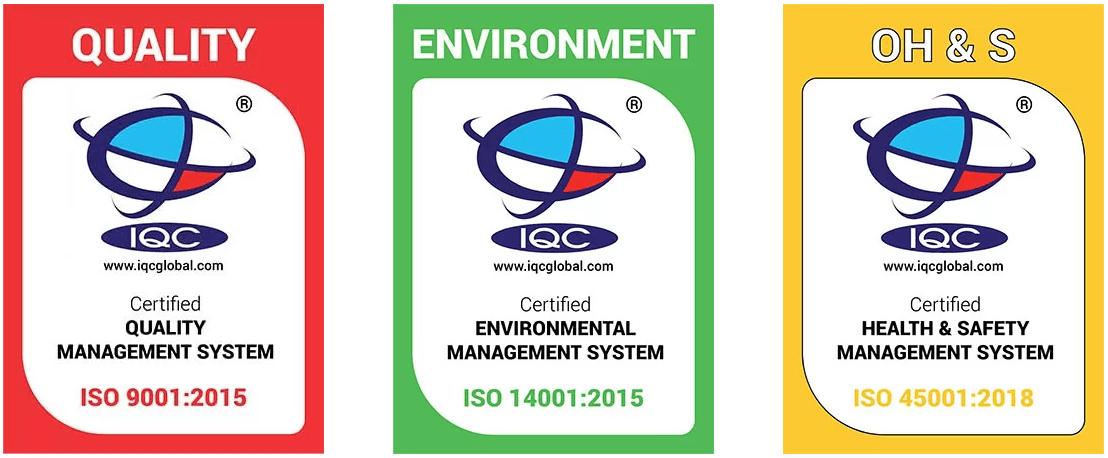
ISO 9001 is the international standard for quality management systems. For a security provider it is not a licence and not a guarantee of good guards. It is independent evidence that the company runs its guarding, patrols and monitoring through controlled, audited processes, rather than on the habits of whoever is rostered that night. If you buy security for a construction site, hospital, office or event, it is a useful filter, as long as you know what to ask next.
TL;DR
- ISO 9001 certifies a company’s quality management system within a defined scope. It does not certify individual guards or the service itself.
- It sits alongside mandatory state security licensing. It never replaces it.
- Certification is voluntary and is done by an independent certification body in two stages, then kept alive through surveillance audits.
- When you evaluate a provider, ask for the certificate, its scope and the audit records behind it, then check how the system shows up on your site.
- ISO 9001 is about quality. Information security (ISO/IEC 27001) and security operations (ISO 18788) are different standards.
Table of Contents
- What ISO 9001 is, in plain terms
- What the principles look like on a security contract
- Which clauses touch security delivery
- What ISO 9001 does not replace
- How a security provider gets certified
- What audit evidence looks like
- ISO 9001 versus ISO 18788 and ISO/IEC 27001
- Our perspective
- How to check a provider’s ISO 9001 claim
- What it means for different sites
- Working with ABCO Security
- FAQ
- Sources
What ISO 9001 is, in plain terms
ISO describes ISO 9001 as a globally recognised quality management standard that helps organisations of all sizes and sectors improve performance and meet customer expectations. The key word is management. The standard does not say how many guards a site needs or what a patrol route should look like. It requires a company to define how it will decide those things, do them consistently, record the results and fix what goes wrong.
In Australia the standard is published as AS/NZS ISO 9001. Standards Australia notes that it sets minimum requirements for a quality management system and applies to organisations of all types and sizes, and that the 2026 edition has now been made available there. A security company is just another organisation under that definition, which is why you see the badge on guarding firms, alarm monitoring centres and patrol operators alike.
The standard rests on seven quality management principles: customer focus, leadership, engagement of people, process approach, improvement, evidence-based decision making and relationship management, as set out in the ISO text. Each of those has a practical meaning in a service that runs 24 hours a day with people spread across dozens of sites.
What the principles look like on a security contract
| Principle | What it should look like in security work |
|---|---|
| Customer focus | Site-specific post orders written from your requirements, not a generic template |
| Leadership | Management who own quality objectives, such as response times and incident reporting standards |
| Engagement of people | Guards who are briefed, trained for the site and know who to escalate to |
| Process approach | Rostering, onboarding, patrol, incident and handover steps treated as one connected system |
| Improvement | Complaints and near misses lead to changed procedures, not just an apology |
| Evidence-based decisions | Patrol logs, alarm response data and audit findings drive changes |
| Relationship management | Controlled use of subcontractors and technology suppliers |
The process approach is the one that matters most for guarding. ISO’s own guidance says it encourages organisations to manage activities as connected processes rather than isolated tasks, taking account of resources, suppliers, infrastructure, information and technology. A guard turning up is the visible part. The roster, vetting, training, equipment, supervision and reporting behind them are what the standard looks at.
Which clauses touch security delivery
You do not need to read the standard clause by clause, but a few matter for a security buyer.
Scope (clause 4.3)
Clause 4.3 requires the organisation to determine the scope of its management system and its boundaries. The ISO technical committee’s guidance explains that the scope identifies the activities, services, sites and processes covered, and that any excluded requirements must be justified. This is the line on the certificate you should read first. A certificate for “administration and sales” tells you something very different from one covering “provision of static guarding, mobile patrol and electronic monitoring services”.
Risks, opportunities and legal requirements
For security providers, ISO 9001 calls for addressing risks and opportunities, planning and controlling service delivery, and determining client and applicable legal requirements. In practice that means a company has to know which licences, work health and safety duties and contractual obligations apply to each job. The ACT Government’s audit checklist for suppliers, for example, expects organisations to comply with relevant legal requirements including the WHS Act 2011 and WHS Regulation 2014, along with applicable state and federal law. Many government and large-corporate buyers ask for the same thing.
Operations (clause 8)
Clause 8 is where the standard meets the roster. It covers planning and control of service delivery, handling client requirements, design of service offerings and control of externally provided services. The last part is easy to overlook. If a provider subcontracts patrols or uses third-party monitoring, the standard expects those suppliers to be controlled too.
What ISO 9001 does not replace
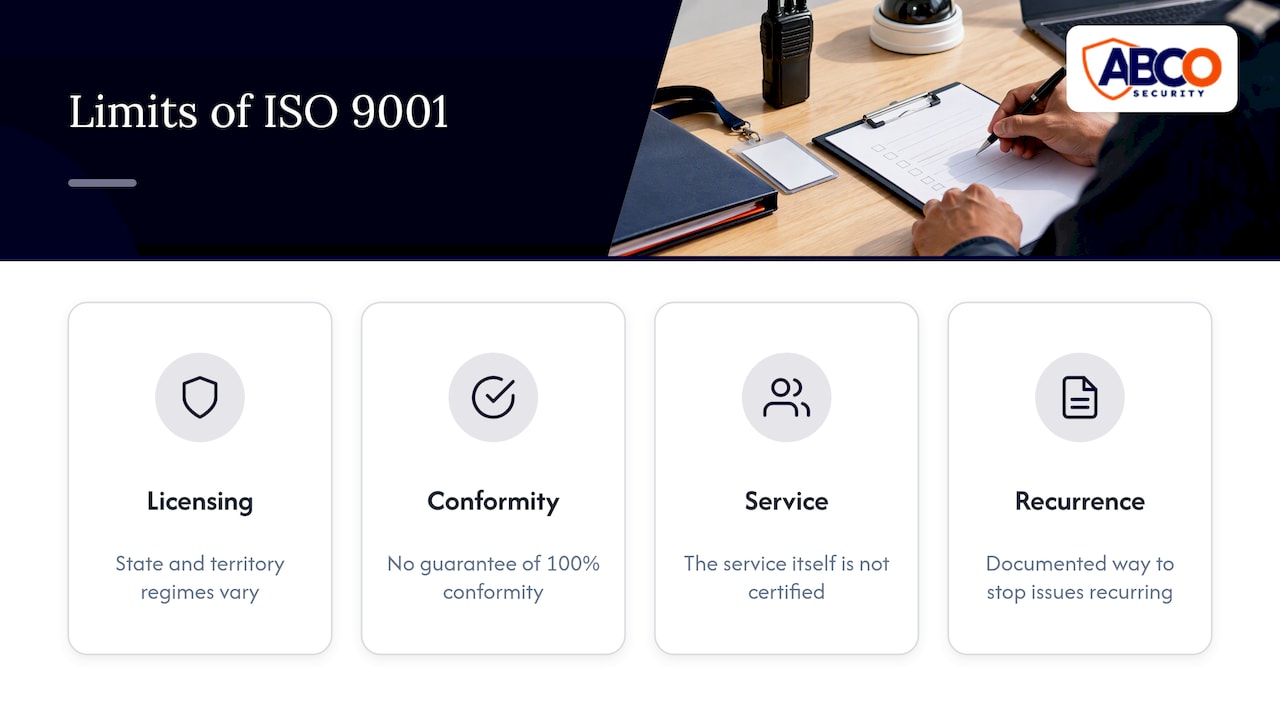
A certificate is not permission to guard. In Australia, ISO 9001 does not replace mandatory security licensing or regulatory requirements; it sits alongside them and can help a company manage and demonstrate compliance. Each state and territory runs its own licensing regime for guards, monitors and installers, so you should always ask for licence details as well as the ISO certificate.
It is also not a promise of flawless service. The ISO Auditing Practices Group is explicit that certification can show a certified system is expected to consistently deliver services meeting customer and applicable legal requirements within its scope, but it does not guarantee 100% conformity or superior service, and the service itself is not certified. A certified company can still have a bad week. What the system should give you is a documented way to find out why and stop it recurring.
How a security provider gets certified
Certification is voluntary. ISO states that it is performed by independent certification bodies, which may themselves be accredited by national accreditation bodies. ISO does not issue certificates itself.
An Australian guide to the process lays out the usual preparation sequence: gap analysis, documenting actual work, running the system long enough to generate records, an impartial internal audit programme, management review, then the two-stage external audit. For a guarding company, those “records” are things like patrol logs, incident reports, training files, client complaints and corrective actions.
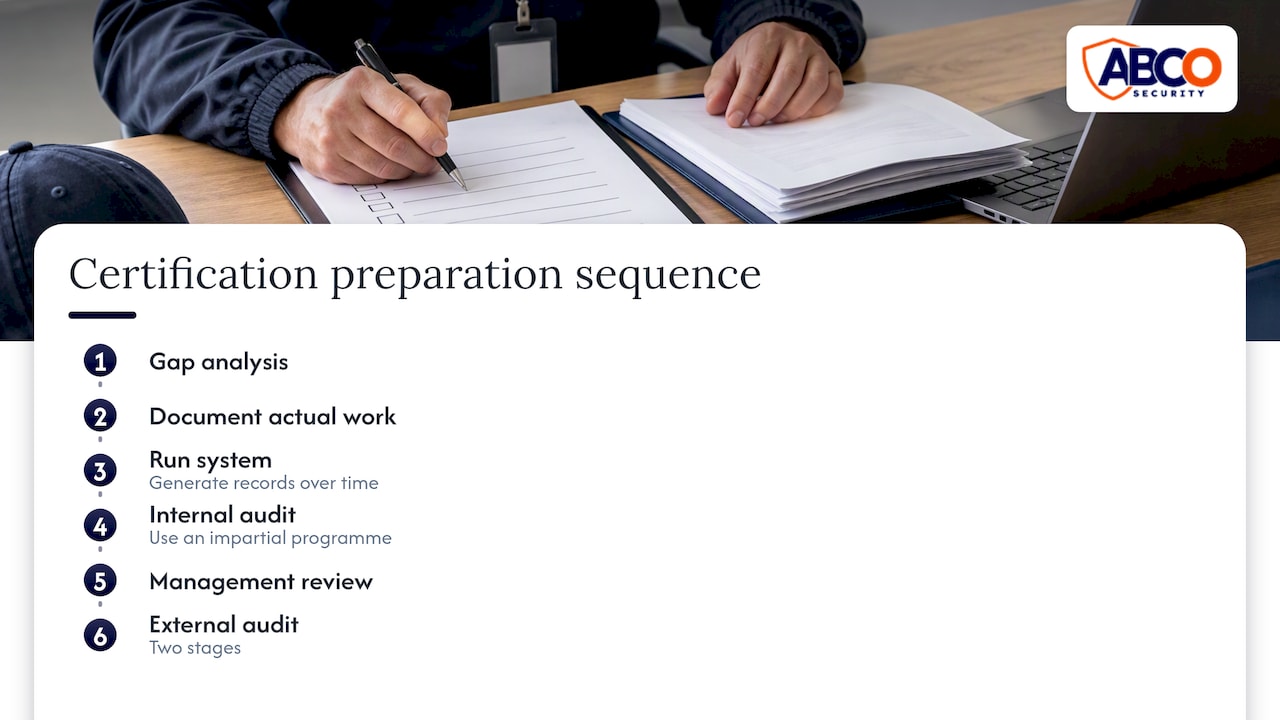
Stage 1 and Stage 2
The ISO 9001 Auditing Practices Group describes initial certification as a two-stage process. Stage 1 reviews the system, scope, processes, locations, documentation, internal audits and management reviews, and assesses readiness. Stage 2 then evaluates whether the system is actually implemented and effective.
An Australian certification body explains that in Stage 2 auditors sample work as actually performed: they review records, interview personnel and observe operations. Any nonconformities must be corrected before certification is decided. For a security company, that sampling can reach into rosters, site files and incident histories, not just a manual on a shelf.
Keeping the certificate
The same Australian guide says certification normally runs on a three-year cycle, with surveillance audits roughly annually and a full recertification audit at the end. Internal audits and management reviews continue in between. If you want a deeper look at how audit stages, surveillance visits and recertification work for security businesses, this explainer on audit stages and recertification walks through the pattern, although it is framed around ISO 27001.
The practical point for buyers: a certificate has a date and a cycle. Ask when the current one was issued and when the last surveillance audit took place.
What audit evidence looks like
If you want to test whether a provider’s system is real, ask what an auditor would see. An Australian certification body lists typical evidence for a security provider as the scope and process map, quality policy and measurable objectives, risk and opportunity records, service records, supplier controls, complaints and nonconforming-output records, customer-satisfaction information, internal audit reports and management review records. You will not get all of it, and some is commercially sensitive. But a provider that runs a real system can usually show you examples, with names removed, within a day.
ISO 9001 versus ISO 18788 and ISO/IEC 27001
The keyword “ISO 9001 for security” often gets tangled with two other standards, because “security” means different things in each.
| Standard | What it manages | Who it matters to |
|---|---|---|
| ISO 9001 | Quality of any product or service, including guarding and monitoring | Any buyer of security services |
| ISO 18788 | Security operations management for private security providers | Buyers wanting a security-specific framework, often with human rights and risk focus |
| ISO/IEC 27001 | Information security (confidentiality, integrity and availability of data) | Buyers whose data, such as camera footage or access logs, sits with the provider |
ISO 18788 specifies requirements for establishing, implementing, operating, monitoring and improving the management of security operations and is aimed at private security companies. It adds security-specific topics such as risk assessment, accountability to law and human rights due diligence on top of general management-system practice.
ISO/IEC 27001 is a different animal. It is the international standard for information security management, built around an information security management system and a set of controls selected through risk assessment. It does not say anything about whether a guard turns up on time. It matters if a provider holds your CCTV footage, visitor data or access records.
So: ISO 9001 asks “does this company deliver consistently and fix its failures?”, ISO 18788 asks “does it manage security operations and their risks properly?”, and ISO/IEC 27001 asks “does it protect information?”. Many large tenders now list more than one. Our guide on requiring ISO 18788, 28000 and 9001 in tenders covers how to write that into procurement documents.
Our perspective
We treat ISO 9001 as a working tool, not a logo. Security is a service delivered at 2 am by people nobody from head office is watching, so the value of a quality system is that it makes standards survive the roster. For us that means site-specific instructions, documented patrol and incident reporting, supervision and a route for client complaints to change how we work. We pair it with risk management practice, which we explain in our guide to ISO 31000 security risk, because quality without risk thinking just repeats a bad plan consistently.
We also hold that standards are only half of a buying decision. Licensed people, proactive technology and 24/7 monitoring matter as much as the certificate. Our approach rests on over 15 years in the industry, a commitment to international quality standards, and anticipating threats rather than only responding to them. Our own page on ISO 9001 quality management in Australian security sets out how that applies to our work.
— Abco
How to check a provider’s ISO 9001 claim
A short checklist you can run before signing anything:
- Ask for the certificate, not the logo. It should name the certification body, the standard and edition, the issue date and the expiry or recertification date.
- Read the scope. Does it cover the services you are buying (static guarding, mobile patrol, monitoring, event security) and the states where they will be delivered?
- Check the certification body. Ask whether it is accredited by a national accreditation body, in line with ISO’s explanation above.
- Ask about the last surveillance audit. A live system has had one in the past year.
- Request examples of records. An anonymised incident report, a corrective action and a site instruction show how the system works in practice.
- Verify licences separately. Check guard, monitoring and installer licences with the relevant state regulator.
- Test it on site. In the first month, compare what you see against the paperwork: are patrols logged, are handovers clean, do reports arrive on time?
What it means for different sites
Construction. Sites change weekly, so a provider needs a way to update post orders and risk assessments as hoarding, access points and stored materials move. Quality systems that force a review at each stage help. Our construction site security services are built around that rhythm, and our guide to a construction site security plan shows the steps.
Healthcare and corporate. Continuity matters most: the same guard knowing the building, consistent escalation, clean handovers. Look for training records and complaint handling.
Events and retail. Short engagements still need briefing, role clarity and incident logging. Ask how a provider records and reviews an event once it ends.
Monitoring. For alarm and camera monitoring, quality means response procedures that are written, timed and tested, which you can see on our CCTV and alarm monitoring page.
Working with ABCO Security
If you want a provider that treats quality management as part of daily delivery, talk to us about security guarding, mobile patrols and monitoring across Australia. Our Night Owl service starts from $5.45 per day, and you can see what it includes on the Night Owl page. For larger or multi-site needs, contact us through our main site and we will scope the work against your risks and your tender requirements.
FAQ
Is ISO 9001 mandatory for security companies in Australia?
No. ISO says certification is voluntary, so no one is required to hold it. What security providers must hold are the licences set by each state or territory. Some tenders and corporate buyers do ask for ISO 9001 as a condition, so it often becomes a commercial requirement even though it is not a legal one.
Does ISO 9001 mean the guards are better?
Not automatically. It shows that the company manages its service through a defined, audited system within its stated scope. It does not guarantee superior service or flawless results, so use it alongside licence checks, references and a look at how the provider operates on your site.
How long does an ISO 9001 certificate last?
Certification typically runs on a three-year cycle. Surveillance audits take place roughly annually, and a full recertification audit closes the cycle. Ask the provider for the issue date and the date of its most recent audit.
Is ISO 9001 the same as an information security standard?
No. ISO 9001 covers quality management. Information security is the subject of ISO/IEC 27001, and security operations management is covered by ISO 18788. A provider can hold one without the others, so check which matter for your contract.
Sources
- Standards Australia: Spotlight on AS/NZS ISO 9001
- ISO 9001 quality management systems
- ISO 9001 quality management principles (ISO text)
- ISO guidance for organisations using ISO 9001
- ISO Technical Committee: scope and applicability
- ISO 9001 for security services providers
- ACT Government audit checklist
- ISO Auditing Practices Group: expected outcomes
- ISO 9001 explained
- Two-stage initial certification audit
- ISO 9001 certification in Australia
- How to get ISO certified in Australia
- ISO 18788 security operations certification
- Guide to ISO/IEC 27001:2022
Recommended
about
avada factory
Sempery ultricies nibh at dolor cras urna eleifend nec. Atiam efficitur tempor.