
There is no single correct number of patrols per night. The right frequency comes from a written risk review of your site: what is worth stealing or damaging, when the site is empty, what has already happened there, and what other protection is in place. A quiet office park and a construction compound full of tools can both be “patrolled nightly” and need completely different schedules. This guide shows how to set a frequency, how to keep it unpredictable, and how to check that it is working.
TL;DR
- Patrol frequency is a risk decision, not a standard number. Australian industry guidance expects a risk review of every site before patrols begin.
- Set the number of visits per period in the contract, vary the timing, and require proof of service for every visit.
- Raise frequency for high-value assets, empty hours, poor lighting and past incidents. Lower it where cameras, alarms and access control carry part of the load.
- Review the schedule against patrol records and incident logs, and change it when the pattern of incidents changes.
- If one patrol cannot cover the risk, move to a static guard or a mix of both.
Table of Contents
- What patrol frequency actually means
- Start with a risk review, not a number
- What pushes frequency up or down
- Frequency by site type: worked examples
- Keeping patrols effective without making them predictable
- Shared patrols and what can go wrong
- Proof of service: the records that make frequency real
- How to tell if your patrol frequency is working
- Patrols alongside cameras, alarms and access control
- Our perspective
- Talk to us about the right schedule
- FAQ
- Sources
What patrol frequency actually means
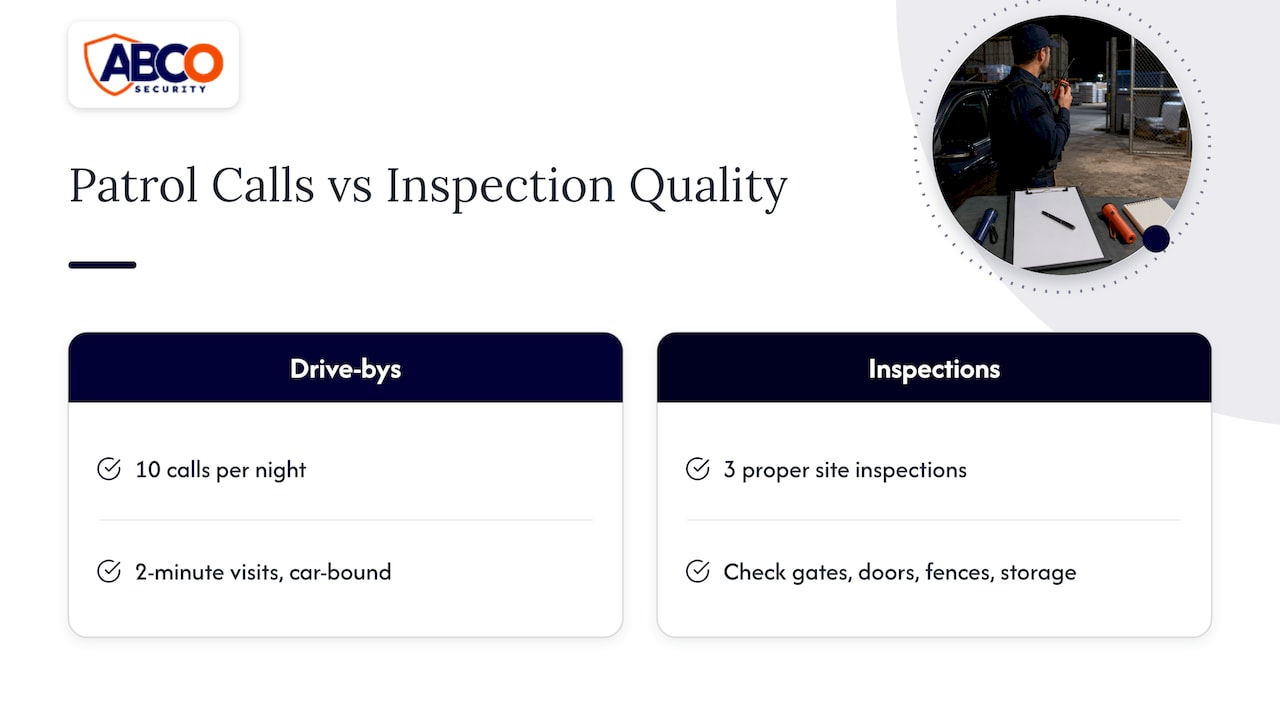
Frequency is how many times an officer attends and inspects your site in a given period, for example a set number of calls per night. It is not the same as how long the officer stays, and it is not the same as coverage. Ten two-minute drive-bys that never leave the car can protect less than three proper inspections of gates, doors, fences and storage.
Standards Australia describes a mobile patrol in AS 4421:2023 as a security service patrolling within a specified geographic area, and notes that patrols may occur at routine, random or casual times. The same standard recognises that patrols may include virtual patrols, such as drones or remote devices, where the parties agree.
The industry code of practice goes further on how the service is written down. The ASIAL Mobile Patrols Code of Practice says patrols are performed under the client contract and may involve external, intermediate or internal inspections at random times for a determined number of calls over specified periods, or an inspection program. In plain terms: your contract should state how many calls, over what period, and what each call involves.
If you are new to the service itself, our overview of what mobile patrol security is covers the basics before you get to scheduling.
Start with a risk review, not a number
The ASIAL code requires a risk review of every site before patrol services start, including urgent or one-off jobs. It also says risk assessments should be carried out by licensed professionals trained in patrol risk assessment, aligned with the Risk Management principles and guidelines standard. The code is the reason any reputable provider will ask questions before quoting a frequency.
A useful review answers these questions:
- What is at risk? Tools, copper, plant, stock, cash, patient areas, records, vehicles.
- Who might cause the loss? Opportunistic thieves, organised crews, trespassers, vandals, or people with legitimate access.
- When is the site exposed? After hours, weekends, public holidays, shutdowns, shift changeovers.
- What has happened before? Break-ins, graffiti, false alarms, near misses, complaints from neighbours.
- What else is protecting the site? Fencing, lighting, CCTV, alarms, locks and access control.
If you want a structured way to work through this, our security risk assessment checklist and risk assessment process guide set it out step by step, and the free risk assessment template gives you something to fill in.
What pushes frequency up or down
The factors below are the ones we see decide the schedule on real sites. They are working guidance rather than fixed rules, and the risk review should always have the final say.
Asset value and attractiveness
A site holding portable, resaleable items (power tools, copper, electronics, pharmaceuticals) draws more attention than one holding bulky or low-value goods. The more easily something can be carried to a vehicle, the shorter the gap you want between visits.
Time of day and occupancy
The riskiest window is usually when nobody is there: late night to early morning, weekends, and long holiday closures. During business hours, staff presence and reception do much of the work, so patrols often focus on the empty hours. Sites with shift work or irregular after-hours activity need a schedule that reflects when people actually come and go, not when the building is meant to be closed.
Size and layout
A large site with several buildings, blind corners, loading docks and long fence lines takes longer to inspect properly. A single visit to a big site is a different thing from a single visit to a small shopfront. If a full circuit takes forty minutes, a call every hour is not much of a patrol.
Incident history
Recent incidents are the strongest signal. Several attempts at the same gate in a month justify more frequent visits at that time of night, aimed at that location, for a defined period. A clean twelve months supports holding steady or trimming back.
Technology already on site
Cameras, monitored alarms, lighting and access control change what a patrol is for. A patrol can verify an alarm, check what cameras cannot see, and test that doors are locked. It should complement these layers, not stand in for them. Our guides to alarm monitoring and camera monitoring explain how remote monitoring and physical attendance fit together.
Regulations, insurance and contracts
Some sites have obligations from insurers, landlords, government clients or their own policies. Check these before you lock in a number, so the schedule does not fall short of a requirement you already carry.
Frequency by site type: worked examples
The figures below are illustrative starting points to discuss with a provider, not industry standards. Your own risk review may point somewhere quite different.
| Site type | Main exposure | Typical patrol approach to discuss |
|---|---|---|
| Construction site | Tool and material theft, plant, vandalism, after-hours trespass | Several randomised visits overnight and extra cover on weekends and before long breaks; static guard for high-value stages |
| Retail strip or centre | After-hours break-ins, loitering, alarm activations | Randomised visits focused on closing, deep night and opening; alarm response alongside |
| Corporate office | Unauthorised entry, doors left unlocked, staff safety after hours | A few random inspections after hours, with access control and CCTV doing the continuous work |
| Industrial or warehouse | Stock, vehicles, fuel, fence-line breaches | Frequent perimeter checks, gate and yard inspections, key point checks |
| Healthcare facility | Patient and staff safety, restricted areas, car parks | Often better served by static or on-site presence, with patrols for car parks and outbuildings |
| Events | Crowd movement, entry points, incidents | Presence is continuous during the event; patrols cover set-up, pack-down and overnight bump-in |
For construction in particular, theft pressure shifts through the project: early stages have plant and materials in the open, while fit-out stages concentrate small, high-value items. Our guides to security for construction sites and a construction site security plan show how to match cover to each stage, and preventing tool theft covers the basics of storage and check-in.
Keeping patrols effective without making them predictable
A fixed pattern is a gift to anyone watching. If the patrol arrives at 11:00 pm and 2:00 am every night, a thief simply works around it. Research on security scheduling makes the same point: in the ARMOR system built for Los Angeles International Airport, the authors explain that adversaries can observe and exploit predictable schedules, and randomised scheduling reduces that weakness.
In practice that means:
- Vary the timing and the order. The number of visits stays the same, but times and routes change from night to night.
- Keep the average steady. Randomness is not an excuse for gaps. The count over each period should still match what the contract states.
- Mix inspection types. Combine external drive-bys with on-foot checks and internal inspections, as the ASIAL code describes.
- Use clusters at the right times. Two visits close together then a longer gap is fine if the timing is unpredictable and the risk window is covered.
- Rotate the first and last call of the night. Those are the times observers learn first.
Shared patrols and what can go wrong
Most mobile patrols are shared: one vehicle covers a run of sites. That keeps the cost down, but it affects frequency. ASIAL says contracts should warn that a shared patrol may be delayed if an incident detains the officer at another client’s premises. Ask how many sites are on the run, what happens when one call runs over, and whether a dedicated vehicle is available for high-risk periods.
If the answer shows one shared vehicle cannot hold the schedule you need, that is the point to consider a static guard, or a dedicated patrol during a high-risk stage. Our page on security guarding explains the static option, and mobile patrol benefits sets out where patrols are the better fit.
Proof of service: the records that make frequency real
A schedule on paper means little without evidence it happened. The ASIAL code says each patrol call should be verified by proof of service. It also requires providers to have systems that transparently record and report all patrol services, with digital proof such as GPS, geo-tagging or electronic on-site recording for every attendance at a client site. Proof-of-service records must be kept in line with legislation or, where none sets a period, for 3 years.
A good report for each visit includes:
- Date, arrival and departure time, and the officer’s name or ID
- What was checked (gates, doors, fence, storage, lights)
- Anything unusual, with photos where appropriate
- Actions taken, such as an alarm reset, a call to police or a note to the site manager
GPS and location records are also useful on your side, for example when you track your own vehicles and equipment; a tool like GPS tracking for business equipment shows how location logs support accountability and security records in general.
How to tell if your patrol frequency is working
Review the schedule on a set rhythm, such as monthly at first, then quarterly once it settles. Use three sources together:
- Patrol records. Did the contracted number of calls happen, at varied times, with proof of service?
- Incident log. What happened, when, and where on the site? Compare against the hours patrols were on.
- Alarm and camera data. Which zones trigger most often, and at what time? False alarms may point to a fixable fault rather than a need for more visits.
Signs to increase frequency
- Incidents cluster in a window with no patrol coverage
- A new stage or new stock raises the value on site
- Neighbouring sites report break-ins
- Patrol reports show doors or gates repeatedly found unsecured
Signs to hold or reduce frequency
- A long run of clean reports and no incidents, after changes to lighting or access control
- Remote monitoring now verifies alarms before anyone is dispatched
- Site occupancy has changed and the empty hours are fewer
Change one thing at a time where you can, so you know what made the difference. A write-up of risk and security management can help you build this review into your normal process.
Patrols alongside cameras, alarms and access control
Patrols are one layer. A monitored alarm tells you something happened; a camera shows what; a patrol can attend, verify and secure the site. Where the first two are strong, the patrol schedule can focus on verification and physical checks instead of constant presence. Where there is nothing but a padlock, frequency has to do far more work, and it still will not match continuous presence.
Government facilities show the principle in a formal way: Australian Government physical security guidelines allow out-of-hours patrols to replace alarms in some lower-risk zones, while other controls depend on the agency’s own risk assessment. For a business, the lesson is that every layer is a trade-off, and the trade-offs should be written down. Our electronic security solutions and A1 CCTV and alarm monitoring are designed to work together with patrol and guard services in one plan.
Our perspective
We treat patrol frequency as the output of a risk review, never as a product with a fixed number attached. The first question we ask a site manager is what has to be protected and when it is exposed, not how many visits they want.
Our approach is proactive: we aim to anticipate threats rather than only respond after something has gone wrong. That means randomised timing, proof of service for every attendance, and a regular look at the incident record so the schedule follows the risk. We work to ISO 9001 and ISO 30000, and have more than 15 years in the industry across construction, healthcare, corporate, retail and events.
Where one layer is not enough, we combine them: licensed guards, mobile patrols, CCTV and alarm monitoring, and access control, with 24/7 operations across Australia. A patrol schedule backed by monitoring and good records is the most reliable way we know to keep a site safe without paying for presence you do not need.
Abco
Talk to us about the right schedule
If you want a patrol frequency built from your own site’s risk rather than a generic package, we can start with a risk assessment and recommend a mix of patrols, guards and monitoring. Our mobile patrol services cover scheduled and randomised visits with reporting. For lower-cost overnight cover, our Night Owl service starts from $5.45 per day, and the page lists the 12M and 24M plan options. For construction projects, see our construction site security services.

To discuss your site, get in touch through our website.
FAQ
How often should a security patrol visit a site?
It depends on the site’s risk, not a fixed rule. Industry guidance expects a risk review first, and the contract should then state a determined number of calls over specified periods. A low-risk office may need a few random checks after hours, while a construction site with valuable tools may need many more.
Should security patrols be at the same time every night?
No. Predictable timing lets people plan around the patrol. Keep the number of visits per period constant, but vary the times and routes, and use a mix of external and internal inspections so the pattern is hard to read.
How do I know the patrols actually happened?
Ask for proof of service for every attendance. The ASIAL code expects digital proof such as GPS or geo-tagging, with records retained for the period set by legislation or, if none is stated, 3 years. Review the reports against your own incident log.
When should I use a static guard instead of mobile patrols?
Consider a guard when risk is continuous, when a single shared patrol cannot reach the site often enough, or when the consequences of a missed incident are severe. Many sites use both: a guard for the highest-risk hours and patrols for the rest.
Can cameras and alarms replace patrols?
They do different jobs. Monitoring detects and verifies remotely, while a patrol can attend, inspect and secure the site. Strong remote monitoring can reduce the number of patrols you need, but the right balance comes from your risk review.
Sources
- Preview: AS 4421:2023, Standards Australia Store
- Mobile Patrols Code of Practice, ASIAL (2020)
- Mobile Patrols Code of Practice, ASIAL (effective 1 January 2020)
- ARMOR at Los Angeles International Airport, AI Magazine
Recommended
about
avada factory
Sempery ultricies nibh at dolor cras urna eleifend nec. Atiam efficitur tempor.