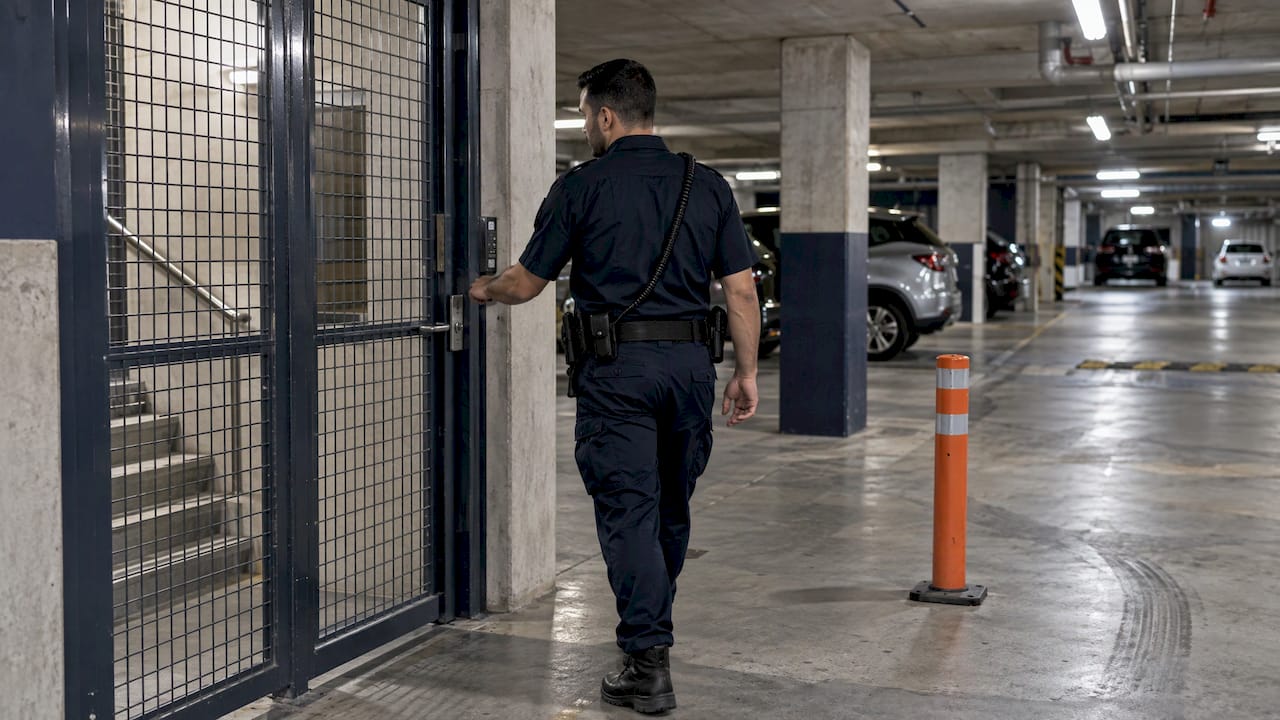
Strata security patrols are scheduled visits by licensed officers who drive or walk to your building, check the common property, deal with what they find and report back to the manager or committee. They suit schemes that need a visible, regular presence but do not need a guard standing in the lobby all night. The right patrol plan depends on your incident history, your building’s layout and how quickly someone needs to respond.
This guide explains what patrols involve, what they can and cannot do, how to set coverage and frequency, what affects the price, and what to write into the contract.
TL;DR
- A patrol is a set of timed visits, not a permanent post. You pay for checks of the car park, entries, lifts, stairwells and perimeter at the times your building is most exposed.
- Set frequency from evidence: your incident log, a day and night walk-through, and the state of your fences, gates, lighting, cameras and access control.
- Patrols work best alongside CCTV, alarm monitoring and working access control, not as a replacement for them.
- Get two to three written quotes from licensed providers, table them at a committee meeting and minute the decision.
- Ask every provider for the same things: licence details, patrol schedule, reporting format, alarm response and contract terms.
Table of Contents
- What strata security patrols involve
- What officers check and how they report
- Where patrols fit alongside guards, CCTV and access control
- How to decide coverage and frequency
- What affects the cost of strata patrols
- Comparing quotes and writing the contract
- Licensing and approvals across states
- Protecting shared equipment and vehicles
- Talk to us about your building
- FAQ
- Sources
What strata security patrols involve
A patrol officer visits the scheme at agreed times, usually after hours, on weekends or during known problem windows. Each visit follows a route through the common property. The officer inspects, records what they see, responds to anything out of place and moves on to the next site, or returns at the next scheduled time.
The shared areas most schemes ask patrols to cover are:
- Car parks and basements: roller doors that have been left open, tailgating, abandoned vehicles, signs of break-ins, damaged lighting.
- Entries and lobbies: propped doors, damaged intercoms, loitering, unauthorised access.
- Stairwells, lifts and corridors: forced doors, graffiti, rubbish dumping, people sleeping or gathering where they should not be.
- Storage cages and bike rooms: broken locks and signs of forced entry.
- Pool, gym and rooftop areas: after-hours use, doors left unsecured, damage.
- Perimeter, gates and fences: gaps, damage, climbing points and landscaping that blocks sightlines.
- Bin rooms and loading docks: unsecured access points that give strangers an easy way in.
In mixed-use buildings the route is more complex, because retail tenants, commercial floors and residential levels each have their own access patterns. If your building has a front desk during the day and a gap at night, our piece on what a strata concierge role must cover in a mixed-use building helps you see where a patrol picks up.
What officers check and how they report
The value of a patrol is only as good as what it records. A good officer does not just “drive past”. They work through a checklist and leave a trail you can read later.
Typical checks on each visit include:
- Are external doors, gates and roller doors closed and locking properly?
- Is lighting working in the car park, entries and paths?
- Are cameras and intercoms visibly operating and unobstructed?
- Is there any damage, graffiti, forced entry or dumped rubbish?
- Are there people on the property who should not be there?
- Are fire exits, stairwells and plant rooms secured and clear?
Reporting matters just as much. Victoria Police recommends that owners corporations review security policies, display building manager and caretaker contact details clearly and keep up-to-date incident logs. Patrol reports feed directly into that log. Ask for each visit to be recorded with the time, areas checked, anything found and what the officer did about it.
A useful reporting set-up has three layers:
- Per-visit record: time on site, checkpoints covered, observations.
- Incident report: for anything beyond routine, with what happened, who was notified (manager, police, emergency services) and any follow-up needed.
- Periodic summary: a monthly view for the committee that shows trends, such as repeated car park door faults or recurring after-hours gatherings.
That third layer is what makes committee decisions easier. Three months of reports showing the same roller door left open at 11 pm tells you where to spend money, whether on a patrol timing change, a door repair or an access control upgrade.
Where patrols fit alongside guards, CCTV and access control
Patrols are one layer in a security set-up, and it helps to be clear about what each layer does best.
| Measure | Best at | Gap to plan for |
|---|---|---|
| Mobile patrol | Visible presence at set times, checking and securing the property, responding to alarms | Not on site between visits |
| Static guard or concierge | Continuous presence, controlling who enters, immediate response | Higher cost to cover long hours |
| CCTV and alarm monitoring | Watching the site around the clock, evidence, triggering a response | Needs someone to act on what it sees |
| Access control | Limiting who can enter and recording when | Only as good as its upkeep and how residents use it |
The strongest combination for many schemes is monitored alarms and cameras that trigger a patrol response. That way the patrol is not guessing when to attend. Our CCTV and alarm monitoring service is built around that kind of link between detection and response, and our page on what mobile patrol security is explains how scheduled and alarm-driven visits differ.
Where a scheme has a specific high-risk period, such as an event in the building, a handover of a new development or a run of break-ins, a security guard on site for that window can sit on top of the patrol schedule.
Problems patrols help with
Patrols are well suited to:
- Deterring opportunistic theft from car parks and storage cages by being visibly present and unpredictable.
- Catching doors and gates left insecure before they become an entry point.
- Moving on loiterers, people sleeping in common areas or unauthorised guests.
- Documenting damage and anti-social behaviour so the committee has records to act on.
- Responding to alarm activations when no one lives or works in the area.
Problems that need another layer
A patrol visits at intervals, so an incident that starts and finishes between visits needs to be caught another way. Continuous control of who walks in at 6 pm belongs to a concierge or access control. Evidence after the fact belongs to cameras. Planning around these differences is part of choosing well, not a weakness of patrols. Car parks are a good example, and our car park security guide for property managers shows how patrol timing, lighting, doors and cameras work together there.
How to decide coverage and frequency
Start with evidence rather than a guess. Victoria Police suggests owners corporations review the incident log and assess the property by day and night, including the surroundings, access control, fences and gates, CCTV, lighting, garages, storage and other security features. That assessment is the foundation of a patrol plan, whichever state you are in.
A practical process:
- Pull the incident history. Collect the last 12 months of resident complaints, break-in reports, damage claims and manager call-outs. Note the times and locations.
- Walk the building twice. Once in daylight and once after dark. Note poor lighting, blind corners, doors that do not latch, overgrown landscaping and any easy climbing points.
- Map the exposure windows. Many incidents cluster in specific periods: late night, early morning, weekends, after bin collection or during move-in days.
- Match visits to windows. Rather than spreading visits evenly, place them where the evidence points. Two well-timed visits often beat four generic ones.
- Decide what the officer must do on each visit. Write the checklist into the scope so it is not left to individual judgement.
- Set a review date. After three to six months, compare the incident log and patrol reports with the original data and adjust.
If you are in Victoria, our guide to security rules for Victorian owners corporations explains the governance side of these decisions, and the strata protection overview shows how patrols, cameras and concierge services fit together for a building.
Fixed or randomised routes
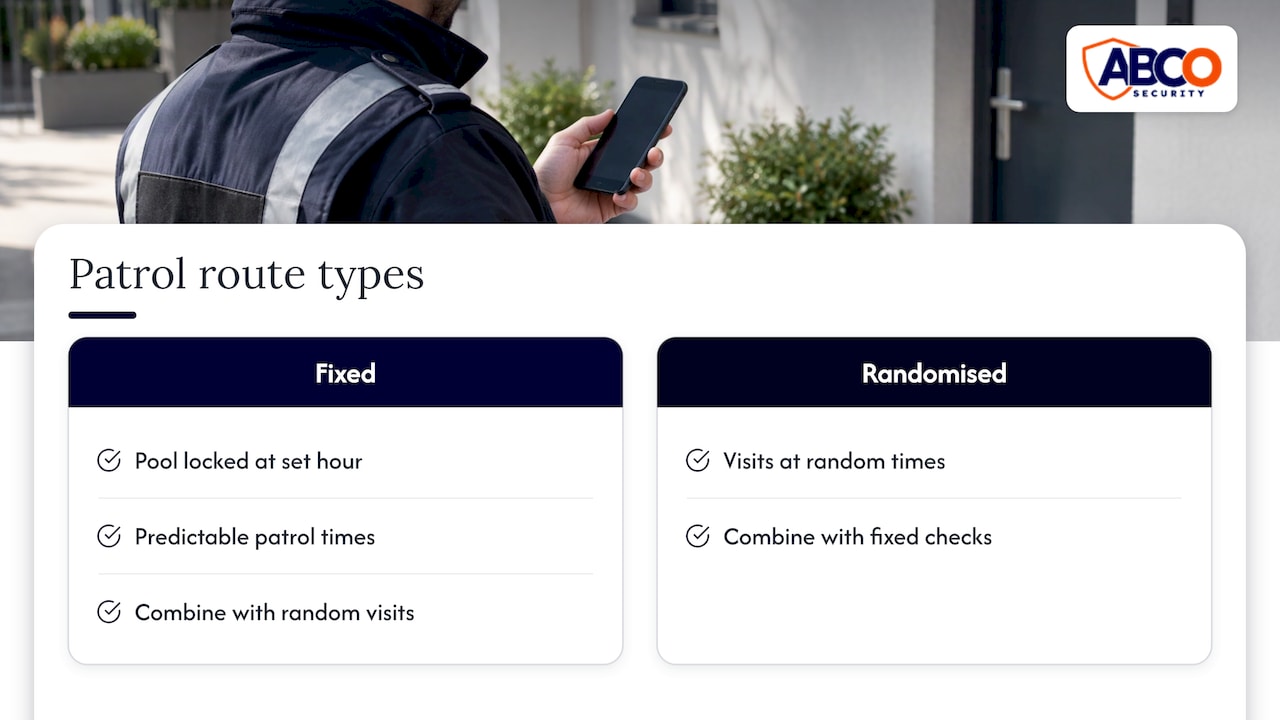
Predictable patrol times are easy for offenders to work around. Many schemes ask for a mix: some fixed checkpoints, such as locking the pool area at a set hour, and some randomised visits. Put this in the scope so the provider designs the schedule on purpose.
What affects the cost of strata patrols
Patrol pricing is built from a handful of variables, and understanding them lets you compare quotes fairly rather than just by the headline figure.
- Visit frequency: more visits per night or week means more cost.
- Visit length: a quick exterior check costs less than a full walk through multiple levels and car park floors.
- Building size and complexity: multiple towers, large basements and extensive grounds take longer to check.
- Time of day: overnight, weekend and public holiday work usually costs more.
- Alarm response: whether alarm-activated attendance is included, or charged per call-out.
- Reporting and technology: checkpoint tracking, digital reports and monthly summaries.
- Contract length: longer terms often come with better rates, but reduce your flexibility.
- Location: travel time between sites matters, and a provider with several buildings nearby can often schedule more efficiently.
The main reason committees choose patrols over a permanent guard is the cost structure: you pay for specific visits rather than for a guard on site all day and night. Whether that works out cheaper depends on how many visits you need. At some point, a constant presence becomes better value than frequent visits, and a provider who is honest about that tipping point is worth talking to.
We publish a price for one of our offers: our Night Owl Service is listed from $5.45 per day, with 12-month and 24-month plan options on the same page. Patrol pricing for a strata scheme depends on the building and the schedule, so we scope it after understanding the site.
Comparing quotes and writing the contract
Best practice for strata committees is to obtain two to three quotes from licensed providers, present the proposals at a committee meeting and minute the security decision so the process is transparent. Give every provider the same brief so the quotes are comparable.
Ask each provider to put the following in writing:
| Item | What to look for |
|---|---|
| Licences | Company and officer licences valid in your state or territory |
| Insurance | Public liability and relevant cover, with certificates |
| Schedule | Number of visits, times, duration and how randomisation works |
| Scope | Named areas, checklist and what officers do when they find an issue |
| Alarm response | Whether it is included and the expected attendance time |
| Reporting | Format, delivery time and monthly summaries |
| Supervision | How officers are supervised and how missed visits are handled |
| Contract terms | Term, renewal, price review, notice and termination rights |
| Escalation | Who the officer calls, in what order, at what hours |
Two extra points are worth adding. First, ask how the provider proves the patrol happened, such as checkpoint scans or time-stamped digital logs. Second, agree how complaints from residents are handled, so that issues raised by owners reach the provider through the manager rather than directly and inconsistently.
The managerial side of these decisions, including who signs, what the committee can delegate and what the manager must report, is covered in our guide to strata manager responsibilities.
Licensing and approvals across states
Security work in Australia is licensed by state and territory regulators, so the provider’s licensing must match where your building is. Ask to see the company licence and the officers’ licences, and confirm them with the relevant regulator.
Officers who move between jurisdictions can often work under mutual recognition. For example, Queensland allows people with a security licence from another Australian state or territory, or New Zealand, to apply to transfer it to a Queensland licence and work while the application is processed, subject to conditions. If a provider is bringing interstate officers to your building, ask how their licences are being handled.
On the scheme side, the owners corporation or body corporate needs to follow its own governance. Check your by-laws, your committee’s spending authority and any requirement for a general meeting resolution before signing a multi-year contract. Rules on these points differ between jurisdictions, so confirm with your strata manager or the relevant state fair trading body. Where you plan to add cameras alongside patrols, check your CCTV by-law first, and if your scheme employs staff, our article on workplace surveillance rules in Victoria explains what applies.
Protecting shared equipment and vehicles
Some schemes keep maintenance trailers, mowers or other shared equipment on site, and these are easy targets when the building is quiet. Patrol officers can check where they are stored at each visit, and some schemes also fit trackers to them. Options such as GPS tracking without monthly subscription fees let a manager see where an item is if it leaves the property, which gives the patrol provider something concrete to act on.
Our perspective on strata patrols
Most strata security problems we see are not dramatic. They are doors left propped, car park gates that do not close, lights that have failed and the same after-hours visitors returning week after week. A patrol earns its fee by catching these early and putting them on the record.
We build strata patrol plans around the building, not a standard package. That means starting with the incident history and a walk-through, then placing visits where the risk sits. It also means linking patrols to monitored alarms and cameras so that detection and response are connected rather than separate purchases.
Our work is backed by more than 15 years in the industry, licensed professionals, 24/7 operations and a quality approach aligned to ISO 9001 and ISO 30000. For committees, that translates into clear reporting, accountable officers and a provider who will tell you when a patrol is enough and when you need another layer.
Abco
Talk to us about your building
If you are weighing up patrols for your scheme, our mobile patrol services cover scheduled checks, reporting and alarm response for residential and mixed-use buildings. We can start from your incident log and a site walk-through, then put a scope and quote in front of your committee.
For buildings that also need camera and alarm coverage, our electronic security solutions can be planned together with the patrol schedule. You can also start from our home page to reach the right team.
FAQ
How often should a strata scheme be patrolled?
It depends on your incident history and exposure windows, not a fixed rule. Many schemes start with a small number of well-timed after-hours visits and review the reports after three to six months. Increase frequency where the log shows repeated problems.
Are patrols cheaper than a security guard?
Often, because you pay for visits rather than continuous hours on site. A building with frequent incidents or high-risk periods may find a guard or concierge better value for those windows. A scoped quote against your own incident data shows which suits you.
What should I ask a patrol provider before signing?
Ask for licences and insurance, the visit schedule, the checklist officers follow, how alarm response works, how visits are verified and what reporting you receive. Also confirm contract term, price review and termination rights, and compare two to three quotes on the same brief.
Can patrols replace CCTV or access control?
They do different jobs. Patrols provide a visible presence and response at set times, while cameras and access control work continuously. Most schemes get the best result by combining them, with monitored alarms triggering patrol attendance.
Do patrol officers need to be licensed in my state?
Yes, officers must hold the licence required where they work. Mutual recognition arrangements exist between jurisdictions, but you should still ask the provider to show current licences and confirm them with your state regulator.
Sources
- Residential Apartment Security Assessment for Owners Corporations, Victoria Police
- Strata Security guide, Strata Plus
- Transfer to a Queensland security licence, Queensland Government
Recommended
about
avada factory
Sempery ultricies nibh at dolor cras urna eleifend nec. Atiam efficitur tempor.