
The owners corporation usually pays for common-property strata building security through the OC budget. A building manager’s fee covers only the coordination duties in their contract, and lot-specific upgrades such as private door hardware or alarms remain the lot owner’s responsibility.
Most strata security disputes are funding disputes in disguise. I’ve found that committees get into trouble when they treat every security request as a single “building security” cost instead of asking three questions: Is the item common property, is it already inside the manager’s scope, and does it exclusively benefit one lot? This guide answers that cost-allocation question step by step. You will see the three-way split at a glance, what sits in the owners corporation budget, what a building manager’s fee actually covers, and what a lot owner can properly be asked to fund. We also cover access control, CCTV and intercoms, with a plan-first check before any upgrade, plus quick answers to the questions committees ask and the pitfall that quietly drains OC funds. For installed systems, especially electronic security and CCTV alarm monitoring, the registered plan and contract wording matter more than verbal assumptions.
Who Pays for Strata Building Security? The Short Answer
The owners corporation funds common-property security from its budget, by lot liability. A manager’s fee usually buys coordination, not delivery; private door hardware and in-unit alarms fall to the lot owner.
An OC forms automatically on registration of a plan with common property; every lot owner is a member. Common property includes foyers, driveways, lifts, walls and fences. The plan sets the lot/common boundary, the starting point for control and repair, not insurance or consequential damage.
In practice, disputes start when owners assume the manager’s fee bought the guard, or the OC will absorb a lock. Review body corporate security rules in Victoria, then verify against the Owners Corporations Act 2006, plan, rules and management agreement. Not legal advice.
The Three-Way Split at a Glance
Match items to what they protect, not who asked. Grey zone: shared-entry items serving one lot (e.g. in-apartment intercom handset) need the plan and rules to decide. For mixed-use rosters, see mixed-use strata concierge security. Manager fees cover coordination, procurement, compliance records and supervision; guard labour, hardware and monitoring subscriptions usually do not. Print and annotate this table against your plan at the next meeting.
| Item | Usually OC budget | Usually manager fee | Usually lot owner |
|---|---|---|---|
| Lobby CCTV and storage | Yes | Coordination only | No |
| Garage gate and access control | Yes | Coordination only | No |
| Concierge or static guard at entry | Yes | Sometimes (check agreement) | No |
| After-hours mobile patrol | Yes | Sometimes (check agreement) | No |
| Apartment door lock or hardware | No | No | Yes |
| In-unit alarm or private camera | No | No | Yes |
| Building-wide access control upgrade | Yes, subject to approval threshold | Coordination only | No |
What Sits in the Owners Corporation Budget
Those rows are defaults. Fees are struck at a general meeting from a budget and allocated by lot liability, except under the benefit principle for services some lots do not benefit from, or for damage and misuse (Parke Lawyers).
VCAT has held owners without balconies still benefit from balcony repairs: analogy only, no security-specific authority. Non-use is no defence: a foyer camera is funded regardless.
Spend above twice annual fees generally needs a special resolution unless urgent. That threshold rests on a case summary, so verify the judgment.
The trap: a $60,000 access control upgrade approved at committee when it needed a general meeting. Ask what implementing these controls actually costs and minute the quote and the threshold test.
What a Building Manager’s Fee Actually Covers

The OC budget funds the service; the manager’s fee buys administration. Most management agreements cover coordination, contractor procurement, compliance and record keeping. They rarely cover the guard’s hourly rate, installer invoices or monitoring subscriptions.
Ask whether your manager arranges a concierge or static guard, delivers that labour, or neither. Check four clauses: scope schedule, exclusions, disbursement billing, and authority to commit OC funds without committee approval. The manager administers; the committee and OC approve major spend.
If your entry uses concierge or static guarding, confirm whether labour is cost-plus or inside the fixed fee. That line changes your levy forecast. When the OC buys labour, an itemised quote from a licensed provider makes the split obvious. The same logic applies when sourcing event security guard services: separate coordination from guarding. Apply that split to lot-owner items next.
What a Lot Owner Can Properly Be Asked to Fund
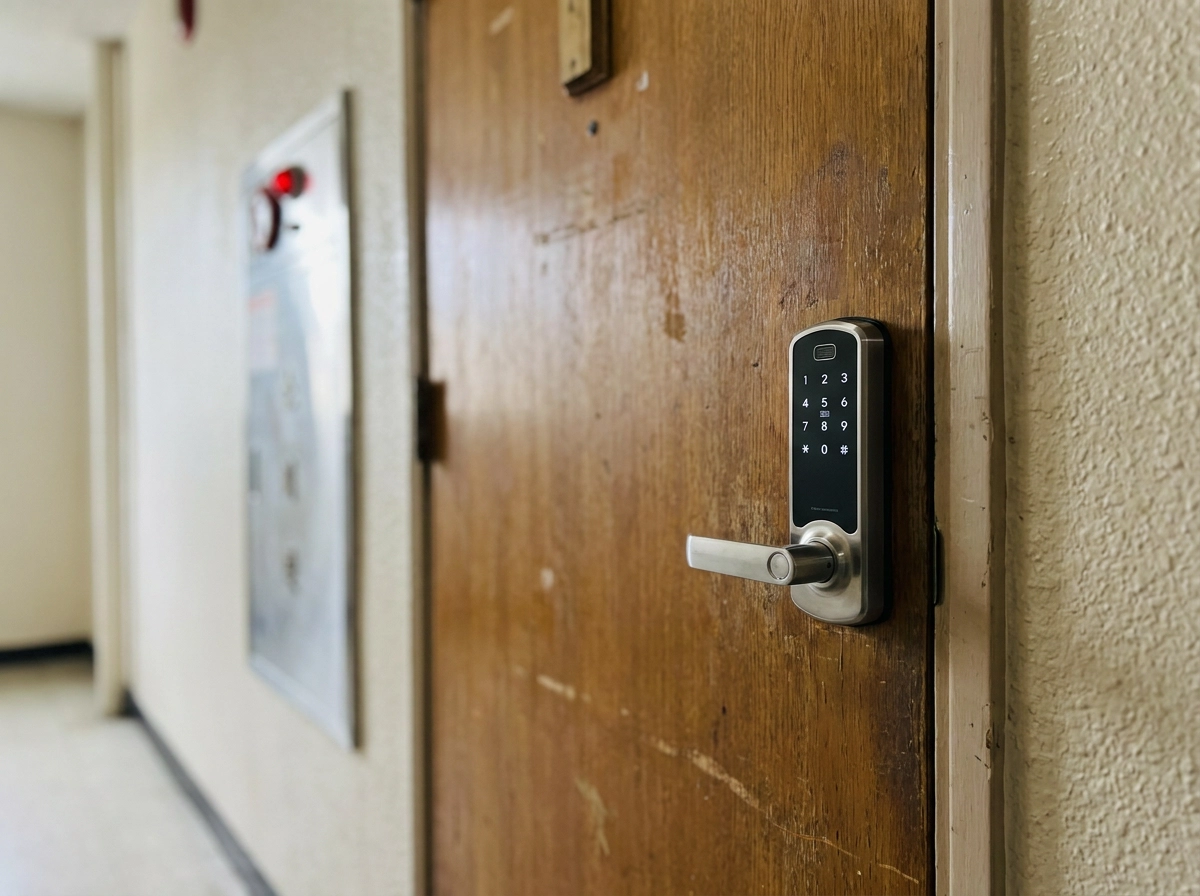
Beyond the manager’s fee, private security is yours: door hardware, in-unit alarms, cameras covering your lot or exclusive-use courtyard. Owners must not damage common property, unreasonably interfere with it, or block lawful access for maintenance. Drilling a strike plate into a common door frame breaches that unless the OC agreed. Cabling through a riser or a reader on a shared wall needs OC consent and a check against alteration rules. Do not quietly load private upgrades onto the OC budget. The benefit principle runs both ways: if only your lot benefits, only your lot pays. Equally, if the OC delivers building-wide security to your lot, you cannot withhold fees for non-use. See cost, timing and prioritisation when budget is limited.
Access Control, CCTV and Intercoms: Check the Plan First
Read the registered plan and OC rules first; no source confirms access control, CCTV or intercom hardware is common property by default. Apply the function test: shared entry readers, garage cameras and building intercoms normally follow the common property line; one-lot devices do not. Recurring costs matter more than hardware. Monitoring, cloud storage and service contracts are annual budget items. Cloud access control, subscription camera packages convert capital into an operating line; budget them as recurring or face another special resolution within two years. For defects, the Building and Plumbing Commission replaced VBA on 1 July 2025, and from 1 July 2026 Home Warranty replaced Domestic Building Insurance for eligible work, up to three storeys. See cameras in shared buildings.
Quick Answers to the Questions Committees Ask
Quick answers:
- Can the OC charge my lot separately for a building-wide security upgrade? Generally yes if lawfully raised by lot liability. The benefit principle may apply; significant special fees usually need a special resolution.
- Does the manager’s fee include the guard’s wages? Usually not. Coordination and delivery are separate; check scope and exclusions.
- Who pays for a new apartment door lock? The lot owner. Common entry doors and intercoms are OC items.
- Can I refuse to pay for security I never use? No. Non-use does not avoid fees (SCA Victoria guide).
- Is the camera outside my door common property? Check the registered plan and OC rules; it varies building by building. See property management security services for coordination.

Pro Tip and the Pitfall That Costs Committees Money
Before the next general meeting, request an itemised security quote separating labour, hardware, monitoring subscription and management fee. Map each line to the registered plan and mark it OC or lot. I’ve found you usually uncover one or two lines the OC has been paying for individual owners.
Pitfall: approving an upgrade at committee level without testing the special resolution threshold, then discovering the OC is contractually bound to a service it never formally funded. Second pitfall: assuming the manager’s fee covered delivery.
For guards, patrols or monitored CCTV, use a provider that quotes this way. Cost allocation becomes defensible at the meeting and auditable later. Event security shows the same trap: scaling guard numbers correctly prevents overbuying.
Conclusion
Security costs follow the registered plan and the scope of work, not who uses what. The owners corporation funds common property systems such as entry doors, intercoms, and shared CCTV. Building managers coordinate delivery, but their fee rarely covers hardware, monitoring, or guard hours. Lot owners fund lot-specific items, and non-use does not exempt them from common property fees. Before approving an upgrade, request an itemised quote, map each line to OC or lot, and confirm the special resolution threshold. For security guard services or electronic security, use a provider that quotes this way.
Pro tip: audit one old security invoice at your next meeting. You will likely find a line the OC has been funding for individual owners.
about
avada factory
Sempery ultricies nibh at dolor cras urna eleifend nec. Atiam efficitur tempor.