Choose a speed gate when you want fast, good-looking, accessible entry for staff and visitors in a corporate, healthcare or education setting. Choose a turnstile, especially a full-height one, when you need rugged, person-by-person physical control on a construction, industrial or outdoor site. The right answer depends on who walks through, how many arrive at once, how much weather and abuse the lane takes, and what your accessibility obligations are.
This guide compares the two on the criteria site managers ask about: how they work, how fast they move people, how well they stop tailgating, what Australian accessibility rules mean for lane design, and which setting suits which hardware.
TL;DR
- Speed gates (also called swing barriers or optical turnstiles) open glass or retractable panels after a credential check. They suit offices, lobbies, campuses and other high-traffic commercial entrances.
- Turnstiles, including tripod and full-height models, use rotating arms or floor-to-ceiling rotors. They suit industrial and construction sites where robustness and accurate people counting matter most.
- Neither product is a complete security system. Sensors, alarms, a wide accessible lane and a guard or monitoring team who respond to alerts do the real work.
- In Australia, every entry point needs a compliant accessible path, and gates must release safely in a fire or power failure.
- Rated throughput is a ceiling. Real queues depend on how people behave at the reader.
Table of Contents
- What is the difference between a speed gate and a turnstile?
- How do they control entry and stop tailgating?
- How do speed and throughput compare?
- Accessibility and emergency egress in Australia
- Which suits which site?
- Quick decision guide
- Perspective
- Making the gate part of a complete security plan
- How ABCO can help
- FAQ
- Sources
What is the difference between a speed gate and a turnstile?
Both are pedestrian barriers that let one authorised person through at a time. The difference is the mechanism and the feel.
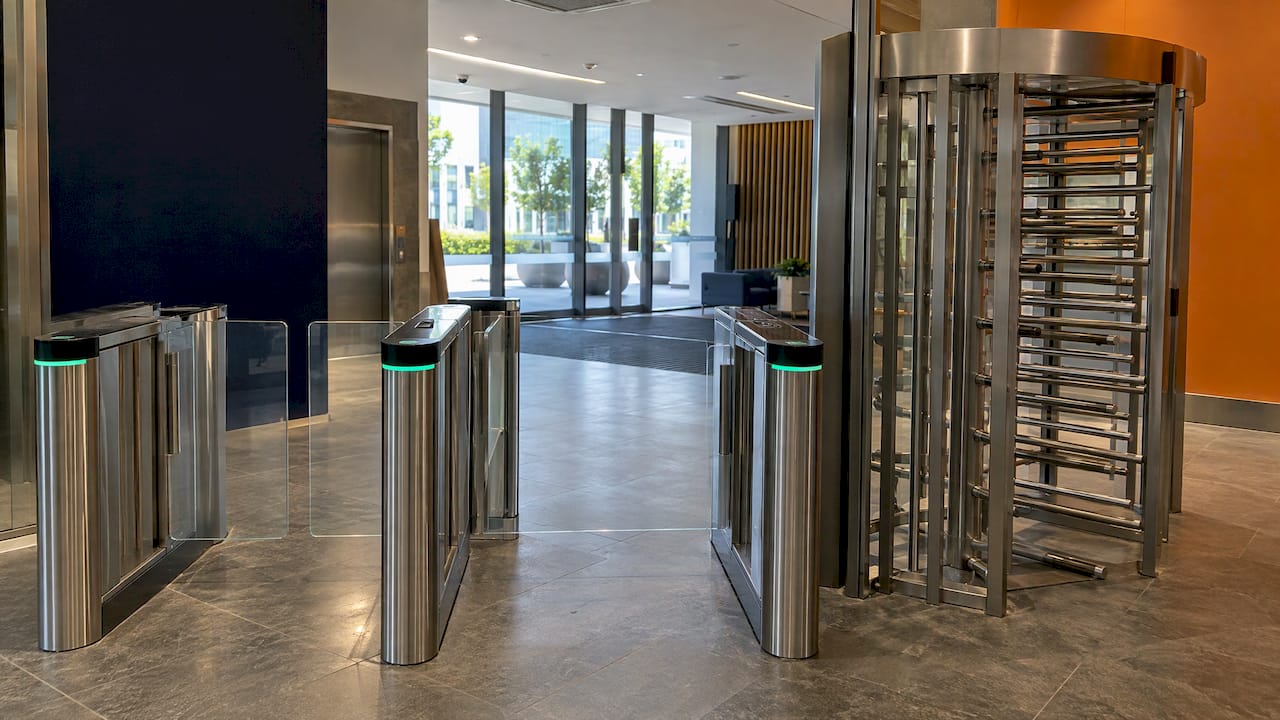
A speed gate, also known as a swing barrier, uses retractable panels that open when a credential is validated. The panels are often glass, and they sit flush with the lane edges until needed. Turnstiles in the traditional sense cover tripod models with rotating arms and full-height models with floor-to-ceiling rotors or cages.
In practice, the two families look like this:
| Feature | Speed gate / swing barrier | Tripod turnstile | Full-height turnstile |
|---|---|---|---|
| Barrier | Retractable or swinging panels | Three rotating arms | Floor-to-ceiling rotor or cage |
| Physical deterrent | Moderate, relies on sensors and alarms | Moderate, waist-high | High, hard to climb or jump |
| Look | Sleek, suits lobbies | Utilitarian | Industrial |
| Typical setting | Offices, universities, banks, airports | Gyms, stadiums, light industrial | Construction, industrial, outdoor perimeters |
| Wide accessible lane option | Yes, in the same unit | Usually a separate gate | Usually a separate gate |
| Relative cost | Higher | Lowest | Mid to high |
The cost row is general market guidance, not a quote. Prices vary by brand, finish, lane count and the access control system behind them, so get a site-specific quotation.
How do they control entry and stop tailgating?
Tailgating, where a second person slips in behind an authorised one, is the main reason sites install either device instead of a plain door.
A full-height turnstile controls it mechanically. The rotor turns only one quarter turn per credential, so a second person simply cannot follow. That is why it is so common where you must know exactly who is on site, such as a construction project with induction and licence checks.
A speed gate controls it electronically. It authenticates a credential, opens the barrier and then uses sensors to watch movement along the lane. One manufacturer’s Australian documentation says its systems can detect tailgating, unauthorised entry and wrong-way travel, sound an alarm for guard response, and support anti-passback. The key phrase is guard response. A sensor that raises an alarm nobody answers does not stop anyone.
So the practical question is not which device is more secure in the abstract. It is which mix of physical deterrent and monitored response fits your threat. A lobby with a staffed reception and a monitored camera suits a speed gate well. An unattended gate on a remote site at 2 am calls for a hard physical barrier plus remote monitoring or patrols.
Credentials and integration
Both types connect to access control software. One major manufacturer says its speed gates and turnstiles work with its access control ecosystem and support RFID cards, QR codes, fingerprints and biometric authentication. When you choose, check three things:
- Does the gate controller speak to the access control system you already own, or the one you plan to buy?
- Can visitors be issued temporary credentials, such as QR codes, without staff walking them through?
- Are door and gate events logged somewhere your security team can review?
Our complete guide to access control systems in Australia covers the software side in more detail.
How do speed and throughput compare?
Speed gates are the faster option because the barrier is open or opens quickly, so people walk through rather than push through. As an example, one Australian manufacturer specifies 20 to 30 people per minute in one direction for its swing speed gate, depending on the access control system. Full-height turnstiles are slower because each person must wait for the rotor, and they are commonly rated at roughly half that rate or less.
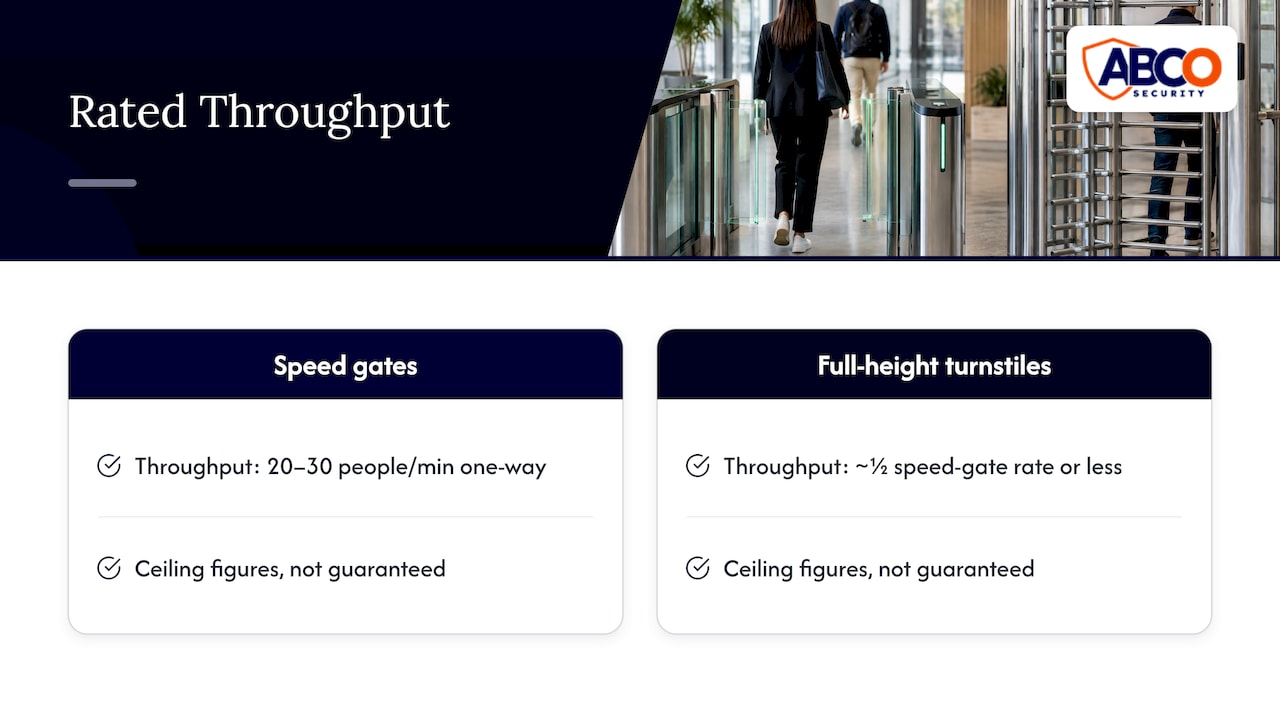
Treat those figures as a ceiling. They assume everyone arrives in a steady stream, presents the right credential on the first try and carries nothing awkward. Real entry points suffer from fumbled cards, bags, prams, visitors who do not know the process and groups arriving together.
Work out your peak, not your average
A simple way to size lanes:
- Count the people arriving in your busiest 10 minutes (shift change, start of work, doors-open at an event).
- Divide by 10 to get people per minute.
- Divide by a realistic lane rate, well under the rated maximum, and round up.
- Add one lane for accessible use or redundancy.
For example, a corporate tower with 600 staff arriving mostly between 8:15 and 8:45 sees about 20 people a minute at peak. One lane at a realistic rate will queue. Three lanes, one of them wide, will not.
Events and crowds
Large events often add a dedicated fast lane rather than relying on hardware alone. The Australian Open, for instance, describes an Express Entry lane on its official arrival and entry page. The lesson is that queue design, signage and pre-checked tickets matter as much as the gate. For a closer look at the human side of entry speed, this piece on event check-in flow and door design is worth reading alongside your hardware decision.
For temporary or large-capacity events, fixed gates are usually the wrong tool. Crowd control staff, barriers and bag-check lanes can be set up for the day and scaled to the crowd. We cover that under our events security service below.
Accessibility and emergency egress in Australia
This is where many gate projects stumble, and it should shape your choice early.
The National Construction Code sets accessibility requirements for buildings. Under the NCC’s access provisions, in a building with a floor area over 500 m², an accessible pedestrian entrance must be no further than 50 m from any non-accessible entrance. Check the current NCC edition for the exact wording that applies to your building class and project.
In practice, this means:
- Provide an accessible lane. Standard speed gate lanes are narrow. Most ranges include a wider lane for wheelchairs, prams, mobility scooters and people with assistance animals. One manufacturer lists a 915 mm passage option suitable for wheelchair use on its swing speed gate. Tripod and full-height turnstiles generally cannot be used by wheelchair users, so they need a separate adjacent gate or door.
- Mount readers where everyone can reach them. Plan the card reader height for people seated in a wheelchair as well as standing users, and keep the path to it clear.
- Fail safe. Gates must release in a fire alarm or power failure so people can leave. Confirm with your certifier and fire engineer how the release is wired into the fire panel, and that doors on the fire path keep their fire rating. Our guide to door hardware for access control explains how to protect fire ratings.
Ask your building certifier and an accessibility consultant to review the layout before you buy. Retrofitting a lane after install costs far more than planning it in.
Which suits which site?
Corporate offices, healthcare and education
Speed gates are the usual pick. They are described as suited to high-traffic commercial settings such as corporate offices, universities, airports and banks. They look appropriate in a lobby, move staff quickly and include an accessible lane. In healthcare, pair gates with a staffed reception or concierge so visitors, patients and families are helped, not blocked. Keep emergency department and ambulance entries free of barriers that could slow urgent access.
Construction and industrial sites
Full-height turnstiles are the same source’s recommendation for industrial sites and construction zones. They hold up to weather, dust and deliberate attempts to climb over, and each rotation gives a clean headcount, which helps with site inductions and emergency muster. A hard barrier still needs a gate for plant and vehicles, plus a way for workers with mobility needs to enter.
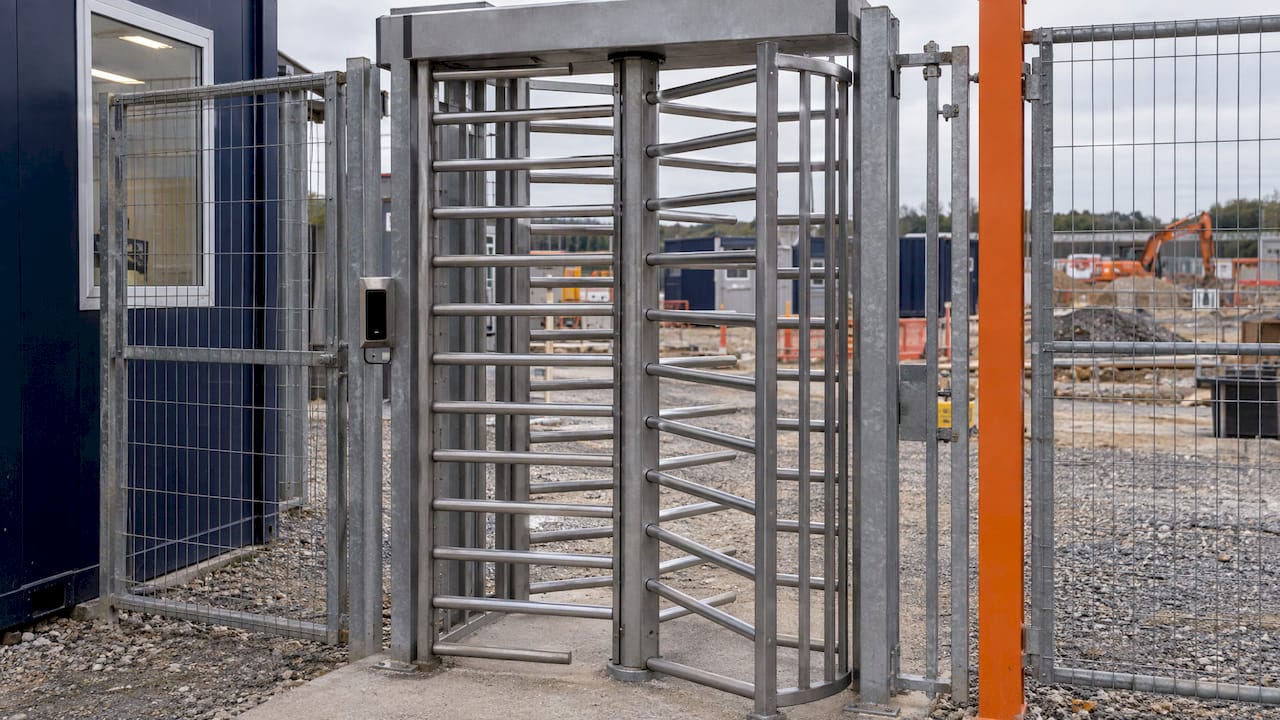
For most active sites, a fixed turnstile is also a question of timing. Early in a project, a temporary fence, a vehicle gate and a check-in point may be all you can justify. Our construction site access control guide walks through that staging, and our factory access control fixes cover industrial entries.
Events
Speed gates and turnstiles work for stadiums and fixed venues with ticket scanning. For festivals, pop-ups and one-off events, temporary barriers, staffed scanning points and trained crowd controllers are more flexible.
Retail
Most shops do not need either device. Entry control is usually about loss prevention: sightlines, staff presence, camera coverage and alarm response. Turnstiles make sense mainly in large-format or back-of-house areas, such as a distribution centre.
Quick decision guide
Work through these questions in order:
- Is the entry outdoors or exposed to weather and abuse? If yes, lean towards full-height turnstiles.
- Do you need a hard barrier against climbing or jumping? If yes, full-height. If sensors and a response are enough, a speed gate works.
- Is the entry in a public-facing lobby where appearance matters? Speed gate.
- Do large volumes arrive at once? Speed gates, in several lanes, plus queue management.
- Do you need an accessible lane in the same unit? Speed gate with a wide lane, or a separate accessible gate beside a turnstile.
- Is the entry unattended at night? Add monitoring, patrols or guards whichever device you choose.
Perspective
We see the same pattern across construction, healthcare, corporate and event clients: the gate is rarely the weak point. The weak point is what happens after the gate raises an alarm.
A turnstile or speed gate gives you control at the door. It does not tell you who is propped against the fence line, who is following a delivery driver in, or whether the alarm at 3 am was answered. That is why we plan entry control as part of a wider security design: a risk assessment first, then the right hardware, then licensed people and monitoring behind it.
Our approach is proactive and technology-driven, backed by ISO 9001 and ISO 30000 standards and more than 15 years in the industry. In practice, that means we help you choose between a speed gate, a turnstile or a simpler solution based on your site, traffic and risk, and we can support it with guards, mobile patrols and CCTV and alarm monitoring.
Abco
Making the gate part of a complete security plan
Whichever device you choose, four supporting pieces decide how well it performs:
- Monitored alarms. Tailgating and forced-entry alerts need someone to act on them. Our CCTV and alarm monitoring is designed to give those alerts a response.
- Staffed or patrolled coverage. Reception, concierge or static guards help visitors, deal with exceptions and deter workarounds. Mobile patrols cover out-of-hours periods.
- Clear credential rules. Decide who is issued what, how contractors are inducted and how lost cards are cancelled.
- Periodic review. Traffic, tenants and threats change. Revisit your assessment regularly, as covered in our guide to security risk review frequency.
If the question is also whether the gate or perimeter itself is right, our security gate installation guide covers vehicle and boundary gates.
How ABCO can help
We help site managers, facility managers and event organisers decide what entry control a site actually needs and support it with people and technology. Our Electronic Security Solutions cover access control and alarm systems, while licensed security guarding and mobile patrols provide the response behind them. For after-hours coverage, our Night Owl Service is listed from $5.45 per day on our Night Owl page.
Tell us about your site, your peak arrival numbers and any accessibility requirements, and we will help you shape a practical plan.
FAQ
Are speed gates more secure than turnstiles?
Not automatically. A full-height turnstile is the stronger physical barrier. A speed gate relies on sensors and alarms to detect tailgating and forced entry, so its security depends on someone responding. Match the device to your threat and your response capability.
Can a wheelchair user go through a turnstile or speed gate?
Generally not through a tripod or full-height turnstile. Speed gates commonly offer a wider lane, and one manufacturer lists a 915 mm passage option for wheelchair use. Whatever you install, an accessible path of travel must be provided, so confirm your design with your building certifier.
Which is faster, a speed gate or a turnstile?
Speed gates are faster. One manufacturer specifies 20 to 30 people per minute in one direction for a swing speed gate, depending on the access control system. Real-world flow is usually lower, because user behaviour at the reader sets the pace.
Do construction sites need speed gates or turnstiles?
Many sites start with fencing, a vehicle gate and a check-in process, then add full-height turnstiles for larger, longer projects that need accurate headcounts. Speed gates are better suited to site offices and finished buildings.
Sources
- Turnstiles & Speed Gates, Hikvision Australia & New Zealand
- Speed Gates, Boon Edam Australia
- Lifeline Speedlane Swing, Boon Edam Australia
- Part D3 Access for people with a disability, NCC
- Arrival & Entry, Australian Open
- Event Check-In Flow: Designing the Door for Faster Entry
Recommended
about
avada factory
Sempery ultricies nibh at dolor cras urna eleifend nec. Atiam efficitur tempor.