Most Australian businesses should keep routine CCTV footage for about 30 days, then let it overwrite automatically. Footage of an incident is kept longer, for as long as a claim, police inquiry or investigation needs it. No single national law fixes one number for every business. What the law does require is that you do not hold personal information, which includes recognisable images, for longer than you have a reason to. A 30-day default, an incident folder and a written policy cover most sites, and a monitored system makes that routine much easier to run.
TL;DR
- Australian Standards recommend keeping footage for at least 31 days before it is overwritten, and 30 days is the most common policy default.
- Businesses covered by the Privacy Act must destroy or de-identify recorded personal information once it is no longer needed.
- Licensed venues in Queensland have fixed rules: 28 days minimum, deletion within 30 days, and longer holds for incident footage.
- Save only the clip an incident needs, record who authorised it and when it will be reviewed, then delete it.
- Your storage, not your policy, is what usually sets the real retention period, so size it before you install.
Table of Contents
- Is there a legal minimum or maximum?
- What the Privacy Act expects
- Sector rules you may meet
- How long for each type of site
- The hidden limit: your storage
- What to put in a CCTV retention policy
- Can you record people without their permission?
- Why monitored systems make retention easier
- Our view on retention
- Setting this up with ABCO
- FAQ
- Sources
Is there a legal minimum or maximum?
For most commercial sites, no. A CCTV policy published by one Australian company puts it plainly: surveillance legislation does not prescribe a specific minimum or maximum retention period for all CCTV systems. In practice the period has generally been treated as somewhere between 14 and 45 days, with longer retention where someone has requested access or law enforcement is investigating.
That gap is why you see so many different answers online. The honest version has three layers:
- A benchmark. Australian Standards recommend at least 31 days before footage is overwritten. Most businesses round that to a 30-day policy.
- A privacy limit. Under the Privacy Act 1988, you cannot keep personal information indefinitely without a reason.
- Industry rules. Some sectors, such as licensed venues in Queensland, have specific retention rules written into their licensing requirements.
If you manage a construction site, hospital, office, event or shop, you are normally in layers one and two. Check layer three with your licensing body if you hold a liquor or similar licence.
What the Privacy Act expects
The Office of the Australian Information Commissioner (OAIC) is the federal privacy regulator. It says that organisations covered by the Privacy Act, which means Australian Government agencies and organisations with annual turnover over $3 million, plus some others, must do three things with CCTV:
- tell people their image may be captured before recording starts (signage at entry points is the usual way);
- keep the recorded footage secure;
- destroy or de-identify it when it is no longer needed.
The last point comes from Australian Privacy Principle 11 (APP 11), the rule on securing and disposing of personal information. Under APP 11.2, covered entities must take reasonable steps to destroy or de-identify personal information once it is no longer needed for any purpose the APPs allow. The duty does not apply where a law or a court or tribunal order requires you to keep it, or where it is a Commonwealth record.
“De-identify” in CCTV terms usually means blurring or redacting faces and other identifying detail. Deleting is simpler and is what most sites do.
If your turnover is under $3 million you may fall outside the federal Act, but state and territory surveillance laws still apply to cameras, and many small operators follow the same retention discipline anyway. Our guide to CCTV laws in Australia for businesses and homes explains where the $3 million line matters.
What changed in December 2024
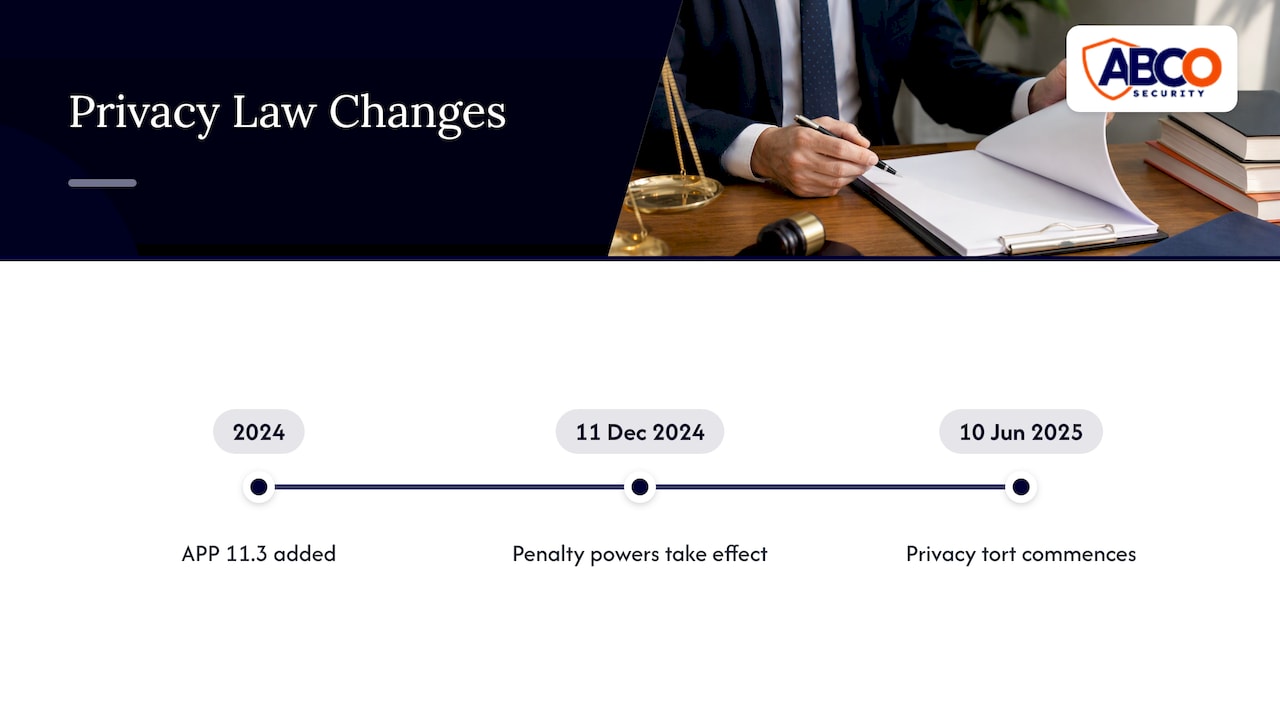
The Privacy and Other Legislation Amendment Act 2024 added APP 11.3, which clarifies that the “reasonable steps” to secure, destroy or de-identify information include technical and organisational measures. It applies to information held after the provision commenced, whenever it was collected. In the same Act, new civil penalty provisions and OAIC infringement and compliance notice powers took effect on 11 December 2024, and a statutory tort for serious invasions of privacy commenced on 10 June 2025.
For a site manager, the practical meaning is simple. “We never got round to deleting it” is a weaker position than it used to be. Automatic overwriting, access controls and a written policy are the technical and organisational measures a regulator would expect to see.
Sector rules you may meet
Licensed venues in Queensland
Business Queensland sets firm numbers for licensed venues. Recordings that do not show a reportable incident must be kept a minimum of 28 days and deleted within 30 days. Recordings containing an incident that must be kept cannot be deleted earlier than one year after the 28-day period. Footage handed to an investigator cannot be destroyed until the investigator confirms in writing that it is viewable.
If you run an event at a licensed venue, ask the licensee which rules apply to the cameras covering your event.
Government bodies
Public agencies often set their own rules. The Queensland Public Trustee’s procedure, for example, recommends storing routine footage for a minimum of 30 days before permanent deletion by overwriting. It keeps footage needed for law enforcement for one year after it is sent to the agency, and requires secure deletion so footage cannot be reconstructed. That is a useful model for private organisations writing a first policy.
Workplaces
If cameras watch employees, workplace surveillance laws add notice duties. In New South Wales that includes written notice before surveillance starts. See our guides on NSW workplace surveillance laws and what Victorian employers must do.
How long for each type of site
The benchmark is the same. The reason you might go longer differs by site, because it depends on how quickly a problem surfaces.
| Site | Typical default | Why you might hold longer |
|---|---|---|
| Construction site | 30 days | Theft or damage is often found at the next stocktake, and insurance claims or site incidents can take weeks to be reported. |
| Healthcare facility | 30 days | Incidents involving patients, visitors or staff may be raised after a delay, and footage then becomes part of an investigation. |
| Corporate office | 30 days | Access disputes, after-hours entry and workplace complaints. Notice duties apply to staff. |
| Event | Short default, then incident hold | Complaints and injury claims arrive after the event, so save the relevant clips straight away. |
| Retail | 30 days | Theft is often discovered at stocktake, and police may request footage later. |
These are defaults, not legal minimums. The pattern is the same everywhere: a short routine period for everything, and a deliberate, recorded hold for the few clips that matter.
The hidden limit: your storage
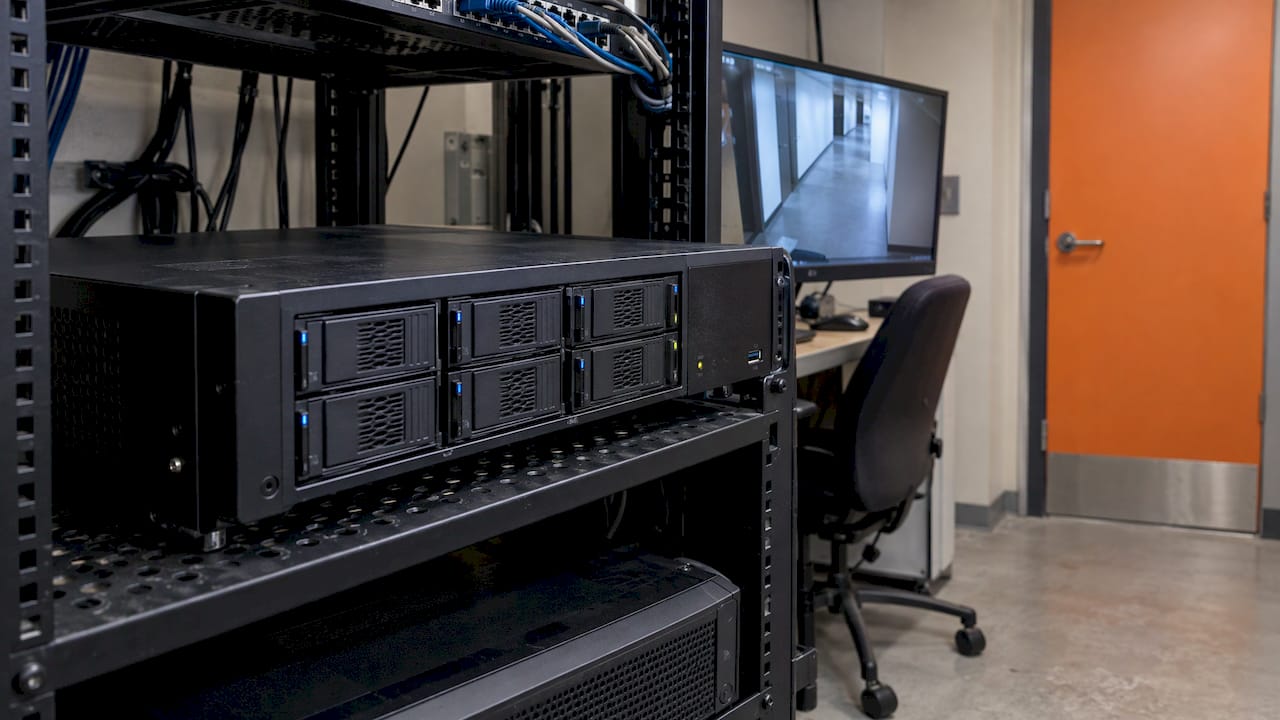
Many managers write a 30-day policy and then discover the recorder only holds nine days. Retention in practice is set by storage, which depends on how many cameras you run, the resolution, the frame rate and how much of the day they record.
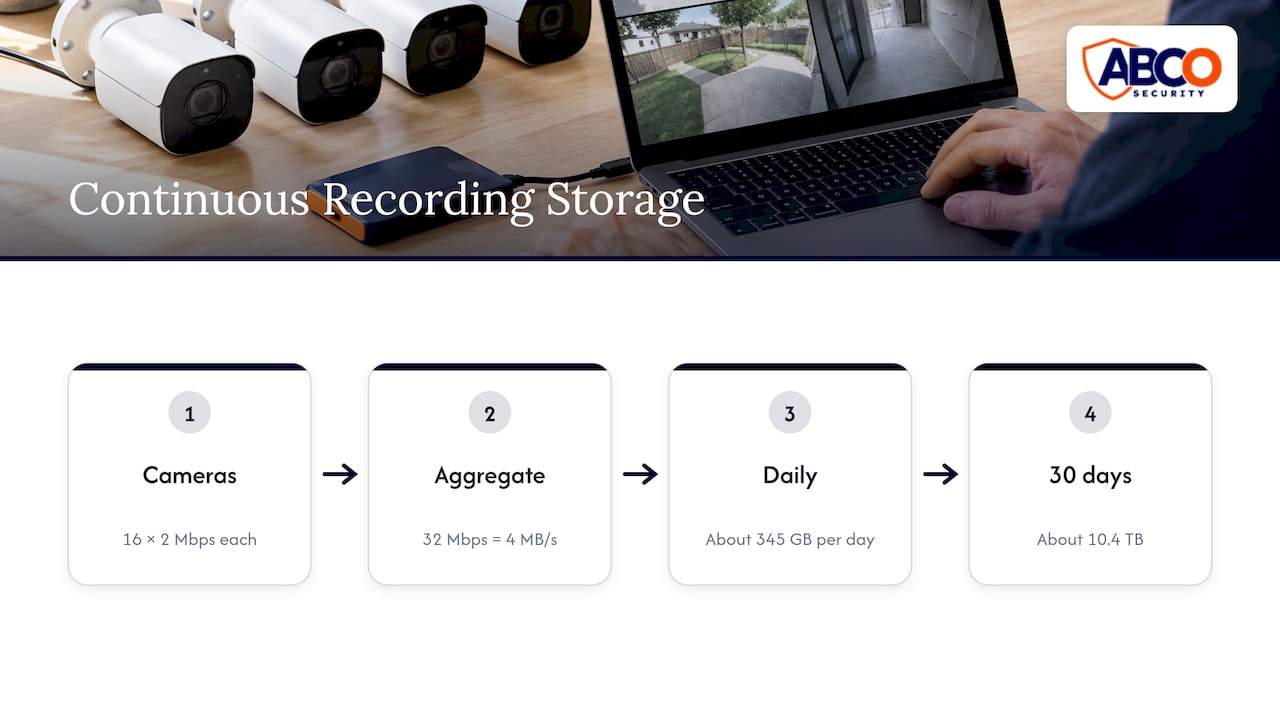
Here is an illustrative calculation. Say 16 cameras each record continuously at an average of 2 megabits per second. Together that is 32 megabits per second, or 4 megabytes per second. Over a day that is about 345 GB, and over 30 days about 10.4 TB, before you allow for headroom. Change the cameras to motion-only recording, or drop the bitrate, and the figure falls. Move to higher resolution and it climbs.
So size storage backwards from the retention period you want, not forwards from whatever the recorder ships with. Our CCTV storage requirements guide walks through the sums for different camera counts.
What to put in a CCTV retention policy
A workable policy is one page. A practical outline, consistent with the guidance on routine deletion and incident folders, looks like this:
- Set a default period. For example 30 days, matched to your storage.
- Automate deletion. Use overwriting or automatic deletion where the system allows it, so deletion does not depend on someone remembering.
- Create an incident folder. When something happens, export the relevant clip and store it separately from the rolling footage.
- Record the decision. Note why the clip was saved, who authorised it and when it will next be reviewed.
- Delete when the matter closes. Once the incident, claim or investigation no longer needs the clip, remove it securely.
- Limit access. Decide who can view, export and delete, and keep a log.
- Display signage. Tell people before they are recorded.
The point of step 3 is to save the relevant clip, not everything. One commentator on Australian CCTV law notes that holding footage for years “just in case” increases privacy and data breach risk, because old footage that was no longer needed is harder to justify if someone accesses it without authority.
When police or a claimant asks for footage
If police request footage, or an insurer or injured person asks for it, preserve it at once, before the rolling cycle overwrites it. Do this even if you have not yet decided whether you will hand it over. Seek legal advice from your own lawyer before releasing footage that shows people other than the person asking, and keep a record of who received what and when.
Can you record people without their permission?
That question is a separate legal topic and mostly concerns audio and private activities. Video of public or common areas on your own premises is normally what a business camera captures. Each state and territory has its own surveillance devices law, and the OAIC notes that state and territory laws also cover surveillance devices. Audio recording, cameras in toilets, change rooms or other private spaces, and cameras pointed at a neighbour’s property raise the most risk. Get legal advice before installing in any of those situations.
Why monitored systems make retention easier
A retention policy only works if the system behind it does. Common failures are a recorder that stopped recording weeks ago, a clock that is wrong so clips cannot be matched to events, a full disk that silently overwrites everything, and no one who knows how to export a clip at 2 am. Each of these is a monitoring problem rather than a policy problem.
This is where an integrated provider earns its place. ABCO Security installs and monitors CCTV and alarm systems, and our CCTV and alarm monitoring service runs 24/7. For a construction manager with equipment on site overnight, a hospital administrator, a retailer or an events lead, that means someone is watching the system as well as storing its output. Our camera monitoring services page explains how that works. For the data side, see our guide to data privacy security measures for businesses.
Our view on retention
We see CCTV retention as a design decision made at installation, not a setting changed later. The number of days you can keep should be chosen first. Then cameras, resolution and storage are specified to deliver it.
Our approach to security is proactive rather than reactive. That applies to footage too. A system that records everything for 30 days and has a clear incident process lets you answer a police request, an insurer or a regulator calmly, because the clip is already saved and documented.
We work to ISO 9001 quality standards and bring more than 15 years in the industry to construction, healthcare, corporate, events and retail sites. Documented processes are how we run our own work, and they are the best way to run retention as well.
Abco
Setting this up with ABCO
If you want cameras, storage sizing, 24/7 monitoring and guarding handled by one provider, ABCO Security delivers integrated security across Australia, including CCTV and alarm installation and monitoring, static guards and mobile patrols. See electronic security solutions for installation, or our Night Owl service, listed from $5.45 per day.

For construction sites there is a dedicated construction site security service. Contact us through abcosecurity.com.au to talk through what your site needs.
FAQ
How long should CCTV footage be stored?
For most businesses, about 30 days. Australian Standards recommend at least 31 days before footage is overwritten. Keep incident footage longer, for as long as the claim or investigation needs it, and delete it once it does not.
Do I have to delete CCTV footage?
If your organisation is covered by the Privacy Act, yes, in the sense that you must take reasonable steps to destroy or de-identify personal information once it is no longer needed. An exception applies where a law or a court or tribunal order requires you to keep it. A short default period with automatic overwriting is the simplest way to meet this.
Is there a different rule for pubs, clubs and bars?
In Queensland, yes. Licensed venues must keep routine recordings for a minimum of 28 days and delete them within 30 days, and incident recordings have a longer hold. Other states have their own licensing conditions, so check with your liquor licensing authority.
Can I keep footage for a year just in case?
It is hard to justify for routine footage. Holding it increases privacy and security risk, and the Privacy Act expects personal information to be destroyed or de-identified when no longer needed. Keep the specific clips linked to an incident and record why.
Sources
- CCTV footage, LawHub (Victoria Legal Aid)
- Security cameras, OAIC
- Guide to securing personal information, OAIC
- Privacy and Other Legislation Amendment Act 2024
- Complying with CCTV legislation for licensed venues, Business Queensland
- Camera Surveillance Procedure, Queensland Public Trustee
- CCTV Surveillance Policy (AU & NZ)
- CCTV Laws In Australia: Privacy And Signage Rules, Sprintlaw
Recommended
about
avada factory
Sempery ultricies nibh at dolor cras urna eleifend nec. Atiam efficitur tempor.