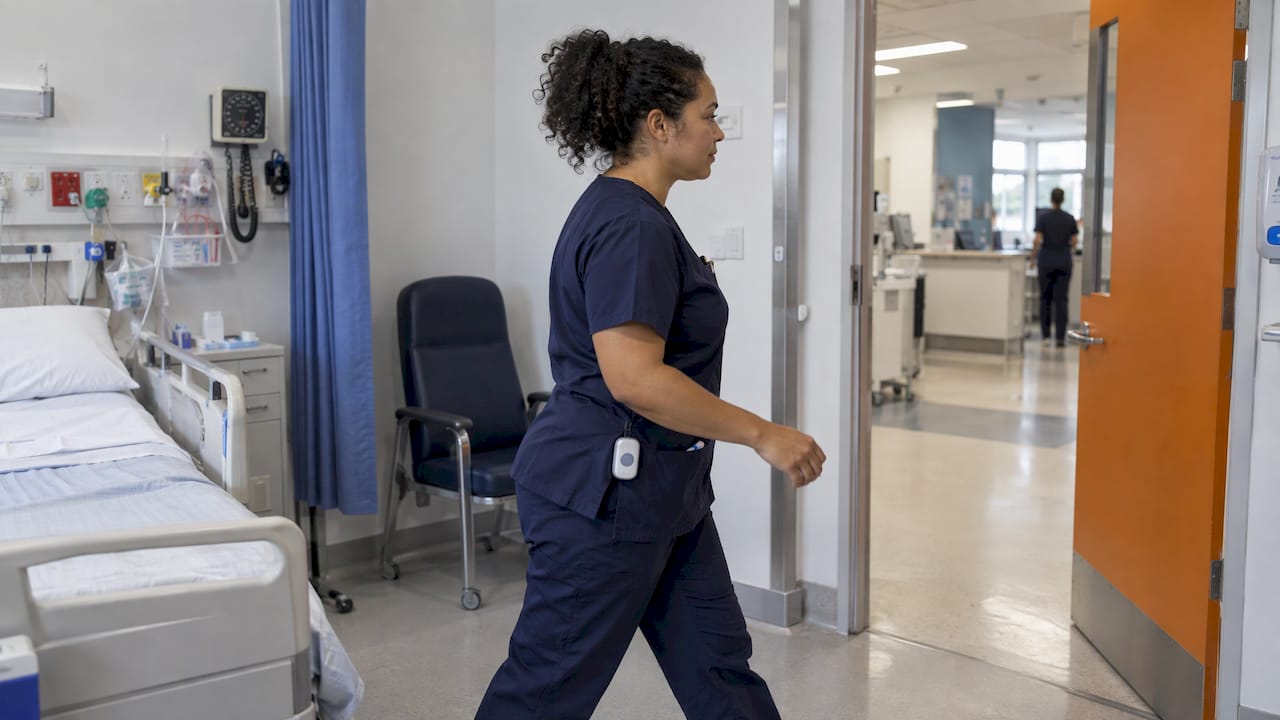
A nurse duress alarm is only as good as the response behind it. The device lets a nurse call for help without escalating a threat. The system around it, which covers the right alarm for each work area, staff who know where it is, regular testing and trained responders, decides whether help arrives in time. For healthcare facilities, the safest approach is to treat the alarm as one control in a wider security plan, and to build that plan around a risk assessment of the actual wards, clinics and community settings where your staff work. That is how we approach healthcare security at ABCO: licensed professionals, 24/7 monitoring and technology working together rather than a button on a wall.
TL;DR
- A duress alarm silently alerts designated responders when a worker faces violence or aggression. Alarms are either fixed in place (static) or carried or worn (portable).
- WorkSafe Victoria’s 2025 guidance says the alarm should match where staff work and the risk of aggression there, and that it should be tested every shift.
- Under the model WHS laws, an alarm is one possible control within a broader duty to eliminate or minimise risk so far as reasonably practicable.
- Alarms fail when responders are untrained, staff don’t know where the buttons are, or the network drops out. Plan the response and the connectivity before you buy.
- Price depends on integration, coverage and maintenance, so scope the site before asking for figures.
Table of Contents
- What a nurse duress alarm does
- Static, portable and mobile: matching the alarm to the work
- What your legal duties actually say
- How to choose and set up a nurse duress system
- What does a nurse duress alarm system cost?
- Our perspective
- Putting protection around your alarms
- FAQ
- Sources
What a nurse duress alarm does
A duress alarm lets a worker summon help in an emergency, most often a threat, violence or aggression. WorkSafe Victoria warns that if a worker cannot activate an alarm quickly, the response can be delayed, physical and psychological harm can increase, aggression can escalate, and patients and bystanders face greater risk.
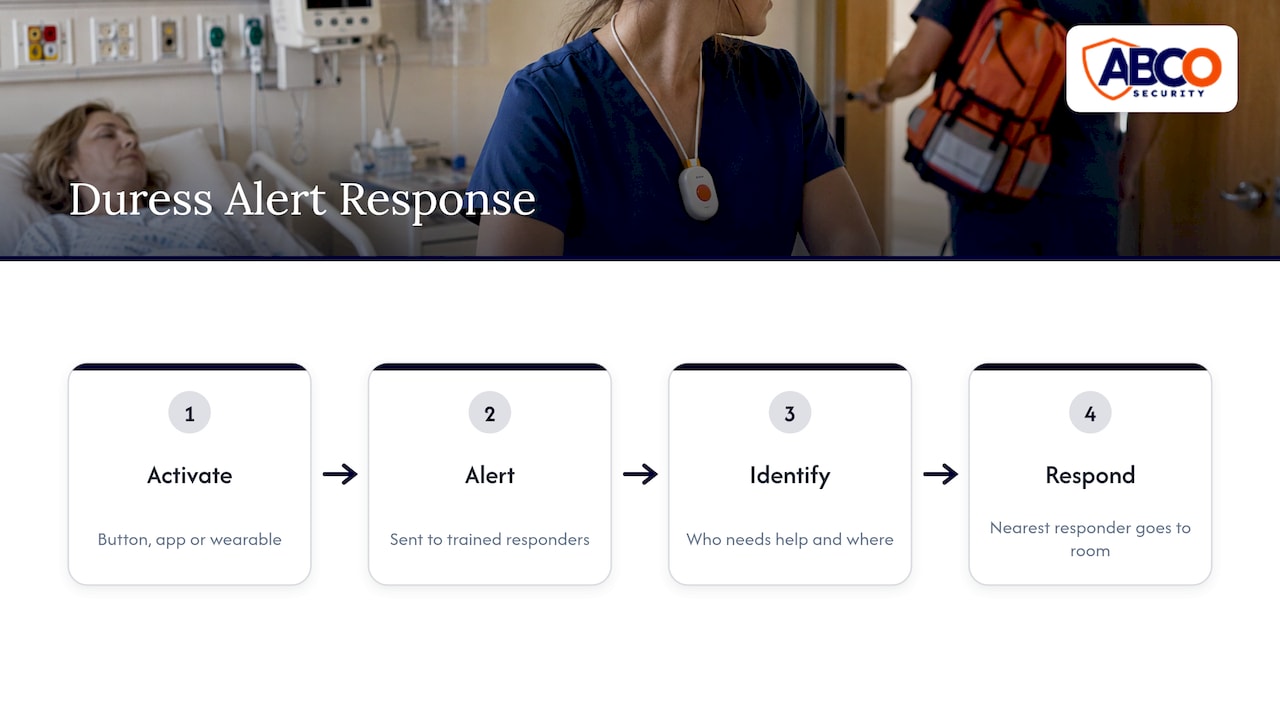
The design goal is usually a quiet signal. A 2024 duress system policy from a community health provider describes the system as a way to signal for help in dangerous situations such as violence or aggression, with a silent alert sent to designated responders so the threat is not escalated. The nurse presses a button, taps an app or activates a wearable. The signal goes to people who have been named and trained to respond, and the best systems tell them who is in trouble and where.
That last part matters more than it first appears. An alert that says only “help needed somewhere on level three” costs responders minutes. An alert that carries location and identity lets the nearest responder go straight to the right room.
Static, portable and mobile: matching the alarm to the work
WorkSafe Victoria’s guidance, updated on 1 July 2025, separates duress alarms into two groups: static alarms fixed in place, and portable alarms that are carried or worn. Which suits you depends on where staff work and how much they move.
Static alarms
Fixed buttons suit places where staff are in one spot for long periods and where the risk is predictable: triage and reception desks, consultation rooms, medication rooms, interview rooms and treatment bays. They are always where you expect them, they need no charging, and a new starter can be shown them in a minute.
Their weakness is obvious. A nurse who is mid-corridor, in a patient’s room or at the far end of a bed has to reach the button, and that is exactly the delay the regulator warns about. That is why static alarms work best as part of a layered setup rather than the only line of defence.
Portable alarms
Staff who move around a ward, between rooms or across a campus are better served by a device they carry. The same WorkSafe Victoria guidance says portable alarms may suit staff moving around a ward and advises that they should not be worn around the neck. A lanyard is a strangulation risk in a physical confrontation, so clip-on, wrist or belt options are the sensible default. Whatever you choose, the nurse should be able to reach it with one hand, under stress, without looking.
Mobile staff in aged care and health settings also depend on dependable site communications, so it helps to look at telecoms for care homes and health when you plan how carried devices will be supported.
Phone and app-based alerting
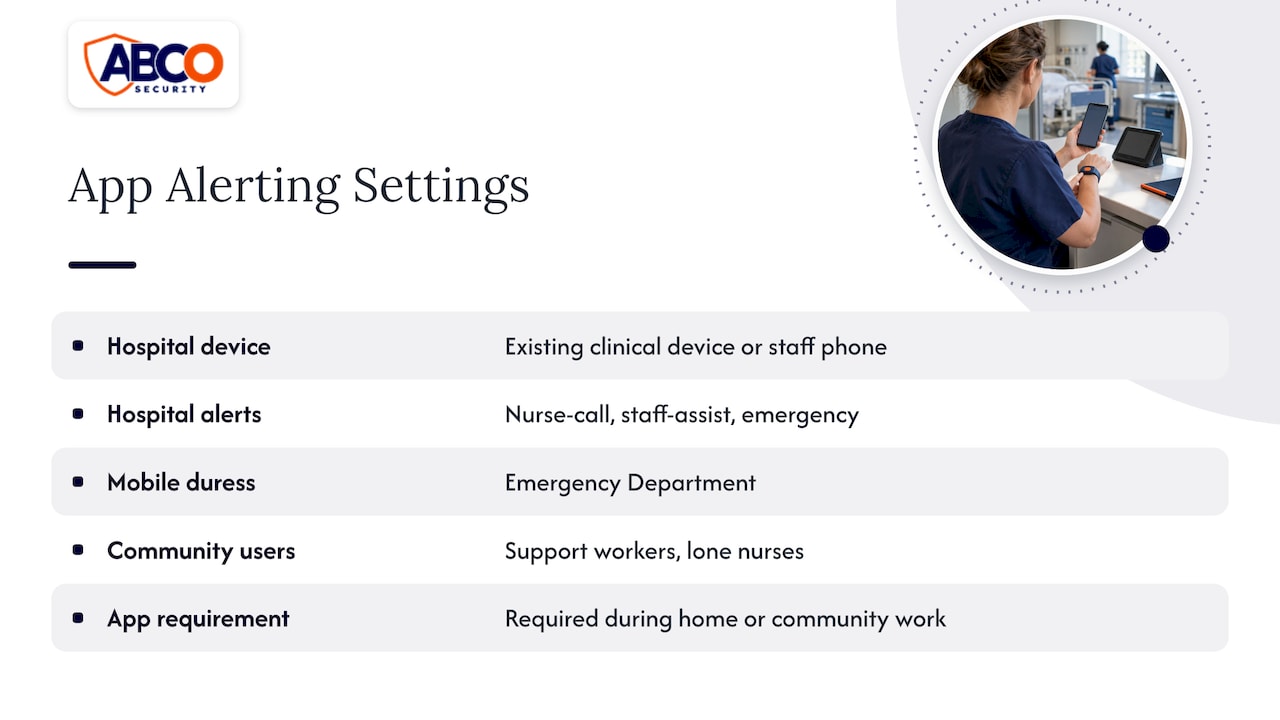
Some facilities use the clinical communication device or phone staff already carry. A 2025 NSW Health policy for the Sydney Children’s Hospital Network describes a mobile device that receives nurse-call, staff-assist, emergency and mobile-duress events through an application, with mobile duress described for its Emergency Department. Community providers use the same idea for staff working alone: the 2024 policy mentioned above applies to community support workers and registered nurses working alone, requires them to use a duress app during work in clients’ homes or the community, and calls for risk assessment, training and a trained response team.
App-based alerting is convenient, but it brings dependencies a wall button does not have, covered below.
A quick comparison
| Type | Best for | Main strength | What to plan for |
|---|---|---|---|
| Static (fixed) | Reception, triage, consult and treatment rooms | Always in the same place, no charging | Out of reach when staff are away from the spot |
| Portable (carried or worn) | Wards, corridors, staff moving between rooms | Goes wherever the nurse goes | Wear it safely (not round the neck), keep it charged, assign and track devices |
| Phone or app based | Community nurses, lone workers, ED teams on mobile devices | Uses a device already carried, can add location | Depends on network coverage and staff logging in each shift |
If you are weighing a fixed button against a wider alerting system, our guide on duress alarm versus panic button sets out the difference, and our overview of duress alarm systems for Australian workplaces covers the system as a whole.
What your legal duties actually say
No Australian law tells you to install a specific brand or type of nurse alarm. What it does is set a general duty. The model Work Health and Safety Act places a duty on a person conducting a business or undertaking (PCBU, the legal term for most employers) to protect workers and others from risks arising from work, so far as reasonably practicable, including through safe systems, information, training and supervision.
The same Act explains how to approach risk. Risks must be eliminated so far as reasonably practicable, or otherwise minimised, taking into account the likelihood of harm, how serious it could be, what you know about it, the controls available and their cost. In practice, that makes an alarm one control among several. Safer layouts, staffing, security presence, access control and aggression-management training sit alongside it. An alarm does not replace them.
Two cautions keep this accurate for your state:
- The model Act only has effect when a state or territory adopts it. Safe Work Australia states that model amendments do not automatically become local law.
- The same page reports that a December 2025 amendment to the model Act expanded incident-notification duties to include extended worker absences, violent incidents and work-related suicide or attempted suicide. Check your own regulator to see whether and when that applies in your jurisdiction.
For Victorian hospitals and other healthcare settings, WorkSafe Victoria has gone further and issued a safety alert on duress alarms. If you operate elsewhere, it is still a useful benchmark of what a regulator expects to see. Your own state’s WHS regulator and your legal adviser can confirm the exact obligations for your facility.
How to choose and set up a nurse duress system
Here is the sequence we recommend, drawing on the WorkSafe Victoria guidance, with the points where facilities most often go wrong.
1. Assess the work and the risk first
WorkSafe Victoria advises that alarm selection should take account of where work is done and the risk of aggression or violence there. Walk each area: the emergency department waiting room, mental health units, aged care wings, pharmacy, night-shift wards, car parks and community visits all carry different risks. Look at incident history and near misses, not only the floor plan.
Where it goes wrong: buying one product for the whole site because it is simpler to procure. A formal healthcare security risk assessment maps what each area needs, and it is the step that stops you over-spending in low-risk areas and under-protecting the high-risk ones. Our security risk assessments are part of what we deliver for healthcare facilities.
2. Consult your staff
The same guidance advises consulting employees and health and safety representatives (HSRs, the staff elected to represent workers on safety). Nurses know which rooms feel unsafe and which corridors have blind spots. They also know whether a device will actually be worn.
Where it goes wrong: a device chosen without nurses’ input ends up in a drawer.
3. Decide who responds, and how
The alert has to land with someone who will act. The community provider policy cited earlier makes the point clearly: lone-worker protection depends on defined response procedures, trained responders and use of the alerting tool, not merely providing an app.
Decide in writing who receives the alert, in what order, what they do on arrival, when police are called and what happens if the first responder does not acknowledge. Our guide to physical security incident response walks through building that sequence, and our piece on what a healthcare security policy must cover shows where duress response fits in the wider policy.
This is where having licensed security personnel and round-the-clock monitoring matters. We provide licensed static guards, mobile patrols and 24/7 monitoring, so a signal can be met by people trained for exactly this situation.
4. Check the infrastructure behind the alarm
If alerts travel over Wi-Fi, the alarm is only as reliable as the network. The 2025 NSW Health policy warns that loss of Wi-Fi connection disables functions such as receiving nurse calls and using duress, and that the device gives a tone and visual warning when disconnected. Staff need to know what that warning means and what to do the moment they hear it.
Map coverage in stairwells, lifts, basements, plant rooms and outdoor areas, and decide what the backup is when the network is down.
5. Orient and train every shift
WorkSafe Victoria’s guidance calls for orienting staff and covering alarm locations at handover, labelling buttons clearly, and providing training and drills. Agency, casual and new staff are the gap: they are the least likely to know where the nearest alarm is.
Devices tied to individuals add another routine. The NSW Children’s Health policy requires staff to log into devices at the start of each shift and complete staff and patient allocations, because an alert that is routed to the wrong person or the wrong ward is a failed alert.
6. Test, audit and review
The regulator’s advice is to test each shift, audit buttons and review near misses or failures. A button that was tested last year is not a tested button. Keep a simple log of who tested what and when, and treat every failed test or missed alert as a reportable near miss that leads to a fix.
What does a nurse duress alarm system cost?
There is no honest single price, because the cost is driven by scope. The main factors are:
- the number of areas and staff covered, and how many static points versus portable devices you need;
- whether alerts show location and identity, which depends on the coverage system behind them;
- integration with nurse call, building management and other messaging;
- who monitors and responds, and when (business hours or 24/7);
- ongoing maintenance, testing and replacement of batteries and devices.
As an example of how integration shapes a project, a Northern Territory Government tender record for Alice Springs Hospital describes a system that integrates personal duress alerts with nurse-call systems, building management and other messaging sources, and records a 36-month maintenance renewal. Maintenance is part of the cost from day one, not an afterthought.
The practical route to a firm figure is to complete the risk assessment first, then price the response and monitoring alongside the hardware. That avoids paying for devices that nobody is positioned to answer.
Our perspective
We see nurse duress alarms as the visible end of a security system, not the system itself. The button gets the attention in procurement, but what protects the nurse is everything the alert triggers: someone who is trained and close enough to respond, a clear plan for what happens next, and a facility that has reduced the chance of the situation arising at all.
That is why the model WHS framework treats an alarm as one control within a broader duty to eliminate or minimise risk. A facility that pairs duress alerting with access control, CCTV, licensed guards and a risk assessment is in a stronger position than one that relies on devices alone.
It is also why we work the way we do. ABCO brings together licensed professionals, 24/7 monitoring and technology, and holds ISO 9001 and ISO 30000 quality and risk management standards across more than 15 years in the industry. We aim to anticipate threats, not only react to them, and for a hospital, clinic or aged care facility, that means starting with the risk assessment and building the response around the people who work there.
Abco
Putting protection around your alarms
If you are planning or reviewing duress alerting at a healthcare facility, we can help you cover the layers around it. Our A1 CCTV and alarm monitoring service provides installation and 24/7 monitoring of CCTV and alarm systems, our electronic security solutions include access control, and our security guarding puts licensed guards on site.
For the full picture of what we offer healthcare sites, see our healthcare security systems page, or contact us through our website to discuss your facility.
FAQ
How does a duress alarm work?
When a worker activates it, by pressing a fixed button, a wearable or an app, it sends an alert to designated responders. Many systems are designed to be silent so the threat is not escalated, as described in the 2024 duress system policy. Better systems also show who raised the alarm and where, so responders can go directly to the right place.
Why would staff use a duress alarm?
They use it to get help fast when they face violence, threats or aggression. WorkSafe Victoria notes that being unable to activate an alarm quickly can delay the response and raise the risk of harm to staff, patients and bystanders. Staff are most likely to use an alarm they know the location of, trust to work and have practised with.
Should a nurse wear a duress alarm around the neck?
No. WorkSafe Victoria’s guidance advises that portable alarms should not be worn around the neck. A clip, belt or wrist option is a safer choice, and it should be reachable with one hand without looking.
How often should duress alarms be tested?
The same WorkSafe Victoria guidance advises testing each shift, auditing buttons and reviewing near misses and failures. Keep a log so you can show the testing happened and what you fixed afterwards.
Is a duress alarm legally required in Australian hospitals?
The model WHS Act does not name a particular alarm. It requires PCBUs to eliminate or minimise risks so far as reasonably practicable and to provide safe systems, information and training. For healthcare, regulators such as WorkSafe Victoria expect appropriate alarms where the risk calls for them. Confirm the rules for your state with your regulator.
Sources
- Duress alarms in healthcare, WorkSafe Victoria
- Duress System Policy, My Flex Health (2024)
- Nurse Call Responder System and Clinical Communication, NSW Health (2025)
- Work Health and Safety Act 2011, compilation of 15 December 2023
- Work Health and Safety Act 2011, compilation of 18 October 2023
- Model Work Health and Safety Act, Safe Work Australia
- Quotations and Tenders Online, Northern Territory Government
- Telecoms for care homes and health
Recommended
about
avada factory
Sempery ultricies nibh at dolor cras urna eleifend nec. Atiam efficitur tempor.