A licensed static security guard in Australia typically costs a business $40 to $60 an hour on a weekday day shift, and more at night, on weekends and on public holidays. The real budget question is not the hourly rate. It is how many hours you need covered, when they fall, and what the guard actually has to do. This guide gives you the 2026 ranges, explains why they sit well above the award wage, and shows how to turn them into a monthly figure for a construction site, clinic, office, event or shop.
TL;DR
- Expect roughly $40 to $60 an hour for a static guard on a weekday day shift, $55 to $75 at night or on weekends, and $80 to $120 on a public holiday (market guide, November 2026).
- The award wage a guard is paid (from $28.42 an hour at Level 1) is only part of the price. Super, workcover, payroll tax, licensing, supervision and insurance sit on top.
- Shift timing, site risk, duties and contract length move the price more than the suburb does.
- To budget, multiply the hourly rate by the hours you need each week, then check whether a mobile patrol or monitored electronic security covers part of those hours for less.
Table of Contents
- What security guards cost per hour in Australia in 2026
- Cost by type of security service
- Why the price is higher than the guard’s wage
- What moves the price of your quote
- How to turn an hourly rate into a monthly budget
- Our view: pay for coverage that fits the risk
- Getting a price from ABCO Security
- FAQ
- Sources
What security guards cost per hour in Australia in 2026
Published market guides for 2026 do not agree to the dollar, which is normal: rates depend on the client, the site and the contract. They do agree on the shape. One national guide dated November 2026 puts a static guard at $40 to $60 an hour on a weekday day shift, typically around $45. Night and weekend shifts rise to $55 to $75, and public holidays reach $80 to $120.
The same guide quotes whole shifts, which is how many businesses buy:
| Shift | Typical price |
|---|---|
| 8-hour weekday static shift | $280 to $480 |
| 10-hour overnight site shift | $500 to $750 |
Treat these as ranges to test your quotes against, not as a price list. Most commercial quotes are also stated before GST, so confirm whether a figure is ex-GST or inc-GST before you compare two of them.
Cost by type of security service
The service you need changes the price more than any other factor. The same November 2026 guide gives these national ranges (source):
| Service | Typical range |
|---|---|
| Event security guard | $45 to $70 per guard per hour |
| Licensed crowd controller | $55 to $85 per hour |
| Construction site guard | $45 to $70 per hour |
| Concierge or front-desk officer | $40 to $65 per hour |
| Mobile patrol | $30 to $60 per site visit |
| Nightly patrol contract, one site | $400 to $1,200 per month |
A few readings of that table:
- Construction sites sit at the upper end because the hours are mostly nights, weekends and public holidays, and the risk is theft of plant, copper and materials. Our page on construction site security services covers what a site manager should have in place.
- Healthcare and corporate sites often need concierge or reception officers whose duties include access, visitor management and incident response, not just standing a post.
- Events are priced per guard per hour, usually with a minimum shift length, and crowd controllers cost more because of the licence class and the responsibility. If you are planning one, see our guide to professional event security.
- Retail loss prevention is typically a day-time static or floor presence, with a patrol or monitored system covering after hours.
Why the price is higher than the guard’s wage
It surprises many first-time buyers that a guard billed at $45 an hour is paid far less. The gap is not profit alone. It is the cost of employing a licensed person legally.
The Security Services Industry Award 2020 sets national minimum wages. From the first full pay period on or after 1 July 2026, the Fair Work Ombudsman’s award page lists a Level 1 security officer at $28.42 an hour (weekly $1,080.10), Level 2 at $29.24, Level 3 at $29.73, Level 4 at $30.23 and Level 5 at $31.20. The 2026 Annual Wage Review lifted award minimums by 4.75%, effective from that same date.
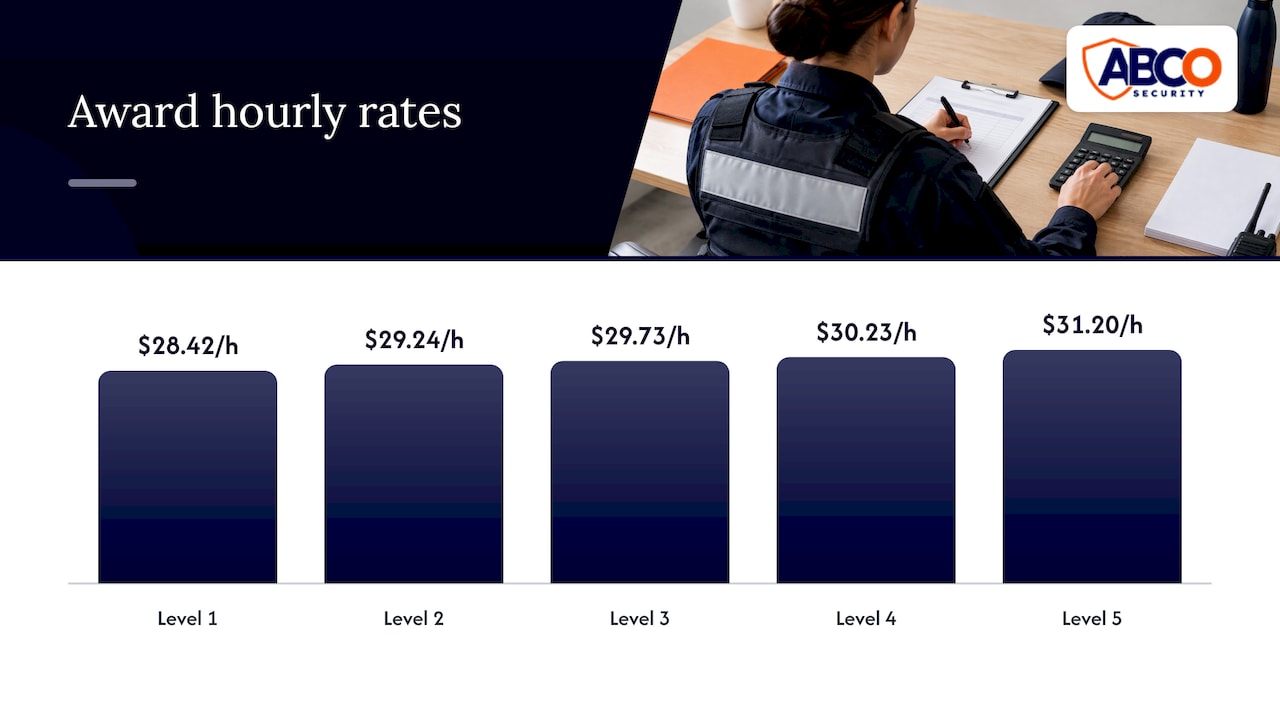
Penalty rates then apply to the base rate: 150% on Saturdays, 200% on Sundays and 250% on public holidays, and a 25% casual loading, which takes the Level 1 casual weekday rate to $35.53. That is why a night or Sunday hour costs so much more than a Tuesday morning hour.
On top of wages, the provider carries superannuation, workers compensation, payroll tax, licensing, insurance, uniforms, supervision, rostering and replacement cover when a guard is sick. Licensing is state-based: in NSW, for example, guards hold a Class 1 licence and the company holds a Master Licence, and Victoria licenses both businesses and individuals under the Private Security Act 2004. If you want to know what a properly licensed guard looks like, read what to check on licensed security guards.
The industry is also growing and getting more regulated. The Security 2030 report, as reported by SEN.news, estimates industry revenue at A$11.22 billion in 2025, and licensed personnel rising from 170,698 to over 200,000 by 2030. The same report argues that margins are too thin to sustain what customers and regulators expect. For a buyer, the practical message is that very low quotes deserve a close look at what has been left out.
What moves the price of your quote
Shift timing
This is the biggest lever. A guard on Monday to Friday day hours is the cheapest you can buy. Nights, weekends and public holidays attract penalty rates that flow straight into the hourly price. If your risk is only after hours, you are buying at the expensive end of the table, which is why it is worth looking at whether a guard is needed for every one of those hours.
Duties and risk level
A guard who watches a gate is priced differently from one who controls access, manages visitors, does patrol rounds with checkpoints, writes incident reports and responds to alarms. A hospital emergency entrance, a late-trading shop or a licensed venue carries more risk and needs more experienced people than a quiet office foyer. Higher award levels and added training cost more.
Location
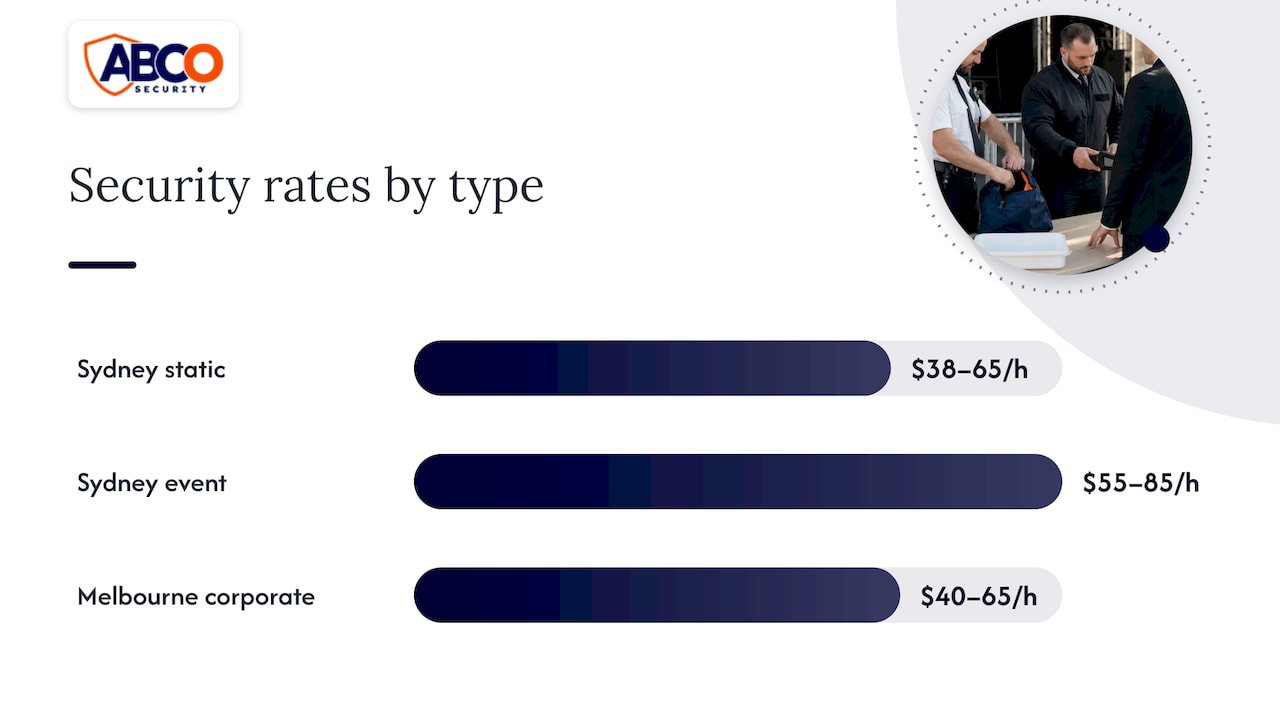
Capital cities usually cost more than regional areas, and remote sites cost more again because of travel and cover. City guides for 2026 show wide bands: one Sydney guide lists static guards at $38 to $65 an hour and event security at $55 to $85, while a Melbourne guide lists corporate security at $40 to $65 plus GST. Within a city, the suburb matters much less than the shift.
Contract length and minimum shifts
Ongoing agreements generally price better than one-off bookings, and short ad hoc jobs often carry minimum shift lengths. A 12-month commitment gives a provider certainty on rostering, which is one reason longer plans exist.
Technology
Cameras, alarms and remote monitoring can replace some guard hours. They do not replace a guard where a person must physically control an area, but they change how many hours you need to buy.
How to turn an hourly rate into a monthly budget
The method is simple: hours per week, times weeks per month (about 4.33), times the hourly rate for those hours.
Example: a construction site needing overnight cover on weekdays. Suppose you need a guard for 12 hours overnight, Monday to Friday. That is 60 hours a week, or about 260 hours a month. At the $55 to $75 night rates quoted above, that is roughly $14,300 to $19,500 a month, before GST. This is an illustration of the arithmetic, not a quote.
Example: a retail store trading late. If you need one guard for four peak hours a day, seven days a week, you are buying 28 hours a week, about 121 hours a month. Weekend hours cost more than weekday hours, so price Saturday and Sunday separately and add them to the weekday total rather than using one average.
Then ask four questions before you sign:
- Are the quoted rates ex-GST or inc-GST?
- Are penalty rates, public holidays and minimum shift lengths in the rate, or charged extra?
- Is replacement cover for sick or late guards included?
- Which of the hours genuinely need a person on the spot, and which could be covered by a patrol or monitored cameras?
The last question is where most savings are found. A mobile patrol suits sites that need regular checks rather than constant presence. Our guide to choosing between a mobile patrol and a guard after hours walks through the decision, and the pricing pages for CCTV monitoring and alarm monitoring show what the electronic layer costs.
Our view: pay for coverage that fits the risk
We have been in security for over 15 years, and the most common budgeting mistake we see in the question “what does a guard cost?” is that it starts from the hourly rate rather than from the threat.
A construction manager worried about theft of materials on weekends, a healthcare administrator protecting patients and staff at a 24-hour entrance, and a retailer losing stock at closing time all need different things. Our approach is proactive: we assess the risk first, then combine licensed guards, mobile patrols, CCTV and alarm monitoring and access control so you are not paying for presence where technology is enough, or relying on technology where a person is needed.
We work to ISO 9001 and ISO 30000 standards and run 24/7 operations nationwide, so the cover you buy is designed to be accountable, not just visible. A good security spend reduces incidents. A cheap one only fills a roster.
Abco
Getting a price from ABCO Security
We provide licensed static guards, mobile patrols, CCTV and alarm monitoring, access control, concierge and reception security, crowd control and security risk assessments for construction, healthcare, corporate, retail and event clients across Australia. For businesses that need after-hours cover, our Night Owl service starts from $5.45 per day, with 12-month and 24-month plans available.
For guarding, patrols and electronic security, pricing depends on your site, hours and risk, so we scope it with you. Start with our security guarding service or contact us through our website and tell us the site type, the hours you need and your biggest concern.
FAQ
How much does it cost to hire a security guard in Australia?
Market guides for 2026 put a static guard at about $40 to $60 an hour on a weekday day shift, rising to $55 to $75 on nights and weekends. Public holidays can reach $80 to $120. Your quote depends on the site, duties and contract length.
What does a security guard cost per month?
It depends on hours. A nightly patrol contract on one site is quoted at $400 to $1,200 a month in a 2026 national guide, while a guard posted for 60 hours a week at night rates can run into the tens of thousands. Multiply hours per week by 4.33 and by the hourly rate to estimate.
Why are security guards charged at more than the award wage?
The award minimum is from $28.42 an hour at Level 1 from 1 July 2026, but the provider also pays super, workers compensation, payroll tax, licensing, insurance and supervision. Penalty rates of 150% to 250% apply on weekends and public holidays.
Is a mobile patrol cheaper than a guard?
For sites that need checks rather than constant presence, usually yes. Patrols are typically priced per visit, and national guides quote about $30 to $60 a visit. A guard remains the right choice where someone must control access or respond on the spot.
Sources
- Security Guards Cost Australia 2026
- Security Services Industry Award 2020 (MA000016), Fair Work Ombudsman
- Security Services Industry Award (MA000016) 2026 pay guide
- Security 2030 report coverage, SEN.news
Recommended
about
avada factory
Sempery ultricies nibh at dolor cras urna eleifend nec. Atiam efficitur tempor.