A fail safe lock unlocks when power is lost. A fail secure lock stays locked when power is lost. Neither is better in general: the right one depends on what the door protects and who has to get through it in an emergency. Fire exits and stairwells lean fail safe, because people must get out. Server rooms, drug stores and cash offices lean fail secure, because a blackout is when theft is easiest. Most buildings need both, and the choice is best made door by door, as part of a security risk assessment that we can run alongside your access control design.
TL;DR
- Fail safe means the door unlocks when power is removed. Power is what keeps it locked. Magnetic locks (maglocks) normally work this way.
- Fail secure means the door stays locked when power is removed. Power is what unlocks it. Electric strikes normally work this way.
- In Australia, exit doors must never trap people. The National Construction Code (NCC) lets a building use fail safe devices tied to the fire alarm so that exits open immediately in an emergency.
- Choose per door: life safety wins wherever the two goals conflict, and fail secure suits doors where the priority is protecting people, drugs, data or stock.
- Backup batteries, fire alarm links and a tested release sequence matter as much as the lock type.
Table of Contents
- What the two terms actually mean
- The access side and the exit side are different questions
- What Australian rules say about exits and release
- Choosing by door: a practical guide by site type
- Power failure: where most designs quietly go wrong
- A five-step way to decide for each door
- Common mistakes to avoid
- Put the decision into a working system
- FAQ
- Sources
What the two terms actually mean
The names confuse almost everyone. “Safe” here refers to the safety of people. “Secure” refers to the security of the opening. A fail safe lock is built to fail in the state that is safest for the people inside, which is open. A fail secure lock is built to fail in the state that best protects the space, which is closed.
In hardware terms you will also hear fail open (fail safe) and fail closed (fail secure). It helps to think about what power does:
| Fail safe | Fail secure | |
|---|---|---|
| Power on | Door locked | Door unlocked only when a credential is accepted |
| Power lost | Door unlocks | Door stays locked |
| Power’s job | Power to lock | Power to unlock |
| Typical hardware | Magnetic lock | Electric strike, electric latch retraction |
| Energy use | Draws power continuously while locked | Draws power only while unlocking |
| Best for | Stairwells, exit routes, doors needing re-entry | Server rooms, stores, plant rooms, high-value areas |
The energy point is documented by the US National Institutes of Health in a technical bulletin on electronic locksets. It notes that fail secure items typically use less power because they only need power to unlock, while fail safe products need continual power. That matters for backup battery sizing, which we return to below.
The access side and the exit side are different questions
Most of the confusion disappears once you separate the two sides of a door.
The access side is where someone arrives and needs a card, code or intercom to enter. Fail safe or fail secure decides whether that side is open or locked when power fails.
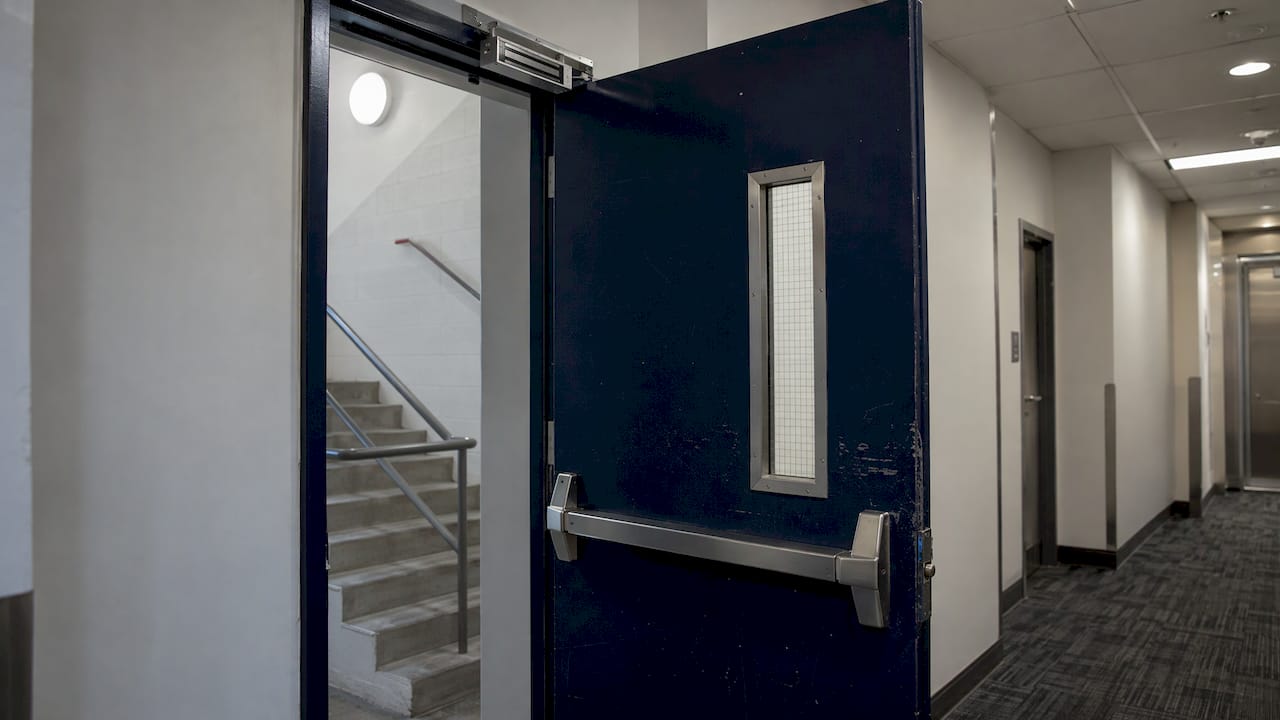
The exit side is where someone leaves. In a correctly designed opening, a person leaving should be able to operate a handle, push bar or release without a key, whether or not the power is on.
This is why a fail secure door is not automatically a trap. A fail secure electric strike or electric latch controls entry only. The person inside still turns the lever or pushes the bar and the latch retracts mechanically. The problem appears with locking devices that hold the door shut against the person leaving. A maglock does exactly that while powered, which is why it must release when power drops or the fire alarm activates, and why it is paired with a request-to-exit device and an emergency release.
So the practical question for each door is: if the power fails or the fire alarm goes off right now, who must be able to do what?
- Someone inside must always be able to get out.
- Someone outside should or should not be able to get in, depending on what is behind the door.
- If a fire alarm triggers, which doors must release, and which must hold?
What Australian rules say about exits and release
Australian requirements are written around one principle: occupants must not be impeded or trapped. The NCC performance requirements for doors state that doors must avoid the risk of occupants having their egress impeded or being trapped, and that exits must let people evacuate safely. Every lock decision on your site sits under that rule.
The Australian Building Codes Board (ABCB), which writes the NCC, gives more specific guidance on two situations that matter to access control.
Latches and automatic release
The ABCB’s guide to NCC clause D3D26 on the operation of latches describes an exemption for buildings fitted with automatic fail safe devices that are activated by another active system, such as the fire alarm. The authority must be satisfied that the device is genuinely fail safe, including during a power failure, and that in an emergency access to exits is enabled immediately, with effectively no time delay. In other words, a card reader and a maglock are not enough on their own: the release has to be reliable, instant and linked.
Re-entry from fire-isolated stairs
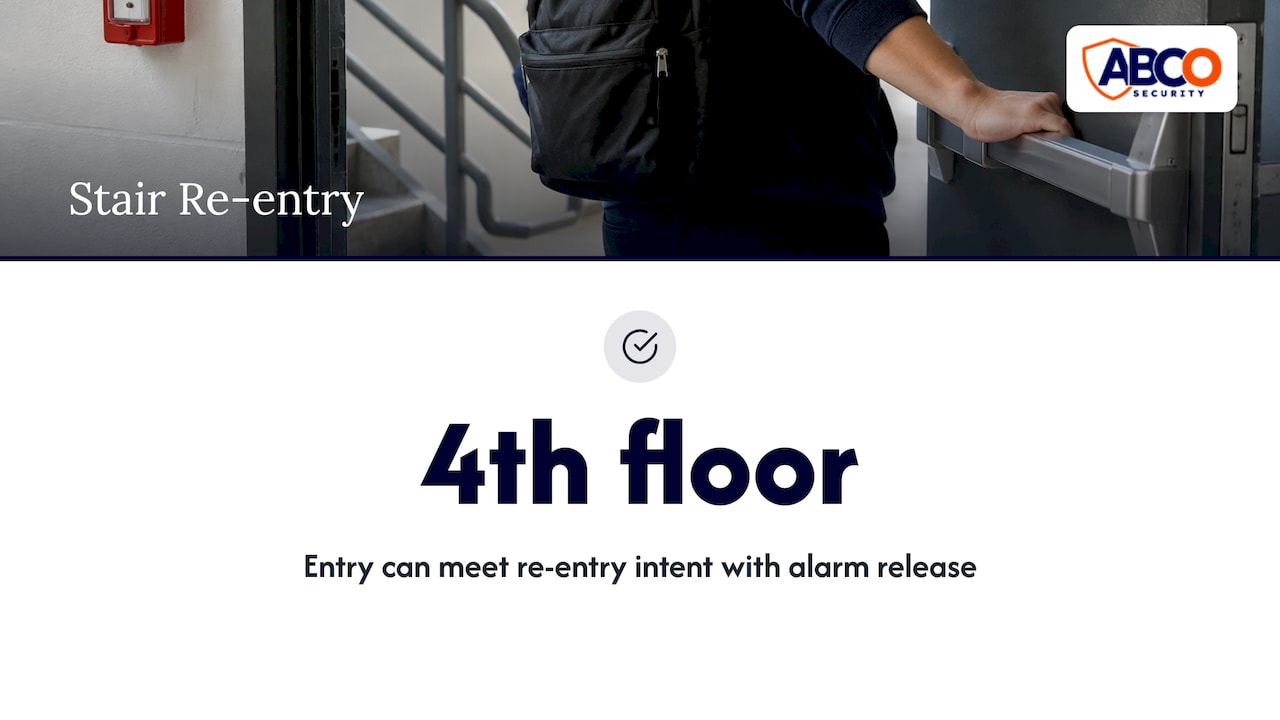
Fire-isolated exits are the protected stairwells people use to leave a building in a fire. Leaving the stair at every floor is easy, but allowing re-entry at every floor can be a security problem. The ABCB’s guide to D3D27 on re-entry from fire-isolated exits explains that entry at every fourth floor can meet the intent without significantly interfering with security, provided all doors can be opened by a fail safe device activated by the fire alarm. The same fail safe fire-alarm release applies where an intercom is used instead. For a corporate tower, this is the clause that explains why stair doors that stay locked from the stair side on a normal day still open when the alarm sounds.
Healthcare adds its own layer
Health facilities have to balance patient safety, wandering risk and infection control as well as fire. The 2025 Health Facility Design Guidance for doors says doors in horizontal egress paths must permit free egress in fire mode, that secured doors may need fail safe electric locking that releases in a fire, that hold-open electromagnetic devices must be fire-tripped so they release and close, and that automatic sliding doors must be linked to the fire system to open in fire mode. If you run a ward, a secure unit or a pharmacy, these are the points your design brief should reflect.
Standards are updated
The fire alarm interface that releases access-controlled doors is governed by the AS 1670 series. NCC 2025 Volume Two references the 2024 editions of AS 1670 Parts 1, 3 and 4 for fire detection, warning, control and intercom systems. Your fire services contractor and building certifier confirm which edition and clauses apply to your building class. For a closer look at how door hardware affects ratings, see our guide on door hardware for access control in Australia.
For wider reading on how fire-rated doors and their hardware are checked, this overview of fire-rated door hardware rules shows why release hardware is part of the inspection, not an afterthought.
Choosing by door: a practical guide by site type
There is no single answer for a site, only an answer for each opening. The table below shows how the choice typically falls. Treat it as a starting point for a conversation with your certifier and security provider, not a specification.
| Door | Usual priority | Typical lean |
|---|---|---|
| Fire-isolated stair, re-entry floors | Release on alarm, otherwise controlled | Fail safe, linked to fire alarm |
| Main lobby or entry doors | Free exit, controlled entry | Fail secure strike or latch, with free mechanical exit; or fail safe where the design requires release |
| Server or comms room | Protect equipment and data | Fail secure |
| Pharmacy, drug store, records | Prevent unauthorised entry in a blackout | Fail secure, with egress always free |
| Retail stockroom and back-of-house | Theft prevention, staff exit | Fail secure with free exit |
| Construction site office, site gates | Stop theft of plant and materials | Fail secure, battery-backed |
| Event gates and back-stage areas | Crowd flow and controlled zones | Release on emergency, controlled otherwise |
Construction sites
Sites are open, changing and often temporary. Power may come from generators or temporary supply, which makes outages more likely. Stores, site offices and compounds holding tools, copper and plant usually want fail secure operation with a battery backup, so that a tripped breaker does not leave the gate or container open overnight. Access control is only one layer here: it works best alongside guarding, patrols and monitored cameras. Our construction site security services combine these layers for builders and project managers.
Healthcare facilities
Patient safety cuts both ways. A secure dementia unit or paediatric ward must stay secure, but a fire must never leave patients behind a locked door. Drug rooms and records stay fail secure with free exit. Doors on escape routes release in fire mode, as the health facility guidance above describes. The release has to be tested as a sequence: alarm, power cut to the lock, door free.
Corporate offices
Offices tend to have a mix: fail safe on stair re-entry doors, fail secure on server rooms and executive floors, and free egress everywhere. The key detail is the link between the fire alarm panel and the access control controller, so a fire alarm releases the doors that must open and leaves the rest alone.
Retail
Shopfront doors have to open for customers and staff during trading and stay locked after hours. Back-of-house doors protect stock and cash. Fail secure with a clear exit path is the common arrangement for stockrooms. A power cut at closing time is exactly when a fail safe back door would let someone in, which is why this choice has direct theft-prevention value.
Events
Temporary venues add crowd density to the equation. Gates and barriers need to release or open quickly in an emergency, and back-stage and cash areas need to hold. Plan the release points and stewards’ positions before the day, not on it.
Power failure: where most designs quietly go wrong
A lock type only describes what happens when power disappears. It says nothing about how long power lasts or how reliably the rest of the system behaves.
Battery backup. A fail safe lock draws power the whole time it is locked, so a battery that is too small simply drains and releases the door. An access control specification published by the Australian National University requires automatic door controllers to have battery backup for a minimum of 8 hours in a mains power failure, with the battery keeping doors locked and secure unless there is a fire alarm. That is a useful benchmark for sizing: decide how long you need the site to hold, then size the batteries to it.
Fire alarm interface. The same specification requires access-controlled fire exit doors to connect the fire system and the card system so that fire trip requirements are met. The principle is that egress takes priority over security only when fire is detected. A simple power outage should not open every door in the building, and a fire should not leave any exit locked.
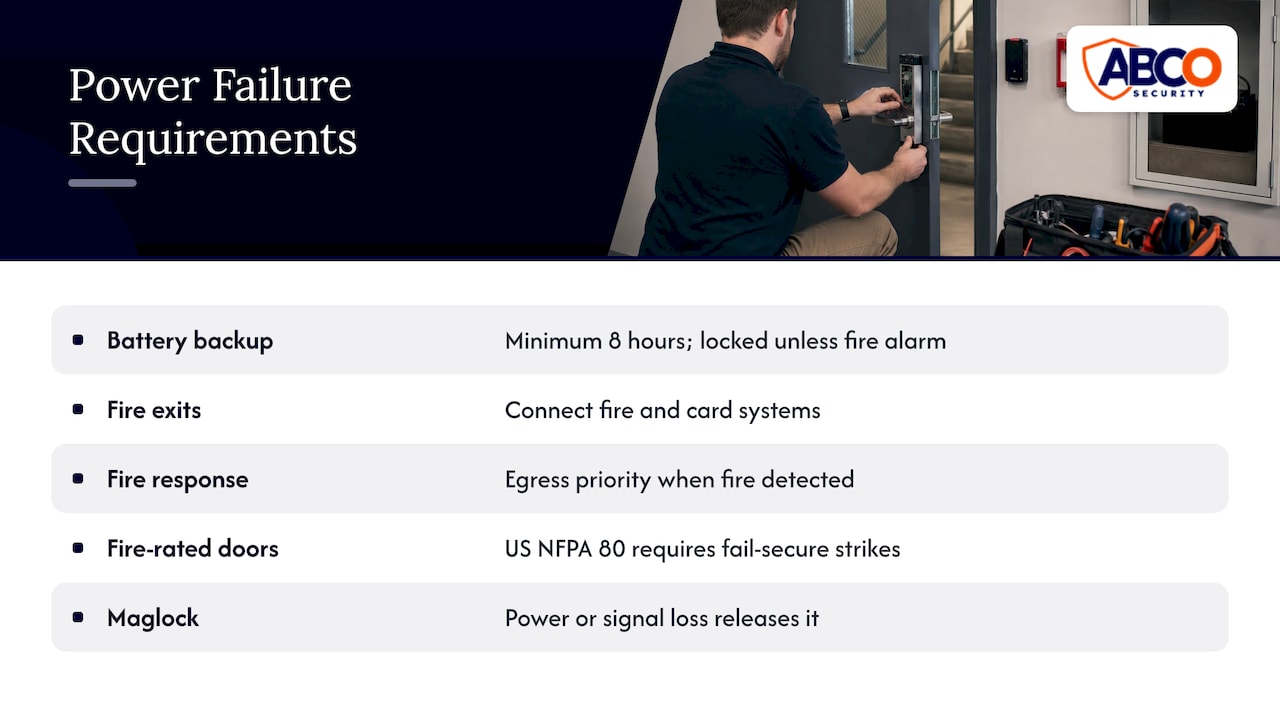
Fire-rated doors. The NIH bulletin notes that fail secure strikes must be used on fire-rated doors under the US standard NFPA 80. That is a US rule, not an Australian one, but it illustrates a general point: hardware fitted to a fire-rated door must not compromise the door’s rating. In Australia, check the hardware against the door’s fire test evidence and your certifier’s advice before anything is cut into a door. Our article on protecting fire ratings with access control hardware covers this in more detail.
Wiring logic. Fail safe and fail secure hardware are wired differently: a maglock sits on the normally closed relay contact so that losing power or the signal releases it, while an electric strike is wired so a momentary closure unlocks it. A wrong connection can turn a fail safe door into one that stays locked in a failure. Our guide on how to wire an access control system explains the principle.
A five-step way to decide for each door
- List every controlled door. Include stairs, loading docks, gates, plant rooms and any door a card reader touches.
- Write down what is behind each one. People, patients, drugs, cash, stock, data, plant, or nothing of value.
- Mark the escape routes. Any door on a path of travel in a fire must allow free exit and, where fire-isolated stairs are involved, follow the re-entry rules.
- Decide the failure you can live with. If power fails at 2 am, is the greater harm someone trapped, or someone walking in? Where life safety conflicts with security, life safety wins.
- Specify the release and the backup. Name the fire alarm link, the battery duration, the manual override and who tests it, and how often.
Then have the finished design checked by your building certifier and fire services contractor. The decision is not complete until the release has been tested end to end: trigger the alarm, cut the power, and walk the doors.
If you are comparing systems more broadly, our guide to the best access control systems for Australian businesses and the piece on access control versus keys help frame the options. For emergency scenarios where you need to lock down rather than release, see designing and testing access control lockdowns.
For a sense of how fire engineers think about releasing doors and clear access in large buildings, this explainer on fire department access doors in warehouses is a good companion.
Common mistakes to avoid
- Treating fail secure as a fire exit risk by default. The exit side is still free when the opening is designed correctly. The risk comes from locking devices that hold the door shut against people leaving.
- Using one setting building-wide. Different doors have different jobs, and a single approach leaves some of them wrong.
- Undersized batteries. A fail safe door releases the moment the battery runs flat.
- No test of the fire alarm link. The link is where the code requirement is met or missed.
- Forgetting the monitoring. A door that fails open in an outage is a security event. Someone should know about it straight away, which is where alarm and camera monitoring comes in.
Our view: the lock is one layer, not the plan
We design security around the question of what happens when something goes wrong, because that is when a site is tested. A fail safe or fail secure decision is a good example. The lock type is a single setting. What protects people and property is the system around it: a risk assessment that tells you which doors matter most, electronic security that links access control to the fire alarm, and 24/7 monitoring that tells someone the moment a door does not behave as designed.
That is why our approach is proactive rather than reactive. We combine licensed professionals with technology, and we work to ISO 9001 and ISO 30000 standards. With more than 15 years in the industry, we have worked across construction, healthcare, corporate, events and retail, and each of those sites answers the fail safe versus fail secure question differently.
Our advice is to decide door by door, put life safety first on every escape route, and keep valuable areas locked through a blackout, then back that with monitoring and patrols so a power failure is never an unattended one.
Abco
Put the decision into a working system
Choosing the right lock is the start. Making it work through a power cut, a fire alarm and a 2 am break-in attempt takes the full system. We provide electronic security solutions and access control, security risk assessments, CCTV and alarm monitoring around the clock, licensed guards and mobile patrols for construction sites, healthcare facilities, corporate offices, events and retail across Australia. For sites that want an overnight presence, our Night Owl service starts from $5.45 per day.

To talk through the doors on your site, start at abcosecurity.com.au.
FAQ
Is fail safe or fail secure better?
Neither is better in every case. Fail safe suits doors where people must be able to leave or move freely when power fails or the fire alarm sounds. Fail secure suits doors protecting people, drugs, data or stock where a blackout must not open the door. Most sites use both.
Is a fail secure door a fire safety problem?
Not when it is designed correctly. A fail secure electric strike or latch controls entry, while people inside can still leave by operating the handle or push bar. Anything that holds a door shut against someone leaving must release on power loss or fire alarm, as the ABCB guidance on D3D26 describes.
Do maglocks have to be fail safe?
A maglock is fail safe by nature, because it holds the door shut only while powered. Because it can impede exit, it needs to release on a fire alarm and power loss, with a reliable emergency release. Confirm the arrangement with your building certifier.
What happens to access control doors during a power outage?
It depends on the hardware and the battery. Fail safe doors release when power or the battery is gone, and fail secure doors stay locked. Many Australian specifications require battery backup, for example a minimum of 8 hours in one university specification, with doors staying secure unless the fire alarm activates.
Who decides which doors are fail safe?
The choice comes from the security risk assessment, the fire safety design and your building certifier. Your security provider and fire services contractor then implement and test it, including the link between the fire alarm and access control.
Sources
- NCC D3D26 Operation of latch, ABCB
- NCC D3D27 Re-entry from fire-isolated exits, ABCB
- Design Guidance: Doors, Health Facility Guidelines 2025
- NCC 2015 Performance Requirements Extract, ABCB
- NCC 2025 Volume Two, ABCB
- Security, CCTV and Access Control specification, Australian National University
- Fail Safe vs. Fail Secure Electronic Locksets, NIH Office of Research Facilities
- Fire rated door rules and hardware checks
- When does a warehouse need fire department access doors
Recommended
about
avada factory
Sempery ultricies nibh at dolor cras urna eleifend nec. Atiam efficitur tempor.