A physical penetration test is an authorised attempt to break into your site the way a real intruder would: by following staff through doors, posing as a contractor, or finding the gate that never gets locked. It shows whether your guards, cameras, access control and procedures work together, not whether each one exists on paper. For a site manager, the value is in what you do with the result: tightening the layers of security that failed. That is where a security provider with licensed guards, patrols, monitoring and access control earns its place.
This guide is written for construction managers, healthcare administrators, corporate facility managers, event organisers and retail owners. It explains what a test involves, what must be agreed before anyone tries a door, and how to turn findings into a stronger site.
TL;DR
- A physical penetration test simulates a real break-in on your premises, using techniques such as impersonating an employee or entering restricted areas, to see whether people, procedures and equipment stop it.
- It is different from a cyber test and from an audit: it attempts to defeat your controls rather than tick them off a checklist.
- Nothing starts without written authorisation from someone entitled to give it, and a signed scope that says what is in, what is out and who can stop the test.
- The usual weak points are human: tailgating, weak visitor checks and unlocked rooms. Guards, patrols, monitored cameras and tighter access control are how you fix them.
- Most sites do not need a test every year. Trigger points such as a fit-out, a new access system or a change to guard routines are better reasons.
Table of Contents
- What physical penetration testing is
- What a test looks at on your site
- How an authorised test runs
- Authorisation and boundaries: the part you cannot skip
- What tests typically find
- What this means for your type of site
- Turning findings into a stronger site
- How often to test
- Where ABCO fits
- Our perspective
- FAQ
- Sources
What physical penetration testing is
The ISACA white paper on physical penetration testing describes it as simulating a physical attack on premises such as a building, data centre or server room. Testers might impersonate an employee, enter restricted areas without permission or take assets. ISACA, the international body for IT governance professionals, points to social engineering (talking or bluffing your way past people) as what sets this kind of test apart from other penetration testing.
That last point matters if you have heard the term mostly from IT. A cyber penetration test probes networks and software. A physical test probes doors, fences, locks, cameras, reception desks and the people who work around them. Searches for “red team physical security” usually mean the same thing at a more demanding level: a realistic, goal-driven attempt, such as reaching a particular room, rather than a general walk-through.
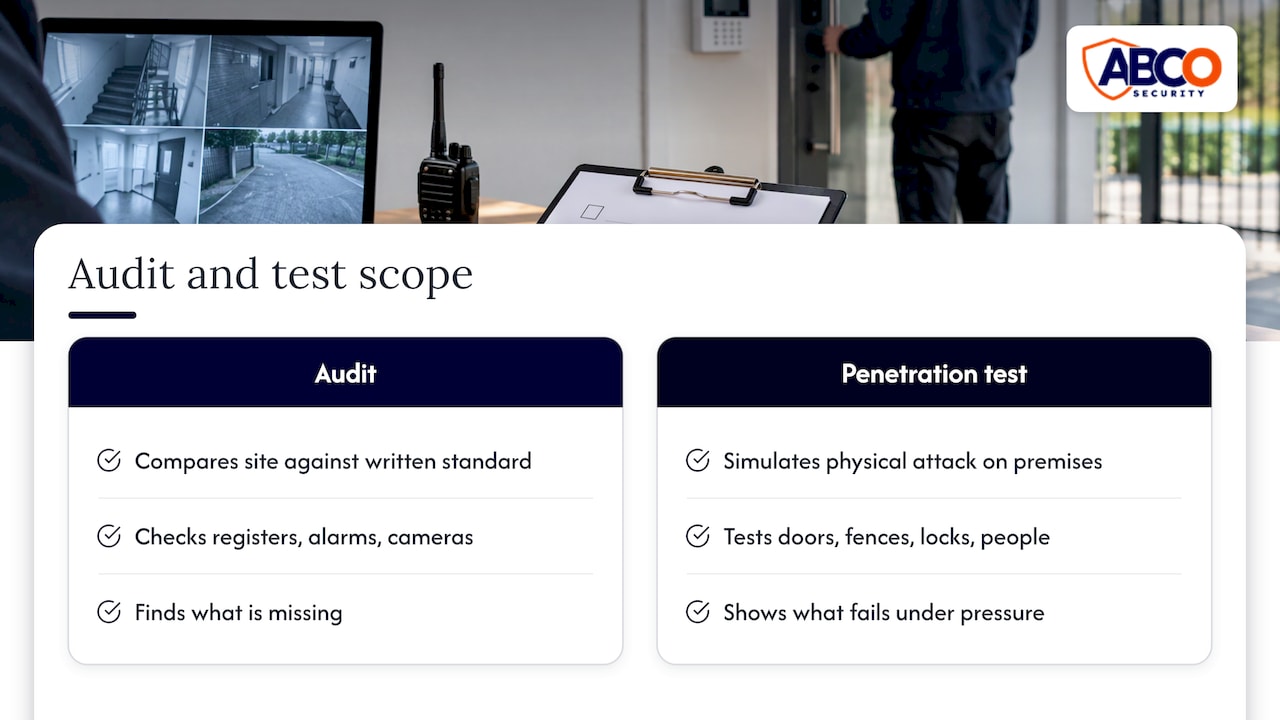
It is also not an audit. An audit compares your site against a written standard: is there a visitor register, is the alarm installed, are cameras covering the entrance. A penetration test asks a harder question: if someone really tried, would any of it stop them? Both are useful. The audit finds what is missing, and the test shows what fails under pressure.
What a test looks at on your site
Scope is agreed in advance, but a typical test touches the same layers you already pay for:
- Perimeter: fences, gates, hoardings, loading docks and the points where a person or vehicle could simply walk in.
- Entry points and after-hours access: doors that are propped open, keys and codes that are shared, side entrances used by smokers or delivery drivers.
- Access control and credentials: whether cards, fobs or PINs can be borrowed, copied or bypassed, and whether lost credentials are cancelled promptly.
- Visitors and contractors: whether someone in a hi-vis vest with a clipboard is challenged, signed in and escorted.
- Surveillance: whether cameras actually cover the approach routes, and whether anyone watches the footage or responds to an alarm in real time.
- Response: how quickly a guard, patrol or monitoring operator notices, escalates and acts.
- Internal zones: whether a stranger who gets past the front desk can reach stock rooms, comms rooms, medication stores or cash offices.
The last two are where most sites learn the most. Many organisations have decent hardware, but nobody is tasked with noticing when it is being tested.
There is growing recognition of this gap. A session at the Australian Cyber Conference 2024 in Melbourne noted that while organisations focus on red and purple team exercises for ICT assets, physical security assessments are equally critical yet frequently overlooked.
How an authorised test runs
Providers structure their work differently, but a sound engagement follows a recognisable sequence.
- Written authorisation and rules of engagement. Nothing happens until a person with authority over the site signs off. This is the step most often rushed, and it protects everyone.
- Pre-test review. The tester studies your site layout, public information, staff presence online and existing controls. Much of a real attacker’s preparation happens before they set foot on site.
- Scenario planning. Realistic scenarios are chosen with an end goal, such as reaching a specific room, photographing a document or placing a harmless marker.
- On-site testing. Testers attempt entry under the agreed rules, often over several days to see staff patterns, shift changes and delivery times.
- Observation of detection and response. Did anyone notice? How long did it take? Who was told? This step usually produces the most useful findings.
- Reporting. A good report records what was accessed, how, with photos or timestamps, and how staff reacted.
- Recommendations and debrief. Fixes are prioritised, and the site team is walked through what happened.
- Re-test. Significant findings are tested again once fixed, to confirm the fix works.
If you are the site manager, your own work happens either side of these steps. Before the test, you need to know what your controls are meant to do. After it, you need people who can change them quickly. We cover both below.
Authorisation and boundaries: the part you cannot skip
A test that looks like a break-in is, without paperwork, a break-in. In Australia, written authorisation from a person entitled to give it is what makes the tester entitled to access under section 476.2 of the Criminal Code, according to a legal analysis of penetration testing agreements. The same source says a signed scope schedule should identify:
- which sites are in scope and which are out;
- dates, times and blackout periods;
- techniques that are excluded;
- whether impersonation and targeting of individuals are allowed;
- who can confirm the engagement at any hour;
- who has the power to halt the test.
ISACA makes the same point from the professional side: rules of engagement set the agreed parameters, objectives, allowed techniques and tools and off-limits areas, and written authorisation ensures the test is lawful, ethical and carried out with explicit consent to access premises and assets.
Two practical points follow for managers on multi-tenant or public sites.
You may not own every door. A building owner, a head contractor, a landlord or a hospital board may need to consent as well. Establish who is entitled to authorise before you commit to a date.
Decide who knows. Usually only a handful of senior people are told. That means your guards, receptionists or security control room could challenge a tester, call police or escalate genuinely. Agree beforehand how that is handled and who can verify the tester’s letter of authority, at any hour, including nights and weekends.
On healthcare sites, add a further boundary: patient areas, medication stores and clinical spaces should be excluded or tightly controlled, so the test never interferes with care. On construction sites, agree around live works, plant and exclusion zones. At events, tests are usually done in the setup or bump-in phase rather than with crowds present.
What tests typically find
Findings tend to repeat from site to site, and few of them are exotic. Practitioners commonly report:
- Tailgating: someone walks through a card-controlled door behind an employee who holds it open out of politeness.
- Pretexting: a person posing as a courier, maintenance worker or IT technician is waved through.
- Weak visitor control: badges are not collected, or are accepted after they expire.
- Old card technology: some older proximity cards can be read and copied from close range.
- Unsecured rooms and ports: server or comms rooms left unlocked, and live network ports in meeting rooms or public areas.
- Doors that defeat themselves: exit sensors that can be triggered from the wrong side.
The pattern behind them is consistent. In one account of a test on a financial institution that had barriers, guards and cameras, the successful breach came from untrained, complacent staff rather than failed equipment. That does not make technology unimportant. It means technology needs people trained and rostered to back it up, around the clock.
What this means for your type of site
Construction sites. Perimeters change weekly, workers and subcontractors rotate, and plant and materials are valuable and portable. A test would look at gate control, induction and sign-in, out-of-hours access and how fast anyone responds to an intrusion. Our guides on construction site access control and building a construction site security plan cover the controls that matter most.
Healthcare facilities. The risks are open public access, after-hours wards, medication and records areas, and staff who are rightly focused on patients rather than on challenging strangers. The test question is whether a person can reach restricted areas without being stopped or noticed.
Corporate offices. Reception, lift lobbies, shared tenancies and meeting rooms are the usual targets. Tailgating through card-controlled doors and unattended network ports are common findings.
Event venues. Accreditation, back-of-house access, vendor loading and crowd-control points are the pressure areas. Staff are often temporary, which makes pretexting easier.
Retailers. Stockrooms, loading docks, staff entrances and cash offices matter more than the shopfront. Theft is often enabled by routine gaps, such as a back door propped open during deliveries.
Turning findings into a stronger site
A report only has value if the fixes happen. Most fixes sit in four areas, and each is something a security provider delivers day to day.
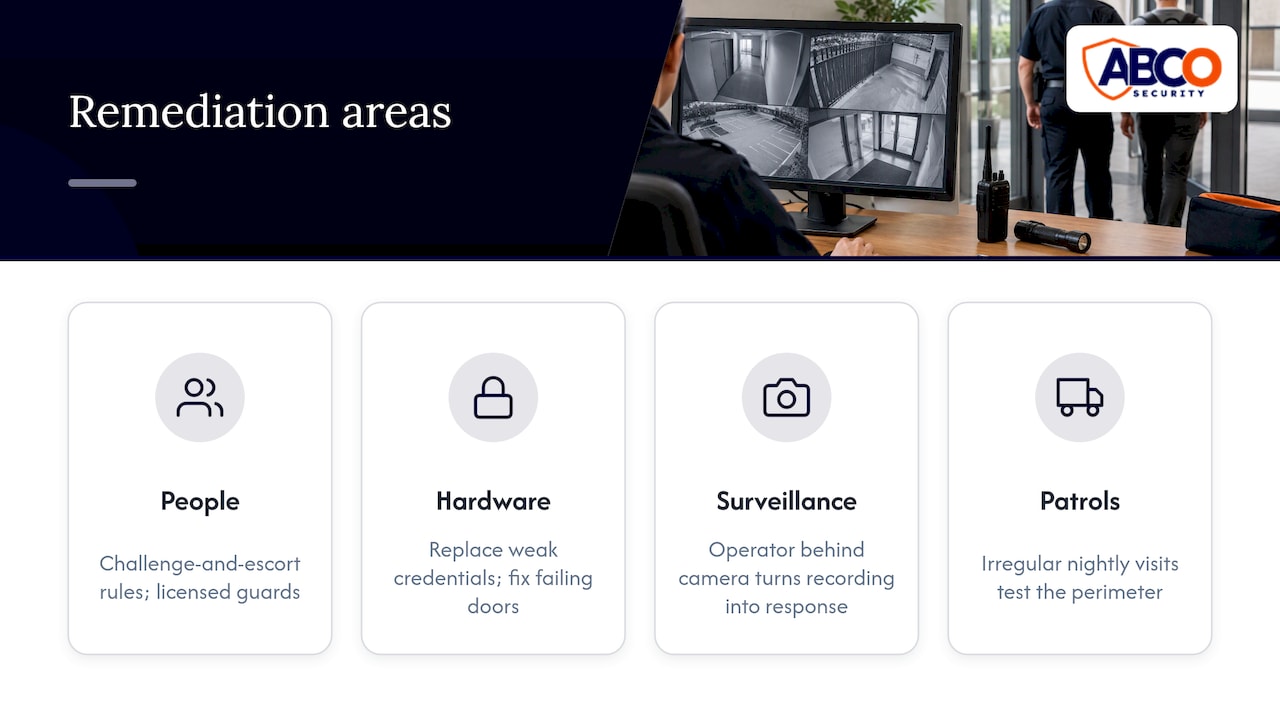
Procedures and people. Challenge-and-escort rules, visitor sign-in, and staff who feel authorised to ask “Can I help you?” Trained, licensed guards on reception and entry points make this a daily habit rather than a policy document. Our access control policies guide shows how to write rules people will follow.
Access control hardware. Replacing weak credentials, zoning the site so one breach does not open everything, and fixing doors that fail. See our overview of the best access control systems and the electronic security solutions we install and support.
Surveillance that someone watches. A camera that records an intrusion is evidence. A camera with an operator behind it is a response. That is the difference between CCTV and alarm monitoring and passive recording.
Patrols and presence. Irregular visits by mobile patrols test your perimeter every night, much as a tester would, and give you a record of what they found.
If you are not ready for a full test, or want a clearer picture first, a structured review of your own site is a sensible starting point. Our security risk assessment checklist, vulnerability assessment guide and security gap analysis walk through the same layers a tester looks at, so the obvious gaps are closed before anyone tries to exploit them.
How often to test
There is no single rule. Standards such as PCI DSS and ISO/IEC 27001 do not set a universal fixed schedule for physical penetration tests, and leave scope and frequency to be set by facility risk, change and the obligations that apply to you. Think in triggers rather than calendar dates:
- an office move or major fit-out;
- replacing the access control system or credentials;
- changing guard, visitor or contractor procedures;
- storing sensitive data, stock or assets on site that raise the stakes;
- a break-in, near miss or repeated theft.
Between tests, regular reviews, patrol reports and monitoring logs show whether your controls still behave as designed. Our physical security best practices give a routine for that.
Where ABCO fits
Whatever a test reveals, the fixes are ongoing security work: people on site, systems watched around the clock and controls maintained over time. ABCO Security provides licensed static guards, mobile patrols, CCTV and alarm installation and monitoring, access control, concierge and reception security, crowd control and security risk assessments for construction, healthcare, corporate, event and retail sites across Australia. Our operations run 24/7 nationwide, and we work to ISO 9001 and ISO 30000 standards with more than 15 years in the industry.
For sites that need overnight cover, our Night Owl Service is listed from $5.45 per day. For a site-specific conversation about guarding, patrols or monitoring, start at the ABCO Security home page.

Our perspective
Most break-ins we hear about at the planning stage do not rely on clever tricks. They rely on a door nobody checked, a visitor nobody challenged or a camera nobody was watching.
That is why we treat security as layers that work together: licensed guards who know the site, patrols that vary their routes, monitored CCTV and alarms, and access control zoned so one failure does not expose everything. A penetration test is a way of proving those layers hold. Our job is to build and run them so they do.
We start with a security risk assessment, because the best time to find a gap is before someone else does. Then we put the right mix of people and technology in place for the site, whether it is a construction compound, a ward, an office tower, an event or a shopfront.
Abco
FAQ
Is physical penetration testing legal?
Yes, when it is authorised in writing by a person entitled to give consent, with an agreed scope. Without that authorisation, the same actions can be criminal offences. A signed scope should name who can verify the engagement and who can stop it.
What is the difference between a physical penetration test and a security audit?
An audit checks your site against a documented standard. A penetration test tries to defeat your controls, using methods such as tailgating or posing as a contractor. Audits show what is missing, and tests show what fails under realistic pressure.
Will staff know a test is happening?
Usually only a small group is told, so staff behaviour reflects real life. You should agree beforehand who can confirm the test to guards, police or monitoring operators if someone raises the alarm. Testers carry a letter of authority for exactly this reason.
Do we need a test every year?
Not necessarily. Frequency should follow risk and change: a move, renovation, new access system or revised guard procedures are stronger triggers than the calendar. Regular reviews and patrol and monitoring reports cover the time in between.
Sources
- ISACA: Physical Penetration Testing white paper (2023)
- Penetration Testing Agreement Adelaide: Scope and Liability
- Australian Cyber Conference 2024: How safe is safe?
- When security gets physical
- What is Physical Penetration Testing?
Recommended
about
avada factory
Sempery ultricies nibh at dolor cras urna eleifend nec. Atiam efficitur tempor.