Starting a career in Australia's security sector is a rewarding move, and it all begins with getting your security licence. This is your foundational ticket to entry.
The process involves three key steps: confirming your eligibility, completing nationally recognised training, and submitting an application to the regulatory body in your state or territory.
Your Path to Becoming a Licensed Security Professional
Embarking on a career as a security professional in Australia means entering a stable and respected industry. Before you can start, you need that all-important security licence.
This guide provides a clear, practical roadmap from start to finish. We’ll break down the major milestones so you know exactly what’s required to succeed.
We will cover the essentials like age requirements, background checks, and the specific training you must undertake. Our goal is to simplify the process, setting you up for a successful career with a trusted Security Company Melbourne or wherever you are based.
Why a Security Licence is Non-Negotiable
A security licence isn’t just a piece of plastic; it’s a legal requirement proving you are vetted and trained to protect people, property, and information.
Holding a valid licence shows your commitment to public safety and professional standards. It tells potential employers you understand the responsibility that comes with roles in access control, patrols, and managing risk.
Without this qualification, you cannot legally work in roles from static guarding at a construction site to crowd control at a major event. The industry is built on trust, and the licensing system upholds it.
A security licence is the bedrock of a trustworthy and effective security operation. It ensures every officer on site has met stringent background checks and completed accredited training, which is fundamental to client peace of mind.
Core Stages in the Security Licensing Process
Getting your head around the licensing process is straightforward once you understand the main stages. While details vary between states, the core steps are consistent across Australia.
Here is a summary of the core stages involved.
Quick Steps to Obtain Your Australian Security Licence
| Stage | Key Action | Primary Outcome |
|---|---|---|
| Eligibility Check | Verify age, work rights, and pass a National Police Check. | Confirmation that you meet the basic legal requirements. |
| Mandatory Training | Complete a course like Certificate II in Security Operations. | A nationally recognised training certificate. |
| Application | Submit your application with all required documents. | The official grant of your security licence. |
Let's break these down further.
- Eligibility Check: You must be at least 18 years old. You also need the legal right to work in Australia and must pass a National Police Check.
- Mandatory Training: You must successfully complete a course like the Certificate II in Security Operations from a Registered Training Organisation (RTO).
- Application Submission: With your training certificate, you submit an application to your state or territory’s licensing body with all supporting documents.
Getting these steps right is essential. Top-tier private security contractors in Australia only hire professionals who are fully licensed and compliant.
Ready to take the next step in your security career?
Book a Consultation with Abco Security
Security Licence Eligibility: Where to Start
Before looking at training courses, the first step is ensuring you qualify. These are not just bureaucratic boxes to tick; they are the bedrock of trust and integrity in Australia's security industry.
Every state and territory has these rules to ensure the people protecting our communities are suitable for the job.
The core requirements are consistent. You must be at least 18 years old and have the legal right to work in Australia. You will need proof, such as a passport or birth certificate.
The Make-or-Break Step: The National Police Check
The National Police Check (NPC) is a non-negotiable part of every security licence application. It is a thorough background check of your criminal history.
The check reveals convictions, court appearances, and pending charges. State licensing bodies—like Victoria Police's LRD or NSW's SLED—will carefully review your record.
An industry's reputation is only as strong as the people within it. That’s why rigorous background checks are not just about compliance; they are about maintaining public confidence and ensuring every licensed officer is a person of integrity.
What kind of history could get your application denied? While each case is reviewed individually, certain offences are almost always deal-breakers.
- Violent Offences: A history of assault, robbery, or any other violent crime is a major red flag.
- Dishonesty Offences: Convictions for theft, fraud, or deception undermine the trust required for the job.
- Drug-Related Offences: Serious charges for trafficking or supplying drugs will likely disqualify you.
- Weapons Offences: Illegal use or possession of firearms is a critical issue.
A minor traffic fine from five years ago is unlikely to be an issue. However, a recent or serious conviction will likely lead to rejection. Understanding these requirements is a core part of effective risk and security management strategies.
Fitness and Competency Requirements
Beyond a clean record, you also need to meet basic fitness and competency standards. You must be physically able to handle the job's demands, like standing for hours or responding to incidents.
Your communication skills are just as important. A large part of the job involves writing incident reports and de-escalating tense situations. A solid command of English is essential for safety and legal reasons.
Nailing these prerequisites shows you have the character and capability for a trusted security career.
Ready to book a service with a team of fully licensed and vetted professionals? Contact Abco Security today to discuss your security needs.
Getting the Right Security Training and Qualifications
Your path to a security guard licence begins with one non-negotiable step: completing a nationally recognised training course. Choosing the right course and a reputable Registered Training Organisation (RTO) is crucial.
For new entrants, the go-to qualification across Australia is the Certificate II in Security Operations. It prepares you for common roles like static guarding, mobile patrols, and loss prevention.
What to Expect From Your Security Course
A quality Certificate II program provides practical, hands-on training in skills you will use daily.
You can expect to cover core competencies like:
- Conflict Resolution and De-escalation: Learn techniques to professionally handle heated situations.
- Legal and Procedural Requirements: Understand your rights, responsibilities, and legal boundaries.
- First Aid and Emergency Response: Complete a first aid unit, like HLTAID011 Provide First Aid, which is a licensing must-have.
- Patrolling and Observation Skills: Learn how to conduct patrols, spot risks, and report findings clearly. For example, identifying weak spots during a late-night patrol is a critical skill.
Choosing your RTO is just as important as choosing the course itself. A great trainer doesn't just read from a slideshow; they share real-world stories and insights that prepare you for the unpredictable side of this job.
Choosing a Reputable Training Provider
Not all training providers are equal. Find an RTO whose trainers have recent, on-the-ground experience to ensure you receive relevant, practical knowledge.
When researching RTOs, ask about their trainers' industry backgrounds. A good provider will be proud of their team's real-world expertise. For context on training structures, you can even look at how other industries handle it, like an online food handling certification.
Specialised Training for Advanced Roles
While the Certificate II is your entry ticket, advanced roles require further qualifications.
If you aim for roles like armed guarding, you’ll need a Certificate III in Security Operations, which includes units on firearm handling and defensive tactics.
Likewise, control room work requires specific skills. Professional security camera monitoring opens up a different career path. Ensure your training aligns with your career goals.
Ready to take the next step with a trusted security partner?
Book a Service with Abco Security Today
Navigating the State-by-State Application Process
Once you have your training certificate, it's time to apply. Australia does not have a single national authority for security licensing. Each state and territory has its own regulatory body, rules, and fees.
This means the process for getting a security licence in Sydney is different from Melbourne. Being organised and attentive to detail will save you significant time and effort.
The infographic below maps out the training journey, which is the essential foundation for your state-specific application.
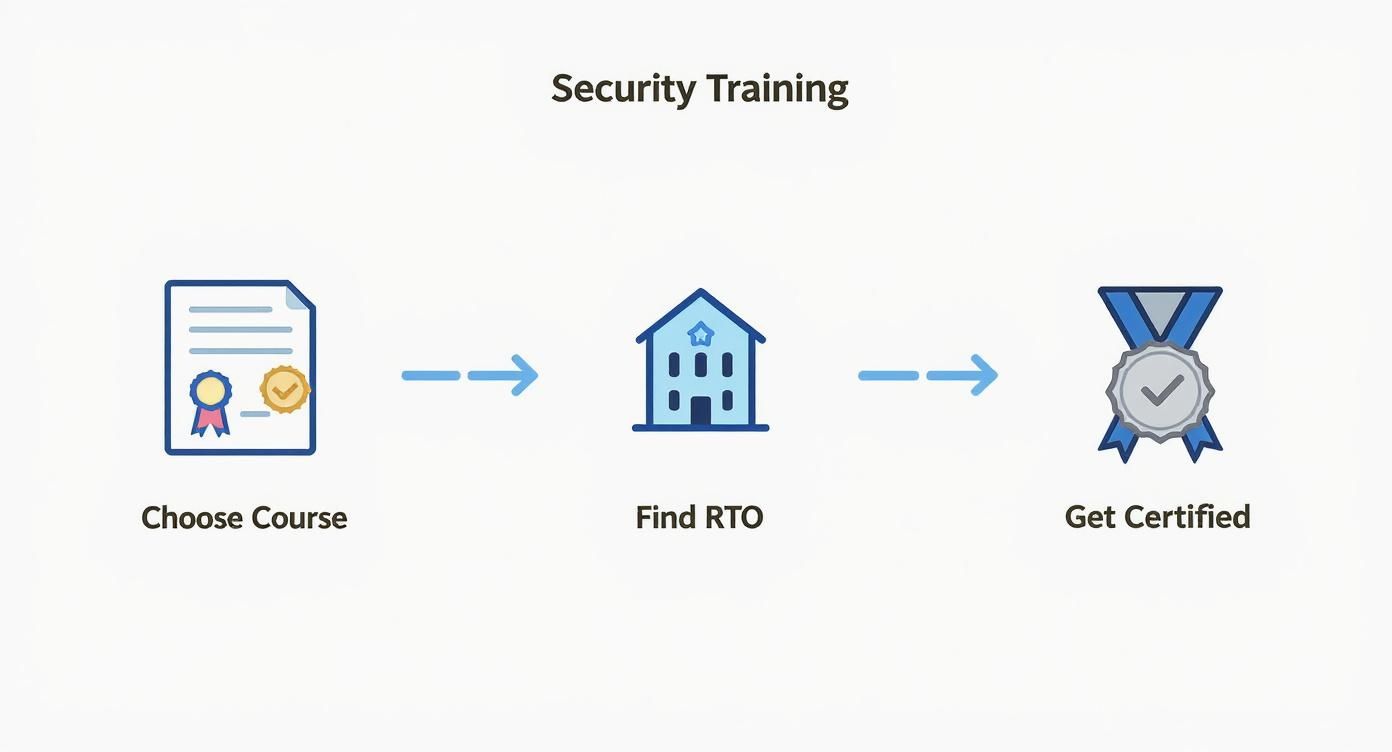
With your training complete, let’s dive into the state-specific application details.
Key Licensing Bodies Across Australia
First, you need to know who you’re dealing with. Submitting paperwork to the right government agency is the first step.
Here’s a quick rundown of the main regulators:
- New South Wales: Applications go to the Security Licensing & Enforcement Directorate (SLED), part of the NSW Police Force.
- Victoria: You'll deal with the Licensing & Regulation Division (LRD) of Victoria Police.
- Queensland: The Office of Fair Trading (OFT) manages security provider licences.
Each agency has its own online portal and forms. Always go directly to their official websites for the most up-to-date information and fee schedules.
The state-by-state licensing framework means security standards are shaped by local laws. For applicants, this means meticulously following the exact procedure for your specific state to remain compliant.
Assembling Your Application Documents
To avoid delays, get your paperwork in order before starting. Most hold-ups are due to missing documents or incorrect information.
Here’s a checklist of what you’ll likely need:
- Proof of Identity: Prepare for the 100-point check with documents like a passport and driver's licence.
- Training Qualifications: Provide a certified copy of your Certificate II in Security Operations and statement of attainment.
- First Aid Certificate: A current HLTAID011 Provide First Aid certificate is non-negotiable in most states.
- Photographs: You’ll need passport-quality photos that meet your state's specific guidelines.
A pro tip: scan every document as a high-quality PDF and save them in a dedicated folder. This makes online submission much easier.
The Submission and Vetting Process
Once your documents are ready, complete the online application form. Provide your details, disclose any criminal history, and pay the fees. Be completely honest.
After submission, your application enters the vetting stage. The authority conducts background checks, which can take four to eight weeks. Patience is key during this period.
Ready to secure your business with a team of fully licensed and compliant professionals? Book a security service with us now.
What It Really Costs to Get and Keep Your Security Licence
Budgeting for the entire licensing process is essential. It’s an investment in your career, and understanding the full financial picture prevents unexpected costs.
The main expenses are the training course, state-based application fees, and other essential checks.
The Upfront Investment: What to Expect
The largest initial cost is typically the training course, like the Certificate II in Security Operations. Prices from RTOs can range from $400 to over $1,000.
Next are the government application fees. For instance, a new three-year licence in Victoria costs around $580. Each state has its own fee structure, so check your local requirements.
Don't forget the mandatory smaller costs:
- National Police Check: This typically costs between $40 and $60.
- Fingerprinting: Some states require this, adding another $50 to $100 to your total.
In Victoria, for example, your total upfront cost could be around $1,320.
Understanding the total cost of entry is a critical step in planning your security career. It's not just a course fee; it’s an investment in your professional standing and your commitment to public safety.
Staying Licensed: The Renewal Process
Earning your licence is the first step; keeping it active is an ongoing commitment. The renewal process ensures every officer remains compliant with industry standards.
Renewal frequency depends on your state, with options for one, three, or five years. Know your expiry date and mark it on your calendar. Working on an expired licence is a serious offence.
Renewal typically involves:
- Submitting a renewal application.
- Paying a renewal fee, which is usually less than the initial fee.
- Providing a fresh National Police Check.
- Sometimes showing proof of ongoing training or CPD.
Organisations like the Australian Security Industry Association Ltd (ASIAL) are excellent resources for staying updated on industry best practices. Proactive renewal demonstrates your professionalism.
Ready to partner with a security company that values professionalism and full compliance?
Book a Service with Abco Security Today
Building Your Career with Your New Security Licence
https://www.youtube.com/embed/Gfy8Ng1-ccI
Getting your security licence is a huge first step, but what comes next is where the real opportunity begins. This qualification opens doors to a dynamic industry with diverse career paths.
Your journey will likely start with an entry-level position, where you'll build a solid foundation and prove your reliability.
Common Starting Points in the Security Industry
With your new licence, you are ready for some of the most essential roles in the security world.
You'll likely find yourself starting in one of these key areas:
- Static Guarding: Protecting a single site like a corporate office or factory. This role demands sharp observation and clear communication.
- Mobile Patrols: Driving between client sites to perform security checks and respond to alarms. This requires a proactive mindset and independence.
- Retail Loss Prevention: Preventing theft in shopping centres and retail stores, ensuring a safe environment for shoppers and staff.
These roles provide invaluable, real-world experience. For example, providing security for construction sites teaches you about asset protection in a dynamic environment.
Pathways for Career Advancement
In the security industry, hard work and professionalism pay off. With dedication, you won't stay in an entry-level role for long.
Once you have experience, you can pursue specialised roles:
- Event Security and Crowd Control: A high-energy role managing safety at concerts, festivals, and sporting events.
- Corporate Concierge: A blend of high-level security and customer service in prestigious corporate buildings.
- Supervisory or Team Leader Roles: The natural next step for proven officers, involving managing teams and overseeing site operations.
Your reputation is everything in this industry. Every single shift is a chance to show clients and colleagues they can count on you. That's what opens the door to leadership opportunities down the track.
Once you have your licence, prepare for interviews. Practising essential job interview practice questions will help you articulate your skills effectively.
At Abco Security, we seek new talent and provide clear career paths for officers committed to trust, compliance, and local expertise.
Our straightforward online booking system reflects our core values of professionalism and efficiency.
These are the qualities we look for in our team members.
Book a Service with Abco Security Today
Answering Your Questions
If you're considering getting your security licence in Australia, you probably have questions. Let’s clarify some common points about timelines, rules, and restrictions.
Licence Timelines and Work Restrictions
How long does it take to get licenced? Realistically, plan for a two to three-month process.
The Certificate II in Security Operations course typically takes one to three weeks full-time. After lodging your application, expect another four to eight weeks for processing and background checks.
You absolutely cannot work in any security role while your application is being processed. You must have your physical security licence on you from your first shift.
State-Based Rules and Criminal History
A common mistake is assuming a licence is valid Australia-wide. It is not.
Licensing is handled at the state and territory level. To work interstate, you must apply for mutual recognition.
What if you have a criminal record? This doesn't automatically disqualify you, but you must be upfront. Regulators are mainly concerned with offences related to violence, dishonesty, or drugs. Complete honesty on your application is crucial.
For more detailed answers, explore our security industry FAQs page.
Key Takeaway: Honesty and patience are your best friends here. The process is deliberately thorough to make sure only the right people are joining the industry. It's all about upholding the trust that clients place in us as security professionals.
At Abco Security, our entire team consists of fully licenced, vetted, and compliant professionals. If you want to discuss your security needs with a team that operates with integrity, book a service with us today.
about
avada factory
Sempery ultricies nibh at dolor cras urna eleifend nec. Atiam efficitur tempor.