When density surges and sentiment shifts in seconds, your margin for error disappears. At scale, crowd behavior becomes a system, not a series of individuals. This analysis goes beyond stanchions and staffing ratios. We examine advanced strategies for effective security crowd control that integrate behavioral science, spatial analytics, and command decision cycles. The goal is to minimize risk while preserving throughput and experience, even under stress. Expect a pragmatic synthesis, rooted in data and field-tested protocols, suitable for high-stakes venues and complex urban environments.
You will learn how to model crowd flow using predictive indicators, deploy sensor fusion for real-time situational awareness, and architect layered interventions that escalate proportionally. We will compare ingress and egress schemes, highlight choke point remediation, and outline communications that shape sentiment without inflaming it. We will quantify posture shifts with measurable KPIs, from density variance to time-to-stabilization. Legal and ethical constraints are addressed, including proportionality and duty of care. Finally, we translate insights into checklists, playbooks, and rehearsal drills you can operationalize immediately.
Current State and Challenges in Security Crowd Control
Security crowd control today demands licensed guards supported by 24/7 operations, data-driven planning, and integrated tech to manage record-scale gatherings without increasing risk. Traditional barriers and manual observation alone cannot keep pace with Melbourne’s surging attendances and rising crime, so operators must fuse human expertise with real-time analytics and unified platforms.
Melbourne is operating at new scale. The 2026 Australian Open drew 1.36 million across three weeks and 100,763 on day one, stretching entry and egress beyond manual capacity record Australian Open attendance. Concurrently, crime has risen, with reports citing a 24.6 percent Melbourne increase, and police noting 39.3 percent more thefts from vehicles and 42.1 percent more car thefts Victoria Police crime data. I have seen fences, queues, and radio-only comms create choke points, hide early disorder signals, and slow triage once densities exceed design limits. To stay ahead, deploy licensed guards with clear SOPs and 24/7 oversight, then layer AI-assisted video, live occupancy analytics, and unified incident management to preempt congestion and opportunistic crime. Most people overlook how unified platforms cut handoff delays and enable rapid mass-notification during surges.
Integrating Cutting-edge Technology for Enhanced Security
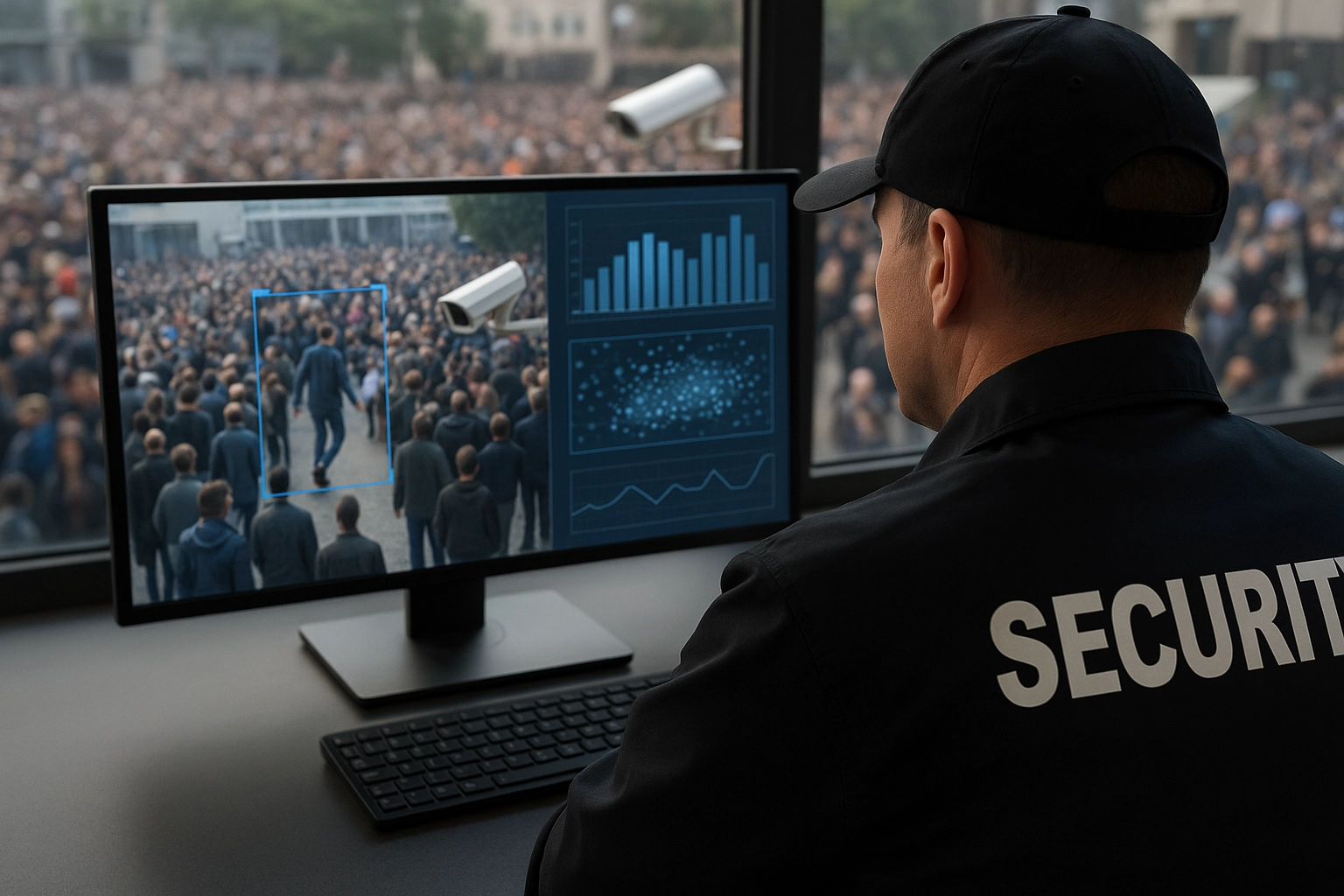
In 2026, effective security crowd control is powered by AI predictive analytics fused with live IoT telemetry. As outlined in SIA’s Technology Insights 2024, computer vision and behavior models mine video, access events, and environmental cues to flag anomalies in near real time. I have found that pairing these models with thermal people counters, BLE density sensors, and ticketing feeds, exemplified by IoT-Ticket’s Crowdsense, enables demand forecasts from minutes to 30 days, which lets teams pre open lanes, retune turnstiles, or deploy stewards before pressure escalates. Unifying CCTV, access control, and alarms into one platform then converts alerts into actions, doors auto lock, PA cues fire, and PTZs pivot to hotspots. At Melbourne venues, ABC Security Services Melbourne, via abcosecurity.com.au, coordinates this stack through a 24/7 operations hub so guards receive targeted tasks on radios and devices fast. At scale, AI cameras improve detection latency, density accuracy, and post event analytics while reducing operator load, and this mirrors findings on real-time predictive detection in cybersecurity.
| Capability | Traditional CCTV | AI camera systems |
|---|---|---|
| Detection latency | Human dependent, minutes | Sub second alerts from behavior and density models |
| Staffing ratio | 1 operator per 16 to 25 cameras | 1 operator per 64 to 100 cameras |
| Outcomes at gates | Manual throttling, inconsistent throughput | Predictive staffing, higher safe throughput per lane |
Pro Tip: Before event day, run a one hour dry run to validate model thresholds and sensor health.
Strategies for Managing Large-scale Events Effectively
Large tournaments prove what works in security crowd control. At the 2026 Australian Open, facial recognition and biometric screening sped up identity checks, but privacy pushback forced clearer consent flows and opt-outs. Opening day exposed capacity gaps with hours-long entry queues at Melbourne Park; I’ve found adaptive resourcing, extra scanners, and overflow lanes can recover throughput within a session. Layering licensed guards with an enhanced Victoria Police presence around venues builds deterrence and compresses response time for disorder or counter terrorism threats. Predictive planning matters more than posture; fuse ticketing curves, transport telemetry, and heatmaps to pre-empt choke points and trigger timed holds upstream. Use steel mesh and water-filled barriers for vehicle mitigation, angled bike-racks for soft guidance, one-way contraflow in concourses, and illuminated evacuation routes with 50 meter sightlines. Licensed guards must own zone control, radio discipline, MIMMS triage, and egress decisions. Pro Tip: run a tabletop on day one, re-tune staffing and barriers before gates open day two.
Impact of Effective Security Strategies on Businesses
Rising crime has turned security into a reputational control, and I’ve found that visible, trained personnel plus data-led controls sustain trust and spend. Customers are unforgiving, 78% stop after a breach per Curam AI, and 87% switch if they do not trust data handling per Business.com. The cost curve is steep, large Australian firms now average AUD 202,700 per cybercrime incident, a 219 percent jump year on year, according to The Queenslander, before downtime, legal exposure, and higher premiums. On the ground, weak access control and ad hoc event ops drive lost revenue and compliance risk, while disciplined security crowd control with barriers, trained stewards, and AI monitoring lowers incidents and lifts dwell time. ABC Security Services Melbourne, via abcosecurity.com.au, closes gaps with risk assessments, concierge and guardhouse teams, event and construction coverage, mobile patrols, and unified monitoring tied to KPIs like sub 4 minute response time and shrinkage reduction. Pro Tip: Set quarterly OKRs that link controls to outcomes, for example 20 percent fewer trespass incidents and 30 percent faster alarm verification, and validate with independent walk-throughs and red team tests.
Future Trends and Developments in Security Crowd Control
Predictive and real-time orchestration
Predictive analytics is shifting from static heat maps to operational forecasts that trigger action. Models that fuse mobility, weather, and incident history, including ConvLSTM approaches, now deliver block level forecasts in sub hour windows and beat legacy baselines in multi city tests. For networked offending, Graph Attention Networks for crime forecasting add lift by learning association context. In Australia, SmartNSW at Sydney Olympic Park showed how analytics improves pre event staffing and ingress staging. I have found that when these feeds drive a live dashboard, managers see occupancy heat maps and wait times, then pre position teams before bottlenecks without adding headcount.
AI protocols, evolving threats, and readiness
AI is reshaping protocols, from vision models that flag counter flow and hazardous density to optimizers that redeploy patrols in minutes; equal focus is needed on bias testing, audit logs, and lawful use. Threats are converging, cyber physical attacks on venue tech, low cost drones, misinformation driven flash crowds, and health triggers that change egress profiles. The 2026 move to unified ecosystems requires video, access, radio, and CAD to share context in real time. To prepare, Melbourne operators should add counter UAS detection, zero trust networking, quarterly red team drills with transport, and privacy impact assessments. Pro Tip: map dashboard critical alerts to radio talk groups with SMS failover, and drill a no connectivity mode.
Pro Tip and Common Pitfall to Avoid
Pro Tip: Update practices quarterly with emerging tech. I have found AI video analytics and unified command platforms surface anomalies, occupancy spikes, and counterflow early, so teams intervene before crush risks form; at Sydney Olympic Park, advanced analytics have improved safety during major events, and 2026 roadmaps prioritize AI threat detection and unified ecosystems. For security crowd control, never underestimate attendance or venue geometry; model flows from ticketing curves, transport timetables, and weather, then deploy temporary fencing and position roaming supervisors to protect ingress, egress, and medical routes. Always carry backups, redundant comms, spare barriers, surge staffing, and tabletop-tested contingencies, and keep communication lines open with tight briefings, plain-language call signs, and live incident boards. Consider abcosecurity.com.au for Melbourne-specific, integrated strategies across events and construction sites. Common Pitfall to Avoid: treating radios and cameras as enough without a single command interface and rehearsed failovers.
Conclusion
Advanced crowd control succeeds when you treat the venue as a living system. The essentials are clear: model flow with predictive indicators and spatial analytics; fuse cameras, access data, and staff observations for real time awareness; stage layered, proportional interventions that escalate only as needed; and design ingress and egress to relieve choke points while communications guide sentiment. This pragmatic approach minimizes risk and preserves throughput and experience.
Your next step: run a rapid audit. Map baseline flows, score choke points, define KPIs for posture shifts, and pilot a small sensor fusion stack. Train teams on decision cycles, then rehearse with tabletop and live drills. Start with one gate or one concourse, learn fast, and expand. Lead with data and empathy, and turn volatile crowds into managed momentum.
about
avada factory
Sempery ultricies nibh at dolor cras urna eleifend nec. Atiam efficitur tempor.