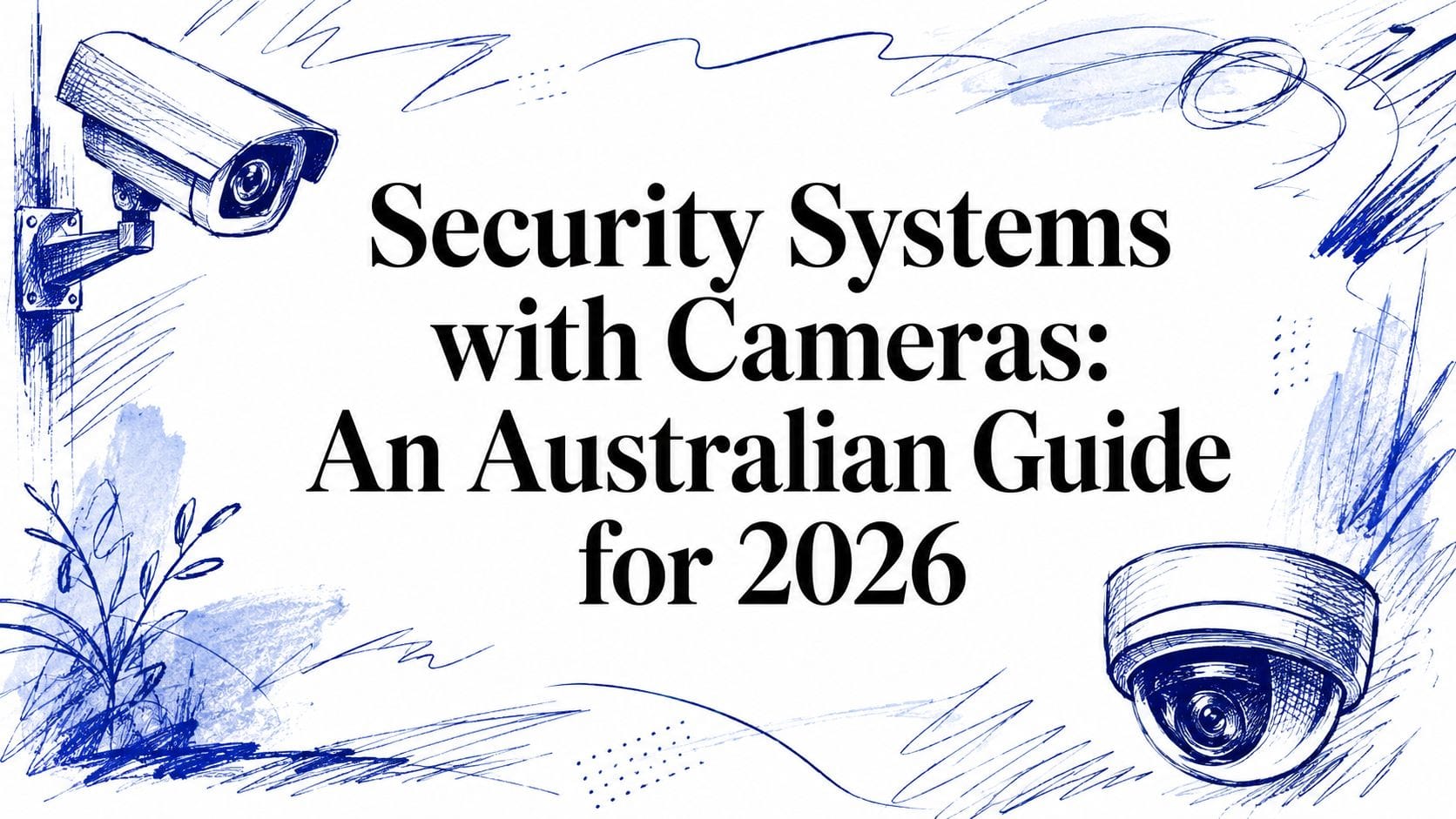
A home camera system shouldn’t just tell you what happened after the fact. It should help deter the wrong person at the gate, capture usable footage if something does happen, and support a fast response when you’re not home.
That matters in Australia because the burglary risk is real, not hypothetical. The Australian Bureau of Statistics’ Crime Victimisation Survey reports that 2.1% of Australian households experienced a break-in in 2023–24, down from 2.7% in 2022–23, and 5.4% of households experienced a break-in in the previous 5 years according to this Australia-relevant summary of the ABS data. For homeowners, strata managers, and gated communities across Melbourne, Sydney, Brisbane, Perth and surrounding suburbs, that’s enough to justify a practical, layered approach.
From a practitioner’s point of view, the gap in most buying guides is simple. They focus on app features and camera specs, but not on what changes outcomes on site. The difference between a phone notification and a verified response is where many residential security systems with cameras either prove their value or fall short.
Foundations of Home Protection Understanding Security Systems
A modern home security setup works like a digital night watch. One part sees, one part remembers, one part decides what matters, and one part tells someone to act.
That’s why a proper system is more than a few cameras bolted under the eaves. The useful setup combines cameras, sensors, a control point, and a monitoring method that matches how the property is used. In a freestanding home, that might mean perimeter coverage and driveway views. In a townhouse or strata complex, it often means shared access points, side paths, garage entries, and delivery zones.

The four parts that make a system work
Cameras as the eyes
Cameras provide visual coverage, deterrence, and evidence. They need the right angle and enough image quality to be useful when you need to review footage.Sensors as the trigger
Door contacts, motion detectors, and environmental sensors tell the system something changed. They reduce reliance on video alone and help separate routine movement from actual concern.The control panel as the brain
It houses arming modes, zones, event rules, and alert logic. A well-programmed control panel makes a home easier to secure properly day to day.Monitoring as the voice
Alerts only matter if someone receives them and can act. That can be the owner through an app, or a licensed monitoring pathway with escalation procedures.
A lot of poor residential installations fail because one of those parts is weak. Good cameras with weak storage won’t preserve evidence. Good sensors with poor alert handling create nuisance alarms. A strong system needs all four parts aligned.
Practical rule: Buy the system for the response you need, not for the feature list on the box.
What homeowners often get wrong
People often start with camera count instead of risk points. Four cheap cameras aimed generally around a property usually perform worse than fewer, properly positioned cameras tied into sensible alert rules.
The other mistake is treating cameras as a complete answer. They’re a foundational layer, but they work better when the property itself is harder to approach, enter, and leave unnoticed. That means locks, lighting, sightlines, and occupancy habits still matter.
For larger homes and body corporate settings, this is also where professional design starts to outperform DIY. The system doesn’t just need to record. It needs to behave predictably when someone opens a gate at night, walks a boundary line, or enters a shared access area.
Choosing the Right Eyes Types of Security Cameras
Different cameras do different jobs. The right choice depends less on brand and more on what the camera must see, from how far away, and under what lighting conditions.

For Australian homes, the practical baseline is 1080p HD, infrared night vision, two-way audio, and both cloud and local storage, as outlined in this consumer camera guidance. That baseline matters because evidence quality depends on resolution and low-light performance, and 1080p generally provides enough detail for identification at typical residential distances.
Which camera suits which area
A camera on a front fence line has a different job from one covering a porch or side gate.
| Camera type | Best use around a home | Main trade-off |
|---|---|---|
| Bullet camera | Driveways, front boundaries, long side access paths | More visible, less discreet |
| Dome camera | Front doors, alfresco areas, under eaves near entries | Shorter visual deterrence effect than a bullet |
| PTZ camera | Larger blocks, shared driveways, wider outdoor zones | More complex and usually unnecessary for smaller homes |
| Doorbell camera | Front entry interactions, deliveries, visitor verification | Narrower coverage than a fixed perimeter camera |
Bullet cameras are often the right pick for driveways because they naturally suit longer viewing corridors. Dome cameras are better where you want a cleaner look and less tampering risk near an entry point.
PTZ units can work on acreage or larger residential compounds, but many suburban homes don’t need them. In practice, fixed cameras aimed correctly usually produce more consistent evidence than a moving camera that wasn’t looking at the right spot at the right time.
Features worth paying for
Not every spec on a product page improves security. A few features do.
Resolution that supports identification
If a person’s face turns into a blur at the gate, the camera hasn’t done its job.Infrared performance that holds up at night
Most incidents of concern don’t happen in ideal daylight. Night footage needs to stay usable without relying on decorative exterior lighting.Two-way audio for front entry management
This is especially useful for deliveries, unexpected visitors, and vulnerable occupants who don’t want to open the door.
Later in your buying process, it can also help to compare less conventional options such as trail cameras for home security, particularly for rear boundaries, sheds, or low-traffic areas where a traditional fixed camera may not be the only option.
For homeowners who want a professionally installed residential setup rather than a retail off-the-shelf kit, home security cameras with installation is usually the safer path.
A short product overview can help you translate spec sheets into real-world use:
The best camera is the one that captures a clear, correctly framed image when someone actually uses the approach you didn’t expect.
System Architecture Wired Wireless and Storage Options
The camera is only half the story. The architecture behind it decides whether footage records reliably, whether playback is available when you need it, and whether the system stays stable as you add more devices.
For most homes where reliability matters, wired IP/NVR architecture remains the stronger option. Independent industry guidance describes these systems as combining cameras, cabling, and a recorder into a dedicated surveillance path with recorder-based storage, HD or 4K capability, remote monitoring, and smart alerts on the Lorex camera systems page. In practical terms, that’s why wired setups are often the better fit for larger Australian homes where Wi-Fi can drop out or compete with household internet use.
Wired versus wireless in real homes

Wireless systems look attractive because installation is simpler. In a small apartment, that can be a reasonable trade-off. In a multi-level house with a detached garage, side access, or thick construction materials, wireless limitations show up quickly.
Practical comparison
Wired IP/NVR systems
Better for continuous recording, stable image transport, and multi-camera setups. They suit family homes, larger blocks, and properties where evidence continuity matters.Wi-Fi camera systems
Easier to fit and reposition. They’re often suitable for renters, short-term needs, or simpler self-monitored setups, but they’re more exposed to interference, router issues, and bandwidth contention.Battery-powered cameras
Useful in difficult cable locations, though they’re rarely my first recommendation for primary perimeter protection. They work best as secondary coverage, not as the entire security plan.
Storage is where many DIY systems fall over
Storage decisions affect both resilience and convenience. If footage lives only in the cloud, your evidence depends heavily on internet continuity and subscription settings. If footage exists only on a local recorder, remote access and off-site redundancy may be weaker.
The most balanced setup for a residential property usually includes both local and cloud options, with the recorder acting as the primary evidence store.
On-site lesson: If a camera can detect motion but doesn’t retain the footage when the network drops, you don’t have a security system. You have a notification device.
This is also why centralised design matters. As camera numbers increase, piecemeal wireless additions often create uneven retention, inconsistent playback, and mixed app experiences. A properly designed CCTV system for security keeps storage, viewing, and maintenance under one structure.
A simple decision guide
| Property type | Usually the better fit |
|---|---|
| Apartment or rental | Wi-Fi or hybrid setup with minimal drilling |
| Standard suburban home | Hybrid, leaning wired for key external cameras |
| Large home, strata, or gated property | Wired IP cameras with NVR and managed storage |
If the property has multiple access paths, detached structures, or long cable runs, don’t let convenience drive the whole decision. Reliability matters more than tidy marketing claims.
Active Defence Professional vs Self Monitoring
A phone alert is not a response plan. It’s just information delivered to whoever happens to be available.
That’s the biggest difference between self-monitoring and a professionally managed arrangement. Self-monitoring works when you’re awake, have your phone on you, understand the alert, and can decide quickly whether it matters. If you’re asleep, travelling, in a meeting, or overseas, the system may still record well, but nobody is actively managing the event.

What self-monitoring does well
Self-monitoring suits some households. It gives owners direct visibility and immediate app access. For low-risk properties or owners who are comfortable managing alerts themselves, it can be enough.
But there are limits:
Alert fatigue builds quickly
Pets, deliveries, visitors, and weather movement can train people to ignore notifications.Response depends on your availability
If you can’t check the footage at the right moment, the value of the alert drops fast.No physical follow-up is built in
Seeing a trespasser on your screen doesn’t mean the property is being attended.
What professional monitoring changes
Professional monitoring turns cameras from passive evidence tools into part of an active defence posture. An operator can review the event, assess whether escalation is warranted, and follow a response procedure.
That procedure may include calling the resident, checking additional cameras, or arranging an on-ground attendance. Where the model supports it, Mobile Patrols become the missing operational piece between detection and action. For households that want that structure, security camera monitoring is the category to compare.
This is also where integrated providers can make sense. ABCO Security Services Australia, for example, combines CCTV monitoring with patrol response as part of its broader service model, which is relevant for homes, strata sites, and gated communities that don’t want cameras operating in isolation.
A recorded incident answers “what happened?” A monitored incident starts answering “who’s dealing with it now?”
Which model fits which household
| Monitoring model | Best suited to | Main limitation |
|---|---|---|
| Self-monitoring | Tech-comfortable owners with simpler needs | Relies on personal availability |
| Professional monitoring | Homes needing 24/7 oversight or structured escalation | Higher setup and service commitment |
| Hybrid approach | Owners who want app visibility plus backup response | Requires careful setup to avoid duplicated alerts |
For many Melbourne homes, the deciding factor isn’t technology. It’s whether the residents want to manage security themselves or want a licensed pathway that can verify and escalate events properly.
Strategic Placement and Australian Legal Guidelines
Placement decides whether a camera deters, detects, or merely records the back of someone’s cap. A strong system covers likely approach paths first, not just the areas that are easiest to cable.
Australian crime-prevention guidance consistently points toward layered security. Cameras perform best when paired with lighting, quality locks, and active monitoring, as reflected in this Australian-focused crime prevention discussion. That matters because opportunistic entry usually happens at the point of least resistance.
Where cameras usually earn their keep
Start with the path an intruder is most likely to use, not the path a homeowner uses every day.
Front approach and driveway
This gives an early view of arrivals, vehicles, and loitering before someone reaches the door.Main entry and porch
Essential for visitor verification, parcel activity, and face-level capture near the entrance.Side gate or narrow side path
These are often overlooked in suburban homes but regularly provide cover from street view.Rear access points
Sliding doors, laundry doors, and back fencing lines deserve attention if they’re concealed.
Placement mistakes that reduce evidence quality
A common error is mounting cameras too high. High placement protects the device, but it often sacrifices face detail. Another problem is aiming too wide. Owners like a broad view, but broad views usually spread pixels too thin across the relevant scene.
A better approach is to assign each camera a single purpose. One camera identifies faces at the front entry. Another observes vehicle movement on the driveway. Another watches the side passage. That produces stronger footage than one wide camera trying to do everything.
Field advice: Cover transitions. Gates, doors, corners, and narrow passages give better security footage than broad empty lawn.
Privacy, strata rules, and compliance
In Australia, legal obligations vary by state, territory, and building type. The safest operating principle is straightforward. Keep cameras focused on areas you own or are authorised to monitor, and avoid deliberate capture into neighbours’ private spaces.
For strata or body corporate properties, approval pathways may apply before installing devices on common property, facades, or shared structures. Audio recording can also trigger stricter considerations than video-only capture, so it’s worth checking the rules that apply to your location and building.
For industry guidance and professional standards, review the Australian Security Industry Association Limited. If you’re engaging an installer, ask how they handle privacy settings, camera masking, signage, and written scope approval. For householders who want the fit-out handled professionally, CCTV camera installation should include both technical and compliance considerations.
Integrating Cameras with Alarms and Smart Homes
Standalone cameras are useful. Connected systems are better.
When cameras, alarms, lighting, locks, and automation rules work together, the property becomes harder to approach unnoticed and easier to manage remotely. A motion event at the driveway can trigger exterior lights. An alarm state can tell cameras when to shift alert behaviour. A smart lock can confirm whether a family member has already entered rather than forcing you to guess from a motion clip.
What integration improves
Deterrence gets stronger
Lights activating with visible cameras create more pressure on an intruder than silent recording alone.Alerts become more meaningful
A camera event tied to an armed alarm state carries a different priority from routine daytime movement.Daily use becomes simpler
Households are more likely to use security properly when arming, viewing, and access control sit in one routine.
Google Home and Amazon Alexa can handle basic consumer-level workflows, but homes with broader security requirements usually benefit from a dedicated alarm and CCTV integration rather than a loose collection of smart gadgets.
Keep automation sensible
Over-automation is a genuine problem. If every motion event turns on every light and triggers every phone, the household stops trusting the system. Security logic should stay clear and restrained.
The strongest result is a layered one. Cameras verify. Alarms trigger. Lights deter. Monitoring decides whether escalation is needed. Each part supports the others, which is exactly how a home system becomes a security solution rather than a set of devices.
Choosing Your Security Partner A Decision Checklist
Most homeowners compare camera brands first. A better approach is to compare the people designing, installing, and supporting the system.
A reliable provider should be able to explain why each camera is positioned where it is, how the footage is stored, what happens after an alert, and who is responsible if something stops working. If they can’t explain that clearly, the proposal probably isn’t mature enough.
Questions worth asking before you sign
Are you properly licensed and insured?
This should be a basic check, not an awkward one. Residential clients have every reason to ask.What architecture are you proposing, and why?
A provider should justify wired, wireless, or hybrid design based on the property, not on what’s easiest for them to install.How is footage stored and accessed?
You want a clear answer on local retention, cloud access, and what happens if internet service drops.Who responds to alerts?
If monitoring is part of the discussion, ask whether alerts go only to the homeowner or into a managed process.What support is available after handover?
Good systems need occasional adjustments, firmware management, and practical troubleshooting.
A quick fit-for-purpose checklist
| Situation | What to prioritise |
|---|---|
| Apartment or townhouse | Compact design, privacy compliance, entry-point coverage |
| Family home | Reliable perimeter coverage, storage resilience, easy daily operation |
| Strata or gated property | Shared-area planning, approval process, centralised oversight |
The right provider should also understand local conditions. What works in inner Melbourne terraces isn’t always right for larger blocks on the fringe, and the same applies in Sydney, Brisbane, Perth, and surrounding metro corridors.
If you’re comparing options, this overview of best home security systems in Australia is a useful starting point for narrowing the field. It also helps to ask whether the provider has capability beyond home cameras. Experience in areas such as Security Guarding, Mobile Patrols, Concierge Security, or Gatehouse Security often signals a stronger understanding of real-world response, not just equipment sales.
The safest choice is usually the company that treats your home as an operating environment, not a shopping basket of devices.
If you want a personalized assessment of residential security systems with cameras, monitoring options, and patrol response pathways, contact ABCO Security Services Australia for practical advice based on your property type, risk points, and compliance requirements.
about
avada factory
Sempery ultricies nibh at dolor cras urna eleifend nec. Atiam efficitur tempor.