
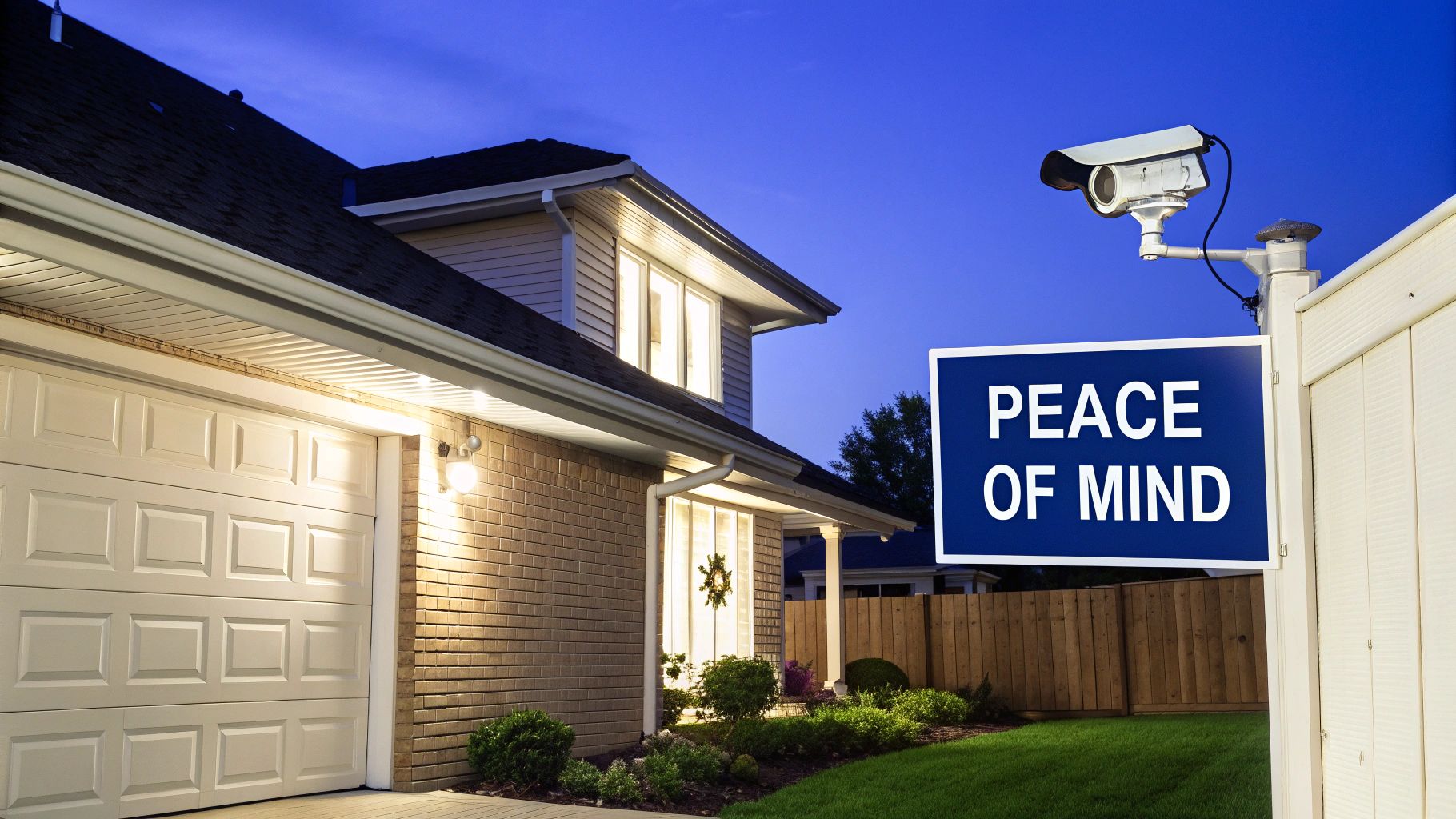
Installing a security camera is one thing; creating a reliable security shield for your Australian home or business is another entirely. A professional CCTV camera installation is a strategic investment, moving beyond a simple deterrent to provide genuine peace of mind and protect your assets.
This guide provides practical advice on the entire process. We will cover everything from initial planning to ongoing maintenance, showing how licensed expertise transforms a set of cameras into an effective security solution you can count on.
Why Professional CCTV Installation is Your Best Defence
A strategically installed CCTV system is the foundation of modern security. It acts as a vigilant, constant presence that not only records events but actively helps prevent incidents from occurring in the first place.
For Australian home and business owners, a professionally designed system offers clear, actionable evidence when it is needed most. It is the critical difference between blurry footage and a reliable security asset.
The Growing Need for Reliable Surveillance Systems
Australia is seeing a significant uptake in surveillance technology. The national CCTV camera market was valued at around USD 555.51 million in 2024 and is projected to grow substantially. This boom is driven by a heightened awareness of security needs.
This trend highlights a crucial point: as more properties adopt robust security, unsecured ones become more attractive targets. A professional installation ensures your system is a genuine deterrent, not just a decoration.
Key Benefits of a Professional CCTV Installation
Choosing an expert Security Company Melbourne over a weekend DIY project offers clear, undeniable advantages. It ensures every component of your system works together seamlessly from day one.
- Strategic Camera Placement: Professionals possess a trained eye for vulnerabilities. They identify blind spots you might miss, ensuring total coverage of entry points, driveways, and high-value areas.
- Regulatory Compliance: This is a major factor. Licensed technicians understand Australian surveillance and privacy laws, ensuring your system is installed legally and ethically. This protects you from future privacy disputes.
- Technical Expertise: Experts guarantee correct wiring, secure network configuration, and proper camera weatherproofing. These are all crucial for long-term reliability and performance.
A properly installed system is an integrated defence mechanism. It combines high-quality hardware with expert configuration to create a reliable security asset that safeguards your property around the clock.
Exploring advanced options like Meraki Security Cameras, which offer cloud management and AI analytics, shows just how powerful modern surveillance systems have become.
A professionally installed system delivers confidence. Ready to secure your property with a CCTV solution designed by the experts?
Book Your Professional Security Consultation Today
Planning Your Surveillance: The Blueprint for Security
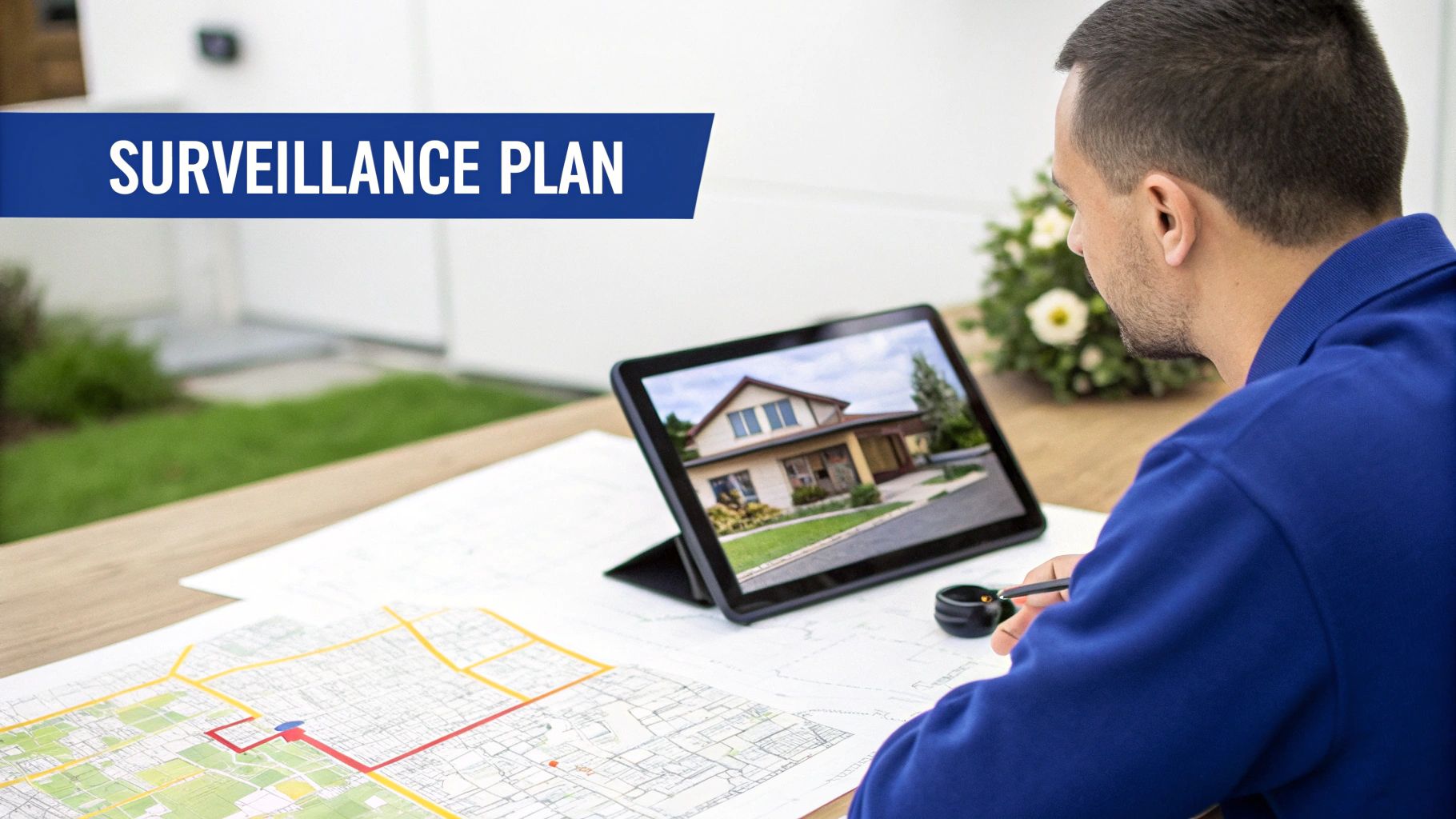
Effective security doesn’t happen by chance—it’s meticulously planned. Before purchasing a single camera, the most critical step is creating a detailed surveillance blueprint. This roadmap ensures every camera serves a distinct purpose and provides necessary coverage.
Think of it like building a house; you wouldn’t start without architectural plans. A thorough site assessment is the first step, whether for a suburban home or a large commercial warehouse. This involves identifying potential weak spots from an intruder’s perspective.
Identifying Key Surveillance Zones
First, we must pinpoint the essential areas requiring monitoring. These zones typically fall into three categories, each demanding a slightly different approach.
Your priority list should include:
- Vulnerable Entry Points: These are the most obvious targets, including all external doors, ground-floor windows, and access gates.
- High-Traffic Areas: Consider where people naturally move. For a home, this is often the driveway and front porch. For a business, it’s the main entrance, reception, and car park.
- High-Value Zones: This is where you store important assets. Examples include a retail cash register, a warehouse loading bay, or a home office with expensive equipment.
Defining these zones from the outset ensures you build a system designed not just to deter, but to provide clear, usable evidence if an incident occurs.
Tailoring Your Plan to Your Security Goals
What are you trying to achieve? The answer shapes every aspect of your CCTV installation. Whether you want to deter trespassers, capture licence plates, or receive delivery notifications, each goal requires different hardware.
For example, a retail owner needs a camera at their entrance capable of capturing sharp facial details, even in bright sunlight. This is a very different requirement from a homeowner wanting a wide-angle view of their garden at night.
A common mistake is installing cameras without a clear purpose. A camera monitoring a driveway needs different specifications than one aimed at a cash register. Define the “why” for each camera location first to avoid investing in the wrong technology.
As you map out your plan, a simple sketch of your property layout can be invaluable. Mark potential camera locations and draw their fields of view to identify any blind spots. You can use a sample monitoring layout diagram to see how professionals map out total coverage.
Comparing Residential and Commercial Security Needs
While the fundamental planning principles are the same, the focus shifts between a home and a business. A professional security installer understands this difference and designs the system accordingly.
Key Planning Considerations for CCTV Installation
| Consideration Area | Residential Focus (Example) | Commercial Focus (Example) |
|---|---|---|
| Primary Goal | Deterring break-ins and monitoring property boundaries (e.g., front door, backyard). | Preventing theft, monitoring employee activity, and ensuring public liability compliance. |
| Key Zones | Entry points like doors and ground-floor windows, driveways, and back gardens. | Entrances/exits, point-of-sale areas, stockrooms, loading docks, and car parks. |
| Camera Types | Weatherproof outdoor cameras with night vision, wide-angle lenses for general oversight. | High-resolution cameras for facial recognition, varifocal lenses for specific zoom needs. |
| Legal Compliance | Adhering to neighbour privacy laws (e.g., not recording their private property). | Meeting strict Australian Privacy Principles, displaying clear signage, and managing staff privacy. |
Ultimately, residential security often focuses on the perimeter. Commercial installations are more complex, needing to cover large areas, manage staff access, and protect valuable inventory. According to the Australian Security Industry Association Limited (ASIAL), using a licensed professional is key to getting this right.
Taking the time to plan properly is non-negotiable. It is what makes the difference between a real security solution and a set of ineffective cameras.
Book a No-Obligation Site Assessment Now
Choosing Your Cameras and Recording Equipment
Selecting the right hardware is the foundation of a reliable security system. The vast array of cameras and recorders on the Australian market can seem overwhelming, but the choice becomes clearer when you focus on what you need them to do.
The goal is to create a cohesive system where every component—from a discreet indoor camera to a robust outdoor unit and the recorder—is perfectly suited for its specific task.
Understanding Different Camera Types
Different cameras are built for different jobs. By understanding their unique strengths, you can place the right tool in the right location to build an effective surveillance network.
Here are the main types and their ideal uses:
- Dome Cameras: Their compact, low-profile design is perfect for indoor locations like retail stores or office receptions. The tinted dome makes it difficult to see where the lens is pointing, acting as a powerful deterrent.
- Bullet Cameras: These are your classic, highly visible cameras. Their presence clearly indicates that an area is under surveillance, making them an excellent choice for outdoor deterrence at driveways, car parks, and building perimeters.
- PTZ (Pan-Tilt-Zoom) Cameras: These are active surveillance workhorses. A single PTZ camera can cover a massive area, such as a warehouse floor, allowing an operator to track movement or zoom in to capture critical details.
Key Technical Specifications That Matter
It’s easy to get lost in technical jargon. From years of experience, only a handful of specifications truly impact the quality and usefulness of your footage.
Focus on these key features:
- Resolution (1080p vs. 4K): This determines image clarity. While 1080p (Full HD) is adequate for general monitoring, 4K offers four times the detail. This allows you to zoom in on recordings to identify a face or read a licence plate without pixelation. Understanding spatial resolution is key.
- Night Vision (Infrared/IR): This is non-negotiable for 24/7 security. IR technology allows cameras to see in complete darkness by emitting infrared light, producing a crisp black-and-white image. See what modern night vision can do in our Night Owl monitoring technology flyer.
- Weatherproof Rating (IP66/IP67): For any outdoor camera in Australia, a high IP rating is essential. An IP66 or IP67 rating guarantees the camera is protected against dust, rain, and harsh weather conditions.
The secret to choosing the right camera is not buying the most expensive one. It’s about selecting a model with the right features for its specific job. A 4K camera is unnecessary for a small storeroom, while a camera without weatherproofing won’t last outdoors.
NVRs vs. DVRs: The Heart of Your System
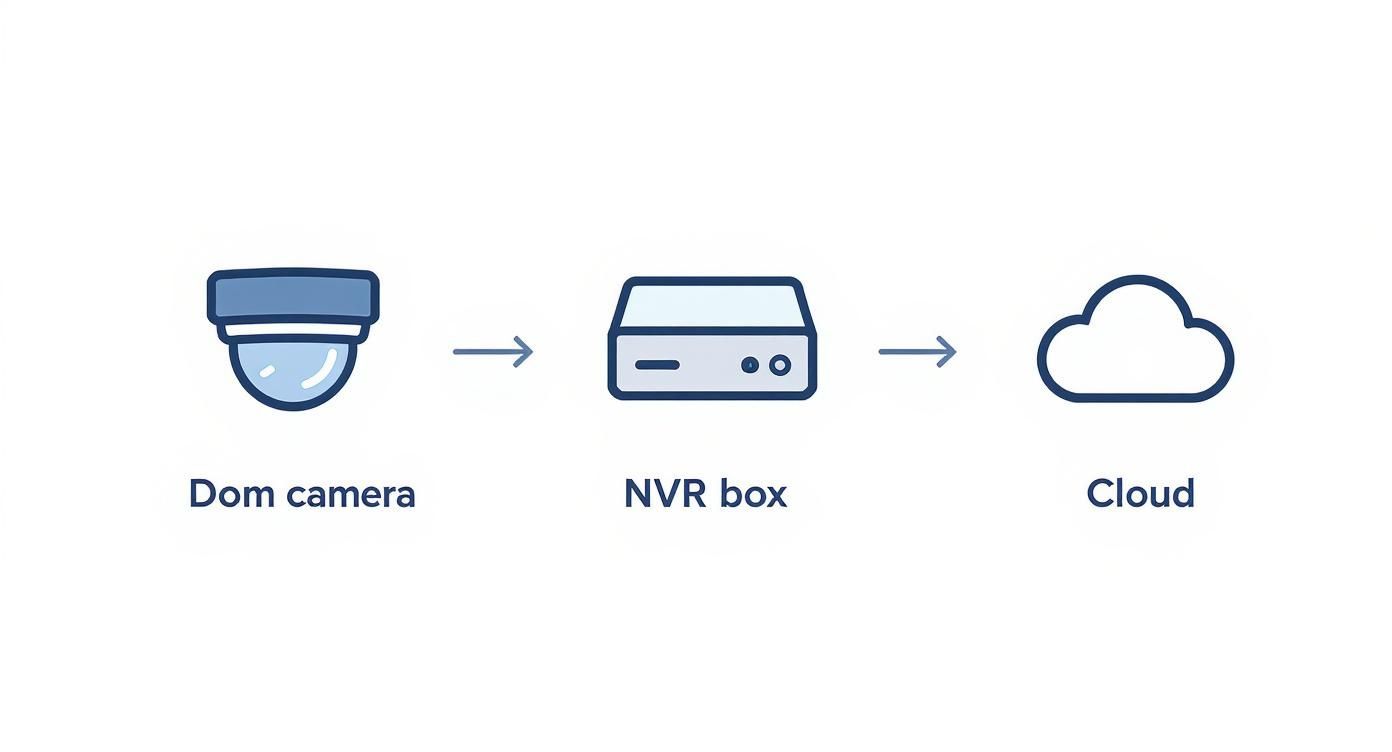
The recorder is the central brain of your security operation. The choice between a Network Video Recorder (NVR) and a Digital Video Recorder (DVR) depends on the type of cameras you use.
An NVR is the modern standard, working with IP (Internet Protocol) cameras. This setup provides higher resolutions and advanced features. A DVR pairs with older analogue cameras and is a budget-friendly option, but it cannot match the performance of an NVR system. For any new CCTv camera installation, an NVR system is the recommended choice.
The Professional Installation Process
Once the blueprint is finalised and the equipment is selected, the expertise of a licensed technician becomes paramount. A professional CCTV camera installation is a precise, methodical process that ensures every component functions flawlessly for years to come.
It is about transforming a box of high-tech components into a robust and reliable surveillance shield for your property.
Secure Camera Mounting and Positioning
The first on-site task is securely mounting the cameras. This requires different techniques depending on the surface, whether brick, weatherboard, or steel. An experienced installer uses the correct fixings to make the camera immovable and tamper-resistant.
Proper positioning is equally important. We are trained to calculate the perfect height and angle to achieve the desired field of view while avoiding common issues.
- Avoiding Glare: Professionals position cameras to use ambient light effectively, not fight against it.
- Eliminating Blind Spots: Careful angling ensures the view is not obstructed by columns, trees, or other structures.
- Finding the Height Sweet Spot: Cameras placed too low are vulnerable to vandalism; too high, and they lose crucial details.
Meticulous Cabling and Concealment
Professional work is evident in the wiring. Exposed cables are not only unsightly but also a significant security risk, as they can be easily cut.
A professional will run cables through wall cavities, ceiling spaces, and protective conduits. This painstaking process delivers a clean finish while protecting the wiring from tampering and the elements. We primarily use Power over Ethernet (PoE) technology for modern IP systems.
PoE is a game-changer. It allows a single network cable to carry both video data and power to the camera. This simplifies wiring, reduces clutter, and creates a more reliable, centralised power source.
Our commitment to quality service is visible in every installation, often carried out using our clearly marked professional vehicles.
System Connection and Configuration
With cameras mounted and cables run, everything is connected to the recorder. The technician then powers up the system and begins the crucial configuration phase.
This technical process includes:
- Assigning IP Addresses: In NVR systems, each IP camera requires a unique network address.
- Setting Recording Schedules: We configure the recorder for continuous, scheduled, or motion-activated recording.
- Configuring Remote Access: We establish secure network permissions for you to access your cameras from anywhere.
This final configuration ensures your system operates intelligently and securely. A professional technician will also secure the network against unauthorised access, a step often overlooked in DIY setups. Licensed installers adhere to codes of practice from bodies like the Australian Security Industry Association Limited (ASIAL).
Book Your Professional CCTV Installation Now
Navigating Australian Surveillance Laws
Installing a security system involves significant legal responsibilities. A professional CCTV camera installation is as much about compliance and ethics as it is about technology. Getting this right protects you from both intruders and potential legal disputes.
Australia’s surveillance laws balance security needs with an individual’s right to privacy. The rules vary between states and territories, and regulations differ for residential and commercial properties. This complex legal landscape makes working with a licensed security provider essential.
Privacy is Non-Negotiable
You cannot install cameras that capture private spaces where people have a reasonable expectation of privacy. This means avoiding views into a neighbour’s backyard, windows, or living areas. It is a critical rule that prevents privacy complaints and legal action.
For homeowners, this means angling cameras to cover only your own property. For a business, you must ensure cameras do not monitor sensitive areas like bathrooms, break rooms, or change rooms.
The guiding principle is simple: your security should not infringe on someone else’s privacy. A professional installer knows how to maximise your coverage without crossing these critical legal and ethical lines.
The Importance of Signage
In many cases, especially for businesses, you are legally required to inform people they are being recorded. Clear, visible signs at the entrances to monitored areas are the standard method.
This serves two crucial functions:
- Ensures Compliance: It helps you meet your obligations under state and federal surveillance and privacy acts.
- Acts as a Deterrent: A prominent sign can make a potential intruder reconsider. It is a powerful, low-cost security measure.
A reputable security company will advise on the correct type of signage and its placement, which is vital for protecting your organisation from liability.
Working with a Compliant Security Provider
These laws can be a minefield. A reputable security provider’s deep understanding of this legal framework is a major benefit. A licensed technician ensures your CCTV camera installation is fully compliant from day one.
They will consider all relevant legislation, including:
- The specific surveillance device acts for your state or territory.
- The Federal Privacy Act 1988, which is particularly important for businesses.
- Any applicable local council by-laws.
Engaging experts who are well-versed in these regulations is the smartest way to avoid legal issues. For industry standards, bodies like the Australian Security Industry Association Limited (ASIAL) provide essential guidance.
Book Your Professional Security Consultation Today
Maintaining Your Security System for Optimal Performance
Your CCTV camera installation is complete, but the work isn’t finished. A security system is a critical asset that, like a car, requires regular maintenance to ensure it performs reliably when needed most.
The final step of any professional installation is the commissioning process. A licensed technician meticulously tests every component, confirming clear camera feeds, proper recording and storage, and secure remote access.
Proactive Maintenance for Long-Term Reliability
Consistent maintenance prevents system failures. A simple, routine checklist can help you avoid major issues by addressing small problems before they escalate into serious vulnerabilities. Any reputable Security Company Melbourne will confirm this is non-negotiable.
Here are essential tasks you can perform yourself:
- Clean Camera Lenses: Regularly wipe lenses with a microfibre cloth to remove cobwebs, dust, and grime that can obscure the view.
- Check Cable Integrity: Visually inspect any exposed cables for signs of wear, animal damage, or fraying, especially for outdoor cameras.
- Verify Recording Storage: Log into your recorder periodically to ensure it has sufficient space and is correctly overwriting old footage.
Think of maintenance as a health check for your security. A few minutes of proactive care each month ensures the system you rely on is always ready to perform at its peak.
Software Updates and Professional Servicing
Keeping your system’s software and firmware up to date is critical. Manufacturers release updates to patch security vulnerabilities, improve performance, and add new features. Ignoring these can leave your network exposed.
While you can handle basic upkeep, scheduling an annual professional service is a smart investment. A technician will perform deeper diagnostics, such as checking power supplies and ensuring all connections are secure. You can see the detail our technicians provide on-site in this example.
Licensed professionals in Australia stay current with compliance standards. According to the Australian Security Industry Association Limited (ASIAL), ongoing professional management is a hallmark of a robust security setup.
Book a Security System Service Today
Your CCTV Installation Questions Answered
When considering a new security system, many practical questions arise. Here are answers to some of the most common queries from Australian home and business owners.
Can I view my cameras when I am away?
Yes, absolutely. Any modern IP camera system is designed for secure remote access.
During a professional installation, we configure your network to allow you to securely view live and recorded footage from anywhere using a smartphone, tablet, or computer. This is a standard and essential feature.
How much recording storage do I need?
The ideal amount of storage depends on several factors:
- The number of cameras in your system.
- The resolution they record at (4K uses more space than 1080p).
- Whether you record 24/7 or only upon motion detection.
- How long you need to retain footage for legal or personal reasons.
A licensed technician from a trusted security company in Melbourne can calculate the optimal storage capacity to ensure you always have the footage you need.
Are wireless cameras a reliable option?
Wireless cameras offer placement flexibility but come with trade-offs. They are not always the most reliable choice for serious security applications.
They can suffer from signal dropouts caused by other devices and require regular battery charging or replacement. For continuous, dependable surveillance, a hardwired CCTV installation using Power over Ethernet (PoE) remains the industry standard for its reliability.
For any security application where failure is not an option, the stability of a wired system is unbeatable. It eliminates the risk of a dead battery or dropped Wi-Fi signal leaving you exposed at a critical moment.
For more information on industry standards, the Australian Security Industry Association Limited (ASIAL) is an excellent resource.
At ABCO Security Services Australia, we ensure every installation is reliable, compliant, and perfectly suited to your needs. Ready to secure your property? Book your expert security consultation and installation today.
about
avada factory
Sempery ultricies nibh at dolor cras urna eleifend nec. Atiam efficitur tempor.