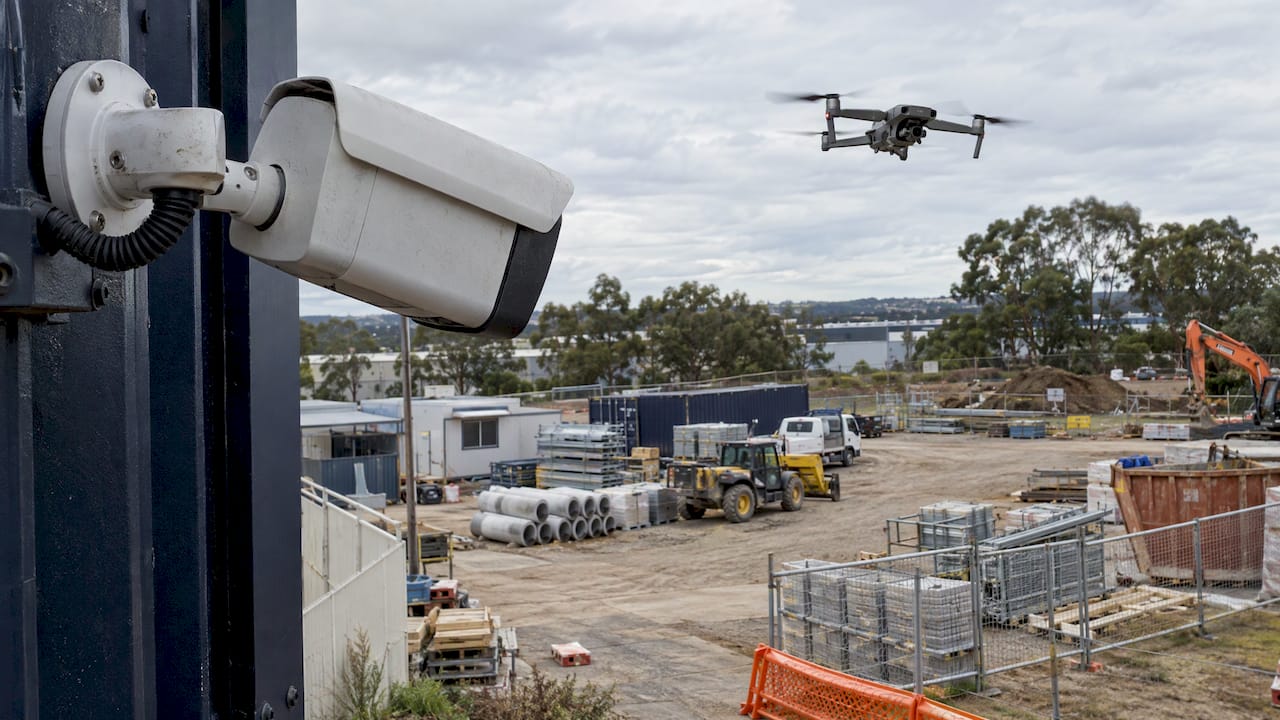
For most Australian sites, fixed cameras are the foundation and drones are an add-on. Fixed cameras watch the same spots around the clock. Drones give you a moving aerial view of large or changing areas, but only for short flights and under aviation and privacy rules. The right answer depends on your site layout, how often it changes and who responds when something is detected.
TL;DR
- Fixed cameras give continuous, repeatable coverage of entries, perimeters and high-value areas. Drones give mobile, aerial views of areas that are hard to cover with installed cameras.
- Industry guidance presents drones as extending fixed-camera capability, not replacing it.
- Commercial drone use in Australia brings CASA requirements, and any camera, fixed or airborne, raises privacy and surveillance-device questions.
- Most sites get the best result from layered security: fixed cameras, monitoring, and a human response such as patrols or guards.
Table of Contents
- The short answer, side by side
- Coverage and image detail
- Continuous monitoring, weather and conditions
- Staffing and running costs
- Australian rules for commercial drone use
- Privacy and surveillance laws apply to both
- Handling footage so it holds up
- Which sites suit which approach
- Building a layered setup
- Our perspective
- Get a security plan that fits your site
- FAQ
- Sources
The short answer, side by side
The table below compares the two on the points that decide most purchases.
| Criterion | Fixed cameras | Drones |
|---|---|---|
| Coverage | Set field of view, always the same | Wide and flexible, can reach remote or elevated spots |
| Continuity | Run continuously once installed | Limited by flight time and recharging |
| Image detail | Consistent framing at doors, gates, yards | Aerial perspective, detail depends on altitude and conditions |
| Weather | Housed in weatherproof enclosures for outdoor use | Sensitive to severe weather |
| Staffing | Minimal once installed, plus monitoring | Needs a trained operator or supervised automation |
| Regulation | Privacy and surveillance-device laws | Privacy and surveillance laws plus CASA rules |
| Best for | Permanent assets, access points, evidence of who came and went | Large, remote or fast-changing areas, rapid alarm checks |
The rest of this article explains each row so you can judge what your site needs.
Coverage and image detail
A fixed camera does one job well: it watches a defined area, every minute of every day. That makes it ideal for gates, loading docks, reception areas, car parks and site compounds. Because the framing never changes, footage is easy to compare over time, and a monitoring team learns what “normal” looks like for that view.
The limit is geometry. A camera sees what it faces. Large perimeters, long boundaries or sites with lots of blind corners need many cameras to avoid gaps. Our guide to CCTV placement that meets AS 4806 covers how to position cameras so overlapping views leave fewer blind spots.
A drone solves the geometry problem differently. One aircraft can look at a whole yard, a roof, a stockpile or a back fence from above in a few minutes. Industry guidance notes that drones add mobile aerial views, reach large or remote areas and can rapidly assess alarms. That is valuable when a fixed camera triggers an alert and someone needs to see what is happening beyond its field of view.
Image detail depends on how each is used. A fixed camera at a gate can be specified to capture faces or number plates at a known distance. A drone’s detail varies with its altitude, speed, lighting and the camera it carries, so it suits situational awareness better than repeatable identification.
For more on how cameras fit into a wider setup, see our security systems with cameras guide.
Continuous monitoring, weather and conditions
Security is mostly about the hours when nobody is watching: nights, weekends, public holidays. This is where the two technologies differ most.
Fixed systems are built for continuity. A construction-monitoring comparison describes the trade-off as fixed cameras giving up flexibility for operational continuity, while drones give up continuity for redeployability and an aerial perspective. The same comparison reports typical drone flight times of 20 to 40 minutes, with recharging cycles interrupting coverage.
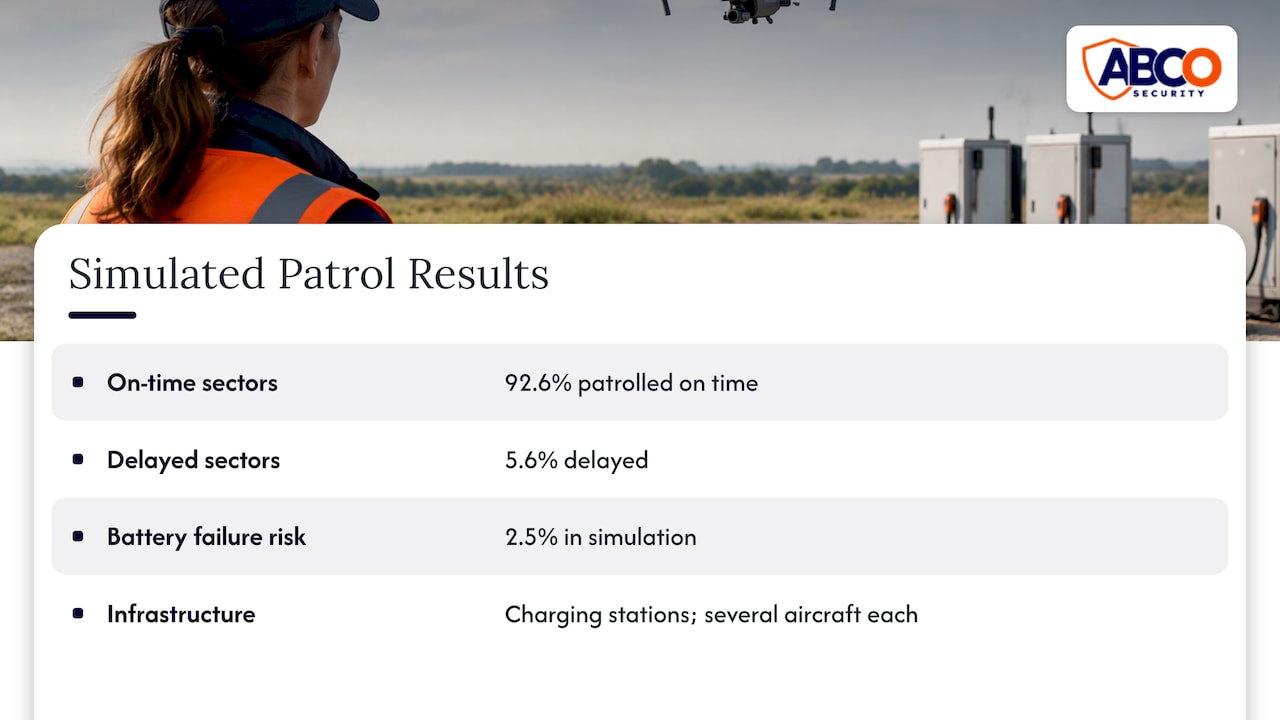
Research on persistent drone patrols shows what it takes to close that gap. An academic study of a perimeter patrol system relied on charging stations and several aircraft per station. In one simulated scenario, 92.6% of sectors were patrolled on time and 5.6% were delayed, with a 2.5% risk of battery failure. Those are simulation results, not field guarantees, but they show that round-the-clock aerial coverage needs infrastructure, not just an aircraft.
Weather matters too. The Electronic Security Association says drones generally tolerate moderate wind and rain but not hail or severe weather, and that docking stations need open sky, power and internet. Australian sites in storm-prone regions, or exposed coastal and port locations, should factor that in.
Fixed cameras are chosen for the opposite brief: they sit in weatherproof housings, run on permanent power and can be paired with lighting or infrared for night coverage. If your main concern is overnight theft or trespass, that continuity is usually the deciding factor.
Staffing and running costs
When you compare cost, look past the purchase price to who has to do what after day one.
The construction-monitoring comparison notes that fixed systems can operate with minimal human intervention once installed, whereas drones need pilots or operators, battery replacement, maintenance and potentially insurance and compliance costs. Treat these as the categories to budget, then get quotes for your own site, because figures vary widely by equipment and use.
A practical checklist for either option:
- Installation or deployment. Cabling, mounting, power and network for cameras. Docking, pilot time or approvals for drones.
- Monitoring. Who watches the feeds or receives alerts, and when? A camera nobody monitors records the incident but may not prevent it. Our camera monitoring services page explains what live monitoring adds.
- Response. Someone has to attend. Mobile patrols or on-site guards turn an alert into action.
- Maintenance and compliance. Lens cleaning, firmware and storage for cameras. Batteries, servicing, registration and operator accreditation for drones.
- Insurance. Confirm cover for the equipment and for the way you use it.
For sites that want a predictable daily cost for overnight attendance, our Night Owl service starts from $5.45 per day. You can see what it covers on the Night Owl Service page.
Australian rules for commercial drone use
Using a drone for security is commercial use, and CASA regulates it. CASA’s drone pages cover safety rules, operator accreditation for business use, remote pilot licences, operator certificates, flight authorisations and registration.
Key points for a site manager:
- Commercial use is recognised. QBE Australia states that monitoring, surveillance and security services count as commercial drone use, and that commercial equipment must be registered with CASA.
- Accreditation or a licence. The same insurer notes that pilots or supervisors flying certain categories commercially need either CASA operator accreditation or a Remote Pilot Licence, and may be asked to show documents to CASA, the AFP or state and territory police. It also reports fines of up to A$11,100 for contraventions (as at August 2024), so confirm current penalties on CASA’s site.
- Beyond visual line of sight. CASA defines BVLOS as operating when the pilot cannot see the drone, and says BVLOS operations need CASA approval for the planned area. Automated patrols across a large site often fall into this category.
- Site-owner permission. Controlled areas can add their own rules. One Western Australian port authority, for example, requires written approval for drone operations over its lands and waters, on top of CASA requirements and site induction. Airports, ports, government and healthcare sites should expect similar conditions.
Fixed cameras avoid the aviation layer entirely, which is one reason they remain the default for permanent protection. For aviation-specific obligations, see our aviation security requirements guide.
Privacy and surveillance laws apply to both
Whether the camera is bolted to a pole or flying overhead, you are collecting images of people.
The federal Drone Privacy Guidelines say the Privacy Act and Australian Privacy Principles apply where they cover the organisation and personal information, and recommend steps such as a privacy impact assessment, clear notice of purpose, minimal capture and retention, secure access and destroying unneeded footage. The Privacy Act covers Australian Government agencies and organisations with annual turnover above $3 million, plus some other organisations. The OAIC also notes that the Act does not specifically cover surveillance, which is why state and territory law matters.
Those state and territory surveillance-device laws can restrict optical recording on private property or during activities reasonably understood to be private. A Western Australian legal analysis illustrates why you must check the law where the cameras or drones operate. Since your sites may span several states, get advice for each one.
There is also a statutory tort for serious invasions of privacy. The OAIC explains that a person may have a cause of action for intrusion upon seclusion or misuse of information where they had a reasonable expectation of privacy and the public interest in protecting it outweighs competing interests.
In practice, a few habits cover most of the risk:
- Point cameras at your own assets and entry points, not neighbouring properties.
- Display clear signage and keep a written purpose for each camera.
- Limit who can view and export footage, and set a retention period.
- Keep a record of why aerial recording is needed if you use drones.
Handling footage so it holds up
Footage is only useful if it can be found, trusted and produced when needed. Whether a clip comes from a fixed camera or an aircraft, keep timestamps accurate, restrict access, record who exports what, and store originals unaltered. If an incident may end up in a dispute or police matter, it helps to understand CCTV forensics and digital evidence, including how chain of custody protects the value of a recording.
Which sites suit which approach
The CASA survey of regional operations lists aerial spotting, inspections, photography and filming, search and rescue, and surveying among reported drone activities. Security overlaps with several of them. Here is how that maps to the sites we work with.
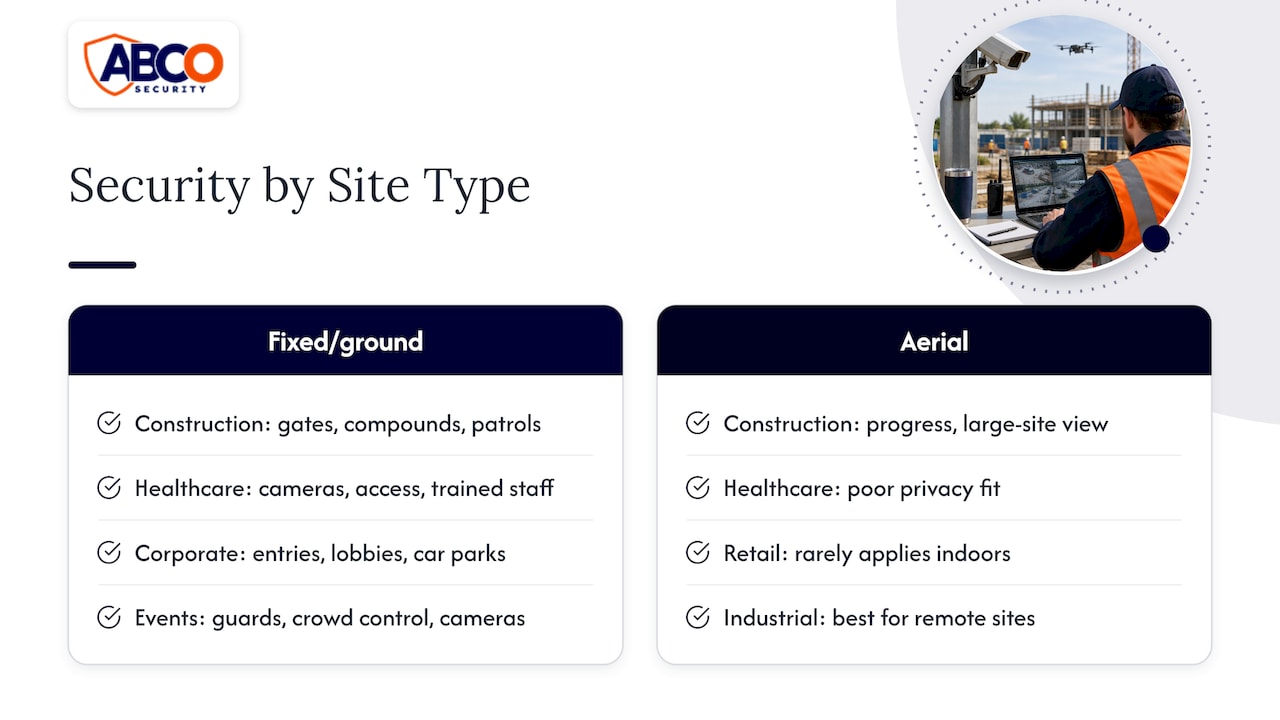
Construction sites. Layouts change weekly, but the risks stay constant: plant, tools and materials leaving after hours, and unauthorised entry. Fixed cameras on gates and compounds, backed by patrols, protect those. Aerial views can help with progress and large-site overview. See our construction site security guide and seven steps to a construction site security plan.
Healthcare facilities. Patient safety depends on controlled access, visible presence and reliable alarms. Fixed cameras, access control and trained staff on the ground matter most. Outdoor aircraft are a poor fit for sensitive, privacy-heavy environments.
Corporate offices and campuses. Continuous surveillance of entries, lobbies, car parks and plant rooms is a fixed-camera job, ideally integrated with access control and alarms. Our guide to integrated security services for corporate campuses explains how to manage this as one outcome rather than several vendors.
Events. Crowds move and layouts are temporary. Guards and crowd-control staff are the core, with temporary cameras where needed. Read more in our event security crowd control guide.
Retail. Theft prevention relies on fixed cameras at entries, aisles and tills, plus visible staff. Aerial coverage rarely applies indoors.
Large or remote industrial sites. This is where aerial views add the most, because a fixed-camera network over a very large area is expensive and a person on foot or in a vehicle takes time to check an alarm. Even here, the ESA frames drones as extending the fixed network.
Building a layered setup
The best-performing approach is rarely one tool. Think in layers:
- Deter. Visible cameras, lighting, signage and controlled access.
- Detect. Cameras, alarms and sensors that raise an alert quickly.
- Verify. A monitoring team looks at the feed and confirms what is happening. Aerial views can help here on very large sites.
- Respond. A patrol vehicle or guard attends, and police are called when needed.
- Review. Footage and incident logs are kept and used to fix weak points.
Our integrated security solutions guide walks through this layered thinking in more depth, and our commercial property security systems article shows how it applies to commercial premises.
Our perspective
We have worked in security for more than 15 years, and the pattern is consistent: incidents are stopped by a connected chain, not by a single gadget. Detection only matters if someone verifies it and someone arrives.
That is why we start with fixed cameras and alarms on the places that matter most, such as gates, compounds, entries and storage, because they work every hour of the day and give you footage you can rely on. Then we add the human layer: 24/7 monitoring, mobile patrols and licensed guards, so each alert has an owner.
Where a site is large or awkward, we look at the whole risk picture first, through a security risk assessment, and then decide how each layer should work. Our approach is proactive and technology-led, and our work is guided by ISO 9001 and ISO 30000 quality and risk management standards.
If you are weighing up aerial options, the question to ask is what happens after the picture arrives. A proper answer covers monitoring, response and compliance, and that is what we help you build.
Abco
Get a security plan that fits your site
If you are comparing drones and fixed cameras for a construction site, healthcare facility, office, event or retail premises, we can help you build a layered plan with installed cameras, monitoring and a response you can count on. Our A1 CCTV and alarm monitoring service watches your systems around the clock, and our mobile patrol services provide the physical response.

To talk through your site, start from the Abco Security homepage or look at our electronic security solutions for installation and support.
FAQ
Can a drone replace fixed security cameras?
In most cases, no. Industry guidance describes drones as extending fixed-camera capability where installing cameras is impractical, not replacing it. Flight time, weather and operating requirements mean they cannot match the round-the-clock watch of installed cameras.
Do I need approval to fly a drone for security in Australia?
Commercial drone use, which includes security monitoring, falls under CASA rules. These cover registration, operator accreditation or a remote pilot licence, and approval for BVLOS flights. Check CASA’s drone pages for what applies to your aircraft and use, and ask the site owner about any extra permissions.
Do privacy laws apply to security cameras?
Yes. The Privacy Act may apply depending on your organisation, and state and territory surveillance-device laws apply to recording in many situations. The Drone Privacy Guidelines suggest a privacy impact assessment, clear notice, minimal retention and secure access. Seek legal advice for the state where you operate.
What should a construction site use?
Most construction sites start with fixed cameras at gates and compounds, monitored out of hours, plus patrols or guards for response. Our construction site security services are built around that layered approach.
Sources
- Untapped Potential: Drones and Commercial Security, Electronic Security Association
- Drone Monitoring vs Fixed Camera Systems on Construction Sites, Patsnap Eureka
- Design and Assessment of Robust Persistent Drone-Based Patrol, MDPI Mathematics
- Drones, Civil Aviation Safety Authority
- BVLOS drone operations in regional Australia, CASA survey summary
- Rules for Commercial Drone Use, QBE Australia
- Drone Operations Over Port Lands and Waters, Mid West Ports Authority
- Drone Privacy Guidelines, Australian Government
- What is privacy?, OAIC
- Statutory tort for serious invasions of privacy, OAIC
- Drones: Flying within the law, McLeods
- CCTV Forensics: Uncovering Truth in Digital Investigations
Recommended
about
avada factory
Sempery ultricies nibh at dolor cras urna eleifend nec. Atiam efficitur tempor.