There is no single national crowd control law in Australia. Each state and territory sets its own licensing rules, and councils, police and liquor regulators add event conditions on top. In practice, if you pay someone to keep order at your event, that person generally needs a state security licence. You also need a crowd management plan that fits your event, and you may need set numbers of licensed crowd controllers.
This guide covers who is responsible, what licensing applies in NSW, Queensland, Western Australia, Victoria and South Australia, how staffing ratios work, and what a council or police will expect to see in your plan. Rules change, so treat the official pages linked below as the final word for your event date and location.
TL;DR
- Organisers carry the duty to provide a safe, secure and orderly event. In Victoria, police describe public safety as a joint responsibility between the organiser and police.
- Anyone paid to act as a crowd controller must hold the right state licence. In NSW, that has meant a Class 1A (Security Officer) licence for crowd controller functions at events since 1 June 2023.
- Ratios are usually set by liquor licence conditions, councils or health guidelines. A common benchmark is two crowd controllers for the first 100 patrons, then one per additional 100.
- Expect to produce a risk assessment, crowd management plan and emergency plan, and to consult police, councils and emergency services early.
- Check each state’s rules separately. A licence or ratio that works in one state may not apply in another.
Table of Contents
- Why crowd control is regulated state by state
- Who is responsible for crowd control at an event
- Crowd controller licensing by state
- How many crowd controllers do you need
- Approvals, plans and who to consult
- What a crowd management plan should cover
- Start with a risk assessment
- Our perspective: compliance is the minimum, not the plan
- Plan your event security with ABCO
- A short pre-event compliance checklist
- FAQ
- Sources
Why crowd control is regulated state by state
Security work is licensed by the states and territories, not the Commonwealth. That is why a Melbourne festival, a Perth concert and a Sydney street fair face different paperwork, even when the crowd is the same size.
Two layers matter to an organiser:
- Security industry law. This decides who may work as a crowd controller and what licence, training and identification they need.
- Event and venue conditions. These come from councils, police, liquor regulators and health authorities. They decide how many crowd controllers you need, what plans you lodge and what approvals come first.
Most compliance problems come from treating these as one thing. A fully licensed guard team does not replace a crowd management plan, and a good plan does not make an unlicensed guard legal.
Who is responsible for crowd control at an event
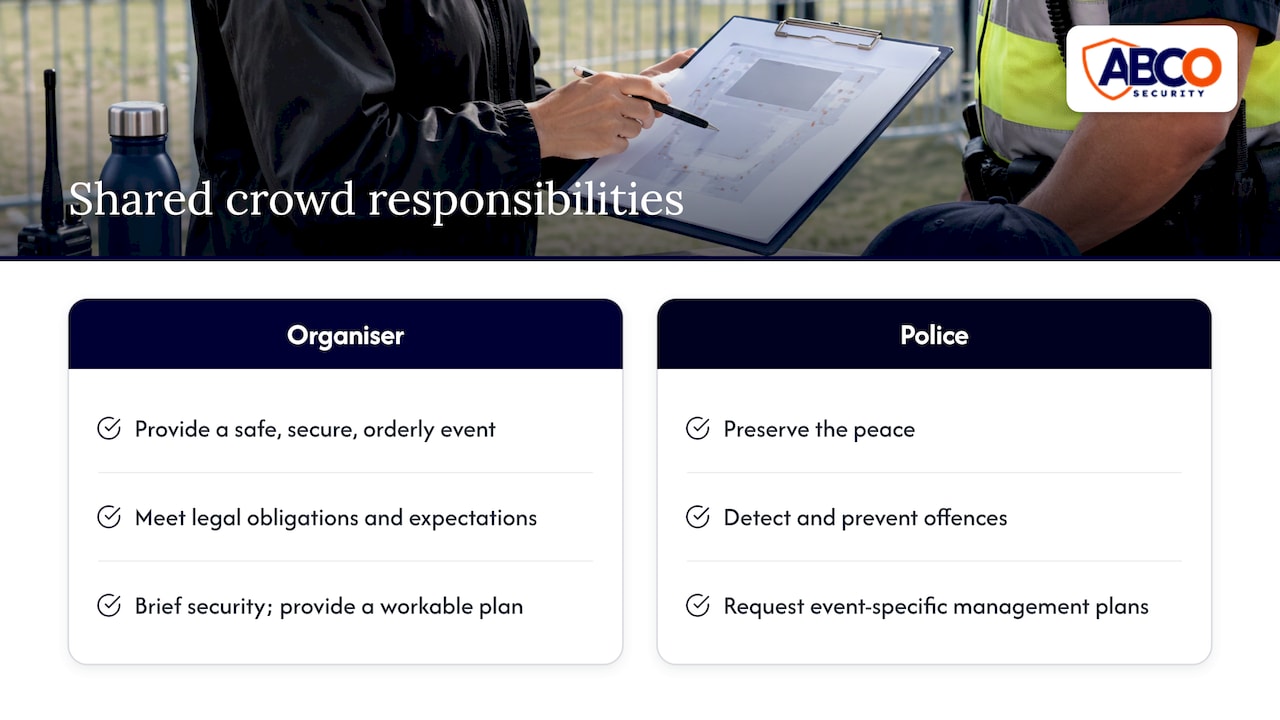
The organiser is the starting point. Victoria Police says public safety at an event is a joint responsibility between the organiser and police. Organisers must provide a safe, secure and orderly event in line with legal obligations and community expectations. Police are responsible for preserving the peace and detecting and preventing offences.
The same page says local police will ask for event-specific management plans. These cover crowd behaviour strategies, traffic management, responsible service of alcohol, risk and hazard identification, and emergency response and safe evacuation.
Occupational health and safety adds another layer. WorkSafe Victoria publishes a practical guide on crowd control at venues and events. It sets out the duties of crowd control agencies and of the host employers, such as venues and events, that use crowd control staff. It also covers how to assess and manage common risks, who must be consulted, who controls which risks, and when an incident must be reported to WorkSafe Victoria.
In short, hiring a security company does not hand your responsibility to someone else. You still need to brief them, give them a workable plan and make sure the site lets them do the job.
Crowd controller licensing by state
The definition of “crowd controller” and the licence class differ by state. Here is what the official sources say for the states we can point you to.
New South Wales
The NSW Government’s event guidance says organisers need to ensure anyone carrying out a security activity is appropriately licensed. That includes acting as a bouncer or crowd controller. It does not necessarily include marshals and wayfinders. The same guidance says NSW RSA certification is mandatory for anyone serving liquor at an event, including volunteers and security staff working at the venue.
NSW Police explain that from 1 June 2023 a person who, for remuneration, carries out crowd controller functions as part of their regular duties at a relevant place must hold a Class 1A (Security Officer) licence. A relevant place includes a place where an event or function is held.
Queensland
The Security Providers Act 1993 defines a crowd controller as a person who, for reward, is at a public place principally to keep order. That can mean screening entry, monitoring or controlling behaviour, or removing people. Section 47 of the Act requires a licensed crowd controller to wear prescribed identification where it is clearly visible, with a maximum penalty of 20 penalty units for non-compliance.
Western Australia
Part 5 of the Security and Related Activities (Control) Act 1996 requires crowd control agents and crowd controllers to be licensed, and crowd controllers to be employed by a crowd control agent.
The Australian Business Licence and Information Service lists the eligibility rules for a WA crowd controller licence. The person must be at least 18, be a fit and proper person, hold a current first aid certificate and have evidence of a Certificate II in Security Operations from an approved provider. Crowd controllers may not carry weapons. Interstate visitors who hold an equivalent licence may apply for a temporary licence of up to one year, which matters if you are bringing in a touring crew.
Victoria
Victoria’s liquor regulations tie licensed crowd controllers to specific event types (see the ratio section below). The City of Greater Geelong also notes that ratios may be specified through Liquor Licensing Victoria, so your liquor licence conditions are a first stop.
South Australia
South Australia focuses on record keeping. The sa.gov.au crowd control register page says a business or event that employs crowd controllers must keep a register. It records each controller’s full name and address, ID card number, licence number and start and finish times. It also records where the register is kept and who runs the business or event. The register must be kept for at least six months and be available to an authorised officer under the Fair Trading Act 1987, the Commissioner for Consumer Affairs or a police officer.
For Tasmania and the territories, check the licensing regulator in that jurisdiction before you book. Our guide to how to get a security licence in Australia explains the general licensing pathway, and what to check on licensed security guards is a useful pre-hire checklist.
How many crowd controllers do you need
There is no national ratio. Numbers come from regulations, liquor licence conditions, council requirements or health guidelines, and the figure that applies to you depends on event type, alcohol, finishing time and assessed risk. The examples below show the pattern.
| Jurisdiction and source | Situation | Ratio stated |
|---|---|---|
| Victoria, Liquor Control Reform Interim Regulations 2021, reg 42 | Live music event | At least 2 licensed crowd controllers, plus 1 more for every additional 100 people attending; at least one must be female |
| City of Greater Geelong, Victoria | General event security rule | 2 guards for the first 100 patrons, then 1 per 100 |
| WA Department of Licensing conditions | Nightclubs and venues trading after 1am | 2 crowd controllers for the first 100 patrons, plus 1 for each additional 100 or part thereof |
| WA Department of Licensing conditions | Large one-off events not trading beyond 1am | 1 crowd controller to 150 patrons may be considered |
| WA Health guidelines 2022 | Higher risk licensed events | At least 2 for the first 100, then 1 per additional 100 or part thereof |
| WA Health guidelines 2022 | Events deemed lower risk by the relevant authority | Normally reduced to 1 controller per 200 patrons |
Three practical points follow from this table.
- Part of a hundred counts. WA’s wording is “or part thereof”, so 101 patrons means three crowd controllers under the first benchmark, not two.
- Exits matter. The WA Health guidelines say that where an exit point also serves as an entry, at least two controllers are needed there.
- Ratios are a floor. They count licensed crowd controllers, not total staff. Your risk assessment may call for more, as well as marshals, first aid and traffic staff who do not need a crowd controller licence.
If you want a worked estimate for your own event, see our guide on how many security guards you need for an event.
Approvals, plans and who to consult
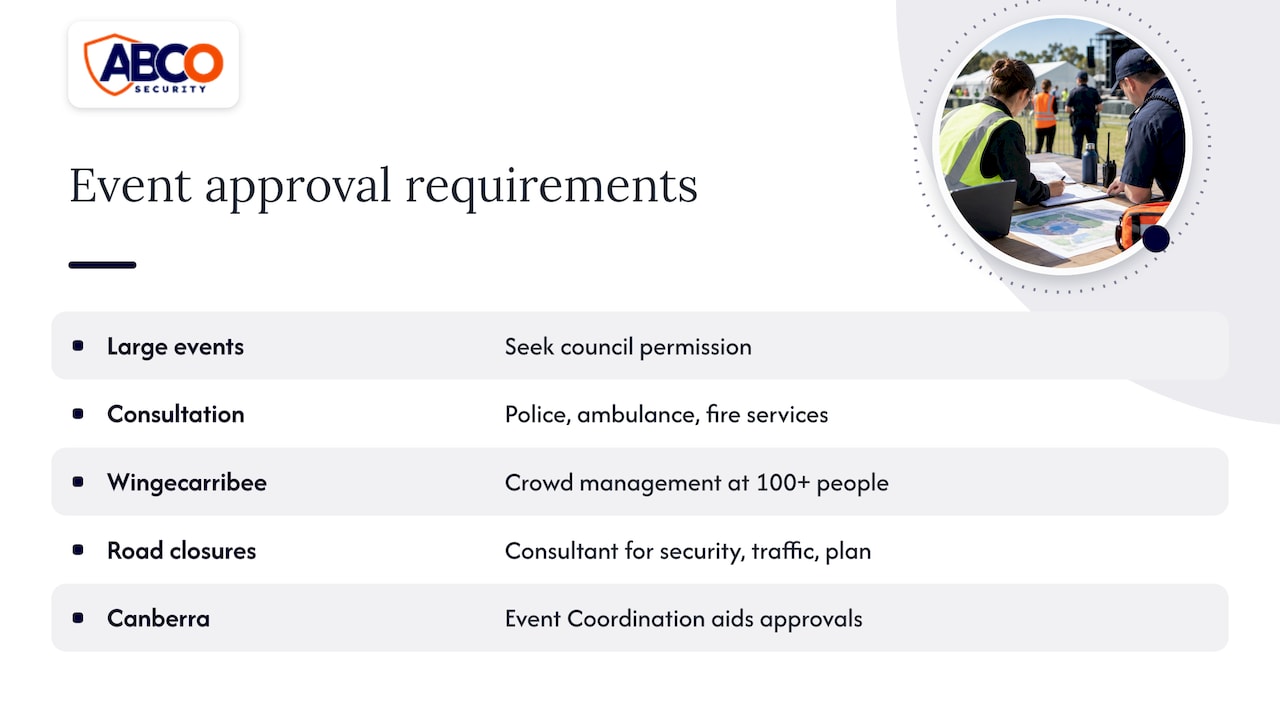
For larger events, the NSW Government says organisers need to seek permission from the local council or consent authority. They should also consult NSW Police, NSW Ambulance, Fire and Rescue NSW or the NSW Rural Fire Service. Traffic and local service disruptions need to be discussed with council and Transport for NSW, and public transport services and parking should be considered.
Council thresholds vary. Wingecarribee Shire Council in NSW says crowd management is required for any event of 100 or more people. If you are closing public roads, it requires a professional consultant to manage crowd security and traffic control and to develop the plan. The council does not set pedestrian capacity limits itself. It expects organisers to engage a qualified traffic management provider, with measures subject to planning approvals, the relevant Australian Standards and the National Construction Code.
In Victoria, WorkSafe’s Victorian Guidelines for Planning Safe Public Events, published on 11 December 2025, cover roles and responsibilities, risk management, building permits, operational considerations, crowd dynamics, alcohol and drug issues, food safety and amenities. If you run events in Canberra, Access Canberra runs an Event Coordination service that helps coordinate public event approvals.
The habit that saves most events is simple: contact your council first, and ask which agencies they will pass your application to. Then build your timeline backwards from that answer.
What a crowd management plan should cover
The NSW Government recommends that a crowd management plan address:
- clearly marked, adequately lit entrances and exits, large enough for evacuation
- stage and barricade design
- crowds around focal points
- sufficient facilities, including accessible facilities and water
- alcohol sales and BYO alcohol
- crowd-control-licensed security guards
- communication with participants
- risks such as overheating, crush and fire
- ticketing to control numbers
- the needs of people with disability and people who may not speak or read English
The same guidance offers a useful design principle, the “straight line rule”. People take the quickest route to where they want to go, and will resist barriers and signage that try to send them elsewhere. Place toilets, food and water so that the natural path works for you, and use barriers to support that flow rather than fight it.
Size is no protection either. NSW guidance notes that even a small event can become crowded, depending on venue or area capacity against expected numbers. Crowds can build in front of a stage or when a VIP arrives in a space that holds few people.
For a deeper set of tactics, our crowd control strategies and checklists for Australian event organisers cover entry management, queue design and communication.
Start with a risk assessment
Security levels should come from your risk assessment, not guesswork. The City of Greater Geelong says different types and scales of events need different levels of security. That level should be set in the risk assessment and detailed in the Emergency Management Plan. The assessment shows which times and areas carry higher risk, and what type of guard is needed, such as a licensed crowd controller with Responsible Service of Alcohol qualifications.
A workable sequence looks like this:
- List the hazards by zone and time: entry queues, bars, stage fronts, car parks, exits.
- Rate each for likelihood and consequence, and note what controls exist.
- Assign people and equipment to the higher risks: licensed crowd controllers, marshals, first aid, barriers, lighting.
- Write the emergency and evacuation plan and brief every team on it before gates open.
- Record decisions and incidents, including crowd controller registers where your state requires them.
Our event risk assessment template for Australia gives you a starting format.
Our perspective: compliance is the minimum, not the plan
Organisers often ask us for “the right number of guards”. The legal number is only one input. The better question is where your crowd will bunch up, when, and who is positioned to see it early.
We think about event security the way we think about every site: proactively, before an incident rather than after it. That means a risk assessment first, licensed professionals matched to the risks it finds, and clear lines of communication between security, organisers and emergency services on the day.
Our work is built on over 15 years in the industry and on adherence to international quality standards, ISO 9001 and ISO 30000. For an organiser, the benefit is practical: a team that documents what it does, briefs properly and keeps the paperwork regulators ask for in order.
If your event is licensed, alcohol is served or the gates are tight, treat the ratios above as a starting point and let the risk assessment decide the rest. Bring your security provider into planning early, not the week before.
Abco
Plan your event security with ABCO
If you are organising an event anywhere in our service area (New South Wales, Queensland, South Australia, Tasmania, Victoria and Western Australia), our Events Security service covers crowd control with licensed professionals, backed by 24/7 operations across Australia. We can also assess your risks and advise on guard numbers before you finalise your plan. Tell us your venue, expected attendance, finish time and whether alcohol is served, and we will start from there.
If you are comparing options first, our guides on how to hire event security in Australia and event security staffing set out what to ask and when to book.
A short pre-event compliance checklist
Use this as a prompt list, then confirm each item with your council, regulator and police.
- Confirm which state licence applies to the people you plan to engage, and that each licence is current.
- Check your liquor licence and council permit for any stated crowd controller numbers.
- Work out ratios using the strictest figure that applies, rounding up for part-hundreds.
- Where required, such as South Australia, set up the crowd controller register before the event.
- Make sure licensed staff wear visible identification where your state requires it, as Queensland does.
- Confirm RSA certification for anyone serving liquor, including volunteers and security working at the venue in NSW.
- Lodge your risk assessment, crowd management plan and emergency plan in the form the council or police request.
- Brief all teams on exits, evacuation points and who has authority to stop the event.
FAQ
Who is responsible for crowd control at an event?
The organiser is responsible for providing a safe, secure and orderly event. Victoria Police describes public safety as a joint responsibility between the organiser and police, with police responsible for preserving the peace and preventing offences. Hiring a security company supports your plan but does not remove your duty.
Do crowd controllers need a licence in Australia?
Yes, in general. Crowd controllers are licensed under state laws, such as NSW’s Class 1A requirement since 1 June 2023, the Queensland Security Providers Act 1993 and Part 5 of the WA Security and Related Activities (Control) Act 1996. Marshals and wayfinders in NSW do not necessarily need one. Confirm the position in your state with its licensing regulator.
How many crowd controllers does my event need?
It depends on your liquor licence, council conditions and risk assessment. A common benchmark is two for the first 100 patrons and one for each additional 100, but WA guidelines allow lower ratios such as 1 per 200 for lower risk events. Ask your council and licensing authority which figure applies.
What are crowd control measures?
They include clear, lit entrances and exits, barricade and stage design, ticketing to control numbers, accessible facilities and water, controlled alcohol service, licensed security staff and communication with attendees. NSW guidance lists these as items for a crowd management plan.
Do small events need a crowd management plan?
Often, yes. Wingecarribee Shire Council in NSW requires crowd management for any event of 100 or more people, and NSW guidance says small events can become crowded depending on venue size. Ask your local council for its threshold.
Sources
- Safety and security for your event, NSW Government
- Crowd controller definition and relevant place, NSW Police
- Security Providers Act 1993 (Qld)
- Security and Related Activities (Control) Act 1996 (WA)
- Crowd Controller Licence, WA, Australian Business Licence and Information Service
- Crowd control register, sa.gov.au
- Events, Victoria Police
- Crowd control at venues and events, WorkSafe Victoria
- Victorian Guidelines for Planning Safe Public Events, WorkSafe Victoria
- Liquor Control Reform Interim Regulations 2021, reg 42 (Vic)
- Security and crowd control planning at events, City of Greater Geelong
- Security licensing conditions, WA Government
- Guidelines for concerts, events and organised gatherings 2022, WA Health
- Event Management, Wingecarribee Shire Council
Recommended
about
avada factory
Sempery ultricies nibh at dolor cras urna eleifend nec. Atiam efficitur tempor.