A commercial access control system in Australia typically costs about $1,500 to $4,000 per door, including GST, covering the reader, controller and locking hardware, according to a 2026 industry cost guide. That is an indicative range, not a quote. The final figure depends on the door type, the cabling route, the software, the number of sites and whether work happens after hours. Below we break down where the money goes, what you pay after installation, and how to put together a budget a licensed installer can price accurately.
TL;DR
- Budget roughly $1,500 to $4,000 per door for reader, controller and lock hardware, GST included. Treat it as a planning range only.
- The site walk sets the real price: cable runs through concrete or high ceilings, after-hours work and door condition move the quote more than the reader brand.
- Plan for running costs. One published Australian example carries an annual subscription of $380 ex GST for monitoring and remote support.
- In every state and territory, security installation work must be done under the right licence, so confirm your installer holds one.
- Ask for a site-walk quote that itemises hardware, cabling, software, commissioning and support, so you can compare like with like.
Table of Contents
- What access control costs per door
- What is included in an installed price
- Why installation costs vary so much
- IP systems, scaling and total cost
- Ongoing costs after installation
- Worked budget example
- How to get a quote you can compare
- Our perspective
- Pairing access control with monitoring and guarding
- Talk to us about your site
- FAQ
- Sources
What access control costs per door
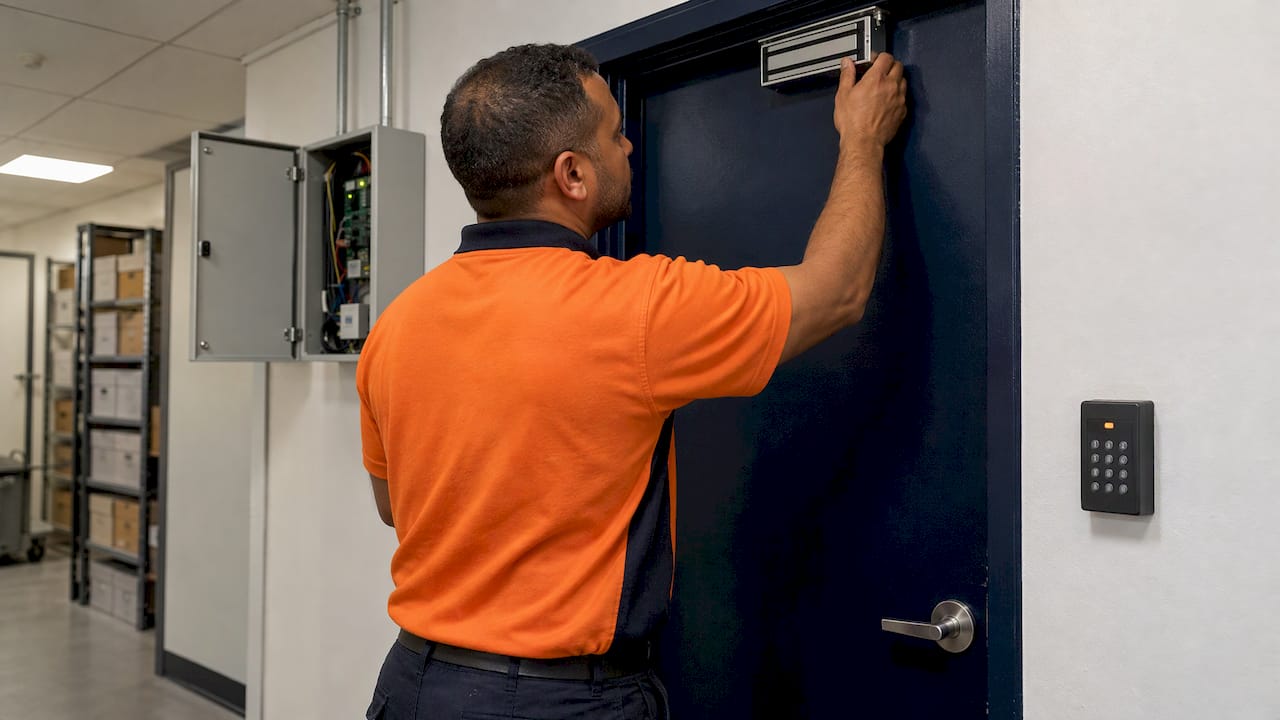
Most Australian quotes are built door by door. A “door” in a quote usually means one controlled opening: a reader (card, fob, keypad, mobile credential or biometric), a controller that makes the decision, and the locking hardware such as an electric strike or magnetic lock. The 2026 cost guide puts that bundle at $1,500 to $4,000 per door including GST.
Why such a wide gap? Because “a door” can be a simple internal office door or a fire-rated entry with a request-to-exit device, a door contact, a power supply and an intercom. The cheap end suits a standard interior door where cabling is easy. The top end suits doors that need heavier hardware, more components or harder installation.
Here is a practical way to think about the spread:
| Door situation | What pushes the price | Where it tends to sit in the range |
|---|---|---|
| Internal office door, easy ceiling access | Basic reader, controller, lock | Lower end |
| Main entry with intercom and visitor handling | Extra components, power, integration | Middle to upper |
| Fire-rated or high-traffic door | Hardware that must keep its rating, more testing | Upper end |
| Loading dock, gate or remote shed | Long cable runs, weatherproofing, power | Upper end, sometimes beyond |
These placements are our reading of the cost drivers, not published prices. Use them to prepare questions, not to set a final number.
A real-world equipment example
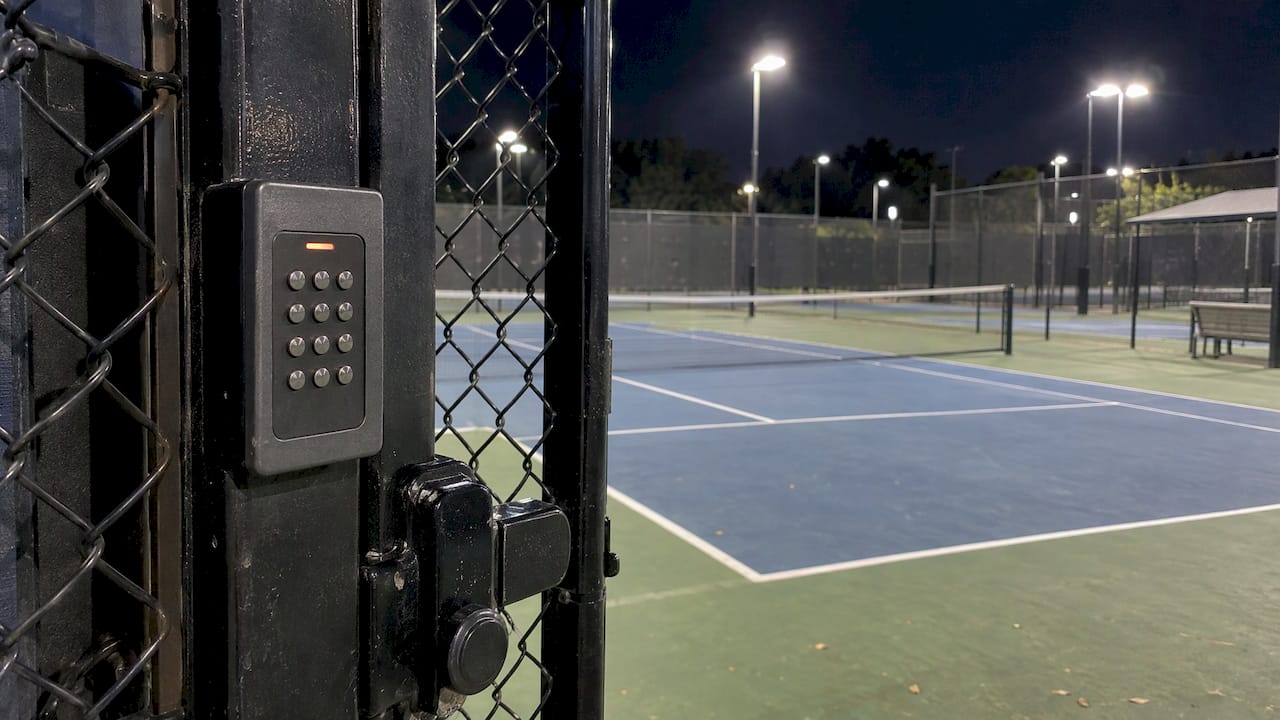
Published figures for complete systems are rare, but Tennis Australia’s Complete Security VAS flyer gives one. For an eight-court lit venue with one access keypad, equipment costs around $5,000 ex GST. That excludes installation, shipping, remote technical support, pre-installation conduit and lighting integration. It shows how quickly the hardware figure becomes only part of the project cost, and why you should read what a quote leaves out.
What is included in an installed price
When you compare quotes, make sure each one covers the same scope. A complete installed price normally has these parts:
- Hardware: readers, controllers, locks, door contacts, exit buttons, power supplies and credentials (cards, fobs or mobile licences).
- Cabling and conduit: the cable from each door back to the controller or network, and any conduit or core drilling needed.
- Software: the management platform that holds users, schedules and logs, either installed on your server or hosted.
- Installation and commissioning: mounting, terminating, programming, testing and handover.
- Training and documentation: how your staff add and remove users, and what the as-built drawings show.
- Support: remote help, call-outs and maintenance after handover.
If a quote shows one lump sum per door with none of this broken out, ask for the detail. It is also the easiest way to spot why two quotes for the same building differ by thousands.
Why installation costs vary so much
The hardware is the visible part. The labour and conditions are where quotes diverge. The same 2026 guide explains that the installer’s price depends mostly on what they find on the site walk. Cable runs through concrete slabs or high warehouse ceilings take longer than runs through an office ceiling cavity, and work done after hours to avoid disrupting trade costs more.
The factors that most often change a quote:
- Building construction. Concrete, masonry and heritage walls slow down cabling. Plasterboard and accessible ceiling space speed it up.
- Distance to the controller. Doors at the far end of a warehouse or across a car park need longer runs and sometimes additional power.
- Existing doors. A door that does not close properly, has a worn frame or needs new hardware will add cost before the access control even goes on.
- Fire and egress requirements. Locks on exit routes must release correctly. Our guide to door hardware for access control explains how to protect fire ratings when you add electronic locking.
- Timing. Out-of-hours installation avoids disruption in retail, healthcare and busy offices, but costs more.
- Integration. Linking access control to CCTV, alarms, lifts or visitor systems adds configuration time. If cameras are part of the picture, a primer on business security camera systems covers how to choose and secure them.
If you want to understand the physical side in more detail, our article on how to wire an access control system shows what the cabling stage involves.
Licensing is part of the price
Australian security installation is a licensed activity. Gemcell’s industry guide states that all states and territories require licensing for security installation work, including electronic, electromagnetic and biometric access-control devices. The same guide notes that in NSW a Class 2C Security Equipment Specialist licence is needed to sell, install, maintain, repair, service and advise on security equipment.
For you, that means a very low quote from an unlicensed operator is a risk to your insurance and compliance, not a saving. Ask for the installer’s licence number and check it with the relevant state regulator before you sign.
IP systems, scaling and total cost
The cheapest system on day one is not always the cheapest over five years. 2N’s article on total cost of ownership in access control says IP and Power-over-Ethernet architectures can reduce separate cabling, power supplies and hardware, and that centralised management lowers configuration and administration effort. It also says IP-based systems can add devices without major infrastructure redesign, which helps avoid replacement or expansion costs later.
This matters if you expect to grow. A business that starts with four doors and adds twelve more in two years should ask early:
- Can the controllers be expanded, or will they need replacing?
- Is the software licensed per door, per user or per site?
- Can a second site be managed from the same platform?
- Will the system work with the cameras and alarms you already have?
Multi-site operators, such as retail groups or healthcare networks, tend to gain most from one central platform. For a comparison of what suits smaller premises, see our guide to the best access control system for small business, and for the wider market, our guide to access control systems in Australia.
Ongoing costs after installation
Budget for the years after handover as well. Typical recurring items include:
- Software licences or hosting. Cloud platforms often charge per door or per user.
- Monitoring and remote support. The Tennis Australia example above carries an annual subscription of $380 ex GST covering booking-data transmission, PIN activation, system-status monitoring and remote technical support. That is one venue’s figure, so use it as an example of the type of fee, not as a benchmark.
- Credentials. Replacement cards, fobs and mobile licences as staff change.
- Maintenance. Lock and reader servicing, battery replacement and periodic testing.
- Call-outs. Faults, door damage and reconfiguration after a restructure.
Standards also shape what a well-designed system should do. According to ASIAL, the AS/NZS IEC 60839 series is the Australian standard for electronic access control systems, specifying minimum functionality, performance and test methods and defining different security grades. Asking which grade a proposed system meets is a sensible way to compare quotes.
Worked budget example
To show how the pieces combine, here is a planning exercise using the published per-door range. It is arithmetic, not a quote.
Imagine a single-site office with six controlled doors: a main entry, a reception door, a server room, two internal tenancy doors and a rear staff entry.
| Item | Planning figure |
|---|---|
| 6 doors at $1,500 (low end of range) | $9,000 |
| 6 doors at $4,000 (high end of range) | $24,000 |
So the hardware-and-fit budget for this office sits between $9,000 and $24,000 including GST, based on the 2026 cost guide’s range. Where your site lands depends on the factors above. A site walk replaces this range with a real number. Add the ongoing items from the previous section and keep a contingency for door repairs found once work starts.
How to get a quote you can compare
- List your doors and why each needs control. Group them: perimeter, internal, high-risk areas.
- Decide who needs access and when. Staff, contractors, cleaners and visitors all need different rules.
- Book a site walk with at least two licensed installers. A quote without a site visit is a guess.
- Ask for itemised pricing covering hardware, cabling, software, commissioning, training and support.
- Confirm licensing and insurance before you compare price.
- Ask about expansion. What does door number seven cost once the system is in?
- Check how the system links to guarding and monitoring if you use them.
If you are still deciding whether to move away from mechanical locks at all, our comparison of access control versus keys covers the trade-offs for different sites. Construction managers have different needs again, and our construction site access control guide covers temporary and relocatable setups.
Our perspective
Access control is rarely a standalone purchase. The doors, readers and software only deliver value when someone responds to what they record: a door held open, a credential used at an odd hour, an alarm at a site that is empty.
That is why we approach access control as part of an integrated security plan. Our electronic security work sits alongside licensed static guards, mobile patrols and 24/7 CCTV and alarm monitoring, so the system you install is backed by people and procedures. We work with construction, healthcare, corporate, retail, event and industrial clients, and the questions differ at each: a hospital needs patient safety and clear egress, a construction site needs a system that can move, an office needs after-hours visibility.
We hold ISO 9001 and ISO 30000 standards and have more than 15 years in the industry, and we aim to be proactive, anticipating risk instead of only reacting. For cost, our advice is simple: scope the whole security picture first, then price the technology to fit it. A well-scoped system costs less over its life than one patched together door by door.
Abco
Pairing access control with monitoring and guarding
Access control tells you who came in. It does not stop a determined intruder or respond to an alarm by itself. Many of our clients combine it with:
- A1 CCTV and alarm monitoring, so events at a door are seen and acted on.
- Mobile patrol services, so a patrol can attend after an alarm or check the perimeter overnight.
- Security guarding at sites that need a visible presence at entrances.
The Electronic Security Solutions team can scope access control along with CCTV and alarms in one site assessment.
Talk to us about your site
If you manage a construction site, clinic, office, retail premises or event and want security that fits your budget, we can assess the site and recommend a layered plan. For sites that need coverage after hours, our Night Owl Service starts from $5.45 per day, with 12M and 24M plan options available on the same page.
For access control and electronic security pricing, we quote after a site assessment, so you get a figure that reflects your doors and your building. Start with our Electronic Security Solutions page or contact us through the ABCO Security site.
FAQ
How much does an access control system cost for a small business in Australia?
Using the published planning range of $1,500 to $4,000 per door including GST, a three-door small business would budget roughly $4,500 to $12,000 for hardware and installation. Your figure depends on cabling, door condition and software. A site walk by a licensed installer gives the real number.
Are there ongoing fees for access control?
Often yes. These can include software licences or hosting, monitoring and remote support, replacement credentials and maintenance. One published Australian example lists an annual subscription of $380 ex GST for monitoring and support. Ask every installer to list recurring costs in the quote.
Why do two quotes for the same building differ?
Usually because the scope differs: different hardware grades, different software licensing, or one quote leaving out cabling, commissioning or support. After-hours work and cabling conditions also change the labour cost. Itemised quotes make the difference visible.
Does the installer need a licence?
Yes. All Australian states and territories license security installation work, including electronic access control devices. In NSW, a Class 2C Security Equipment Specialist licence is required for selling, installing and servicing security equipment. Ask for the licence number and verify it with your state regulator.
Sources
- Commercial Security Cost Australia 2026
- Complete Security VAS flyer, Tennis Australia
- How to become a security system installer: a checklist, Gemcell
- Total cost of ownership in access control, 2N
- Electronic Security Standards, ASIAL
Recommended
about
avada factory
Sempery ultricies nibh at dolor cras urna eleifend nec. Atiam efficitur tempor.