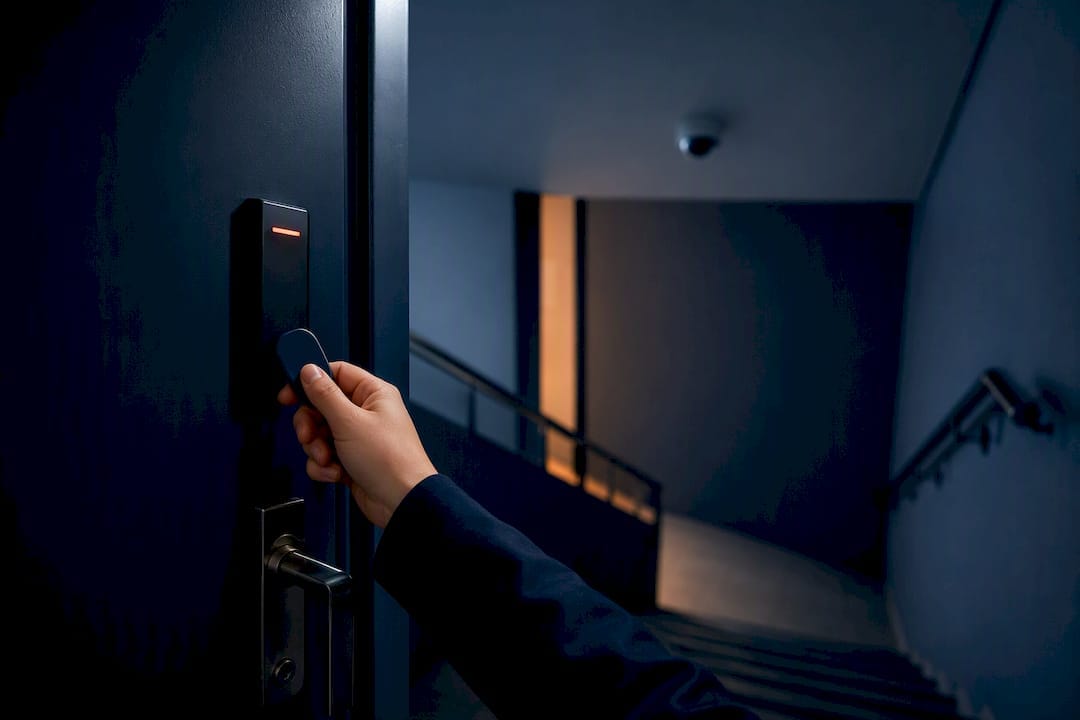
An access-control lockdown lets you instantly place a site or zone into a secure mode that stops entry or exit when sheltering in place is safer than evacuating. It protects people during an active threat by controlling movement through doors rather than people, and the trigger is always a specific hazard, whether that’s a hostile intruder, an external danger, or a situation where getting everyone outside would create more risk than it solves. Getting it right means treating it as engineered infrastructure governed by standards like SA HB 188 and D3D26, not a software feature bolted onto existing doors.
TL;DR:
- The system must have local relay fallback, uninterruptible power supply, supervised wiring, and resilience testing to ensure lockdowns function during network or power failures.
- Activation methods like manual buttons or duress alarms are most reliable under stress, while automated triggers require careful tuning to avoid false alarms.
- Proper integration with CCTV, PA systems, and monitored alarms ensures fast, coordinated responses within seconds, not minutes.
- Staff roles, authorizations, and rehearsal schedules must be clearly defined and regularly tested, with at least quarterly lockdown drills mandated by sector standards.
- Compliance with Australian standards and the NCC D3D26 provision requires documented fail-safe hardware and detailed emergency management plans for safe, effective lockdowns.
Table of Contents
- How does an access control lockdown system actually work?
- Which activation method actually holds up under pressure?
- How should lockdown integrate with CCTV, PA and alarms?
- Who does what: roles, authorisation and rehearsal cadence
- What Australian standards and rules constrain lockdown design?
- What should you require before accepting a lockdown system?
- Design principles that hold up in the field
- Why most lockdown advice misses the point
- How Abco can help you build a lockdown you can trust
- Sources
- FAQ
How does an access control lockdown system actually work?
A lockdown system is built from five layers that have to talk to each other reliably under stress. The controller is the brain, usually a distributed network of door controllers rather than one central box, because a single point of failure defeats the whole purpose. Door hardware, magnetic locks, electric strikes, or motorised bolts, does the physical work. Card or fob readers and duress buttons feed input. Management software coordinates the fleet, and a monitoring service watches for anomalies and confirms status in real time.
When someone triggers a lockdown, whether that’s a staff member hitting a duress button, an operator issuing a software command, or an automated sensor firing, the signal has to reach every affected door, actuate the lock, and then send confirmation back that it actually happened. That round trip matters. A lockdown that reports “activated” but hasn’t physically engaged the door hardware is worse than no lockdown at all, because it gives false confidence.
Most sites need more than one lockdown mode. Consider:
- Site-wide lockdown, locking every controlled door across a campus or building simultaneously.
- Zoned lockdown, isolating a wing, floor, or building while leaving the rest operational for evacuation or emergency services access.
- Partial lockdown, restricting external access while allowing internal movement, common for a suspicious person on the perimeter rather than a confirmed threat inside.
Resilience is where a lot of systems fall down. Controllers should hold local logic so they can execute a lockdown command even if the connection to the head-end server drops. Distributed processing means one controller failing doesn’t take out the whole fleet. Every panel needs uninterruptible power supply backup, and door circuits should be supervised so a cut wire or tampering attempt triggers an alert rather than failing silently.
Which activation method actually holds up under pressure?
Activation methods fall into three categories, and each carries different failure risks. Manual triggers, physical duress buttons under a desk, a panic app on a staff phone, or a keyed switch, are the most reliable because they don’t depend on anyone correctly reading a situation through a monitor. Operator consoles let a security control room initiate a lockdown after reviewing camera feeds or an alarm event, which adds judgement but also adds a human bottleneck. Automated triggers, tied to gunshot detection, forced-entry sensors, or duress-linked alarms, remove the delay but need careful tuning to avoid false activations that erode staff trust in the system.
The biggest reliability risk in the industry right now is server dependency. If your lockdown command has to travel from a duress button, through a network switch, to a central server, and back down to a door controller, every one of those hops is a place the system can fail during exactly the event you built it for. Field experience across the security sector consistently flags network outages as one of the most common real-world failure points, which is why a hardwired relay path that bypasses the network entirely is worth the extra cost on critical doors.
Build your mitigation checklist around these points:
- Require local relay fallback on every critical door so a lockdown can fire without network connectivity.
- Specify redundant communication paths, cellular backup alongside the primary network link, on sites with any history of outages.
- Insist on supervised wiring so a cut cable reports as a fault rather than a silent failure.
- Test battery and UPS runtime under full lockdown load, not just standby load.
Pro Tip: During acceptance testing, physically pull the network cable and cut mains power to a controller, then confirm the lockdown still fires and the door still locks. If your integrator doesn’t let you do this test, that’s a red flag about how the system was actually built.
How should lockdown integrate with CCTV, PA and alarms?
A lockdown that locks doors but leaves your monitoring team blind is only half a system. The value comes from the sequence: a trigger locks the affected doors, cameras covering those doors and corridors snap to a preset view, the monitoring centre receives an alert with location data, and a PA or mass-notification system pushes a clear instruction to occupants. Each step should happen in seconds, not through a chain of phone calls.
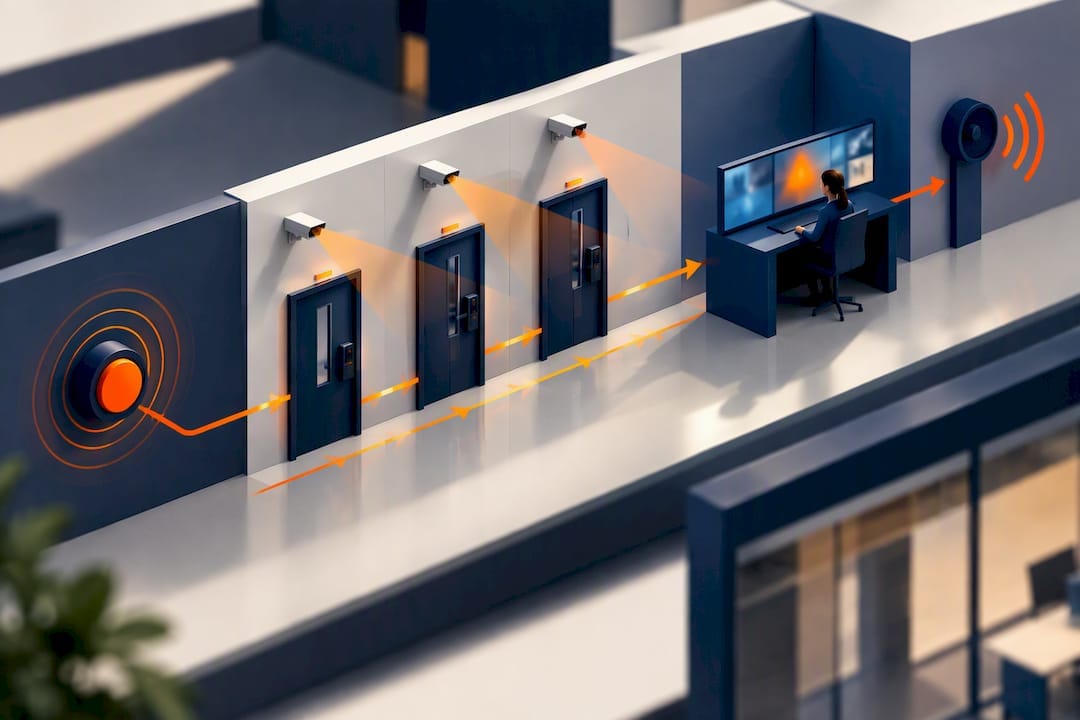
Responders arriving on scene, whether that’s internal security, police, or an emergency coordinator, need three things fast: which zones are currently locked, the last known footage from cameras near the incident, and recent access logs showing who badged through which door and when. Systems that can’t produce that picture within a minute or two aren’t actually integrated, they’re just co-located.
A 24/7 monitored service earns its keep here. Rather than relying on an on-site guard to notice an alert, a monitoring provider watching feeds continuously can confirm a lockdown has physically engaged, cross-check camera footage against the reported trigger, and start the call tree to police or the site’s emergency coordinator without waiting for someone on-site to act. That interface between electronic monitoring and the site’s emergency management plan needs to be documented, not assumed, so everyone knows who calls what and in which order.
When commissioning a system, verify these integration points directly rather than taking the integrator’s word for it:
- Confirm camera presets actually load automatically when a specific door group locks.
- Check the PA message triggers within a defined time window of the lockdown command, not minutes later.
- Test that access logs remain queryable during lockdown, not just after it’s lifted.
- Confirm the monitoring provider’s alert format matches what your emergency coordinator can actually act on quickly.
Who does what: roles, authorisation and rehearsal cadence
An emergency management plan (EMP) is what turns hardware into a usable response. It needs to spell out exactly who can authorise a lockdown, what the escalation path looks like if that person is unreachable, what the PA and text-alert wording says at each stage, and who has authority to call the all-clear. Vague plans that say “management will assess the situation” fail in real incidents because nobody knows if they’re that person.
On-site roles typically break down as follows:
- Emergency coordinator authorises lockdown and all-clear, and is the single point of contact for arriving emergency services.
- Switchboard or control room operator activates the system, monitors feeds, and manages the initial communication.
- Block or floor wardens confirm their area is secured, account for occupants where practical, and report status back.
- Emergency response officers or security guards move to check unlocked or non-compliant doors and manage foot traffic near entry points.
Rehearsal frequency isn’t optional guesswork, it’s set by sector guidance. ACECQA’s emergency and evacuation guidance requires certain early childhood services to rehearse emergency procedures, including lockdowns, at least every three months, alongside strict recordkeeping obligations. Victorian Department of Education guidance sets similar expectations for school EMPs, requiring regular review and rehearsal rather than a one-off drill filed away and forgotten.
Vary how you run drills, not just how often. A lockdown at 9am on a Tuesday with full staffing tells you nothing about how the system copes at an after-hours event, with casual staff unfamiliar with the procedure, or with a non-ambulatory occupant who can’t reach a designated safe area quickly. Document every debrief, log what failed, and feed corrective actions back into the EMP and into your next security risk assessment, because the plan is only as good as its last honest review.
What Australian standards and rules constrain lockdown design?
Two documents shape almost every serious lockdown design decision in Australia, and ignoring either one risks a system that either fails compliance or fails safely in the wrong way. SA HB 188:2021 was developed with the Australian Reinsurance Pool Corporation and ASIO input to guide proportional, risk-based base-building security, and it builds directly on ISO 31000:2018 risk management principles rather than a one-size-fits-all checklist.
The other is the D3D26 provision in the National Construction Code, which governs door latch and locking hardware. D3D26 requires that door opening actions never delay egress, and it only permits special security arrangements, the kind of hardware a lockdown system relies on, when fail-safe devices are demonstrably in place and immediate exit remains possible. This is the clause that trips up poorly designed systems: a mag-lock that can’t release during a fire alarm isn’t a security feature, it’s a code breach and a life-safety failure waiting to happen.
In practice: any door where security hardware could conflict with fire egress needs documented, tested fail-safe behaviour, and that documentation should sit alongside your EMP for audit purposes.
Sector-specific rules layer on top of these base requirements. Consider these when scoping a project:
- Education providers face state department EMP requirements on top of general building code compliance.
- ACECQA-regulated services face a mandated minimum rehearsal frequency, not just a recommendation.
- Higher-sensitivity zones, per guidance like PHYSEC1 in the South Australian protective security framework, often require electronic access control conforming to Australian CNC safety standards with full audit logging rather than mechanical keys.
- Any emergency egress interlock between lockdown hardware and fire systems needs formal sign-off, not an informal handshake between installer and fire contractor.
What should you require before accepting a lockdown system?
A procurement checklist that only lists features misses the point. What matters is proof the system behaves correctly under the exact failure conditions it’s designed for. Before signing off on a proposal, confirm the vendor can demonstrate:
- Local hardware logic on every controller, so a lockdown fires without a live server connection.
- A hardwired relay fallback path on doors identified as critical in your risk assessment.
- Documented power and communications resilience, including UPS runtime figures under load.
- Full audit logging that captures every access event, override, and lockdown activation with a timestamp.
- Genuine integratability with your existing CCTV, PA, and monitored alarm platforms, not just a claim of compatibility.
Acceptance testing is where you separate a system that works on paper from one that works in an actual incident. Require, at minimum, a live activation test, a simulated network-loss test, a power-fail test, and a check that camera presets, PA messaging, and monitoring alerts all fire correctly together. Any acceptance suite worth signing off should also include a full rehearsal with the staff who’ll actually use the system, plus a formal handover briefing with your 24/7 monitoring provider so they know exactly what each alert means and what to do about it.
Pro Tip: Ask for every test result in writing, including the failures. A vendor who can’t show you what went wrong during testing, only the passes, hasn’t actually tested thoroughly.
Warranty terms and the maintenance schedule deserve as much scrutiny as the hardware. A lockdown system that isn’t serviced regularly degrades quietly, batteries lose capacity, supervised circuits drift out of calibration, and firmware falls out of date, until the one time you actually need it. Build a service agreement with defined response times for faults, not just an annual health check.
Design principles that hold up in the field
Standards give you the floor, not the finish. Abcosecurity applies a defence-in-depth approach to every lockdown-capable system: access control is one layer among perimeter security, detection, and a monitored response, never the whole solution on its own.
That translates into a consistent set of design choices:
- Supervised circuits on every critical door, so tampering or a cut wire triggers an alert rather than staying invisible.
- Local failover logic on controllers, so a lockdown still fires if the network or head-end server drops out.
- 24/7 monitoring integrated into the emergency management plan, not sitting alongside it as an afterthought.
- Test regimes built from SA HB 188’s risk-based framework and D3D26’s egress requirements, mapped into a documented, repeatable acceptance process.
Abcosecurity’s services cover the full lifecycle: system design, electronic security installation, ongoing monitoring, and staff rehearsals that turn a compliant system into a genuinely usable one. Case-specific results and client outcomes are available on request for sites with comparable risk profiles.
Why most lockdown advice misses the point
Most guidance on this topic treats a lockdown as a single dramatic event, a button gets pushed, doors lock, crisis managed. That framing undersells what actually determines whether a system works: the boring parts. Whether the controller has local logic. Whether the UPS was tested under full load, not standby. Whether the last drill happened at an inconvenient time with unfamiliar staff, because that’s when real incidents happen too.
The conventional advice to “install access control and add a lockdown button” also skips the regulatory tension at the heart of good design. D3D26 exists precisely because security hardware and fire egress can conflict, and too many facility teams discover that only during an audit, not during design. Standards like SA HB 188 aren’t bureaucratic overhead. They’re a risk-proportional framework that stops you over-engineering low-risk sites and under-engineering high-risk ones.
If you take one thing from this, prioritise resilience testing over feature lists. A system with fewer bells and whistles that still locks the door during a power outage beats a feature-rich platform that quietly fails when the network drops.
— Abco
How Abco can help you build a lockdown you can trust
Some security providers work with facility managers and education administrators to design, install, and support access-control lockdown systems that hold up during network outages and power failures, not just on a showroom demo. Where a self-managed setup leaves you juggling vendor firmware updates, battery replacement schedules, and after-hours fault response on your own, Abcosecurity’s A1 CCTV & Alarm Monitoring service keeps a monitored team watching your system around the clock, so a fault or an activation gets a response even at 3am on a weekend.
If you’re weighing a managed service against handling monitoring in-house, the deciding factor is usually response speed during the exact events you’re planning for, not day-to-day cost. Abcosecurity’s Night Owl Service starts from $5.45 per day and includes 24/7 monitored oversight, while larger sites often suit the 12M or 24M plans for longer-term coverage. Facility teams also draw on Abcosecurity’s electronic security installation capability to fit lockdown-capable hardware to existing door infrastructure without a full rebuild.
Request a site review to get a specific quote and a written breakdown of what a compliant, resilient lockdown build looks like for your building.
Sources
- D3D26 operation of latch | ABCB
- Emergency and evacuation (ACECQA guidance)
- PHYSEC1 Physical security (South Australian protective security framework)
- Emergency Management Policy v2.15 (example campus policy)
FAQ
What are the four types of lockdown?
Most Australian EMPs define lockdown by scope and cause: site-wide lockdown (every door locked), zoned or partial lockdown (specific areas isolated), external-threat lockdown (perimeter secured, internal movement allowed), and internal-threat lockdown (movement restricted throughout, including internally). Which type applies depends on where the hazard is and whether evacuation is safer than sheltering, as outlined in sample campus emergency management policies.
What are the five steps of access control?
The typical sequence runs identification, authentication, authorisation, access decision, and audit logging, meaning the system checks who someone is, verifies that claim, checks what they’re allowed to do, acts on the request, and records it. During a lockdown, that same chain still runs, but the authorisation step is overridden by the lockdown command rather than individual credentials.
Is it good to have lockdown mode enabled on my access control system?
Enabling lockdown capability is standard practice for any site with a credible active-threat or hazard risk, including schools, corporate offices, and healthcare facilities. The real question isn’t whether to have it, but whether it’s been engineered to fail safely, tested under network and power loss, and rehearsed regularly enough that staff use it correctly under pressure.
How often should we rehearse our lockdown procedures?
Rehearsal frequency depends on your sector, but ACECQA guidance requires certain early childhood services to rehearse at least every three months, and school EMPs under Victorian Department of Education policy expect similarly regular review. Vary drill timing and staffing levels to genuinely test the plan rather than repeating the same scenario.
Does Abcosecurity offer 24/7 monitoring for lockdown-capable systems?
Yes, Abcosecurity’s A1 CCTV & Alarm Monitoring service provides continuous monitored oversight that integrates with lockdown activations, alongside the Night Owl Service starting from $5.45 per day. Pricing for larger or multi-site plans is available on request through a site review.
Recommended
about
avada factory
Sempery ultricies nibh at dolor cras urna eleifend nec. Atiam efficitur tempor.