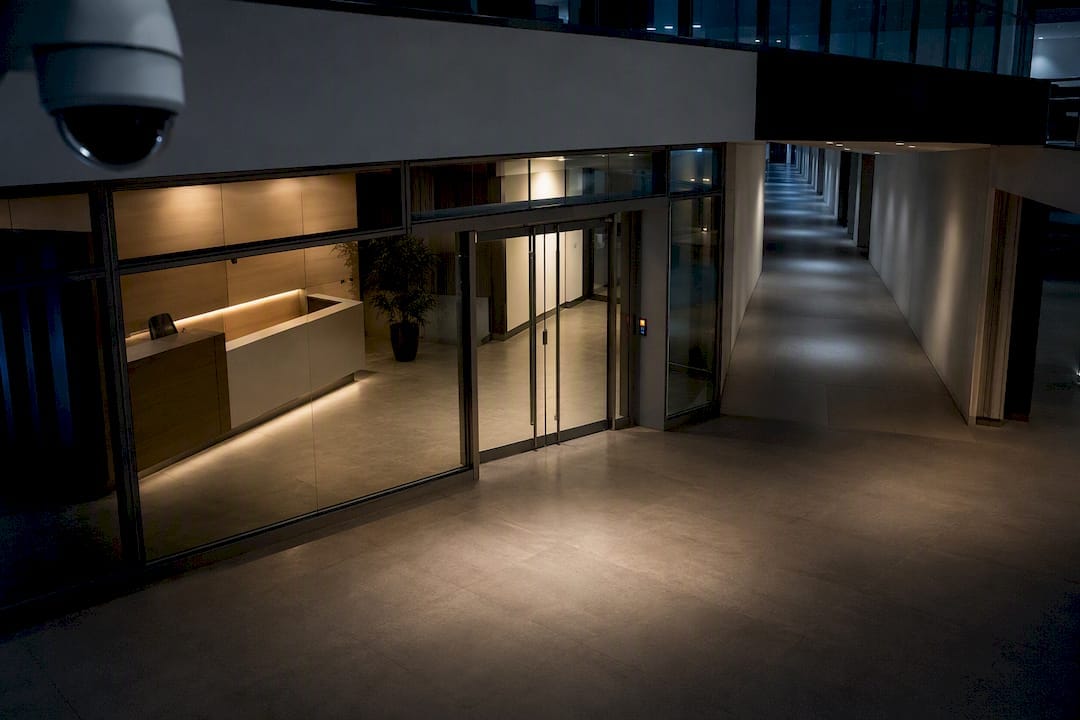
The best defence for an office after hours is layered protection: a monitored alarm, remote video verification, and a licensed mobile patrol or lock/unlock service tied together. This combination catches an intrusion within minutes, sends a verified alarm to a human, and produces evidence a guard or the police can act on. Anything less, a lone alarm siren or an unmonitored camera, leaves the gap between detection and response wide open. The sections below walk through how to build that layer, choose a provider, and budget for it properly.
TL;DR:
- A layered security approach combining monitored alarms, remote video verification, and licensed patrols is essential to catch intrusions within minutes and gather verifiable evidence.
- Effective security systems must be carefully placed and integrated, with sensors, cameras, and access controls tested under real night conditions and in alignment with site-specific risk assessments.
- Contracts should include clear response SLAs, proof-of-service mechanisms, and compliance with licensing, insurance, and safety standards, with pilot testing recommended before long-term commitments.
- Site assessments and staged implementation over several months ensure a practical transition from basic alarms and CCTV to fully integrated security workflows.
- Most offices fail by mismatched systems that do not communicate, emphasizing the importance of starting with a risk assessment and building security measures as a coordinated workflow.
Table of Contents
- What after-hours security services actually cover
- Which technology actually stops after-hours break-ins?
- What should a mobile patrol or guard contract include?
- How do you choose a provider and write the brief?
- A multi-month staged plan to get from assessment to full deployment
- Why ABCO Security is set up to deliver this
- What most offices get wrong about after-hours security
- Get a site risk assessment or run a pilot with ABCO
- Sources
- FAQ
What after-hours security services actually cover
Most offices patch together some mix of five services, and each one solves a different problem.
- Static night guards sit on-site for the full closed period. Right for high-value stock rooms, executive floors, or multi-tenant buildings where a physical presence deters loitering and manages access for cleaners or contractors.
- Mobile patrols visit on a scheduled or randomised route, checking doors, windows, and car parks. This suits a single-tenant small office that doesn’t need a guard parked there all night but wants regular eyes on the building.
- Remote monitoring connects your alarm and cameras to a monitoring centre that watches for triggers and dispatches a response. It’s the backbone of almost every after-hours setup because it operates continuously without a wage bill attached to every hour.
- Alarm response is the guard or patrol dispatched when a monitored alarm activates, usually within a contracted window, to verify the trigger and secure the site.
- Lock/unlock and key holding covers a guard or patrol officer securing the premises at close and opening it again for early staff, holding keys under documented custody rather than handing them to whoever’s rostered on.
The buyer question is coverage windows: does the service run from close to open, or only overnight core hours? Ask whether patrols are scheduled at fixed times (predictable, but also predictable to anyone watching the building) or randomised, which is what state police guidance on business security points to when it stresses procedural controls over one-off deterrents. Get the alarm-response steps in writing: what triggers a callout, how fast the officer arrives, and what happens if they can’t gain entry.
Which technology actually stops after-hours break-ins?
Cameras and sensors only earn their cost if they’re placed and integrated properly. Cloud CCTV with AI-based analytics filters out cats, wind-blown bins, and passing traffic before they ever reach a human reviewer, which cuts down the false-alarm fatigue that makes monitoring staff slower to react to a real one. When an incident does happen, cloud storage means footage is pulled and reviewed in minutes rather than someone driving to site to pull a hard drive.
Placement matters more than camera count. Priority spots are:
- Every entry point, including fire exits staff prop open during the day and forget to check at close
- Loading bays and delivery doors, where after-hours access is common and least supervised
- Server rooms and comms cupboards, which hold more resale and disruption value than most petty thieves realise
- Stairwells and lift lobbies in multi-tenant buildings, where an intruder can move between floors unseen
Access control needs the same discipline. Set credential expiry so a departed employee’s swipe card doesn’t quietly work for another six months, build in anti-tailgating rules for shared entries, and run a logged visitor workflow for contractors working late. Lighting and automation round it out: motion-activated exterior lighting exposes anyone loitering near a door, and integrating it with your alarm means a trigger doesn’t just sound a siren, it also floods the area in light. Alpha Security’s guide to integrated office security makes the point that these systems only work if they’re commissioned and tested under real night conditions, not just switched on and assumed to function.
Pro Tip: Test your CCTV’s night mode footage quality once a quarter. Infrared and low-light performance degrades with lens grime and firmware drift, and you won’t notice until you need footage that turns out to be unusable.
What should a mobile patrol or guard contract include?
Contracting a guard or patrol firm without checking their compliance posture is how offices end up with a service on paper and nothing enforceable in practice. ASIAL’s Mobile Patrols Code of Practice sets the benchmark: proof of attendance through GPS records or geotagging, documented key custody procedures, and secure storage for any keys held off-site. If a provider can’t show you how they log attendance, that’s a compliance gap, not a minor detail.
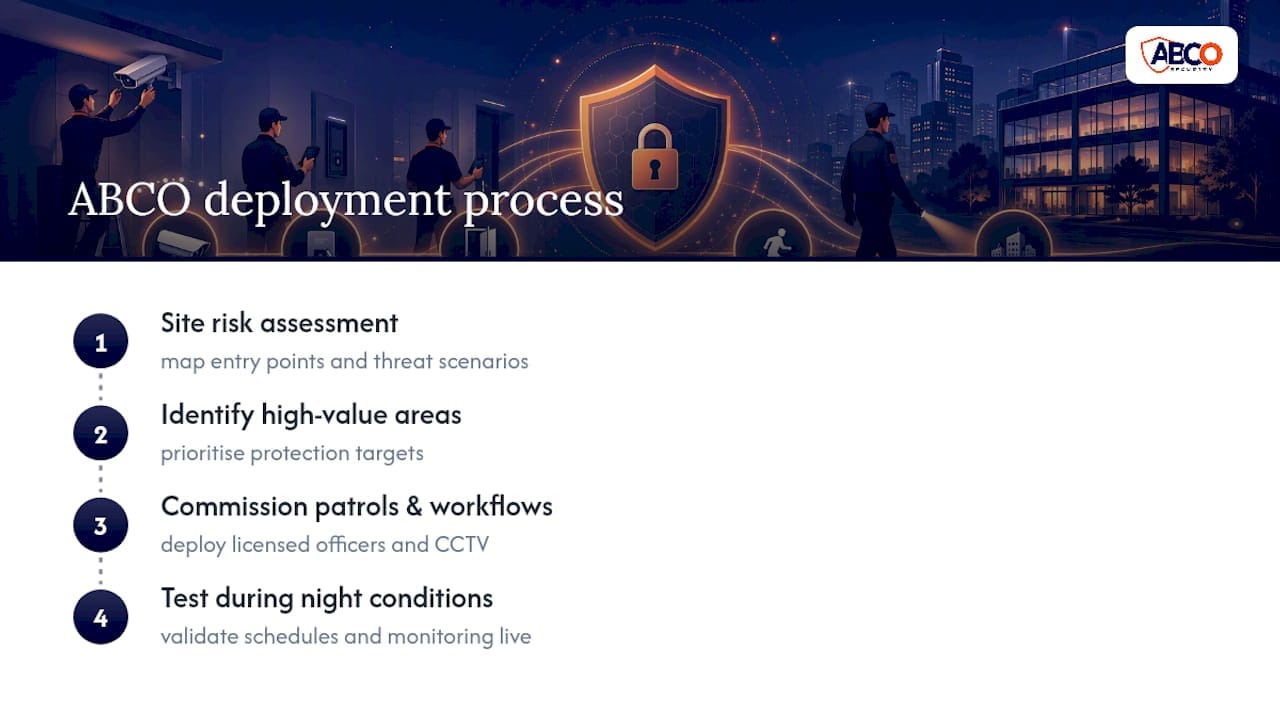
Before any service starts, a proper site risk assessment should map entry points, high-value areas, lighting gaps, and the specific threats your building faces, echoing the same insight that police guidance and ASIAL’s code both share: generic patrol schedules are far less effective than one built around your actual site.
Health and safety obligations matter too, particularly fatigue management rosters and lone-worker check-in procedures for officers working solo overnight. A provider without documented lone-worker protocols is carrying risk that eventually becomes your liability.
Red flags to walk away from in any proposal:
- Vague response times with no contracted SLA
- No proof-of-service mechanism offered as standard
- Insurance certificates that can’t be produced on request
- No named risk assessment step before service commencement
A key management policy that spells out custody, audit trails, and lost-key procedures should sit alongside any patrol or lock/unlock contract, not as an afterthought.
How do you choose a provider and write the brief?
Compare proposals against a fixed set of criteria rather than letting each provider define its own pitch. Build your scoring around:
- Licensing and vetting — every officer holds a current security licence, and the provider can show its screening process on request.
- Monitored response capability — the monitoring centre meets recognised standards such as AS 2201.2, which sets equipment, staffing, and redundancy expectations for alarm monitoring.
- Proof-of-service — GPS-verified patrol logs or digital attendance records, not a hand-filled paper sheet.
- Insurance and liability cover — current certificates of currency provided without you having to chase them.
- Local response capability — how far is the nearest patrol vehicle or guard from your site at 2am, genuinely?
Put these questions directly to every supplier: what’s your contracted response SLA after an alarm trigger? How is evidence of attendance delivered, and how quickly? What’s your key management process, and can I audit it? What’s your escalation path if the first responding officer can’t clear the site?
On cost, a contracted retainer usually bundles monitoring, a set number of patrol visits, and alarm response into one predictable monthly fee. Ad-hoc callouts outside that scope, false-alarm fees, or after-hours lock/unlock requests beyond the agreed schedule are where bills blow out, so get those line items priced upfront rather than discovering them on the first invoice.
Pro Tip: Run a two to four week pilot before signing a long-term contract. Scope it around one clear KPI, response time from alarm trigger to officer on-site, and verify it against the proof-of-service records the provider actually delivers, not what they promised in the sales call.
A multi-month staged plan to get from assessment to full deployment
Most offices can move from bare-bones to fully deployed after-hours security within six months if they work in stages rather than trying to do everything at once.
- Days 0 to 30: Secure every external door and window, activate a monitored alarm if one isn’t already running, set exterior lighting to motion activation, and audit who actually holds access credentials versus who should.
- Days 30 to 90: Walk the site at night to find CCTV blind spots and patch them, lock in a patrol schedule (randomised where possible), and run a live alarm-response test to confirm timing against the SLA in your contract.
- Days 90 to 180: Integrate access control, CCTV, and alarm systems into one workflow so a triggered alarm automatically pulls the relevant camera footage, then commission the full setup with an overnight drill under real conditions, exactly the kind of live test that separates a system that works on paper from one that works at 3am.
Why ABCO Security is set up to deliver this
The company has extensive experience building integrated security programs across various sectors, with a commitment to international quality standards. That mix matters for after-hours office work specifically: the same licensed officers, 24/7 monitoring infrastructure, and CCTV monitoring capability used to protect a construction site overnight scale directly to a corporate floor or a multi-tenant building. Every engagement starts with a site-specific risk assessment mapping entry points, high-value areas, and realistic threat scenarios before any patrol schedule or monitoring workflow gets commissioned, then tested under actual night conditions rather than assumed to work.
What most offices get wrong about after-hours security
The mistake we see most often isn’t underspending, it’s sequencing. Facility teams buy a camera system, then an alarm, then patrol services, each from a different supplier at a different time, and end up with three systems that don’t talk to each other. A triggered alarm with no linked camera feed just means someone drives out to check a door that’s probably fine.
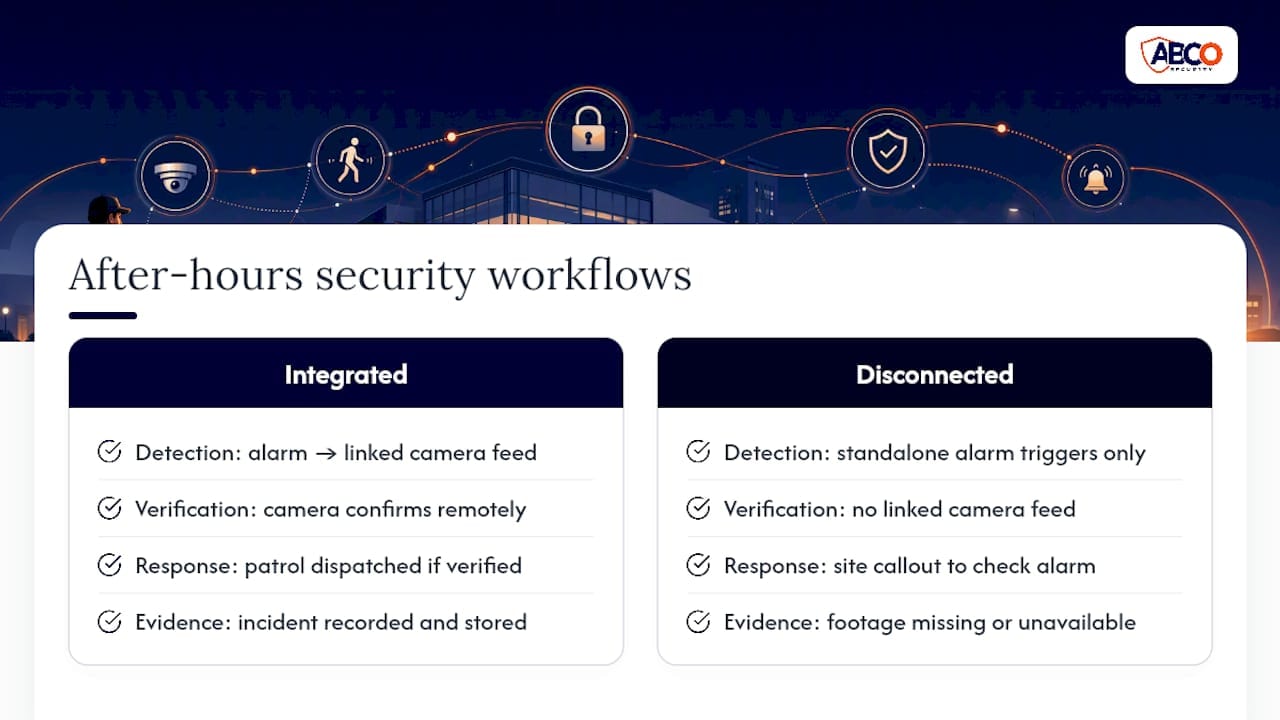
The conventional advice, “get an alarm and a camera,” treats after-hours security as a shopping list. It isn’t. It’s a workflow: detection has to hand off to verification, verification has to hand off to response, and response has to produce evidence. Skip any handoff and the whole chain is only as strong as its weakest link, usually the one nobody tested at night.
If you’re prioritising one thing first, make it the risk assessment, not the technology. A camera bought before you know where your actual blind spots are is money spent on the wrong wall. Start with the site walk, then build outward from what it tells you.
— Abco
Get a site risk assessment or run a pilot with ABCO
ABCO Security is a direct alternative to piecing together alarm, camera, and patrol contracts from separate suppliers: one integrated program, one point of contact, and proof-of-service you can actually audit. A site risk assessment maps your entry points, blind spots, and threat profile before anything is installed, and a short pilot lets you test response times and evidence delivery against a real KPI before you commit to a longer contract.
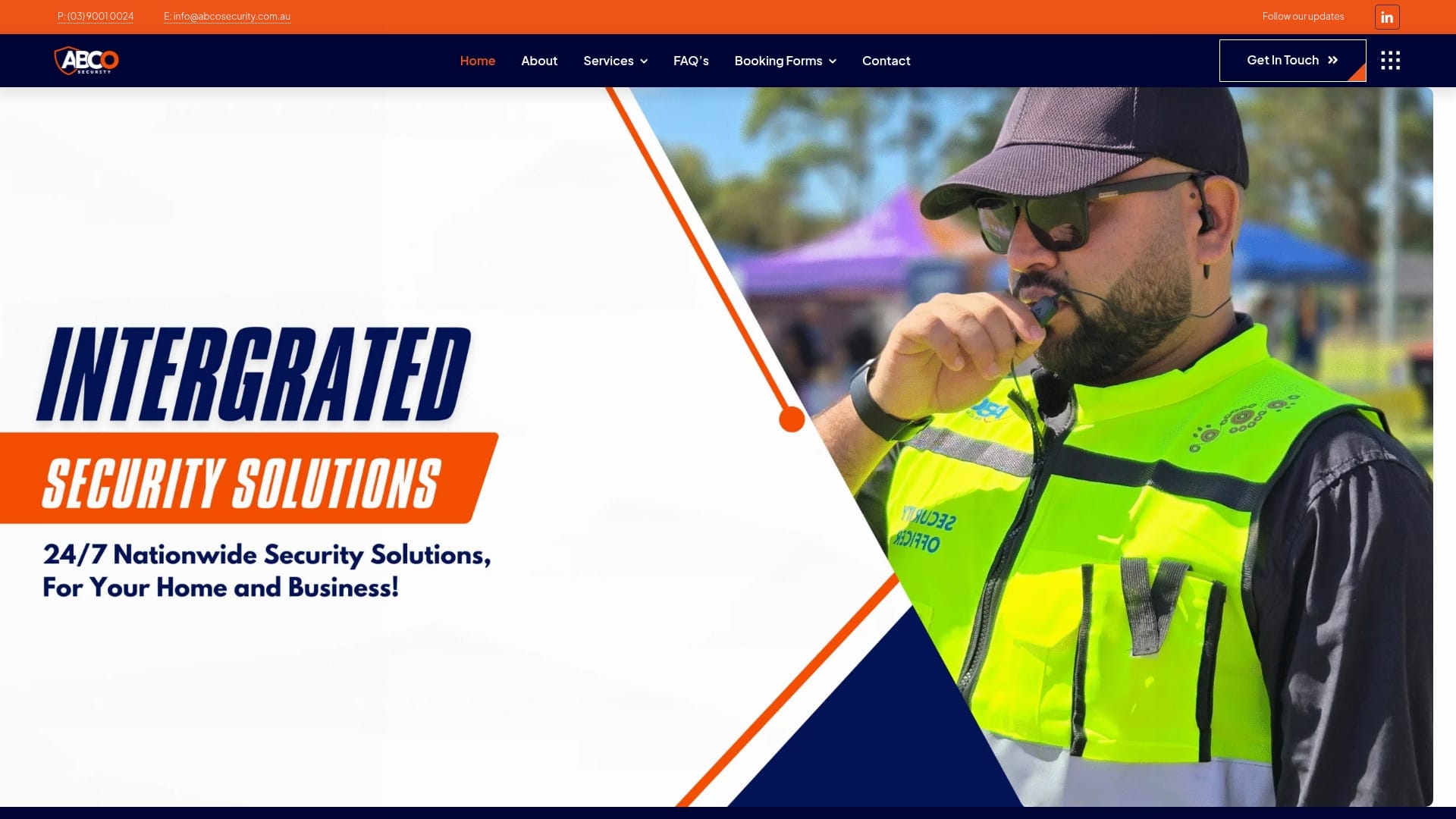
The pilot typically covers a defined patrol or monitoring window, a documented response SLA, and a proof-of-service report at the end so you can measure exactly what you’re getting. If your building already has cameras or an alarm in place, ABCO’s commercial alarm monitoring services can integrate with what’s there rather than ripping it out. Get in touch to scope a risk assessment or pilot for your site and see what a properly tested after-hours program actually looks like before you sign anything longer term.
Sources
- Business security | Queensland Police Service
- Mobile Patrols code of practice | ASIAL
- Buy AS 2201.2-2001 | Intertek Inform
FAQ
Is after-hours security necessary for a small office?
Yes, if the office holds any equipment, stock, or data worth stealing or damaging, since a monitored alarm alone can’t verify what’s actually happening on-site or produce evidence after an incident.
What’s the difference between mobile patrols and static guards?
Static guards remain on-site for the full closed period, while mobile patrols visit on a scheduled or randomised route, making patrols the more cost-effective choice for a single-tenant office without high-value stock.
How fast should an alarm response actually be?
Response times should be written into the contract as a specific SLA rather than left vague, and providers should be able to produce GPS-verified proof-of-service records confirming when an officer actually arrived.
What should a proof-of-service record actually show?
It should show GPS location data, a timestamp, and either a geotagged photo or digital attendance log confirming the officer physically attended the site, standard practice under ASIAL’s mobile patrol guidance.
How long does it take to fully deploy after-hours office security?
A staged rollout typically takes several months, moving from immediate fixes like monitored alarms and lighting in the first month through to a fully integrated, tested system in later stages.
Recommended
about
avada factory
Sempery ultricies nibh at dolor cras urna eleifend nec. Atiam efficitur tempor.