A lawful bag search policy runs on two separate rules. For visitors and customers, it’s consent-first: ask, don’t touch, and let them walk if they refuse. For staff, it works because the search is written into the employment contract, backed by the Incat Tasmania decision, so refusal becomes a disciplinary matter, not a legal grey zone.
TL;DR:
- Staff bag checks should only involve visual inspections requested politely; physical contact or removing items is never lawful during a search.
- Signage must use conditional language like “may request a visual inspection” to avoid misleading customers about mandatory searches.
- Refusals should be handled calmly, with a manager explaining the options, and physical restraint or detention is never justified under law.
- Incorporate bag search clauses into employment contracts and keep scope consistent to ensure policy enforcement is legally binding.
- Incident documentation must include who was involved, what was found, time, location, and follow-up actions, with CCTV and witness details recorded immediately.
Table of Contents
- What does a bag search policy actually need to cover?
- How should you word conditions of entry and signage?
- How do you train staff to run a bag check calmly?
- What happens when a customer refuses a bag check?
- How do you make staff bag searches legally binding?
- How should you document incidents and handle CCTV footage?
- How do you roll out and review the policy?
- What managers get wrong about bag search policy
- How Abcosecurity helps you get this right the first time
- Sources
- FAQ
What does a bag search policy actually need to cover?
Every enforceable policy needs the same backbone: a clear purpose, a defined scope, and named authorised persons who can carry it out. Vague policies fall apart the moment someone challenges them, usually at the worst possible time, in front of other customers.
Start with purpose and scope. State exactly what the policy protects against (stock loss, prohibited items, workplace theft) and where it applies (main entry, staff exit, loading dock). Then name who can conduct a check. A casual staff member on their first shift should not be doing this alone.
The clauses that matter most:
- Consent wording for visitors: “Staff may request to visually inspect your bag before you leave the store. This is voluntary.”
- Employment clause: “As a condition of employment, staff bags and personal belongings may be subject to inspection when entering or leaving the premises.”
- Limits on staff action: no touching, no removing items, no physical restraint, ever.
- Anti-discrimination commitment: checks are triggered by objective, consistent criteria, not appearance.
- Escalation trigger: any refusal or dispute goes straight to a manager, never argued out at the door.
The Major Events Act shows the other end of the spectrum. It gives authorised officers at declared events statutory search powers that ordinary retail or corporate staff simply don’t have. If you’re running a private site or store, don’t borrow that language. Your policy needs to say what you can actually do, not what a stadium security officer can do under legislation that doesn’t apply to you.
Pro Tip: Write the policy assuming it will be read aloud in a tribunal. If a clause sounds like a guess rather than a rule, rewrite it.
How should you word conditions of entry and signage?
Signage sets expectations, but it doesn’t create a legal power to search anyone. Get the wording wrong and you risk a misleading claim under the Australian Consumer Law, because signage that implies a mandatory search overstates what a business can actually enforce.
Use conditional, honest language:
- “We may request a visual inspection of your bag before you leave.”
- “CCTV is in operation on these premises for security purposes.”
- “Entry to this event is subject to a voluntary bag check.”
Place signs at every entry point, at the register, and again near exits, not buried in fine print near the door frame. If you run an online booking system for an event or venue, mirror the same wording in your terms and conditions and membership agreements, so there’s no gap between what a customer reads online and what they encounter on site. Consistency between your physical signage and digital terms is what protects you if a complaint ever reaches a regulator or a court.
How do you train staff to run a bag check calmly?
Staff need a script, not a vibe. Free-styling a bag check request is how calm interactions turn into confrontations.
- Opening request: “Would you mind if I had a quick look in your bag before you head out? It’s just routine.”
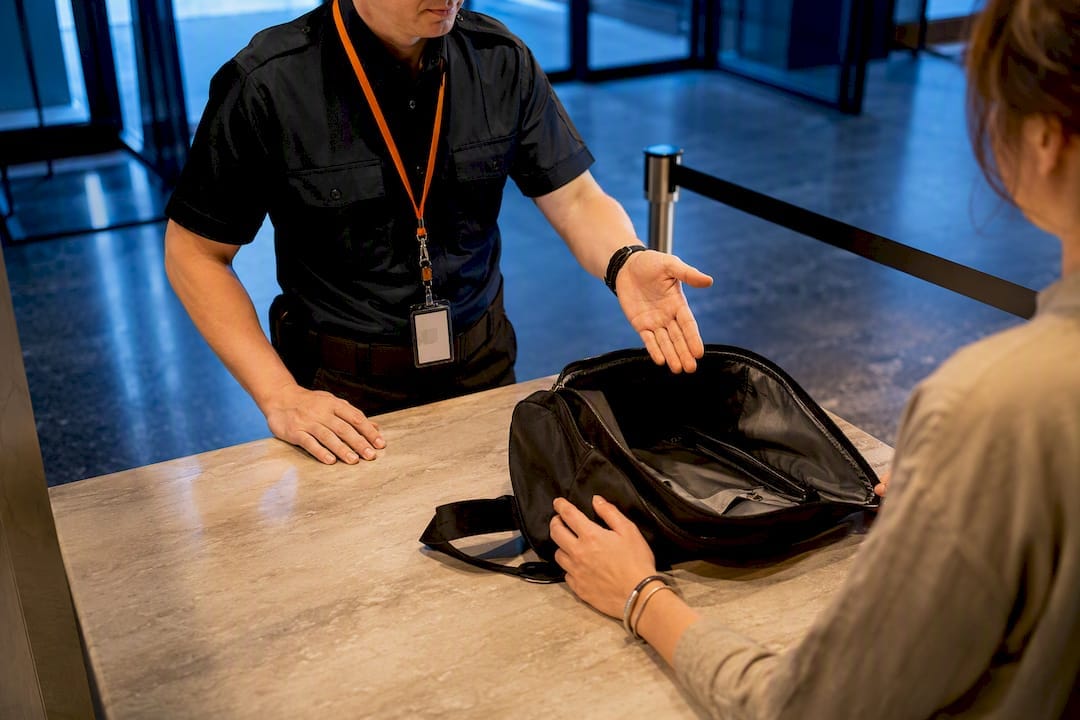
- If they agree: ask them to open it and move items themselves. Guidance from Queensland’s Fair Trading office is blunt on this point: staff should never touch the bag or its contents.
- If they hesitate or refuse: don’t repeat the request more firmly. Thank them and step back, then flag it to a manager if something still feels off.
- If tension rises: withdraw to observing distance rather than closing the gap. A staff member’s job is to notice and report, not to physically contain a situation.
Run scenario drills at least quarterly: a flat refusal, an alarm triggering at the exit, a suspected theft caught on camera. Each drill should end with the same debrief question: did the staff member stay consent-first the entire time?
Pro Tip: Rehearse the exact words for a refusal scenario until they’re automatic. Under stress, staff default to whatever they last practised, not whatever the policy document says.
What happens when a customer refuses a bag check?
The National Retail Association’s code of practice is explicit that refusals should never turn into a standoff between a staff member and a customer. The flow should be short and boring, by design.
- Staff make one polite request. If refused, they don’t push.
- A manager steps in, explains the conditions of entry, and offers a simple choice: allow the check or leave without completing the visit.
- Refusal to comply is not grounds for detention or physical search. Asking someone to leave is the lawful ceiling for a private business.
- If theft is suspected regardless of the bag check outcome, switch to observation: note CCTV timecodes, keep receipts, get a witness statement, and let the evidence do the work.
- Call police when there’s a genuine belief an offence occurred. Grabbing a bag or blocking an exit exposes the business to a far bigger legal problem than any stolen item.
Physical restraint is almost never the right call. It converts a property question into an assault question, and it’s the business that usually ends up defending that one.
How do you make staff bag searches legally binding?
The Incat Tasmania ruling remains the clearest word on this: a bag search rule enforced through disciplinary action holds up when it’s written as a condition of employment, not bolted on as an unwritten expectation.
- Include the search clause in the employment contract at hiring, not as a surprise memo six months in.
- If you’re updating policy for existing staff, consult first and give proper notice. Employment law guidance consistently flags mid-employment changes made without consultation as a common source of disputes.
- Keep the scope reasonable: bags, lockers, and personal items on site, applied the same way to every employee, every shift.
- Apply disciplinary steps proportionately. A first refusal warrants a conversation, not instant dismissal.
How should you document incidents and handle CCTV footage?
Every bag check incident needs the same five fields recorded: who was involved, what was found or alleged, when it happened, where on site, and what action followed. Skip a field and the record is close to useless if police or a tribunal ever ask for it later.
- Log CCTV timecodes alongside the written note, not as a separate afterthought.
- Keep signage current on any camera or audio recording in operation, and never record audio without checking your state’s surveillance rules first.
- Only release footage to police through a documented request, and keep a release log showing what was handed over and when.
One habit separates businesses that get police follow-up from those that don’t: capturing CCTV timecodes, witness names, and receipt or SKU references at the time of the incident, not reconstructed from memory a week later. That level of detail is what makes an incident report worth acting on rather than filing away.
A gatehouse-style escalation procedure gives a useful template for who logs what, and when to hand a file to police.
How do you roll out and review the policy?
- Pilot the policy at one entry point or one shift before going site-wide, so you catch wording problems early.
- Install signage everywhere the policy applies, checked against your entry and exit points.
- Train every relevant staff member on the scripts before the pilot goes live, not after.
- Track three numbers monthly: refusals, incidents, and complaints. A spike in any one is a signal to review wording or retraining, not just a data point to file.
- Review the policy at least annually, or the moment a refusal ends up disputed, and get legal advice before rewriting a clause that’s been tested in a real incident.
What managers get wrong about bag search policy
The biggest mistake is copying stadium-style language into a retail policy. The second is skipping staff scripts and hoping instinct fills the gap. The third is treating documentation as optional until police actually ask for it. Fix those three and most of the risk disappears.
— Abco
How Abcosecurity helps you get this right the first time
Writing the policy is one job. Training every shift to run it the same way, every time, is a different job entirely, and it’s the one most sites get wrong. Security providers draft bag search policies, deliver the staff training and scenario drills that back them up, and build the incident report templates that make your records useful if police or a tribunal ever ask for them.
We also run policy audits for sites that already have a bag check process but aren’t confident it would survive a challenge, checking your signage, employment clauses, and staff scripts against current practice. If you want a second set of eyes on your current setup or a full risk assessment that folds bag checks into your wider site security, get in touch for a quote and we’ll scope out what a pilot rollout looks like for your site.
Sources
- Construction, Forestry, Mining and Energy Union, Tasmanian Branch and Incat Tasmania Pty Ltd 2002 (T10377)
- Bag checking factsheet — ACT Policing
- Bag check code of practice — National Retail Association
FAQ
Can a store legally force a customer to open their bag?
No. A business can request a visual inspection, but a customer can lawfully refuse. The store’s only lawful response is to ask them to leave without completing the visit.
Can an employer search staff bags without consent?
Yes, when the search is written into the employment contract as a condition of employment. The Incat Tasmania decision confirms refusal can then justify disciplinary action.
Should staff ever touch a customer’s bag during a check?
No. Staff should ask the customer to open the bag and move items themselves, never touch or remove anything directly.
What should bag check signage say?
Use conditional language such as “we may request a visual inspection”, never wording that implies the check is compulsory, to avoid misleading customers under consumer law.
What should happen if theft is suspected during a bag check?
Staff should stop engaging directly, record CCTV timecodes, receipts, and witness details, and call police rather than attempting to detain or physically search the person.
How often should bag search training be refreshed?
Run scenario drills, covering refusals, alarms, and suspected theft, at least quarterly, and review the whole policy annually or after any disputed incident.
Recommended
about
avada factory
Sempery ultricies nibh at dolor cras urna eleifend nec. Atiam efficitur tempor.