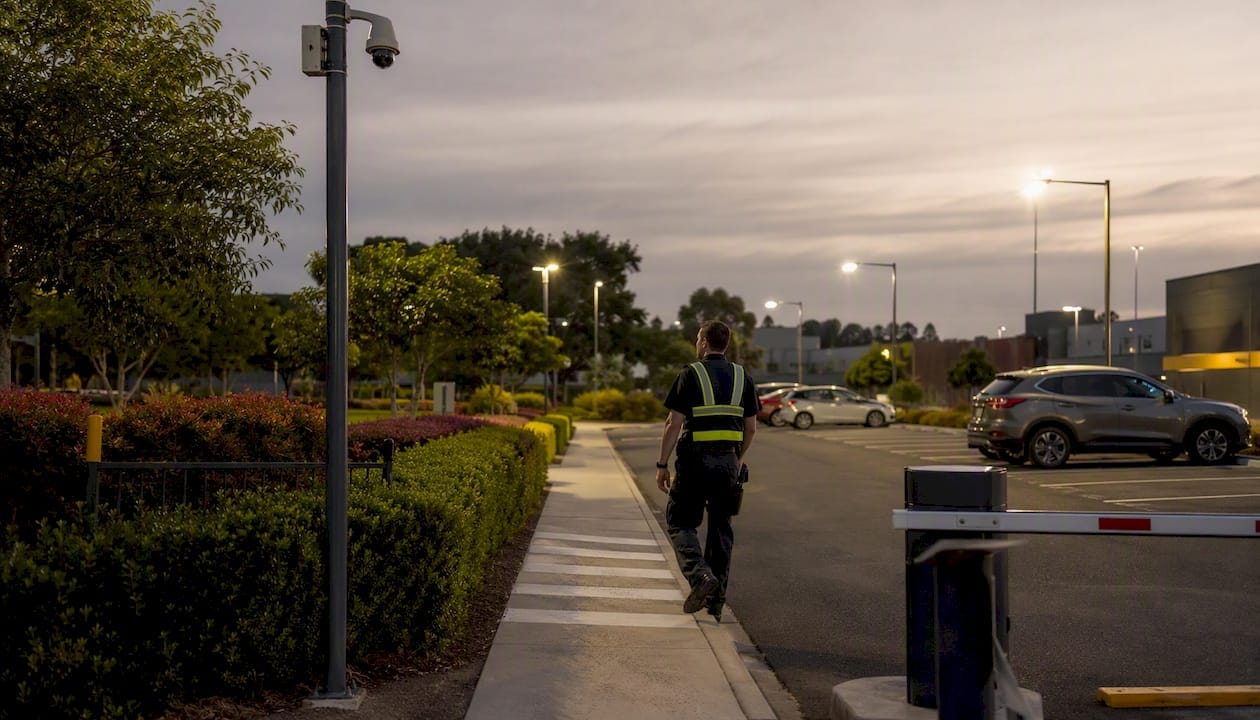
An integrated security package combining CPTED-informed design, active employee guardianship, and 24/7 monitored technology is the most reliable approach to commercial car park security in Australia. If your site lacks a current risk audit, that is the single most valuable first step. Abcosecurity offers site assessments and security design advice for property managers across Australia, and the process typically takes less than a week to arrange. Your obligations under AS 2890.1 and WorkSafe Victoria’s OHS guidance for workplace car parks make that audit more than a good idea — it is a legal and design baseline.
Key takeaways
An integrated approach combining CPTED design, active guardianship, and 24/7 monitored technology is the most reliable and legally defensible way to secure a commercial car park in Australia.
| Point | Details |
|---|---|
| Start with a risk audit | Commission a site assessment before specifying any technology or staffing; it sets your compliance baseline and budget scope. |
| Fix lighting and sightlines first | CPTED quick wins (lighting, foliage, signage) cost relatively little and signal active management to would-be offenders. |
| Demand a single integrated provider | One contract covering guarding, CCTV monitoring, and access control eliminates accountability gaps at 2 AM. |
| Verify licences before signing | Confirm state security industry licences and individual guard registration numbers; non-compliance is your liability. |
| Abcosecurity for integrated car park security | Abcosecurity delivers site audits, CCTV, ANPR, licensed guards, and 24/7 monitoring under a single ISO-certified contract across Australia. |
Table of Contents
- Why integrated solutions outperform technology alone
- Australian standards and OHS duties for car park managers
- What does a car park security project cost and how long does it take?
- How to choose a car park security provider
- How do Australasian car park security providers compare?
- How to request and evaluate quotes in the Australasian market
- Car park security in practice: Australasian implementation examples
- The case for not treating car park security as a technology problem
- Abcosecurity’s car park security services
- Useful sources
- FAQ
Why integrated solutions outperform technology alone
The Australian Institute of Criminology’s CPTED research is direct on this point: passive design measures alone are insufficient. Employee surveillance — the presence of attendants, concierge staff, or guards — is described as a powerful deterrent backed by criminology findings, and it markedly reduces vandalism and improves safety outcomes compared with cameras and barriers operating without active guardianship.
Statistic callout: The AIC’s CPTED research identifies employee surveillance as one of the most effective deterrents in car park environments, consistently outperforming passive design measures when used in combination with monitored technology.
The WA Safer Places by Design guidelines add an important nuance: electronic systems such as LPR and motion detection should be layered on top of passive design, not substituted for it. A car park that relies entirely on cameras tends to feel hostile and fortress-like, which can deter legitimate users and displace rather than prevent crime.
The NHW Victoria CPTED booklet reinforces that strategic lighting and natural surveillance reduce crime opportunities. Poor or excessive glare creates hiding spots and undermines both human recognition and CCTV performance. ML Traffic Engineers’ 2026 developer guide recommends 10–20 lux in general areas and 50 lux at entry points, with attention to colour temperature and CRI to support camera performance.
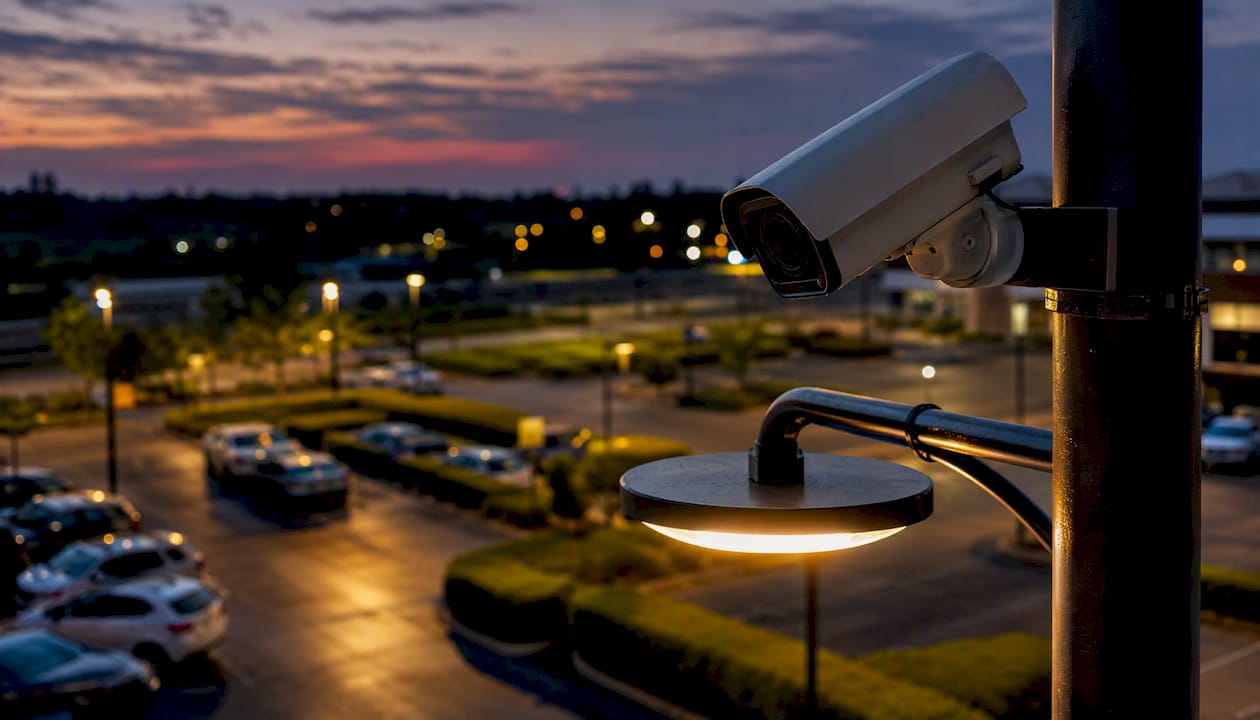
Pro Tip: When retrofitting an existing car park, start with the visible quick wins: repair failed lighting, trim foliage that blocks sightlines, and fix faded signage. These cost relatively little and signal active management to would-be offenders. Then stage the technology rollout — CCTV first, then access control — to spread capital costs without leaving the site unprotected.
A practical scenario: a suburban shopping centre experiencing repeated catalytic converter theft installs ANPR at entry and exit, upgrades lighting to 50 lux at the entry canopy, and adds a roving guard on Thursday–Sunday evenings. The combination means every vehicle is logged on entry, the entry zone is well-lit for camera recognition, and a visible human presence covers peak risk hours. Each layer reinforces the others.
Australian standards and OHS duties for car park managers
Property managers carry specific legal and design obligations that directly shape what a security solution must include.
Key standards and guidance:
- AS 2890.1 — sets minimum design requirements for off-street parking: kerb heights, barrier design, queuing lengths at entrances, and pedestrian sightlines. Physical security controls (bollards, barriers, wheel stops) must comply with these specifications and must not obstruct accessible travel paths under AS 1428.1.
- AS/NZS 1158.3.1 — lighting levels for pedestrian areas; the baseline for any lighting upgrade or new installation.
- AS 1428.1 — accessibility requirements; physical controls must not create barriers for people with disabilities.
- AS/NZS 4373 — where landscaping is part of the site, pruning and vegetation management guidance applies to maintain sightlines and reduce concealment opportunities.
- WorkSafe Victoria (and state equivalents) — workplace car parks are workplaces under OHS law. Managers must identify hazards, control risks (lighting, slip hazards, pedestrian separation, ventilation), and consult staff. Occupational violence risk is explicitly listed.
Compliance checklist for property managers:
- Lighting meets AS/NZS 1158.3.1 lux levels throughout, with no dark zones near stairwells or lift lobbies
- Pedestrian paths are physically separated from vehicle travel lanes
- Ventilation meets minimum requirements for enclosed or semi-enclosed structures
- Signage is current, legible, and compliant with AS 2890.1 layout requirements
- CCTV privacy notices are posted and data handling complies with the Privacy Act 1988
- All security contractors hold current licences under the relevant state Security Industry Act
- Guards are individually registered and carry their licence cards
- A written risk assessment exists and is reviewed at least annually
Council and development approval constraints can affect security hardware. Heritage overlays may restrict the appearance of boom gates or bollards. Public access easements can limit where barriers are placed. Check with your local council before specifying physical controls.
What does a car park security project cost and how long does it take?
Costs vary significantly by site size, existing infrastructure, and service scope. There are no universal published benchmarks for Australian car park security projects, but the primary cost drivers are consistent.
Cost drivers:
- Scope and number of CCTV cameras, plus monitoring centre connection fees
- Access control complexity: ANPR/LPR systems carry higher hardware and integration costs than standard boom gates
- Electrical and lighting upgrades, particularly in older structures where cabling must be replaced
- Civil works for bollard installation, barrier footings, or kerb modifications
- Staffing hours: 24/7 static guard coverage is the single largest ongoing cost for most sites
- Ongoing monitoring contracts and preventive maintenance schedules
Typical project timeline:
- Site assessment and risk audit — 1–2 weeks
- Design, scope, and quote — 2–4 weeks (longer for complex ANPR or multi-site integrations)
- Procurement and installation — 4–12 weeks depending on lead times for hardware
- Testing and commissioning — 1–2 weeks
- Handover and training — 1 week
- Ongoing monitoring and maintenance — continuous, reviewed quarterly or annually
On procurement structure: electronic security systems (CCTV, access control) are often treated as capital expenditure, while monitoring and guarding contracts are operational. Staged rollouts — starting with lighting and CCTV, then adding access control — let you spread capital costs and demonstrate ROI to finance teams before committing to the full scope.
How to choose a car park security provider
Licensing is non-negotiable. Every provider operating in Australia must hold a current security industry licence under their state’s legislation, and individual guards must be registered. Ask for licence numbers and verify them before signing anything.
Ten questions to ask in a tender interview:
- What state security industry licences do you hold, and can you provide the numbers?
- Do you carry public liability and professional indemnity insurance, and at what limits?
- Can you show examples of comparable car park sites you currently manage?
- How do you integrate guarding, CCTV monitoring, and access control under a single SLA?
- What is your guaranteed incident response time, and how is it measured?
- How do you handle CCTV footage custody and chain of evidence for police referrals?
- What certifications do you hold (ISO 9001, ISO 30000, or equivalent)?
- How do you roster and backfill guards to avoid coverage gaps?
- What KPIs and reporting cadence do you offer clients?
- Can you provide a written risk assessment specific to our site before contract execution?
Red flags to watch for:
- No written risk assessment offered before contract signing
- Vague or absent SLAs for response times and incident reporting
- Inability to confirm individual guard registration
- Unclear chain of custody for CCTV footage
- Single-point-failure technology with no redundancy or backup monitoring
- Pressure to sign before a site inspection has occurred
For contract terms, specify reporting cadence (monthly minimum), evidence retention periods (90 days is a common baseline for CCTV footage), and a clear escalation path for major incidents. Shorter initial contract terms with renewal options give you leverage to enforce performance.
Abcosecurity’s security industry best practices guide covers KPI frameworks and operational controls that are worth reviewing before you finalise any contract terms.
How do Australasian car park security providers compare?
The Australasian market includes national integrated security firms, specialist electronic security installers, and local guarding companies. The meaningful distinctions are not brand names but capability combinations.
What separates providers at the top end:
- Ability to deliver guarding, electronic security, and 24/7 monitoring under a single contract and single point of accountability
- ISO 9001 quality management certification, which signals documented processes and consistent service delivery
- ISO 30000 (security management systems), which is less common and indicates a provider has formalised its security management framework
- In-house monitoring centres versus subcontracted monitoring — in-house means faster escalation and clearer accountability
- Demonstrated experience with comparable site types (shopping centres, hospitals, corporate campuses) backed by documented case studies
Providers that offer only guarding or only electronic security force you to manage two separate contracts, two sets of SLAs, and two incident response chains. When a CCTV alarm triggers at 2 AM, you want one provider who can dispatch a guard and review the footage simultaneously.
For asset protection across vehicle-heavy sites, the integration between monitoring and physical response is the most important capability to verify during procurement.
How to request and evaluate quotes in the Australasian market
A well-structured request for quote (RFQ) produces comparable responses and protects you during contract negotiation.
Before you send the RFQ, prepare:
- A current site plan showing bay layout, entry/exit points, stairwells, and lift lobbies
- An incident log covering at least the past 12 months (theft, vandalism, access complaints)
- Peak usage hours and days, including any seasonal or event-driven spikes
- Existing security infrastructure (cameras, access control, lighting) with approximate ages
Structure the RFQ to require:
- Itemised pricing for each service component (guarding hours, monitoring, hardware, installation, maintenance)
- Proposed SLAs with measurable KPIs
- Licence and insurance details
- A methodology section describing how the provider would approach your specific site
- At least two references from comparable sites
When comparing responses, weight the methodology section heavily. A provider who has clearly read your site plan and incident log will produce a more accurate quote and a more realistic implementation plan than one who submits a generic template. Price differences between comparable proposals often reflect staffing ratios or monitoring centre quality — ask providers to explain their assumptions.
Car park security in practice: Australasian implementation examples
The most instructive examples from the Australasian market share a common pattern: the sites that achieved lasting reductions in theft and vandalism combined physical design changes with active human presence and monitored technology, rather than relying on any single measure.
A multi-level retail car park in a major Australian CBD reduced vehicle break-ins significantly after installing ANPR at entry and exit, upgrading lighting to exceed AS/NZS 1158.3.1 minimums, and adding a static guard at the ground-floor entry during evening trading hours. The ANPR system provided post-incident evidence that supported several successful police referrals.
A hospital campus car park addressed occupational violence risk (a specific OHS obligation under WorkSafe guidance) by deploying a concierge security officer at the main entry, adding duress alarms at lift lobbies, and linking CCTV to the hospital’s existing security monitoring centre. Staff reported a measurable improvement in perceived safety, and the site passed its next OHS audit without remediation items.
Both examples reflect the CPTED principle that layered responses combining design, electronic systems, and organised control consistently outperform single-measure approaches.
The case for not treating car park security as a technology problem
Most property managers who contact a security provider have already decided they need more cameras. That instinct is understandable — cameras are visible, quantifiable, and easy to budget. But the criminology evidence is consistent: a car park with excellent CCTV and no active guardianship is a car park where crime is well-documented rather than prevented.
The AIC’s CPTED research makes the point plainly. Employee surveillance, meaning a visible human presence, is one of the strongest deterrents available. A camera records what happened. A guard changes what happens. The most cost-effective car park security programmes use technology to extend the reach of human oversight, not to replace it.
There is also a compliance dimension that often gets overlooked until an incident occurs. WorkSafe Victoria’s guidance frames workplace car parks as workplaces, which means OHS duties apply to the people who use them — not just the vehicles. Lighting, pedestrian separation, and ventilation are not optional design preferences; they are hazard controls. A property manager who has not documented those controls in a written risk assessment is exposed, regardless of how many cameras are installed.
The practical implication: before you specify a single camera or boom gate, get a risk audit that maps your OHS obligations alongside your security risks. The two are not separate problems.
Abcosecurity’s car park security services
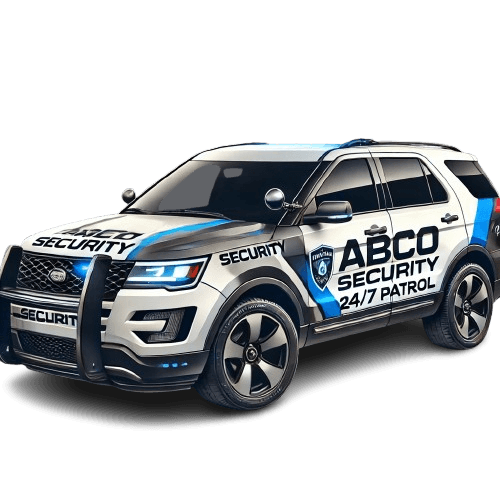
Abcosecurity delivers the full integrated package that the evidence supports: licensed static guards and mobile patrols, CCTV supply and 24/7 monitored alarm response, ANPR and boom gate installation, access control integration, gatehouse and ticketing support, and CPTED-informed site audit and design advice. Every service is backed by ISO 9001 and ISO 30000 certification, more than 15 years of operational experience across Australia, and a monitoring centre that handles escalation in-house.
The difference between Abcosecurity and a provider who offers only cameras or only guards is accountability: one contract, one point of contact, one SLA that covers the whole site from the entry boom gate to the stairwell camera to the guard on the evening shift. For property managers who need to brief a finance team or a board, that single-contract model also simplifies cost reporting and audit trails.
To arrange a site assessment, bring your site plan, a 12-month incident log, and your peak usage hours. Abcosecurity will produce a written risk assessment and a scoped proposal. Request a site assessment or review Abcosecurity’s security best practices framework to prepare your brief.
Useful sources
- Designing Out Crime: Crime Prevention Through Environmental Design (AIC)
- Safer Places by Design
- Safety in workplace car parks | WorkSafe Victoria
- Crime prevention through environmental design (CPTED) — NHW Victoria booklet
- AS 2890.1 standard entry — Standards Australia catalogue
- Car Park Safety and Security Design: The Complete Developer’s Guide for 2026 | ML Traffic Engineers
FAQ
What is car park security?
Car park security is the combination of physical design controls, electronic systems (CCTV, access control, ANPR), and active human guardianship used to protect vehicles, users, and property in parking facilities. Effective parking lot security integrates all three layers rather than relying on any single measure.
What makes a car park secure?
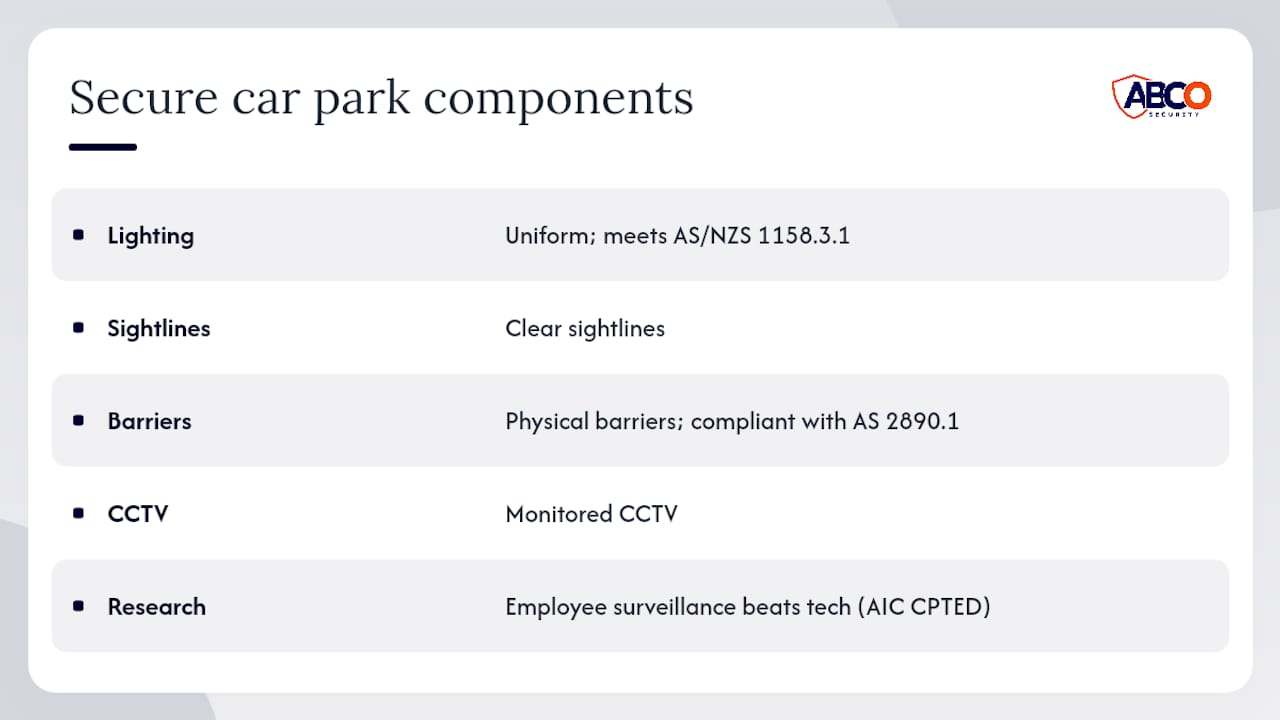
A secure car park combines uniform lighting that meets AS/NZS 1158.3.1 standards, clear sightlines, physical barriers compliant with AS 2890.1, monitored CCTV, and a visible human presence. The AIC’s CPTED research confirms that employee surveillance combined with design measures produces better outcomes than passive technology alone.
What is the AS 2890.1 standard?
AS 2890.1 is the Australian standard for off-street car parking facilities. It sets minimum requirements for physical layout, kerb heights, barrier design, queuing lengths at entry points, and pedestrian sightlines, and it is the primary design compliance reference for any new or upgraded car park in Australia.
Does WorkSafe apply to car parks?
Yes. WorkSafe Victoria (and equivalent bodies in other states) treats workplace car parks as workplaces under OHS law. Property managers must identify hazards, implement controls for lighting, pedestrian separation, ventilation, and occupational violence risk, and consult staff — regardless of whether the car park is staffed or unstaffed.
How do I get a quote for car park security in Australia?
Prepare a current site plan, a 12-month incident log, and your peak usage hours, then request proposals from licensed integrated providers. Abcosecurity offers site assessments and scoped proposals for car parks across Australia — contact Abcosecurity to arrange an initial assessment.
Recommended
about
avada factory
Sempery ultricies nibh at dolor cras urna eleifend nec. Atiam efficitur tempor.