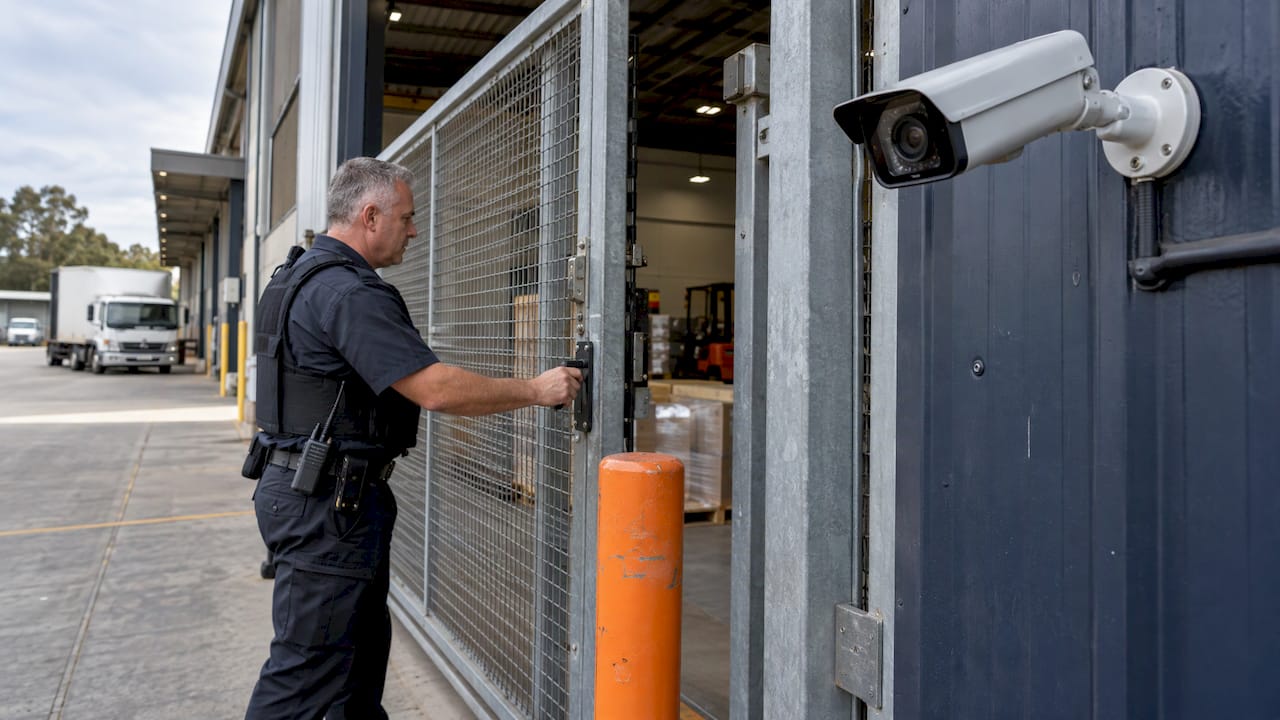
For most Australian businesses the answer is not one or the other. CCTV gives you constant coverage and a record of what happened. Guards give you a person who can challenge, escort, intervene and attend. Monitored cameras joined to a patrol or an onsite guard cover both jobs, and that is how we build most sites at ABCO Security. Our Security Guarding and A1 CCTV & Alarm Monitoring services are designed to work together under one contract.
This guide is for site managers, facility managers, event organisers and retail owners who have to decide what to put in place and defend the budget. It explains what each option does, what the evidence says, how guard hours are priced, and which mix suits each type of site.
TL;DR
- CCTV detects and records. A guard deters, challenges and responds. The two cover different parts of the same problem.
- Cameras that someone is watching (live or remotely) and that trigger a response are far more useful than cameras that only record.
- Guard cost is driven by hours, and weekends and public holidays cost more. Event venues publish rates that show the spread.
- Construction sites, hospitals, offices, retail and events each have a different best mix. Start with a documented risk assessment.
- Cameras need a lawful, privacy-aware design, and guards must hold the right licence for the state they work in.
Table of Contents
- What each option actually does
- What the evidence says
- What guards cost, and what drives the price
- Which mix suits which site
- A simple way to decide
- Legal points that apply either way
- Where ABCO fits
- Our view
- FAQ
- Sources
What each option actually does
CCTV: detection and evidence
A CCTV system is a set of cameras with fixed fields of view, usually connected to a recorder. It captures activity around the clock, lets you review events later and gives police usable footage. It also makes people think twice, because they know they may be identified.
A recording system on its own does not assess an event as it happens. Somebody has to look at the footage, either live or after the fact. That is the gap that monitoring fills. With camera monitoring, trained operators watch for activity and escalate it, so the cameras become an alerting system and not just an archive.
Security guards: presence and response
A guard is a person on the ground. They can greet visitors, check passes, walk the perimeter, talk to someone who should not be there, call emergency services and stay with a situation until it is resolved. A guard reads context that a camera cannot: whether the person at the gate is lost, intoxicated or casing the place.
There are three common forms:
- Static guards stay at one post, such as a gate, a reception desk or a hospital entrance.
- Mobile patrols visit several sites on a schedule and respond to alarms between visits.
- Event and crowd control staff manage entry, queues and behaviour at a venue for a set period.
If you are weighing patrols against a fixed post for after-hours cover, our guide to choosing between a mobile patrol and a guard sets out how the two differ.
Side by side
| Question | CCTV | Security guard |
|---|---|---|
| Hours of coverage | Continuous, every camera angle at once | Per shift, one position at a time |
| Main strength | Detection, recording, evidence | Deterrence, judgement, physical response |
| Responds to an incident | Only when monitored and linked to a response | Yes, on the spot |
| Cost pattern | Upfront installation plus ongoing monitoring | Ongoing hourly rate |
| Best for | Wide areas, long periods, proof of events | Access points, crowds, people-facing risks |
What the evidence says
The research is more nuanced than most online comparisons suggest, and it supports using both.
A systematic review of public-area surveillance published in the Annual Review of Law and Social Science reported an overall 16% reduction in crime from CCTV. The same review found guards showed promise in car parks targeting vehicle crime, although it noted that only a small number of high-quality evaluations of guards exist. Read that as a sign that the effect depends on where and how the measure is used, not as a ranking.
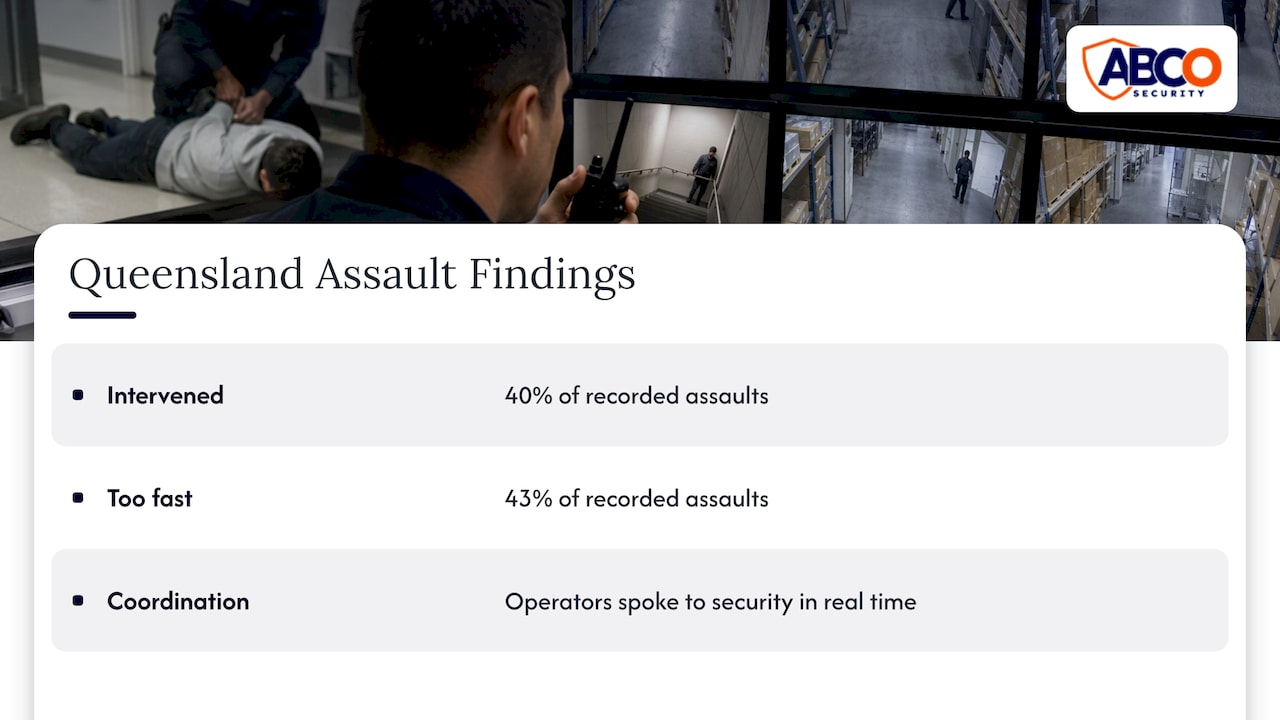
A Queensland study of alcohol-related assaults in an entertainment precinct shows why linking the two matters. In a system where camera-room operators talked in real time to security on the ground, operators and security intervened in 40% of recorded assaults. In another 43% the incident happened too quickly for anyone to step in. The lesson is practical. Fast-moving incidents are best met by people already close by, and the camera room is most valuable when it can direct them.
South Australia Police make a related point in their CCTV guidance: CCTV should be considered through risk management to identify threats and vulnerabilities and decide whether it is a cost-effective treatment. NSW Health’s security policy says camera surveillance in health facilities should be part of a documented security risk management program, not a standalone solution. Neither says cameras or guards are the answer on their own. Both say to start from the risks.
What guards cost, and what drives the price
Guard cost is simple to understand: you pay for hours. A cost comparison between a camera system and a guard therefore depends on how many hours you need covered and when.
Published event-venue rates show how much the day of the week matters. The Melbourne Convention and Exhibition Centre’s event services guide lists GST-inclusive guard rates of $84 per hour Monday to Friday, $110 on Saturday, $141.50 on Sunday and $154.50 on public holidays, with a four-hour minimum. Those are one venue’s rates for its own events, not a market price, but they show the pattern: penalty days and minimum shift lengths change the total quickly. The same guide says guard numbers are set according to risk.
What moves your own cost:
- Hours per week. A guard for every night of a 12-month build costs far more than a guard for a single open-house weekend.
- Timing. Weekends, nights and public holidays attract higher rates.
- Number of posts. One gate or five entrances.
- Minimum shift lengths. A short job still pays the minimum.
- Site risk. Higher-risk sites need more people or more experienced ones.
Camera costs have a different shape: an upfront installation and then a monitoring fee. Because the cameras work through every hour of the day, the cost per hour of coverage falls the longer the site runs. Our Night Owl Service starts from $5.45 per day, with 12M and 24M plans on the same page. For a quote on guarding, patrols or a larger camera system, the price depends on your site and hours, which is why we assess the site first.
Which mix suits which site
This is where most readers need a decision. Each setting has a different dominant risk, and the mix follows it.
Construction sites
Construction sites are open, change shape every week and sit empty at night and on weekends. The main risks are theft of materials and plant, vandalism and unauthorised entry out of hours. During working hours, the risk shifts to site access, visitors and contractors.
A practical mix is cameras covering the perimeter and laydown areas around the clock with monitoring after hours, plus a guard at the gate during delivery peaks and a mobile patrol for after-hours alarm response. Higher-value stages, such as when copper, fixtures or plant arrive, justify an overnight guard. Our construction site security services are built around this layered approach, and our guide to a construction site security plan walks through the steps.
Healthcare facilities
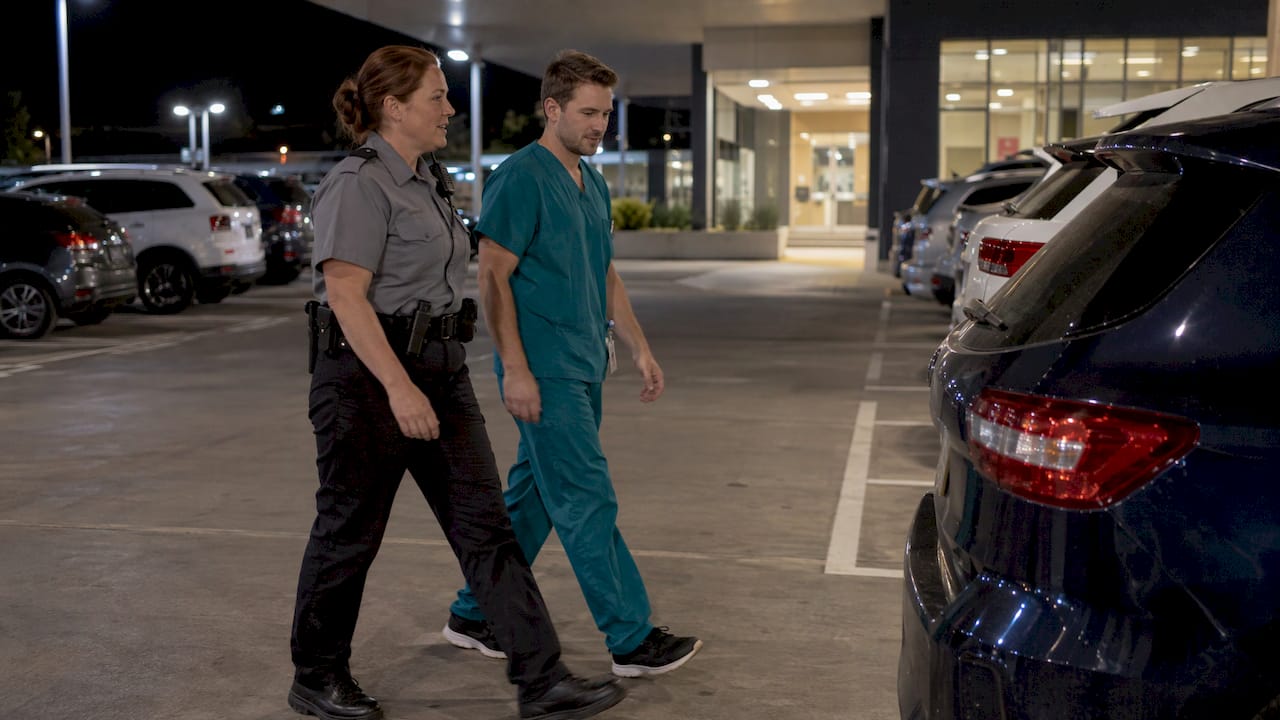
In a hospital or clinic the priority is patient and staff safety. Reception, emergency departments, car parks and after-hours entries are the pressure points. Here guards do work that cameras cannot: de-escalating a distressed visitor, escorting staff to cars at night and controlling who enters sensitive areas.
Cameras support that by covering corridors, car parks and entries, and by giving a record if an incident needs review. Placement has to respect privacy. NSW Health’s policy says camera placement should be designed to avoid encroaching on privacy while still addressing the identified risks. A documented risk assessment sets out which areas get cameras, which get a guard and how the two are connected.
Corporate offices
Offices want continuous surveillance and controlled access. The usual mix is access control and cameras on entries, lifts and loading docks, plus concierge or reception security in business hours. Out of hours, monitored cameras and alarms with a patrol response are often enough, because the building is empty and the aim is detecting a break-in quickly.
A staffed reception also does more than security: it manages visitors and sets the tone for the building. Our concierge and reception security sits alongside electronic access so the front desk and the door system work as one.
Retail
Retail theft happens in front of people during opening hours, which is where a visible guard and in-store cameras work well together. A guard at the door discourages opportunists and handles incidents with customers. Cameras over tills, stockrooms and high-value aisles provide evidence for prosecution and for investigating shrinkage patterns. After closing, monitored alarms and cameras cover the premises.
If your losses cluster in particular hours or aisles, put guard time on those hours and camera coverage on those aisles. The data on where stock goes missing should lead the plan.
Events
Events are the clearest case for people. Crowd flow, queue control, bag checks, intoxication and entry points are all matters for trained staff on the ground. Cameras still help: they give a control room an overview of crowd density and let supervisors send staff to where they are needed, which is the setup the Queensland study above describes.
Resourcing depends on expected crowd, venue layout, alcohol service and the time of day. As the venue rates earlier show, event days often fall on higher-rate days, so plan the guard roster early. Our events security team handles crowd control and entry management.
A simple way to decide
Work through these questions in order.
- What are you protecting, and when is it at risk? List assets, people and the hours of greatest exposure.
- Is the main risk before, during or after an incident? Before means deterrence and presence. During means response. After means evidence.
- Can someone act on what the cameras see? If not, add monitoring or a patrol response.
- Which hours need a person? Put guard hours on peak-risk periods and let monitored cameras cover the rest.
- Are you meeting your legal duties? Check privacy and licensing before you commit.
- Review after 90 days. Incident logs and footage show where the mix should shift.
The point of the exercise is to put human cost where human judgement is needed and to let technology cover the long, quiet hours.
Legal points that apply either way
Cameras. Surveillance and privacy rules differ by state and territory, and workplace surveillance has its own requirements in some of them. Placement should address a real security risk without intruding on privacy, as the NSW Health policy above says. Our guide to CCTV laws in Australia covers what businesses need to know.
Guards. Security guards in Australia must be licensed, and ASIAL’s report notes that licensing eligibility requirements vary between states and territories. If your sites span states, each needs guards licensed in that state. Our guide to licensed security guards in Australia lists what to check.
Where ABCO fits
We deliver the pieces this comparison covers under one agreement: licensed static guards, mobile patrols, CCTV and alarm installation and monitoring, access control, concierge and reception security, crowd control and security risk assessments. Our operations run nationwide and 24/7, and we hold ISO 9001 and ISO 30000 standards. We have more than 15 years in the industry across construction, healthcare, corporate, retail and events.
Because one provider covers both guards and cameras, you do not need to coordinate between an installer, a monitoring company and a guard roster. The risk assessment decides the split, and the same team can adjust it as your site changes. You can start with electronic security solutions for the camera and alarm layer, or with mobile patrol for after-hours response.
To scope a site, request an assessment through ABCO Security and tell us the site type, hours of risk and what has gone wrong before.
Our view
We rarely recommend cameras alone or guards alone. A camera tells you something is happening. A guard changes what happens next. The sites that struggle are usually the ones with cameras nobody watches or guards with no view of the whole site.
Our approach is to anticipate threats, not just react to them. That starts with a risk assessment, then a layered plan: technology for constant coverage, licensed people for the moments that need judgement, and 24/7 monitoring to link them.
Quality systems matter here. Our ISO 9001 and ISO 30000 standards are how we keep that approach consistent across construction sites, hospitals, offices, retail and events, and 15 years of work in these sectors shapes how we staff and schedule each one.
Abco
FAQ
Are security guards more expensive than CCTV?
Guards are charged by the hour, so cost rises with hours, nights, weekends and public holidays. Cameras have an upfront installation and a monitoring fee, and they cover every hour. For long, quiet periods, monitored cameras are usually the more economical layer, and guards are placed where a person is needed.
Do cameras or guards stop more crime?
Both reduce crime in the right setting. A systematic review reported an overall 16% reduction from CCTV and found guards promising in car parks targeting vehicle crime. The strongest results come when cameras and people are linked, so that what the cameras see gets a response.
Is CCTV worth having if nobody is watching it?
Recorded cameras deter and give you evidence after an event. Adding monitoring means someone can act while it is happening, and that is what turns cameras into a response tool. Many sites start with recording and add monitoring for out-of-hours periods.
What is the best option for a construction site?
A mix usually works best: perimeter cameras with after-hours monitoring, a guard at the gate during deliveries and a mobile patrol for alarm response. Add an overnight guard when high-value materials or plant arrive. A site risk assessment sets the right split.
Do security guards need a licence in Australia?
Yes. Licensing is run by each state and territory, and eligibility rules differ between them. If you operate across states, check that your guards are licensed in the state where they work.
Sources
- Effectiveness and Social Costs of Public Area Surveillance (Annual Review of Law and Social Science)
- Queensland study of CCTV and alcohol-related assaults (Injury Prevention)
- CCTV Booklet (South Australia Police)
- Protecting People and Property (NSW Health)
- Event Services Information Guide (Melbourne Convention and Exhibition Centre)
- Security industry report (ASIAL)
Recommended
about
avada factory
Sempery ultricies nibh at dolor cras urna eleifend nec. Atiam efficitur tempor.