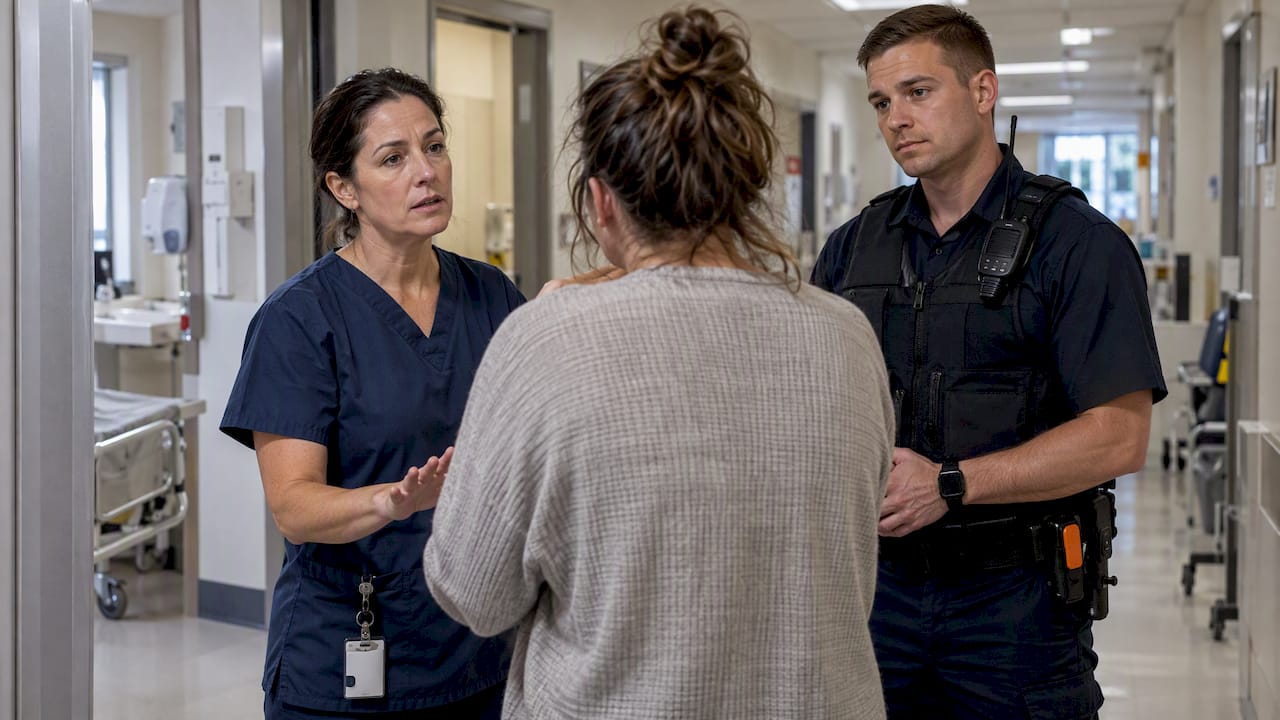
A Code Grey is a clinically led, organisation-level emergency response to actual or potential violent or aggressive behaviour. De-escalation is always the first-line priority, and restraint or sedation are last-resort measures used only when clinical leadership decides they are necessary. A Code Grey can be called as an emergency or scheduled in advance as a planned response.
TL;DR:
- Any staff member who sees escalating threats or imminent danger can call an emergency Code Grey without permission; any weapon triggers Code Black instead.
- A named clinical lead directs the response and authorizes restraint or sedation; security staff manage the scene under clinical direction.
- Teams should first clear bystanders, speak calmly, preserve an exit path, and use environmental controls; restraint is a last resort, and prone restraint is prohibited.
- For predictable risks, schedule a planned response and pre huddle, confirm clinical and security roles, agree on medication and abort criteria, and resolve questions first.
- After each incident, arrange medical care and welfare checks, file an internal report promptly, review triggers and response, and feed findings into training.
Table of Contents
- What a Code Grey covers and how it differs from other hospital codes
- Who can call a Code Grey and when
- Who makes up the Code Grey team and what each role does
- Managing an active Code Grey: de-escalation first, restraint last
- Planned Code Grey and the pre-huddle: getting ahead of predictable risk
- What happens after a Code Grey: reporting, support and review
- How integrated security supports a clinically led Code Grey
- Balancing patient dignity with staff safety
- How we help hospitals prepare for Code Grey responses
- FAQ
- Sources
What a Code Grey covers and how it differs from other hospital codes
A Code Grey response applies whenever a patient, visitor or staff member shows verbal or physical aggression that threatens safety. It covers everything from a confused patient becoming combative on a ward to a visitor making threats in an emergency department waiting room. Victorian policy, set out in the Code Grey standards, requires a clinically led, organisation-wide response with defined team composition and mandatory recording of every activation.
Code Grey is not the same as Code Black, even though both deal with aggression:
- Code Grey covers aggression without a weapon, managed primarily by clinical staff with security support.
- Code Black is called when a weapon is involved or the threat is severe enough to need an armed or specialist security response.
- Local policy should reference the relevant Australian Standard for emergency control organisation alongside health department guidance.
Who can call a Code Grey and when
Any staff member who witnesses or anticipates aggressive behaviour can initiate an emergency Code Grey. There is no need to seek permission first: the person closest to the risk pulls the duress alarm or makes the call.
- Raise the alarm the moment you see verbal threats, clenched fists, pacing or other signs of escalating agitation.
- Call immediately if a patient or visitor displays behaviour that puts themselves, staff or others at imminent risk.
- Treat any mention or sighting of a weapon as a trigger for Code Black instead, not Code Grey.
- Schedule a planned Code Grey ahead of a high-risk appointment, such as a known history of violence or a forensic patient transfer.
- Use the planned pathway whenever a clinical team can reasonably predict the risk in advance rather than wait for a crisis.
Who makes up the Code Grey team and what each role does
Every Code Grey response needs a documented team with a named clinical lead, because clinical judgement, not security force, drives the decision on restraint, sedation or stand-down. Security-trained staff manage physical safety and crowd control but work under that clinical direction rather than independently of it.
- The clinical lead assesses risk, directs the response and authorises any escalation to restraint or sedation.
- Security-trained staff secure the environment, manage bystanders and provide physical support within clinical direction.
- A documentation officer records the timeline, actions taken and outcomes as the incident unfolds.
- A family or patient liaison keeps relatives informed and manages the human side of a distressing situation.
- An escalation gatekeeper decides whether to call for further resources, including police, if the situation outgrows the team’s capacity.
Pro Tip: Keep an up-to-date role list in your Code Grey procedure manual, including names and contact numbers for your current clinical leads, so no one wastes time working out who’s in charge mid-incident.
Managing an active Code Grey: de-escalation first, restraint last
Once a Code Grey is called, the sequence of actions matters as much as the actions themselves. Clinical guidance from the RCH acute behavioural disturbance guideline stresses safety and non-restraint strategies before anything else.
- Assess the scene for immediate danger and move bystanders and vulnerable patients to safety.
- Approach calmly, use short clear statements, and offer small concessions where appropriate, such as nicotine replacement, to defuse distress.
- Position staff with a clear exit path and avoid crowding the person who is agitated.
- Use environmental controls, duress alarms and pre-identified safe rooms to contain risk without physical contact.
- Reserve restraint or emergency sedation for situations where the clinical lead judges it necessary, and never use prone restraint.
- Document every action, medication given and vital sign check in real time, with ongoing monitoring after any sedation.
Assaults resulting in hospitalisation of healthcare workers reached 819 in 2024-25, with the rate per 100,000 workers nearly doubling from 4.3 to 8.1 between 2015 and 2025. That trend is why a tight, rehearsed sequence matters more than ever.
Planned Code Grey and the pre-huddle: getting ahead of predictable risk
Not every Code Grey needs to be a crisis. When a team can see risk coming, scheduling a planned Code Grey and running a pre-huddle beforehand cuts the chance of an emergency escalation later.
- Schedule a planned Code Grey before procedures with patients who have a known history of aggression or forensic status.
- Name the clinical lead and confirm security-trained staff will be present before the procedure starts.
- Set clear abort criteria in advance, so the team knows exactly when to stop and regroup.
- Agree on the medication plan and communication approach with the patient ahead of time.
- Allocate someone to family liaison so relatives are not left guessing during the procedure.
Pro Tip: If any team member still has questions once the pre-huddle checklist is run through, pause the procedure until those gaps are closed, not during the procedure itself.
What happens after a Code Grey: reporting, support and review
The work does not stop once the immediate incident is over. Victorian guidance on post-incident response sets out the welfare and reporting steps that follow every occupational violence event.
- Arrange immediate medical care and a welfare check for anyone involved, including relief from duties where needed.
- Log the incident formally through internal reporting systems straight away, while details are fresh.
- Run an operational review that looks at what triggered the event, how the team responded and what could change.
- Track metrics over time, including activation frequency, response times and restraint or sedation rates.
- Offer hot debriefs, access to employee assistance programs, and rostering adjustments for affected staff.
- Feed findings back into training, environmental changes and individual patient behaviour plans to reduce recurrence.
How integrated security supports a clinically led Code Grey
We work alongside clinical teams rather than in place of them. Our guards support de-escalation, manage bystanders and secure the environment while the clinical lead retains authority over restraint and sedation decisions, in line with the de-escalation approach described in our security guard de-escalation guidance.
- Guards are paired with CCTV and duress alarm monitoring to provide earlier warning of escalating behaviour.
- Joint training exercises with hospital staff help ensure security and clinical roles are clear before an incident happens.
- Site-specific risk assessments identify where environmental controls, like safe rooms or alarm placement, need attention, an approach also showcased in the AI site safety on a hospital build case study.
Balancing patient dignity with staff safety
Least-restrictive practice is not a compliance checkbox, it is the difference between a safe outcome and a traumatic one for everyone in the room. Preparedness, not force, is what protects both patients and staff. Security and clinical teams that train together, with clear policy and shared language, handle these moments better than either group working alone.
— Abco
How we help hospitals prepare for Code Grey responses
Hospitals carry the clinical decisions in a Code Grey, and support is provided for the operational layer around them. Guards work hospital shifts under Security Guarding arrangements, trained to support de-escalation and secure a scene without overstepping clinical authority. Through A1 CCTV & Alarm Monitoring, teams are helped to spot escalating situations earlier, and site risk assessments flag gaps in alarm placement or safe room access before they become a problem during an actual incident.

Joint training sessions with hospital staff help ensure security and clinical roles are rehearsed, not improvised, supporting the development of documented policy as covered in what every healthcare security policy must actually cover. Clinical leadership and local policy always determine the clinical decisions in a Code Grey. For information about site reviews or training sessions, contact details are available through the healthcare security services page.
FAQ
What do the different hospital codes mean in Australia?
Australian hospitals use a standard set of colour codes for emergencies: Code Red for fire, Code Blue for medical emergencies, Code Black for a threat involving a weapon or armed offender, and Code Grey for aggression without a weapon. Each code triggers a different team and response protocol under local and state health department policy.
What is the meaning of Code Grey in a hospital?
Code Grey means a clinically led response to actual or potential violent or aggressive behaviour that does not involve a weapon. It can be called as an emergency when a situation is unfolding, or planned in advance through a pre-huddle when the risk is known ahead of time, as set out in the Code Grey standards.
What does Code Black mean in hospitals?
Code Black is called when a weapon is involved or a threat is severe enough to need an armed or specialist security response, separating it from the lower-level aggression that triggers a Code Grey. Staff are trained to recognise which code applies the moment a weapon appears or is suspected.
Who is responsible for leading a Code Grey response?
A named clinical lead directs every Code Grey response and holds authority over decisions such as restraint or emergency sedation. Security-trained staff and other team members, including a documentation officer and family liaison, work under that clinical direction rather than independently.
How often should hospitals run Code Grey drills?
Health department guidance recommends routine practice drills, including scenarios involving concurrent codes, so staff stay ready for both emergency and planned Code Grey situations. Regular drills, paired with clear governance and executive oversight of activations, help teams respond consistently when a real incident occurs.
Sources
- Code Grey standards — Department of Health (Victoria)
- Acute behavioural disturbance: Code Response — RCH clinical practice guideline
Recommended
about
avada factory
Sempery ultricies nibh at dolor cras urna eleifend nec. Atiam efficitur tempor.